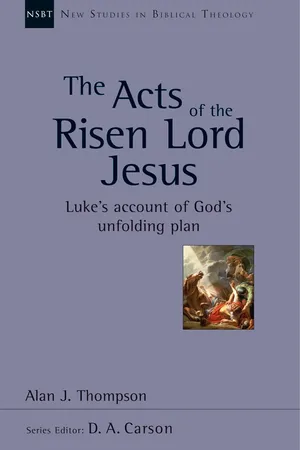
When the book of Acts is mentioned, a cluster of issues spring to mind, including speaking in tongues and baptism with the Holy Spirit, church government and practice, and missionary methods and strategies. At the popular level, Acts is more often mined for answers to contemporary debates than heard for its natural inflections. Instead of using Acts as a prooftext, this New Studies in Biblical Theology volume brings a biblical-theological framework to the account to expose Luke's major themes as they relate to the book as a whole. With this framework in place, Alan Thompson argues that Acts is an account of the 'continuing story' of God's saving purposes. Consequently we find that Luke wants to be read in light of the Old Testament promises and the continuing reign of Christ in the inaugurated kingdom. Read in this way as a snapshot of God's dynamic, unfolding kingdom, the book of Acts begins to regain the deep relevance it had in the first century. Addressing key issues in biblical theology, the works comprising New Studies in Biblical Theology are creative attempts to help Christians better understand their Bibles. The NSBT series is edited by D. A. Carson, aiming to simultaneously instruct and to edify, to interact with current scholarship and to point the way ahead.
- English
- ePUB (mobile friendly)
- Available on iOS & Android
eBook - ePub
About this book
Information
Topic
Theology & ReligionSubtopic
Biblical StudiesChapter One
Living ‘between the times’: the kingdom of God
We have seen that Luke primarily wrote Acts to provide assurance to his readers concerning the purposes and plan of God. This, in addition to the likelihood that he is aiming to highlight the ‘continuing story’ of the fulfilment of God’s promises for his people, indicates that we should look primarily for what Luke is saying about God and his purposes in Acts and how this may provide reassurance for his readers. Thus this chapter will continue the discussion of the last chapter by focusing on what Luke says about the outworking of God’s purposes with a treatment of the sovereignty of God, the kingdom of God, the reign of Christ and the spread of the word in the midst of opposition. We will see that Luke is drawing attention to the continued outworking of God’s saving purposes specifically in the inaugurated kingdom of God through the reign of the Lord Jesus. It is within this framework that Luke wants his readers to see his account of the unstoppable spread of the word and the strengthening of local churches in the midst of persecution and opposition.
The sovereignty of God
Although many often approach the book of Acts by focusing primarily on the human participants in the narrative (such as Peter and the apostles, Paul, Stephen, Cornelius), the focus in the book of Acts is actually on God.1 That Luke is highlighting the sovereignty of God in history is indicated by his use of key terms as well as the way in which he describes God’s involvement in the history of Israel, the events surrounding the life, death and resurrection of Jesus, and the subsequent developments in the history of the church that he is recounting. We will examine this broad theme of the accomplishment of God’s purposes first before focusing attention on the kingdom of God and the continuing reign of the Lord Jesus.
Key terms
As noted in the previous chapter, one of the ways the book of Acts evidences a theological understanding of history in which God is in control and fulfilling his covenant promises is in the prominence of terms that indicate divine sovereignty.2 The most prominent term in Acts that draws attention to ‘divine necessity’ is dei, ‘it is necessary’.3 The term occurs 40 times in Luke-Acts (18 in Luke; 22 in Acts), which is almost twice as many times as in all 13 of Paul’s letters (24 times in total), and significantly more than anywhere else in the NT (6 in Mark, 8 in Matthew, 10 in John).4 Although the term does not always refer to divine necessity (i.e. Acts 15:5; 16:30; 19:36; 25:24), Luke particularly highlights divine necessity in the life, death, resurrection and ascension of Jesus (Luke 2:49; 4:43; 9:22; 13:33; 17:25; 22:37; 24:7, 26, 44; Acts 1:16; 3:21; 17:3), the calling, suffering and journeys of Paul (Acts 9:16; 19:21; 23:11; 27:24, 26) and suffering in the life of believers (14:22). As Walton correctly observes, ‘This Lukan favourite term exposes his belief that God has a purpose which is being carried out through the stories which Luke tells in Acts.’5
Israel’s history
The narrative summaries of Israel’s history given in the speeches of Stephen (Acts 7) and Paul (Acts 13) also draw attention to the view (which Luke adopts in his summary of these speeches) that God has directed Israel’s history and that current events in Acts are a continuation of these histories.
God’s sovereignty in Israel’s history in Acts 7
In Stephen’s speech (Acts 7:2–46) the term theos, ‘God’, is mentioned sixteen times (the term kyrios, ‘Lord’, is also used twice with reference to God) and God is the subject of the action in the narrative. God appeared to, spoke to, gave promises to and sent Abraham (vv. 2–8); he was with, rescued and gave wisdom to Joseph (vv. 9–10); he fulfilled his promise to Abraham in rescuing the people of Israel (vv. 5, 17); he appeared to, sent and used Moses to deliver the people of Israel (vv. 25, 31–35); he directed Moses concerning the construction of the tabernacle, drove out the nations before Israel and was favourable to David (vv. 44–46). Running throughout this narrative account of Israel’s history is an undercurrent of the rejection of God’s messengers (Joseph, v. 9; Moses, vv. 27, 35, 39).6 This rejection and even resistance (v. 51) to God’s messengers, however, does not leave God inactive. Despite the actions of the patriarchs, God accomplished his purposes through Joseph (vv. 9–10).7 Although the Israelites worshipped ‘what their hands had made’, God turned away from Israel, handed them over to idol worship and sent them into exile as promised (vv. 41–43).8 In fact, as Stephen nears the end of his speech he quotes Isaiah 66:1–2, which declares that heaven is God’s throne, the earth his footstool and God has ‘made all these things’ (Acts 7:49–50).
This pattern comes to the fore in Stephen’s conclusion, where he declares that his audience is following the pattern of those (their fathers) who persecuted the prophets. Even though their fathers killed those who predicted the coming of Jesus, and Stephen’s audience followed suit in betraying and murdering this Righteous One, still the one predicted came just as God’s messengers, the prophets, had predicted.9 The appearance again of the glory of God (cf. vv. 2, 55), and now the person of Jesus at the right hand of God, clearly shows that God’s purposes were not thwarted but accomplished through this rejected Righteous One. This reappearance together with the clear allusions to Jesus’ own actions at his death (cf. vv. 59–60 with Luke 23:34, 46) as Stephen is murdered indicate that this pattern is continuing. Stephen is God’s messenger, now not as a messenger anticipating the coming of the Lord Jesus, but as one who points to (vv. 55–56), even prays to (vv. 59–60), and reflects the character of the Lord Jesus (vv. 59–60).
God’s sovereignty in Israel’s history in Acts 13
In Paul’s speech in Acts 13:16–37 God is again the main character in the history of Israel and is again the subject of the main verbs. This time the emphasis is not so much on the rejection of God’s messengers but the gracious provision of God for his people. The God of Israel chose their fathers, made the people prosper in Egypt, led them out, bore with them in the wilderness, overthrew the nations and gave them the land (vv. 17–20). Then God gave the people judges, installed and removed Saul as king, and made David king (vv. 20–22). In fact, it was only when David had served God’s purposes in his own generation that he fell asleep (v. 36). Finally, it is from the descendants of David that God brings to Israel, as he promised (implying also a preservation of that promise through those descendants), the Saviour, Jesus (vv. 23–37). God’s purposes were fulfilled in the condemnation and execution of Jesus (vv. 27–29) and God raised Jesus from the dead (vv. 30–37). The anticipation that God would do something incredible in their days (v. 41), the promise of light for the Gentiles and salvation for the ends of the earth (v. 47) and the granting of eternal life to ‘all who were appointed’ (v. 48) indicate that the culmination of God’s sovereign and gracious provision for his people comes in the offer of salvation (v. 26), forgiveness of sins (v. 38), justification (v. 39) and eternal life (vv. 46, 48), by God’s grace (v. 43), through the death and resurrection of the Lord Jesus to all who would believe, even Gentiles (v. 48).
Jesus’ life, death and resurrection
Jesus’ life
The surveys of God’s actions in Israel’s history given above have already indicated that part of Luke’s purpose is to highlight the continued accomplishment of God’s purposes in Jesus’ ministry despite the rejection he faced from his own people. This is seen in his description of God’s involvement in all aspects of Jesus’ ministry: his life, death and resurrection. Regarding Jesus’ life, Peter’s summary in Acts 2:22 is that God accredited Jesus to the people of Israel by miracles, wonders and signs, which God did among them through Jesus. Similarly, in Acts 10:36–38 Peter states that God is the one who sent the word (logos) to Israel, ‘telling the good news of peace through Jesus Christ’.10 Furthermore, God anointed Jesus with the Holy Spirit and power and Jesus ‘went around doing good and healing all who were under the power of the devil, because God was with him’ (10:38). Again, ...
Table of contents
- Cover
- Title
- Copyright
- Contents
- Series preface
- Author’s preface
- Abbreviations
- Introduction
- 1 Living ‘between the times’: the kingdom of God
- 2 The hope of Israel: the resurrection and the arrival of the last days
- 3 Israel and the Gentiles: the kingdom and God’s promises of restoration
- 4 The promise of the Father: the gift of the Holy Spirit
- 5 The end of an era: the temple system and its leaders
- 6 The end of an era: the law is no longer the direct authority for God’s people
- 7 Concluding summary
- Bibliography
- Index of authors
- Index of Scripture references
- Index of ancient sources
Trusted by 375,005 students
Access to over 1.5 million titles for a fair monthly price.
Study more efficiently using our study tools.
Frequently asked questions
Yes, you can cancel anytime from the Subscription tab in your account settings on the Perlego website. Your subscription will stay active until the end of your current billing period. Learn how to cancel your subscription
No, books cannot be downloaded as external files, such as PDFs, for use outside of Perlego. However, you can download books within the Perlego app for offline reading on mobile or tablet. Learn how to download books offline
Perlego offers two plans: Essential and Complete
- Essential is ideal for learners and professionals who enjoy exploring a wide range of subjects. Access the Essential Library with 800,000+ trusted titles and best-sellers across business, personal growth, and the humanities. Includes unlimited reading time and Standard Read Aloud voice.
- Complete: Perfect for advanced learners and researchers needing full, unrestricted access. Unlock 1.5M+ books across hundreds of subjects, including academic and specialized titles. The Complete Plan also includes advanced features like Premium Read Aloud and Research Assistant.
We are an online textbook subscription service, where you can get access to an entire online library for less than the price of a single book per month. With over 1.5 million books across 990+ topics, we’ve got you covered! Learn about our mission
Look out for the read-aloud symbol on your next book to see if you can listen to it. The read-aloud tool reads text aloud for you, highlighting the text as it is being read. You can pause it, speed it up and slow it down. Learn more about Read Aloud
Yes! You can use the Perlego app on both iOS and Android devices to read anytime, anywhere — even offline. Perfect for commutes or when you’re on the go.
Please note we cannot support devices running on iOS 13 and Android 7 or earlier. Learn more about using the app
Please note we cannot support devices running on iOS 13 and Android 7 or earlier. Learn more about using the app
Yes, you can access The Acts of the Risen Lord Jesus by Alan J Thompson in PDF and/or ePUB format, as well as other popular books in Theology & Religion & Biblical Studies. We have over 1.5 million books available in our catalogue for you to explore.