For many years now, the topic of the New Testament canon has been the main focus of my research and writing. It is an exciting field of study that probes into questions that have long fascinated both scholars and laymen alike, namely when and how these 27 books came to be regarded as a new scriptural deposit. But, the story of the New Testament canon is bigger than just the?~when?T and the?~how?T. It is also, and perhaps most fundamentally, about the?~why?T. Why did Christians have a canon at all? Does the canon exist because of some later decision or action of the second- or third-century church? Or did it arise more naturally from within the early Christian faith itself? Was the canon an
extrinsic phenomenon, or an intrinsic one? These are the questions this book is designed to address. And these are not micro questions, but macro ones. They address foundational and paradigmatic issues about the way we view the canon. They force us to consider the larger framework through which we conduct our research - whether we realized we had such a framework or not.
Of course, we are not the first to ask such questions about why we have a canon. Indeed, for many scholars this question has already been settled. The dominant view today, as we shall see below, is that the New Testament is an extrinsic phenomenon; a later ecclesiastical development imposed on books originally written for another purpose. This is the framework through which much of modern scholarship operates. And it is the goal of this volume to ask whether it is a compelling one. To be sure, it is no easy task challenging the status quo in any academic field. But, we should not be afraid to ask tough questions. Likewise, the consensus position should not be afraid for them to be asked.
eBook - ePub
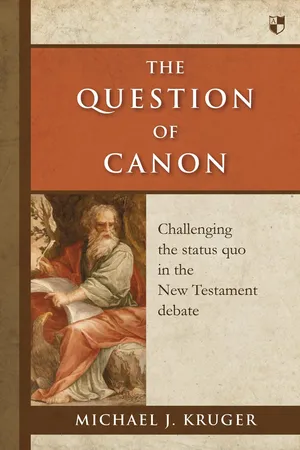
The Question of Canon
Challenging The Status Quo In The New Testament Debate
- English
- ePUB (mobile friendly)
- Available on iOS & Android
eBook - ePub
About this book
Information
Topic
Theology & ReligionSubtopic
Biblical Studies1
THE DEFINITION OF CANON
Must We Make a Sharp Distinction
Between the Definitions of
Canon and Scripture?
Once a distinction is made between scripture and canon, the idea of a New Testament canon does not appear applicable until the fourth century.
GEOFFREY M. HAHNEMAN
The Muratorian Fragment and
the Development of the Canon
the Development of the Canon

BREVARD CHILDS ONCE DECLARED, “Much of the present confusion over the problem of canon turns on the failure to reach an agreement regarding the terminology.”1 Although Childs made this statement in 1979, it could just as easily been written in our current day. As scholars continue to probe into the origins and development of the biblical canon, debates and disagreements about canonical semantics have not abated.2 What exactly do we mean by the term canon?3 Does it refer to books that were widely used by early Christians? Does it refer to books that function as Scripture? Or does it refer only to books that are included in a final, closed list? While these discussions over the definition of canon will certainly continue, and no universal agreement appears to be forthcoming, something does seem to have changed since Childs’s original observation. The definition of canon as a final, closed list of books has begun to emerge as the more dominant one—at least in some circles. In particular, advocates of an “extrinsic” model of canon are typically committed to this particular definition and insistent that all scholars must adopt it, lest the entire field become plagued by confusion and anachronism.4
Such claims are difficult to resist—after all, no one wants to plunge canonical studies into disarray. Moreover, there is certainly something attractive about having a single, unified definition of canon on which we can all agree (and build upon). Nevertheless, we must ask whether this “consensus” position, and the attitude with which it is held, is justified. Does this single definition adequately capture the complexities and nuances of the concept of canon? And are we required to adopt only this definition to the exclusion of all others?
THE EXCLUSIVE DEFINITION OF CANON
The definition of canon as a fixed, final and closed list of books—what might be called the exclusive definition5—was put forth originally by A. C. Sundberg in 1968.6 Sundberg drew a sharp distinction between the terms Scripture and canon and, on this basis, argued that we cannot speak of the idea of canon until at least the fourth century or later. Although Scripture would have existed prior to this time period, Sundberg argues that we must reserve the term canon until the end of the entire process. It would be anachronistic to use the term canon to speak of any second- or thirdcentury historical realities. Thus, simply marshaling evidence of a book’s scriptural status in the early church—as is so often done in canonical studies—is not enough to consider it canonical. The book must be part of a list from which nothing can be added or taken away.
Sundberg’s exclusive definition of canon was initially supported by a number of key scholars such as D. H. Kelsey,7 James Barr8 and Harry Gamble,9 and, in more recent years, has continued to gather adherents. John Barton, while rightly recognizing that multiple definitions of canon have some validity,10 still seems to prefer the exclusive definition: “Much clarity could be gained if we agreed to distinguish sharply between these two concepts [of Scripture and canon].”11 Geoffrey Hahneman has been a vigorous advocate of the exclusive definition, declaring, “Once a distinction is made between scripture and canon, the idea of a New Testament canon does not appear applicable until the fourth century.”12 Lee McDonald has consistently promoted Sundberg’s definition in his many writings over the last twenty years and is no doubt one of the reasons for its recent popularity.13 Eugene Ulrich is quite forceful in his approach, arguing that unless scholars accept the exclusive definition, discussions will be “confusing and counterproductive.”14 Likewise, the recent work of Craig Allert insists on the “necessity of proper distinction between the terms ‘Scripture’ and ‘canon.’”15 Even this brief survey of scholars (and more could be added16) suggests that David Nienhuis was correct when he observed that “Sundberg’s position has enjoyed widespread acceptance.”17
But is the widespread acceptance of this position justified? We begin our analysis by noting that there are many positives to this position that ought to be acknowledged. For one, the exclusive definition of canon rightly captures the reality of the canon’s “fluid” edges prior to the fourth century. It took some time for the boundaries of the canon to solidify, and the exclusive definition accommodates this historical fact by using different terms for different stages. Moreover, this definition helps remind us of the important role played by the church in the recognition and reception of the canon. By restricting the term canon to only the final stage when the church has decisively responded, the exclusive definition keeps church and canon from being unduly divorced from one another—the two concepts go hand in hand. However, there are a number of concerns about this definition that need to be explored.
First, it is difficult to believe that the sharp Scripture-canon distinction drawn by modern advocates of the exclusive definition would have been so readily shared by their historical counterparts in the second century. Would early Christians have regarded “Scripture” as fluid and open-ended and only “canon” as limited and restricted? If they were able to say that certain books in their library were Scripture, then that implies they would have been able to say that other books in their library were not Scripture. But, if they are able to say which books are (and are not) Scripture, then how is that materially different than saying which books are in (or not in) a canon? Thus, it seems some degree of limitation and exclusion is already implied in the term Scripture. As Iain Provan observes, “The question I am asking is whether the idea of scripture does not itself imply the idea of limitation, of canon, even if it is not yet conceived that the limits have been reached. I believe that it does so imply.”18 If so, then the necessity of a strict demarcation between Scripture and canon largely disappears.
Second, while the exclusive definition insists the term canon cannot be used until the New Testament collection has been officially “closed,” significant ambiguity remains on what, exactly, constitutes this closing. If it is absolute uniformity of practice, across all of Christendom, then, on those terms, there was still not a canon even in the fourth century. Indeed, on those terms we still do not have a canon even today.19 If the closing of the canon refers to a formal, official act of the early church, then we are hard pressed to find such an act before the Council of Trent in the sixteenth century.20 The fact of the matter is that when we look into the history of the canon we realize that there was never a time when the boundaries of the New Testament were closed in the way the exclusive definition would require. Stephen Chapman comments on this problem: “Rather than being a minor problem, this inconsistency casts significant doubt upon the appropriateness of the entire approach. Why should scholars adopt as the correct usage of the term ‘canon’ a meaning that does not correspond fully to any historical reality?”21 Ironically, then, the exclusive definition is as guilty of anachronism as any of the views that it critiques.
This leads us to the third, and arguably the most foundational, problem for this definition. Inherent to the exclusive definition is an insistence that the fourth century represents such a profoundly different stage in the development of the New Testament that it warrants a decisive change in terminology. Indeed, Dungan refers to the stage of Scripture and the stage of canon as “very different.”22 But was the canon so very different in the fourth century? While a broader degree of consensus was no doubt achieved by this point, the core books of the New Testament—the four Gospels and the majority of Paul’s epistles—had already been recognized and received for centuries. Whatever supposedly happened in the fourth century neither altered the status of these books nor increased their authority.23 It is precisely at this point that the limitations of the exclusive definition become clear. The abrupt change in terminology gives the impression that these books bore some lesser status prior to this point; it communicates that Christians only had Scripture and not a canon. Or, as one scholar put it, prior to the fourth century Christians only had a “boundless, living mass of heterogenous” texts.24 At best this is obscurant, and at worst misleading. Moreover, it feeds the notion that the canon was somehow the result of “a great and meritorious act of the church.”25 And this is why this definition is a core tenet of the extrinsic model—it implies there was no (and could be no) canon until the church officially acted. Stephen Dempster highlights this problem: “Reserving the terminology ‘canon’ for only the final collection of books obscures the continuity that exists at earlier times. To accept such a limiting definition might suggest that the canon did not have a history, only to be created ex nihilo, the result of a [church] council.”26
An example of this third issue can be seen clearly in the recent work of Craig Allert. The stated goal of his volume is to “emphasize the centrality of the church in the formation of the New Testament.”27 It is no surprise, then, that he is such a strong advocate of Sundberg’s definition of canon because, as he acknowledges, “Sundberg’s work has had the effect of pushing the decisive period, that of formal canonization, into the fourth and fifth centuries.”28 Such a late date for canon allows Allert to raise the profile of the church—it was there from the beginning, whereas the canon only arrives late on the scene. He declares, “The Bible was not always ‘there’ in early Christianity. Yet the church still continued to function in its absence.”29 While Allert is right to remind us of the important role of the church, this whole approach to the development of the canon raises some concerns. If the core books of the New Testament were functioning as authoritative Scripture by the middle of the second century, then is it really helpful to claim tha...
Table of contents
- Cover
- Title
- Copyright
- Contents
- Preface
- Abbreviations
- Introduction
- 1. The Definition of Canon
- 2. The Origins of Canon
- 3. The Writing of Canon
- 4. The Authors of Canon
- 5. The Date of Canon
- Conclusion
- Bibliography
- Author Index
- Subject Index
- Scripture Index
Trusted by 375,005 students
Access to over 1.5 million titles for a fair monthly price.
Study more efficiently using our study tools.
Frequently asked questions
Yes, you can cancel anytime from the Subscription tab in your account settings on the Perlego website. Your subscription will stay active until the end of your current billing period. Learn how to cancel your subscription
No, books cannot be downloaded as external files, such as PDFs, for use outside of Perlego. However, you can download books within the Perlego app for offline reading on mobile or tablet. Learn how to download books offline
Perlego offers two plans: Essential and Complete
- Essential is ideal for learners and professionals who enjoy exploring a wide range of subjects. Access the Essential Library with 800,000+ trusted titles and best-sellers across business, personal growth, and the humanities. Includes unlimited reading time and Standard Read Aloud voice.
- Complete: Perfect for advanced learners and researchers needing full, unrestricted access. Unlock 1.5M+ books across hundreds of subjects, including academic and specialized titles. The Complete Plan also includes advanced features like Premium Read Aloud and Research Assistant.
We are an online textbook subscription service, where you can get access to an entire online library for less than the price of a single book per month. With over 1.5 million books across 990+ topics, we’ve got you covered! Learn about our mission
Look out for the read-aloud symbol on your next book to see if you can listen to it. The read-aloud tool reads text aloud for you, highlighting the text as it is being read. You can pause it, speed it up and slow it down. Learn more about Read Aloud
Yes! You can use the Perlego app on both iOS and Android devices to read anytime, anywhere — even offline. Perfect for commutes or when you’re on the go.
Please note we cannot support devices running on iOS 13 and Android 7 or earlier. Learn more about using the app
Please note we cannot support devices running on iOS 13 and Android 7 or earlier. Learn more about using the app
Yes, you can access The Question of Canon by Michael J Kruger in PDF and/or ePUB format, as well as other popular books in Theology & Religion & Biblical Studies. We have over 1.5 million books available in our catalogue for you to explore.