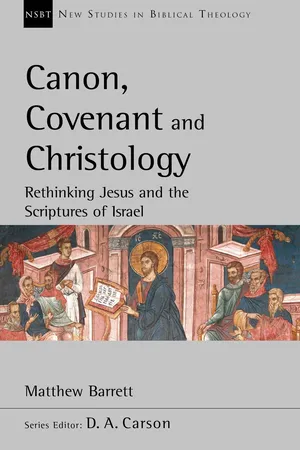
'All Scripture is breathed out by God.' (2 Timothy 3:16). From Paul's epistles the divine inspiration of Scripture may be confidently affirmed, as well as its corollary attributes. However, on turning to Jesus and the Gospels, it is hard to find an explicit approach like Paul's.Matthew Barrett argues that Jesus and the apostles have just as convictional a doctrine of Scripture as Paul or Peter, but it will only be discovered if the Gospels are read within their own canonical horizon and covenantal context. The nature of Scripture presupposed by Jesus and the Gospel writers may not be addressed directly, but it manifests itself powerfully when their words are read within the Old Testament's promise-fulfilment pattern. Nothing demonstrates Scripture's divine origin, divine authorial intent and trustworthiness more than the gospel of Jesus Christ. In the advent of the Son of God, the Word has become flesh, announcing to Jew and Gentile alike that the covenant promises Yahweh made through the Law and the Prophets have been fulfilled in the person and work of Christ.
eBook - ePub
Canon, Covenant and Christology
Rethinking Jesus And The Scriptures Of Israel
- English
- ePUB (mobile friendly)
- Available on iOS & Android
eBook - ePub
About this book
Information
Topic
Theology & ReligionSubtopic
Biblical Studies1
Divine authorial intent, canonical unity and the Christological presuppositions of biblical theology
By the twenty-first century it is well recognized, both among theologians and biblical scholars, that the naturalistic presuppositions that structured historical-critical methods from the Enlightenment to Protestant liberalism had devastating consequences for the doctrine of Scripture and hermeneutics. For example, Brevard Childs observes how traditional doctrinal tenates such as biblical authority and divine inspiration were fundamental to biblical scholarship for the first sixteen hundred years of the church’s existence, rarely being challenged, but in the modern era biblical authority and inspiration were questioned and discarded.1
One must be careful not to oversimplify the Enlightenment or neglect to recognize its variegated representatives. Not everyone was given over to rationalism or methodological naturalism.2 Nevertheless, doubtless a major wing was. Tracing the reception of the Bible from Baruch Spinoza to the twentieth century in their study The Bible in Modern Culture, Roy A. Harrisville and Walter Sundberg have shown that major segments of modernity gave birth to what they label ‘rationalist biblical criticism’ (RBC).3 In particular, the hermeneutical methods of RBC had serious consequences for the Gospels and Christology. ‘Historical criticism sought to measure the meaning of Jesus’ message according to the standards of Enlightenment morality and rationality. Biblical critics eventually retreated from the claim that an historically pristine portrait of Jesus could be disclosed by scholarly investigation.’4
It should be added that such a ‘retreat’ was not due to an evaluation of the person of Jesus alone. Evaluating Jesus’ use of the Old Testament, RBC judged the New Testament’s Christocentric reading of the Old Testament fanciful. This evaluation was an innovation to be sure. ‘Before the modern period,’ say Douglas Moo and Andy Naselli,
Christian interpreters were quite happy to explain that the OT is compatible with the NT; their recourse was various forms of what we might call the ‘figural’ sense. They extensively employed allegory and typology to show how the NT appropriates the OT to uncover the OT’s true, ‘spiritual’ meaning.5
That all changed when a ‘hermeneutics of consent’ was replaced by a ‘hermeneutics of suspicion’ due to the rise of higher criticism in the modern era. How the New Testament authors interpreted the Old Testament (i.e. in a figural, typological and Christological way) was now considered problematic in the light of the ‘modern insistence that the “historical” sense is a text’s only legitimate meaning’. Indeed, the ‘death knell for the traditional approach to the OT was insisting that the “grammatical-historical” meaning is the text’s only legitimate meaning’.6
This is not, however, an assessment voiced by evangelicals alone. Consider Hans Frei for example: pre-critical interpretation assumed ‘one cumulative story’ so that ‘figuration or typology was a natural extension of literal interpretation’. One of figuration’s ‘chief uses had been as a means for unifying the canon’. Then ‘historical-critical eyes’ peered over the hermeneutical horizon only to set the literal and figural over against each other, judging the latter a ‘preposterous historical argument’. With all the attention on the human author’s ‘grammatical and lexical exactness’, historical critics redefined the literal to be ‘concerned with specific texts and specific historical circumstances’, so that the ‘unity of the Bible across millennia of differing cultural levels and conditions . . . seemed a tenuous, indeed dubious hypothesis to them’.7 The divine author, and his intent across the canon, was eclipsed by the priority of the human author(s), all in the name of proper grammatical-historical exegesis.8
The Christological and typological interpretation of the Old Testament by Jesus and the New Testament authors was rejected because RBC precluded divine authorial intent, either in part or in whole.9 In other words, presupposed was the belief that God does not act in such miraculous and providential ways, either to breathe out Scripture (1 Tim. 3:16–17) and carry along the biblical authors by his Spirit (2 Peter 1:21), or to infuse Scripture’s promise–fulfilment tapestry with a meaning that could go beyond the human author’s immediate understanding (1 Peter 1:10–12).10 There is no single, divine author who intervenes and guides the canon and its narrative from start to finish because there is no divine–human concursus intrinsic to the inspiration event itself. Instead, the canon consists of disparate human contributions that have no single theological and textual cohesion.
Can biblical theology survive after the Enlightenment?
What have been the consequences of such an approach for the discipline of biblical theology? In short, such an approach precludes canonical unity: a unified narrative is an impossibility.11 Graeme Goldsworthy explains:
The idea that God himself has a purpose that is accurately revealed in the redemptive–historical narrative of the Bible as a whole has been under attack since the seventeenth century. Biblical theology comes to be regarded by many as a futile exercise on the basis that there is no discernible theological unity to the canon.12
Goldsworthy believes the consequences are devastating not only for biblical theology but for the biblical text itself:
Historical criticism in its extreme form rejected the dogma that God both set in train the events of history and also acted within them. It rejected the notion of divine revelation within space and time, and thus ultimately made biblical theology impossible. In its place it put the study of the history of religious ideas.13
The importance of Goldsworthy’s insight cannot be overemphasized. While some modern thinkers were direct, announcing their abandonment of scriptural inspiration, others were subtle, allowing their neglect of divine authorial intent to eat away at canonical unity, until no unity was left at all. There was, says Craig Carter, an ‘undermining of the unity of the Bible as a single narrative, which was done by ignoring divine authorship and concentrating on human authorship alone’.14 As is often the case in biblical scholarship, emphasis is everything. To emphasize human authorial intent at the expense of divine authorial intent is to undermine the Scriptures as a singular drama with a concentrated plotline; it is not surprising that divine inspiration and authority were soon dismissed in the process.
Although it is tempting to think that more recent scholarship has moved past such an approach, remnants can still be found; its influence is powerful and should not be underestimated. German and Lutheran New Testament scholar Ernst Käsemann, for example, makes the following provocative claim: ‘The one biblical theology, going from a single root and maintaining itself in unbroken continuity, is wish-fulfilment and fantasy.’15 In more recent years German New Testament scholar Udo Schnelle, author of Theology of the New Testament, has argued that the person of Jesus Christ is what makes biblical theology so intolerable: ‘A “biblical theology” is not possible because: (1) the Old Testament is silent about Jesus Christ, [and] (2) the resurrection from the dead of one who was crucified cannot be integrated into any ancient system of meaning formation.’16
Or consider James Barr, who writes, ‘An exegesis which would work strictly within the confines of the canon is certainly a possibility that could be added to other forms of exegesis, but it is doubtful how it could be the basic theological form of exegesis.’ Barr then pushes back against Childs:
And Childs’ argument in favor of the final text, while an important consideration for the interpretation of individual books, like Genesis, or even the Pentateuch, or Matthew, does not thereby validate an extension to the point where the canon of the entire Scripture would define it as if it was a single text.17
What does this mean for Scripture as a whole and the New Testament in particular?
The NT as we have it is a fragmentary collection of documents from the earliest period, while the bulk of the material has vanished forever. By and large there is no internal coherence. The tensions everywhere evident amount to contradictions.18
In this scheme the Bible is fragmentary and atomized.
R. E. Murphy draws a similar conclusion for the discipline of biblical theology but fr...
Table of contents
- Series preface
- Author’s preface
- Abbreviations
- Copyright acknowledgments
- Introduction: reorienting the hermeneutical approach to Jesus and the Scriptures of Israel
- 1
- 2
- 3
- 4
- 5
- 6
- 7
- Bibliography
- Search names for authors
- Search items for Scripture references
- Titles in this series
- Notes
Trusted by 375,005 students
Access to over 1.5 million titles for a fair monthly price.
Study more efficiently using our study tools.
Frequently asked questions
Yes, you can cancel anytime from the Subscription tab in your account settings on the Perlego website. Your subscription will stay active until the end of your current billing period. Learn how to cancel your subscription
No, books cannot be downloaded as external files, such as PDFs, for use outside of Perlego. However, you can download books within the Perlego app for offline reading on mobile or tablet. Learn how to download books offline
Perlego offers two plans: Essential and Complete
- Essential is ideal for learners and professionals who enjoy exploring a wide range of subjects. Access the Essential Library with 800,000+ trusted titles and best-sellers across business, personal growth, and the humanities. Includes unlimited reading time and Standard Read Aloud voice.
- Complete: Perfect for advanced learners and researchers needing full, unrestricted access. Unlock 1.5M+ books across hundreds of subjects, including academic and specialized titles. The Complete Plan also includes advanced features like Premium Read Aloud and Research Assistant.
We are an online textbook subscription service, where you can get access to an entire online library for less than the price of a single book per month. With over 1.5 million books across 990+ topics, we’ve got you covered! Learn about our mission
Look out for the read-aloud symbol on your next book to see if you can listen to it. The read-aloud tool reads text aloud for you, highlighting the text as it is being read. You can pause it, speed it up and slow it down. Learn more about Read Aloud
Yes! You can use the Perlego app on both iOS and Android devices to read anytime, anywhere — even offline. Perfect for commutes or when you’re on the go.
Please note we cannot support devices running on iOS 13 and Android 7 or earlier. Learn more about using the app
Please note we cannot support devices running on iOS 13 and Android 7 or earlier. Learn more about using the app
Yes, you can access Canon, Covenant and Christology by Matthew Barrett in PDF and/or ePUB format, as well as other popular books in Theology & Religion & Biblical Studies. We have over 1.5 million books available in our catalogue for you to explore.