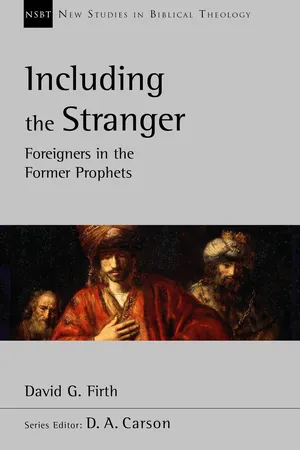
The Old Testament, particularly the Former Prophets, has frequently been regarded as having a negative attitude towards foreigners. This has meant that these texts are often employed by those opposed to the Christian faith to attack the Bible; and such views can be echoed by Christians. While the story of David and Goliath is cherished, other episodes are seen to involve 'ethnic cleansing' or 'massacre' and are avoided.David Firth's contention is that this view emerges from an established interpretation of the text, but not the text itself. He argues that the Former Prophets subvert the exclusivist approach in order to show that the people of God are not defined by ethnicity but rather by their willingness to commit themselves to the purposes of Yahweh. God's purposes are always wider than Israel alone, and Israel must therefore understand themselves as a people who welcome and include the foreigner.Firth addresses contemporary concerns about the ongoing significance of the Old Testament for Christians, and shows how opponents of Christianity have misunderstood the Bible. His reading of the Former Prophets also has significant ethical implications for Christians today as they wrestle with the issues of migration and what it means to be the people of God.
- English
- ePUB (mobile friendly)
- Available on iOS & Android
eBook - ePub
About this book
Information
Topic
Theology & ReligionSubtopic
Biblical StudiesChapter One
Concerning foreigners and the Former Prophets
Being a foreigner and reading the Bible
I am a foreigner. Almost any day when I speak to people I have not met before, I encounter an observation along the lines of ‘You’re not from around here are you?’ Since many British people seem unable to distinguish between an Australian, New Zealand or South African accent I am normally happy to string them along a little – though since I sometimes struggle to identify certain regional accents within the UK in spite of the years we have spent here, it is also quite common for us to spend time in a mutual attempt to work out where the other is from.
So, although I apparently do not look foreign (whatever that might mean!), the status of ‘foreigner’ is one that I constantly bear and which to varying degrees shapes my interaction with my community. Often that takes the form of good-natured teasing during certain sporting events, mostly from those I know well, though that is not entirely predictable. More problematic, though, are times when I or members of my family have attended meetings or events where ‘foreigners’ were blamed for a variety of ills. When we point out that we are foreigners, a response is usually given along the lines of ‘Oh, but you’re not the kind of foreigner I mean.’ Leaving aside the rather problematic concept of exactly what makes some foreigners acceptable and others not, it does indicate that host cultures are capable in some way of distinguishing between foreigners when needed, though equally that it is possible for foreigners to be treated as an undistinguished group. Extending the UK example, it is also possible to regard others as ‘foreign’ under some circumstances and as ‘native’ under others – for example, is someone English, Scottish or Welsh? Each of these can be distinct, yet, under other circumstances all these people would be ‘British’. Even within England, someone might be from Yorkshire or Cornwall, and so ‘not from around here’, although at other times their status as English would be stressed. In short, ‘foreignness’ (however defined) depends on the attitude of a speaker to another and whether someone is defined as ‘us’ or ‘other’ and this is something that can vary.1
This is a non-scientific set of observations, but they form an important background to this study. It emerges out of a social context in which issues of migration and national social identity are widely discussed in the media across much of the Western world. As a migrant, I hope to bring some significant social benefits and skills to my host country. But I am always foreign, and no construction of British identity includes me just because the simple act of my speaking makes this clear. So, even though national identity within the UK can be constructed in a range of ways, some more inclusive than others, some of us cannot be included whereas others might live in a more marginal position in which they might be included under some constructions and not others.
My work as a biblical interpreter cannot be separated from this experience, perhaps because as with any reader my experience of the world makes me more aware of some themes within the Bible than others.2 That is, my social location could well have made me more aware of some themes within the Bible than I might have recognized had I been in another, though there is no real way of testing this. However, it could be said that one of the virtues of reading as a foreigner is that I see things that the dominant culture might not see, or perhaps ask questions that might not otherwise be posed, while conversely others can make me more aware of biblical themes that I might otherwise miss. The fact is that we all bring some degree of pre-understanding to the reading of the Bible, and though the emphasis on wissenschaftlich (scientific/critical) interpretation that emerged out of the Enlightenment discouraged this because of its belief that the interpreter must in some way be detached from the material, the reality is that readers have consistently brought their own political situation to bear on their reading of the Bible.3
At the same time, it is not my contention that the position of the reader is to be absolutized such that this becomes the most important issue in interpretation. Rather, the situation of the reader and those questions for the Bible that emerge from a given reader’s social and political context are themselves to be brought into a dialogue with the Bible. It is through interaction with the Bible that our pre-understanding can be challenged and changed through the process of reading the text.4 This means that although I can reasonably aim for a degree of detachment as an interpreter I can never do so absolutely, and indeed to do so such that I miss certain elements of what is in the Bible is to lose the benefit that acknowledging my pre-understanding brings. At the same time, there will be points where the act of reading the Bible leads me to reassess those convictions with which I began the process of reading.
The reason for this is that although biblical studies has for some time emphasized the place of critical method in reading the Bible, there is also an important place for criticism as something also applied to the reader.5 This idea has been helpfully explored by Briggs as he has noted the ways in which the narrative texts of the Old Testament (our focus for this study) themselves function to shape the interpretative virtues that are important for reading them well.6 Hence, although we come as readers with certain points of pre-understanding, the process of reading these texts also shapes us as readers. This indicates that although hermeneutical reflection is important, good reading of the Bible does not require that this be the starting point.7 Indeed, my own testimony would be that I did not recognize the importance of foreigners within these texts until I had read them several times; though I would also suggest that my status as a foreigner has made me more aware of this motif than might otherwise have been the case. In turn, it is my hope that this volume will enable other readers who might not self-identify as ‘foreign’ to appreciate the significance of this motif within the Former Prophets8 and the implications this has for our understanding of the identity of the people of God in general along with the ethical challenges posed by migration today.
Why the Former Prophets?
Given the goals just noted, a not unreasonable response might well be to ask if perhaps an exploration in Israel’s legal texts of the foreigner might be more constructive. After all, this approach allows us to trace the main lexical data about foreigners. That is, given that the various categories of foreigner are discussed within the law, and these laws direct Israel how to respond to foreigners, might not this be a more constructive approach for considering this theme?
There are several reasons, however, why this approach is not taken here. First, a number of studies already exist that consider the issue of the foreigner in Israel’s law,9 so the relative gain in considering the same selection of texts is relatively small.
Second, there is value in a more focused study that considers the contribution of the Old Testament’s narrative materials. Walter Houston10 has pointed out that laws can change a society’s behaviour only when justice is taught and not only enforced, and one of the key ways in which this teaching happens in the Old Testament is through its narrative materials.11 The importance of the narrative materials for understanding the place of foreigners has been recognized by Fleur Houston12 and Lau,13 though neither has considered the Former Prophets to a significant degree.
There are, however, more fundamental reasons for turning to Israel’s wider narrative traditions. One important point is that the law provides not an ethical maximum but rather a minimum. That is, law recognizes a problem that needs to be addressed, but what it provides is the least that should be done, not necessarily the ethical goal towards which a people should aspire. By contrast, Wenham has argued that the narrative texts of the Old Testament are didactic and so try ‘to instil both theological truths and ethical ideals into their readers’,14 and that therefore the narratives offer a form of paradigmatic ethics.15 Understanding narrative material in this way still requires reflection on whether the narrative presents characters and their actions as exemplary in some way,16 an issue to which we will return. But with Parry17 it is important that the narratives we consider within the Former Prophets are placed within the larger story that the Old Testament, and indeed the New Testament, provides – which is why we reflect briefly on these themes in the New Testament in the final chapter. As we will see, this is often because the narrators in the Former Prophets tend to assume that readers are aware of other texts within the Old Testament (principally the Pentateuch); but beyond this it is an important element in a Christian reading of these texts that they are also placed within the framework of the whole canon, albeit one that takes seriously its nature as a work containing two Testaments in which the two mutually inform our reading of the other.18 It is this awareness that enables a reading of these texts that is alert to their contribution to this theme.
Third, and more specific to the Former Prophets rather than narrative texts in general, these books contain a significant number of references to foreigners and these have not been explored in detail in a systematic way.19 A feature that emerges from a reading of these books is a developing response to the presence of foreigners within Israel whereby foreigners who may seem unacceptable can be included within Israel even as those who are ethnically Israelite are excluded because of their failure to live out the demands of the covenant with Yahweh. For example, within the book of Joshua Rahab is the archetypal foreigner, a Canaanite prostitute, and yet she is included within Israel. By contrast, Achan effectively becomes a Canaanite and is excluded, even though he has an exemplary Israelite heritage. I shall argue that these stories are intended to make readers ask questions about the identity of Israel as the people of God. However, where Joshua is particularly concerned about those people from the land who remain among Israel, by the time we reach the book of Kings the focus is on foreigners who live outside the land and yet desire a relationship with Yahweh. These elements point to positive reasons for considering these texts.
But a more negative reason also exists for considering the Former Prophets, in particular exposing readings of them that have taken hold in popular thought but that may be contrary to what they say. There is a perception that these books point to an understanding of God that is highly ethnocentric. This understanding can be seen in both contemporary critics of the Christian faith and Christians who believe that these books have a highly negative view of foreigners. From the perspective of critics of Christian faith, Richard Dawkins speaks for many, even if they might regard his language as somewhat intemperate. But it should be noted that it is his reading of the Old Testament, and especially the Former Prophets, that leads to his (in)famous observation that
[t]he God of the Old Testament is arguably the most unpleasant character in all fiction: jealous and proud of it; a petty, unjust, unforgiving control-freak; a vindictive, bloodthirsty ethnic cleanser; a misogynistic, homophobic, racist, infanticidal, genocidal, filicidal, pestilential, megalomaniacal, sadomasochistic, capriciously malevolent bully.20
Dawkins, along with his fellow ‘new atheists’, is usually a fairly flat-footed reader of the Bible who does not recognize the nuances of the text.21 Nevertheless, when it comes to the book of Joshua in particular, his comments come close to those of many Christians who struggle with the violence they see in it when he observes that it is
a text remarkable for the bloodthirsty massacres it records and the xenophobic relish with which it does so. As the charming old song exultantly has it, ‘Joshua fit the battle of Jericho, and the walls came a-tumbling down . . . there’s none like good old Joshuay at the battle of Jericho.’ Good old Joshua didn’t rest until ‘they utterly destroyed all that was in the city, both man and woman, young and old, and ox, and sheep, and ass with the edge of the sword’ (Josh. 6:21).22
Dawkins is never knowingly understated in his attacks on God and the Bible, but there is no doubt that he here addresses an issue that continues to trouble many readers of the Bible today. Operating from an expressly Christian perspective, Robert Coote expresses a similar perspective on Joshua:
Much about the book of Joshua is repulsive, starting with the ethnic cleansing, the savage dispossession and genocide of native peoples, and the massacre of women and children – all not simply condoned but ordered by God. These features are worse than abhorrent; they are far beyond the pale.23
Although discussion of most of these issues can be deferred until chapter 2, the popularity of such readings means they cannot be ignored. Staying only with the example of the book of Joshua, it ...
Table of contents
- Series preface
- Author’s preface
- Abbreviations
- Chapter One
- Chapter Two
- Chapter Three
- Chapter Four
- Chapter Five
- Chapter Six
- Bibliography
- Notes
- Search names for authors
- Search items for Scripture references
- Search items for ancient sources
- Titles in this series:
Trusted by 375,005 students
Access to over 1.5 million titles for a fair monthly price.
Study more efficiently using our study tools.
Frequently asked questions
Yes, you can cancel anytime from the Subscription tab in your account settings on the Perlego website. Your subscription will stay active until the end of your current billing period. Learn how to cancel your subscription
No, books cannot be downloaded as external files, such as PDFs, for use outside of Perlego. However, you can download books within the Perlego app for offline reading on mobile or tablet. Learn how to download books offline
Perlego offers two plans: Essential and Complete
- Essential is ideal for learners and professionals who enjoy exploring a wide range of subjects. Access the Essential Library with 800,000+ trusted titles and best-sellers across business, personal growth, and the humanities. Includes unlimited reading time and Standard Read Aloud voice.
- Complete: Perfect for advanced learners and researchers needing full, unrestricted access. Unlock 1.5M+ books across hundreds of subjects, including academic and specialized titles. The Complete Plan also includes advanced features like Premium Read Aloud and Research Assistant.
We are an online textbook subscription service, where you can get access to an entire online library for less than the price of a single book per month. With over 1.5 million books across 990+ topics, we’ve got you covered! Learn about our mission
Look out for the read-aloud symbol on your next book to see if you can listen to it. The read-aloud tool reads text aloud for you, highlighting the text as it is being read. You can pause it, speed it up and slow it down. Learn more about Read Aloud
Yes! You can use the Perlego app on both iOS and Android devices to read anytime, anywhere — even offline. Perfect for commutes or when you’re on the go.
Please note we cannot support devices running on iOS 13 and Android 7 or earlier. Learn more about using the app
Please note we cannot support devices running on iOS 13 and Android 7 or earlier. Learn more about using the app
Yes, you can access Including the Stranger by David G Firth in PDF and/or ePUB format, as well as other popular books in Theology & Religion & Biblical Studies. We have over 1.5 million books available in our catalogue for you to explore.