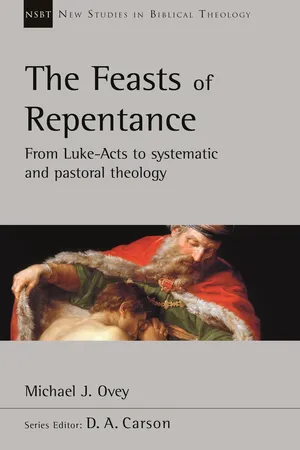
In gospel proclamation today, the critical New Testament element of repentance can be far too often ignored, minimalised or dismissed. Yet John the Baptist, Jesus himself, and those he commissioned to spread his gospel all spoke of the urgent need to repent. Michael Ovey was convinced that a gospel without repentance quickly distorts our view of God, ourselves and one another by undermining grace and ultimately leading to idolatry. Only when we grasp the need for true repentance as consisting of a real change -- a transforming work of the Spirit of God -- can we fully understand the gospel Jesus preached.With care and clarity, Ovey focuses first on the relevant biblical material in Luke-Acts, examining who repents and who does not, and the characteristics of both groups. He surveys the 'feasts of repentance' of Jesus with Levi, the Pharisees, and Zaccheus, and in the parable of the Lost Son. He then moves to more systematic-theological aspects of repentance, in relation to idolatry and to salvation; and finally to pastoral theology in the corporate life of the people of God today, with regard to self-righteousness, hypocrisy, humility, forgiveness and justice.
eBook - ePub
The Feasts of Repentance
From Luke-Acts To Systematic and Pastoral Theology
- English
- ePUB (mobile friendly)
- Available on iOS & Android
eBook - ePub
About this book
Information
Topic
Theology & ReligionSubtopic
Biblical StudiesChapter One
Repentance: formality, necessity or optional extra?
‘Between the stirrup and the ground
He something sought and something found.’
Mercy.
That’s right: Mercy.1
Introduction
Pinkie is a character from Graham Greene’s novel Brighton Rock. He is a teenage gangster, hardened and violent. He knows that his actions are evil and in fact deserve God’s condemnation. He still persists in them and comforts himself with the tag of poetry quoted above. He has been taught that God forgives the repentant and assumes he will be able to repent when the time comes. But this prompts some acute questions. How could God ever forgive someone like Pinkie? Will God tolerate such delay in repentance? These questions are further complicated when Pinkie realizes that the poetry is not true. There is no time between the stirrup and the ground to turn to God in repentance: you are too busy fighting death, or your opponent, or are simply too consumed with fear, to think of repentance. For Pinkie repentance proves impossible, and the prospect of forgiveness vanishes. What remains is only bleak despair in the face of death and God’s wrath.
But is Pinkie worrying about nothing? Does Pinkie need to repent, or will not God forgive him anyway? Was he told the wrong thing about God and our relationship with him? Behind these questions lies the issue of where repentance fits in Christian faith and life. This issue needs to be faced. For our time in the early twenty-first century in the cultural West is widely described as a time of repentanceless Christianity. The notion of repentanceless Christianity prompts two further questions.
First, is repentance part of the evangelistic message? This affects what we preach in our evangelism. Should a presentation of the gospel include a call to repent? In slightly different terms, is repentance really a part of the gospel itself? John Calvin did, of course, talk in just such terms: ‘[W]ith good reason, the sum of the gospel is held to consist in repentance and forgiveness of sins’.2 N. T. Wright, however, differs, famously commenting that the gospel is the proclamation that Jesus is Lord.3 More broadly, the systematic issue at stake is whether a human being needs to repent to be saved. A key practical issue here is how repentance relates to faith. In an evangelistic setting, is it enough to call for ‘faith’ in Jesus Christ if one does not also preach repentance? What are the long-term pastoral consequences, if any, of neglecting or precluding repentance in a call for faith?
Second, is repentance part of the post-conversion Christian life? Even if one thought that repentance was at least part of becoming a Christian, is there space or need for it thereafter? For some might say that the stress on leading a repentant life is just what gives so much Christian life its joyless, guilt-ridden and dour character. Others, that a repentanceless Christian life is the primrose path to a flabby and finally morally and spiritually compromised Christian life.
So, the subject of repentance touches critical areas: what we say in evangelism and how we expect the Christian life to look and be.
Questions of method: the focus on Luke–Acts
The language of repentance in the New Testament predominates in narrative settings, and in Luke–Acts in particular. Within Luke–Acts repentance occupies a prominent place. In the Gospel of Luke repentance is a consistent thread in the narrative, notably present in the account of John the Baptist’s ministry (Luke 3:1–17) and in Jesus’ final commission to preach forgiveness and repentance of sins to all nations (Luke 24:47). In Acts repentance is a theme in Peter’s speeches to the Jews (e.g. Acts 2:38), is present in Paul’s speeches to Gentiles (Acts 14:15; 17:30) and is also significant in his accounts of his ministry (Acts 20:21; 26:18, 20). Of course, given the size of Luke–Acts in the New Testament corpus (over a quarter), and its connections both with Mark and Matthew, as well as Paul’s letters, this significant presence within Luke–Acts suggests repentance is theologically significant more generally. However, given the predominance of repentance material in Luke–Acts, attention must focus on this corpus, and space precludes us here dealing with all the New Testament repentance texts.
Three observations arise connected with this need to focus on Luke–Acts: first, concerning terminology; second, concerning argument by narrative; and third, the focus on people who repent rather than the concept.
Terminology: ‘turning’ and ‘change’
First, concerning terminology. What counts as a reference to ‘repentance’? Calvin was not content simply to be confined to the term metanoia and its cognates as the textual basis for discussing repentance.4 His reason was that the concept of repentance was a turning: ‘[Repentance] is the true turning of our life to God . . .’.5 Hence, he argued, ‘turn’, ‘return’, ‘repent’, ‘do penance’, and so on, were used interchangeably. Calvin here in some ways anticipated the argument of S. Porter who suggests that repentance needs to be seen within the semantic domain of changing behaviour.6
Yet are Calvin and Porter textually justified in seeing a central concept lying behind several different terms? To anticipate later exegetical work, Paul’s speech to Agrippa in Acts 26:17–20 strongly suggests ‘change’ or ‘turning’ terms are closely intertwined. For in Acts 26:20 Paul brackets together metanoein and epistrephein vocabulary as he speaks of God’s commission of proclamation. That metanoein and epistrephein are cognate is further indicated by the way that turning (epistrephein) is associated with forgiveness of sins in 26:18, while in Luke 3:3 and 24:47 metanoia is associated with forgiveness of sins. Similarly, in Acts 14:15 the call for the Lystrans to repent of idolatry employs epistrephein, while the repentance call to Athenian idolaters in Acts 17:30 uses metanoein. In Luke itself John the Baptist ‘turns’ the people towards God (Luke 1:16, using epistrephein) and calls Israel to repentance (Luke 3:3, using metanoia). These instances suggest at least substantial overlap between ‘turning’ (epistrephein) and ‘change of mind’ (metanoia). Hence usage of both terms is relevant to our study.
Argument by narrative
Second, clearly Luke–Acts is not a straightforward argument. For sure the material is ordered to establish a conclusion in the reader’s mind. But this is not a naked argument consisting of categorical propositions arranged in a syllogistic form. Some parts of some New Testament letters may appear more propositional in form. Thus Paul may tell us that if the dead are not raised, then Christ is not raised (1 Cor. 15:16). In one sense, this simply uses the principle that a universal negative proposition (the dead are not raised) must include the particular negative proposition (Christ is not raised), and is valid because Christ is a member of the class of people who have died.
Constructing a more integrated and systematic account of repentance therefore must reckon with the fact that much of the source material is not arranged in straightforward propositional form. Rather, it is cast as narrative, so that there may be a dynamic movement in which our understanding about repentance is cumulatively formed.7 Moreover, this accumulation will be complex if one assumes, as seems highly likely, that Luke–Acts was to be read more than once. The second- or third-time reader takes an early occurrence of repentance terms in the light of what she or he already knows happens later. Such a narrative form also heightens the possibilities of identification by the reader. J. A. Darr comments that Luke wants to move the reader to a position where he believes the witness of believers in the narrative,8 and this is surely right in view of Luke 1:1–4.
This all means that a systematic account of repentance must deal responsibly with a position and understanding advocated through narrative, not straightforward logical argument. This emphatically does not, of course, mean that there is no argument in Luke–Acts: rather, the theological argument is carried on in subtler ways and in more dimensions than the argument of a systematic textbook. We do not write systematic textbooks or arguments in the way we do because naked logical argument is somehow superior to narrative argument. Rather, naked logical argument is simpler and more restricted. There is less to confuse the reader, and also, one might say, less to enrich. Sometimes one wants a simple black and white photograph, not because it is in every way better than a colour photograph, but because it may simplify vision, even though it also clearly loses something.
The focus on who repents and who does not: the question of character
The third observation also concerns the narrative nature of the Luke–Acts discussion of repentance. Luke–Acts does not so much discuss repentance, the theological locus, as people: people who are, and who are not, repentant. This relates to Darr’s point that Luke wants to enlist and persuade his reader. He envisages Luke’s enlisting the reader as he or she witnesses the interactions between Jesus and other characters: ‘In a very real sense, the story functions at two levels: while reading about characters who “witness” the significant events and personages of salvation history, the reader inevitably witnesses in response to them as well.’9
Thus there are many episodes which provide examples of positive or negative ‘recognition and response’.10 The characters who respond function as paradigms,11 for better or worse, orientating readers so that they can know their own position with respect to the plan of God, which R. Tannehill argues is the unifying feature of Luke–Acts.12
This means that to discern the values Luke is establishing we must examine the paradigmatic characters he employs. The narrative nature of Luke’s work entails examining his characterization.
We can envisage characterization in several ways. Famously E. M. Forster saw a spectrum of characterization between poles of flatness or roundness, depending on the detail and other factors supplied.13 While not irrelevant, this categorization is not the most helpful for our purposes, which require rather establishing how the narrative establishes values in the reader’s mind and the approval or disapproval of particular characters,14 be they individual or group characters.
D. B. Gowler suggests a more helpful approach.15 He proposes that characterization in Luke occurs on two sliding scales, one of explicitness, the other of reliability.16 He writes, ‘Reliability is the measure of the extent to which a speaker can be trusted, whereas explicitness refers to the clarity of the message.’17
Reliable speakers in Luk...
Table of contents
- Series preface
- Preface
- Abbreviations
- Chapter One
- Chapter Two
- Chapter Three
- Chapter Four
- Chapter Five
- Chapter Six
- Bibliography
- Notes
- Search names for authors
- Search items for Scripture references
Trusted by 375,005 students
Access to over 1.5 million titles for a fair monthly price.
Study more efficiently using our study tools.
Frequently asked questions
Yes, you can cancel anytime from the Subscription tab in your account settings on the Perlego website. Your subscription will stay active until the end of your current billing period. Learn how to cancel your subscription
No, books cannot be downloaded as external files, such as PDFs, for use outside of Perlego. However, you can download books within the Perlego app for offline reading on mobile or tablet. Learn how to download books offline
Perlego offers two plans: Essential and Complete
- Essential is ideal for learners and professionals who enjoy exploring a wide range of subjects. Access the Essential Library with 800,000+ trusted titles and best-sellers across business, personal growth, and the humanities. Includes unlimited reading time and Standard Read Aloud voice.
- Complete: Perfect for advanced learners and researchers needing full, unrestricted access. Unlock 1.5M+ books across hundreds of subjects, including academic and specialized titles. The Complete Plan also includes advanced features like Premium Read Aloud and Research Assistant.
We are an online textbook subscription service, where you can get access to an entire online library for less than the price of a single book per month. With over 1.5 million books across 990+ topics, we’ve got you covered! Learn about our mission
Look out for the read-aloud symbol on your next book to see if you can listen to it. The read-aloud tool reads text aloud for you, highlighting the text as it is being read. You can pause it, speed it up and slow it down. Learn more about Read Aloud
Yes! You can use the Perlego app on both iOS and Android devices to read anytime, anywhere — even offline. Perfect for commutes or when you’re on the go.
Please note we cannot support devices running on iOS 13 and Android 7 or earlier. Learn more about using the app
Please note we cannot support devices running on iOS 13 and Android 7 or earlier. Learn more about using the app
Yes, you can access The Feasts of Repentance by Michael J. Ovey in PDF and/or ePUB format, as well as other popular books in Theology & Religion & Biblical Studies. We have over 1.5 million books available in our catalogue for you to explore.