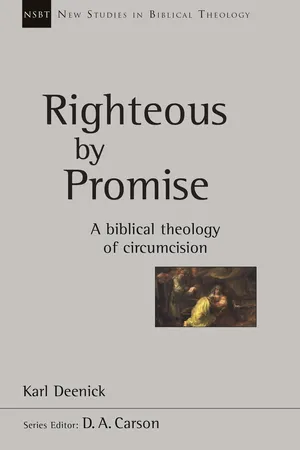
Given the foundational importance of circumcision in the Old Testament and its prevalence in debates in the New Testament, it is remarkable that so little detailed work has been done on establishing a biblical theology of circumcision. This oversight is even more surprising given that circumcision forms the background to some of the most contested writings of the apostle Paul. Furthermore, the biblical material seems to present quite varied and even apparently contradictory pictures of what circumcision means.Two key biblical concepts closely linked to circumcision are righteousness and faith. Karl Deenick shows that these are central to both the New Testament and the developing Old Testament understandings of circumcision. They are held together by the unfolding promise of a blameless 'seed of Abraham', Jesus Christ, through whose sacrifice the promised righteousness will finally come. This righteousness will be enjoyed by those whose hearts are 'circumcised', trusting in God's promise. 'Dr Deenick arrives at nuanced definitions of both physical circumcision and circumcision of the heart. His study sheds fresh light not only on many Old Testament passages, but also on Romans 2 - 4, much of Galatians, Philippians 3, Colossians 2, and Acts 7 and 15. Better yet, it suggests an integrating line of development across the canon...' (D. A. Carson).
- English
- ePUB (mobile friendly)
- Available on iOS & Android
eBook - ePub
About this book
Information
Topic
Theology & ReligionSubtopic
Biblical StudiesChapter One
Introduction
More than once I have been asked what on earth it was that led me to study and write on circumcision. Why that topic? At what point did that begin to seem like a good idea? But actually, the reason is surprisingly simple. Because although circumcision is of foundational importance in the OT and is central to many of the debates in the NT on the nature of the gospel, and while it is often remarked upon in passing by biblical scholars and theologians, it still remains curiously neglected. Very little detailed work has been done on establishing a biblical theology of circumcision.1 Bernat’s observation of the state of play of circumcision in the OT is true more broadly:
Despite the importance attributed to circumcision in the Hebrew Bible, the topic has not been accorded sufficient attention in the scholarship . . . Studies of circumcision have been more narrowly focussed, on individual biblical passages or topics, while attempts at synthesis tend toward summary, appearing as entries in encyclopedias, excurses in commentaries, chapters of larger works, and brief notices in survey literature . . .2
What longer treatments of circumcision do exist are either too broadly focused or too narrowly focused, both in the questions they ask and the texts and sources they use.3
This lack of detailed work on a biblical theology of circumcision is surprising given the place circumcision holds in both Testaments: it is connected with some of the most foundational covenant passages in the OT (e.g. Gen. 15, 17), it occurs repeatedly in the OT in connection with the future hope for Israel (Lev. 26; Deut. 30), it forms the background for some of the most hotly contested writings of the apostle Paul where he defends the gospel against misunderstandings of circumcision (e.g. Rom. 2 – 4; Galatians; Phil. 3), and it is the occasion of one of the earliest church councils (e.g. Acts 15) because circumcision was in danger of overshadowing the gospel. But not only is circumcision a biblically important topic; it is a theologically important topic as well. It is often considered central to the argument for whether to baptize infants or not. And, more recently, it has played a leading role in the debates surrounding the New Perspective on Paul and the question of righteousness.
Nevertheless, despite the lack of detailed work, the unspoken assumption often seems to be that the meaning of circumcision is relatively well understood. In fact, on closer inspection, the issues are much more complicated than one might have expected.
Defining the problem
In seeking to establish a biblical theology of circumcision, the two facets on which this book focuses are the key biblical concepts of righteousness and faith. Part of the motivation for that comes from Paul’s remark that Abraham ‘received the sign of circumcision as a seal of the righteousness that he had by faith while he was still uncircumcised’ (Rom. 4:11).4 Paul’s connection of circumcision with the ideas of righteousness and faith is not limited to this particular verse. The three are also clearly connected in Romans 2 – 4, Galatians and Philippians 3. Moreover, in other places circumcision is linked with related concepts like cleansing (John 7:22–23; Acts 15:1–11), reconciliation (Eph. 2:11–22), forgiveness (Col. 2:6–23) and the receipt of the Holy Spirit (Acts 10:45; 15:1–11).
However, Romans 4:11 connects the ideas in a way that opens up the subject and some of its inherent complexities. Furthermore, it also highlights Paul’s biblical-theological sensitivity with respect to the meaning of circumcision in so far as it relates to righteousness and faith. Paul’s claim in Romans 4:11 is not first of all anchored in what his opponents thought about circumcision but in how circumcision worked in the OT. Circumcision was given to Abraham as a ‘seal of the righteousness that he had by faith’. In Paul’s mind at least, circumcision was intended to mean something to Abraham. Paul is not making a claim about what became apparent about circumcision later, but about what circumcision already meant from the very beginning. It was intended to communicate something to Abraham about righteousness and faith. That raises the possibility of finding those two themes of righteousness and faith woven into the very fabric of circumcision both in the OT and the NT.
Yet circumcision in the OT presents a somewhat different and apparently more complex picture. Circumcision and uncircumcision are related to Yahweh’s covenant with Abraham and to the promise of land and descendants (Gen. 17; Josh. 5). It is used as a slur (Judg. 14:3; 15:8; 1 Sam. 14:6; 17:26, 36; 31:4; 2 Sam. 1:20; 1 Chr. 10:4). It is used as a metaphor to describe the inadequacies of the heart (Lev. 26:41; Deut. 10:16; 30:6; Jer. 4:4; 9:25–26; Ezek. 44:7, 9), ears (Jer. 6:10) and lips (Exod. 6:12, 30) and even fruit trees (Lev. 19:23). It is linked with blood and possibly sacrifice (Exod. 4:24–26), uncleanness (Isa. 52:1), with those who are judged by God (Ezek. 28:10; 31:18; 32:19–32; Hab. 2:16), with obedience and love for God (Lev. 26:40–42; Deut. 10:16; 30:6), and with pride and the sin of Adam (Ezek. 28:1–10). The diverse portrayal of circumcision within the OT does not immediately suggest that righteousness and faith lie at the very heart of its meaning. Moreover, it is not at all obvious why circumcision is a sign of righteousness by faith. Why not something else? Why not something more visible? And why not something in which both men and women can share?
Nevertheless, it is clear that Paul believed there was some connection between circumcision, righteousness and faith. And the existence of numerous letters and speeches in the early church seeking to clarify the connection between the three (e.g. Acts 7; 15; Rom. 2 – 4; Galatians; Phil. 3) suggests that others thought there was a connection too, even if they misunderstood it.
The nature of the righteousness portrayed by circumcision
Another apparent problem in understanding circumcision is that contemporary scholarship understands the nature of the righteousness signified by circumcision quite differently between the two Testaments. In the OT the metaphor of circumcision of the heart is generally understood as relating to some kind of moral transformation, while in the NT circumcision is bound up with arguments about justification, which has been understood within Protestant circles, until more recently at least, as a forensic, legal category. So too the extent of the moral transformation envisaged by circumcision of the heart is uncertain: is it merely repentance, or is it a wholesale transformation into a perfect person?
So, with respect to the OT, circumcision of the heart is often understood subjectively as referring to a change in a person’s character. For example, Merrill writes regarding Deuteronomy 30, ‘circumcision of the heart . . . speaks of internal identification with [the Lord] in what might be called regeneration in Christian theology’.5 While Meade notes that circumcision of the heart refers to ‘the internal transformation which will devote the people to a loyal love of Yahweh’.6
In contrast, the nature of the righteousness that circumcision was intended to confirm has also been understood objectively; most commonly as the imputation of a right standing before God. For example, Murray explains the purpose of Abraham’s circumcision was to indicate to believers that ‘the righteousness which was imputed to Abraham will be imputed to them also’.7 Stott says that Abraham ‘received circumcision as a visible sign and seal of the justification which was already his’.8 Similarly, Cranfield believes that circumcision was the ‘outward and visible attestation of the status of righteousness which he already possessed’.9
In recent times, of course, the notion of imputed righteousness has been challenged by N. T. Wright and others.10 Wright rejects the idea that ‘Jesus “obeyed the law” and so obtained “righteousness” which could be reckoned to those who believe in him.’11 Instead, for Wright, righteousness refers to ‘covenant status’.12 Interestingly, Wright sees as crucial to understanding Paul passages such as Genesis 15 and 17, and Deuteronomy 27 – 30.13 The former are, of course, part of the Abraham/covenant/circumcision narrative, while Deuteronomy 30 is one of the central passages pertaining to circumcision of the heart. In other words, although Wright travels in a distinctly different direction on the understanding of righteousness, he does so in order to ground that concept more squarely in the Abrahamic covenant. That unavoidably brings within its compass the matter of circumcision.
Wright contends that calling circumcision a sign of ‘righteousness by faith’ is simply another way of saying ‘sign of the covenant’.14 That is, Paul means that circumcision was ‘a sign and seal of the covenant status he had by faith while in uncircumcision’.15 The covenant to which Paul is referring is not ‘the promise that his sins would be forgiven and that he would go to heaven when he died’,16 but rather it involved worldwide blessing, that ‘whereas the whole world had been cursed through Adam and Eve, through the human pride which led to Babel, the creator God would now bring blessing to that same world’.17 Wright still maintains that God’s purpose in establishing his covenant with Abraham was to ‘create a worldwide family whose sins were forgiven’.18 Nevertheless, the point is that for Wright righteousness is about covenant membership.
James Dunn, another major proponent of the New Perspective, also sees circumcision as vital to understanding Paul’s notion of justification. According to Dunn, Abraham’s circumcision was a sign of his being ‘accepted by God’.19 However, for Dunn the primary background is first-century Judaism. He writes:
In sociological terms, circumcision functioned as a primary and effective identity and boundary marker, particularly for Jewish minorities in the cities of the diaspora. It was not the only such marker, but because circumcision was such a distinctive feature within a Hellenistic environment, because it had been so integrally tied into the covenant from the first, and because it had become such a test-case for national loyalty for all who regarded themselves as heirs of the Maccabean inheritance, it was bound to be the mark of the covenant people for most Jews of Paul’s time.20
For Dunn, first-century Judaism understood circumcision as the boundary marker of who was in the covenant and who was not. He understands Paul’s doctrine of justification to be trying to demolish that view. Dunn’s view of circumcision as a boundary marker stands opposed to the more typical Reformation view that saw the fundamental issue with circumcision in Paul’s day as being bound up with ‘meritorious works’ and ‘self-achieved salvation’.21 Nevertheless, Dunn agrees that understanding circumcision is crucial to understanding Paul.
But both the t...
Table of contents
- Series preface
- Author’s preface
- Abbreviations
- Chapter One
- Chapter Two
- Chapter Three
- Chapter Four
- Chapter Five
- Chapter Six
- Chapter Seven
- Bibliography
- Search names for authors
- Search items for biblical sources
- Search items for ancient sources
- Titles in this series
- Notes
Trusted by 375,005 students
Access to over 1.5 million titles for a fair monthly price.
Study more efficiently using our study tools.
Frequently asked questions
Yes, you can cancel anytime from the Subscription tab in your account settings on the Perlego website. Your subscription will stay active until the end of your current billing period. Learn how to cancel your subscription
No, books cannot be downloaded as external files, such as PDFs, for use outside of Perlego. However, you can download books within the Perlego app for offline reading on mobile or tablet. Learn how to download books offline
Perlego offers two plans: Essential and Complete
- Essential is ideal for learners and professionals who enjoy exploring a wide range of subjects. Access the Essential Library with 800,000+ trusted titles and best-sellers across business, personal growth, and the humanities. Includes unlimited reading time and Standard Read Aloud voice.
- Complete: Perfect for advanced learners and researchers needing full, unrestricted access. Unlock 1.5M+ books across hundreds of subjects, including academic and specialized titles. The Complete Plan also includes advanced features like Premium Read Aloud and Research Assistant.
We are an online textbook subscription service, where you can get access to an entire online library for less than the price of a single book per month. With over 1.5 million books across 990+ topics, we’ve got you covered! Learn about our mission
Look out for the read-aloud symbol on your next book to see if you can listen to it. The read-aloud tool reads text aloud for you, highlighting the text as it is being read. You can pause it, speed it up and slow it down. Learn more about Read Aloud
Yes! You can use the Perlego app on both iOS and Android devices to read anytime, anywhere — even offline. Perfect for commutes or when you’re on the go.
Please note we cannot support devices running on iOS 13 and Android 7 or earlier. Learn more about using the app
Please note we cannot support devices running on iOS 13 and Android 7 or earlier. Learn more about using the app
Yes, you can access Righteous by Promise by Karl Deenick in PDF and/or ePUB format, as well as other popular books in Theology & Religion & Biblical Studies. We have over 1.5 million books available in our catalogue for you to explore.