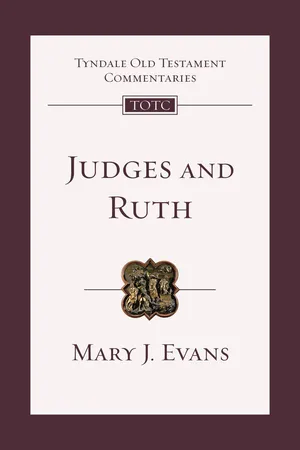
The book of Judges presents Israel's frailty, the nation's need for deliverance, and God's use of flawed leaders to guide his chosen people through a dark period of their history. The book of Ruth tells a smaller story within this narrative, showing God quietly at work in the lives of a few individuals. Mary Evans's commentary places each book in its historical and canonical context, examines key theological themes and addresses issues facing twenty-first-century readers.
Part of the Tyndale Old Testament Commentaries series designed to help the reader of the Bible understand what the text says and what it means.
- English
- ePUB (mobile friendly)
- Available on iOS & Android
eBook - ePub
About this book
Information
Topic
Theology & ReligionSubtopic
Biblical CommentaryCOMMENTARY
1. INTRODUCTION
A. Introductory overview/setting the scene (1:1 – 3:6)
This is the first of the three major sections which form the book of Judges. The central section of the book describes the lives of, and activities related to, specific leaders, and the third section looks at cycles of stories set in motion by ordinary Israelites. This first section provides an introduction to what is to come by painting the big picture. We are given a broad idea of what was going on for the nation as a whole during this period between the death of Joshua and the introduction of the monarchy. In one sense we see a story of failure. It begins by describing the failure of the various armed forces to complete the occupation of the land that Joshua had initiated, and continues by describing the nation’s moral failures. Right from the beginning the writers want us to understand that what they are describing was not how it was supposed to have been. This is not how God intended life in the land to be for his chosen covenant people. However, at the same time we are given room for hope and encouragement. There are individuals who are living in the way that they were meant to, and there are signs that, in spite of their failures, God was still active among them. The writers are more interested in providing an overall impression than in the precise details of chronology, geography or the terminology relating to people groups. Perhaps because of this, some elements, for example the mention of the death of Joshua, are repeated because of their relevance to both parts of this introductory section.
i. Initial military overview (1:1–36)
a. The southern campaign (1:1–21)
Context
The book of Joshua gave details of the first stage of the conquest of the land and the assigning of the various regions to different tribes within Israel. However, it is clear that the land was still populated by earlier inhabitants and that each tribe was responsible for completing the conquest of their own particular areas. The account relating to the southern tribes of Simeon (whose territory was contained within that of Judah), Benjamin and in particular of Judah occupies twenty-one verses and is much more detailed than the rest. This might indicate that the writers came from the south and had access to more detailed documentation relating to, and perhaps more interest in, that area. The reference in verse 1 to Joshua’s death serves two purposes. It asserts that Joshua is not to be held responsible for what is to come and emphasizes that there was now no central government or armed forces leadership. Each tribe had to take responsibility for their own fate. However, as we see on a number of occasions throughout the book, the tribes were sometimes called to assemble together for a variety of purposes, usually military (see the discussion of national identity on pp. 25–28), and it seems that is what happened here. The theme of this introductory chapter has sometimes been seen as Israel’s early battles. However, as Butler (2009: 17) points out, the story of Achsah and the information given in verses 16 and 26 do not fit that theme. On the other hand, they do add to our understanding of the big picture and the impression of interrupted failure that the writers seem to want to leave with us.
Comment
1:1–7. It would have been disadvantageous to all parties if too many campaigns were being undertaken at the same time, so, as their question in verse 1 indicates, they decided to take it in turns. Boling (1975: 53) suggests that they asked the wrong question,1 as they should have recognized that it was God himself who went up first to fight, but God’s response in verse 2 gives no indication that their question was unacceptable. The initial distribution of the land had been determined by lot, ‘as the Lord had commanded through Moses’ (Josh. 14:2; cf. Num. 34:13ff.). It is possible that the same method was used to determine Yahweh’s answer in this instance as well, although the additional information that God has given the land into Judah’s hands may imply that a different method, yielding more information than a simple yes or no, was used. The means of determining God’s response to their request is not specified here.2 Whatever the method, Judah was given the first chance, the assurance of victory not only bolstering their confidence but also providing a reminder that the land had been given by God in the first place and that he was involved in the process.
The Judeans sought the cooperation of the Simeonites to take their combined territories. For the most part, the account of the Judean campaign gives basic details of a number of attacks, with extra information provided in one or two cases. The first attack on Bezek3 was clearly successful. ‘Canaanite’ is a general term including a range of groups, but the reference to Perizzites (v. 4) and later to Jebusites (v. 21) and Amorites (v. 35) helps to create a picture of a land that was occupied by a number of different ethnic groups in a collection of fairly loose alliances. The treatment of Adoni-Bezek (vv. 5–6; his name means ‘the lord of Bezek’) seems strange. To cut off the thumbs and big toes would render the person completely incapable of using weapons or of being involved in any kind of fight or battle, but although this was common in the Ancient Near East generally, there is no mention of this kind of punishment being used elsewhere in Israel. Perhaps the record of Adoni-Bezek’s own reaction is provided in order to explain that this was simply a matter of applying his own system to himself. He sees his defeat as being brought about by God, but whether he means the God of Israel, or a deity of the seventy kings he had disabled, cannot be determined. It is also unclear why he was not actually killed, but maybe a humiliated leader was seen as a more effective way to subdue the rest of his people than a dead leader (cf. the discussion of the Philistines’ treatment of the captured Samson, p. 174). Whether he died from his wounds or at a much later stage is not clarified.
8. The references to Jerusalem create some difficulty. Joshua 15:63 states that the Jebusites could not be dislodged from there, and 1:21 confirms that their expulsion was not achieved at this time either. Jerusalem is in the territory of Benjamin but fairly close to the Judean border. It may be that the name was applied to a wider area than the actual town, and part of this area was taken by the Judeans at this time and used as a base for their wider campaigns. It is also possible that a reference to the Judean headquarters was anachronistically described as Jerusalem by some later editor or copyist. The suggestion that the city was taken and burned by the Judeans, but later reclaimed by the Jebusites, is difficult to reconcile with verse 21, although the lack of chronological clues does make it hard to estimate any potential time gaps.
9–15. These verses are repeated from the account in Joshua 15:13–19. Part of the repetition is word for word, although the Joshua account tells us that it was Caleb himself who took Hebron and defeated Sheshai, Ahiman and Talmai, whereas here, although Caleb’s leadership of the attacking force seems clear, the victory is ascribed to Judah as a whole, rather than personally to Caleb.4 The change of name of Debir illustrates the writers’ interest in such changes (e.g. 1:23; 10:4; 18:12). The point here is perhaps to emphasize the transfer of power within the land: new names indicate new ownership. The account of military campaigns is interrupted by the reference to Caleb’s daughter. It is possible that this reference to Achsah is incidental, included here simply because the writers wanted to incorporate the description of the conquest of the Hebron area, and this story was in the earlier account that they were using. However, given the structure of Judges as a whole, it seems much more likely that this story is deliberately placed here to stand as a contrast to the treatment of Jephthah’s daughter in chapter 11 and in particular to the treatment of women in the final chapter of the book. In chapter 21, after a range of accounts showing just how low Israel had sunk, the climax – the lowest of the lows, as it were – was the appalling mistreatment of daughters from Jabesh Gilead and Shiloh. Judges constantly provides us with an overall picture of complete failure alongside a few highlights, showing by examples that it was possible for people to live in a good way and that there were some who took the opportunity to do just that. Because of Achsah’s story we know from the beginning that in spite of the later horrific examples, some daughters did receive good treatment. Of course, it would be possible to argue that a culture that encourages the giving of daughters as a reward for service is, in itself, somewhat twisted. However, we cannot tell what lies behind this particular instance, nor whether Othniel undertook the task of capturing Kiriath Sepher because a relationship between himself and Achsah was already developing. In either case, although the book shows both awareness and strong criticism of what is presented as mistreatment of daughters, there is no hint that Achsah’s marriage is seen as deserving criticism. The writers here clearly did not share today’s cultural sensitivities, which perhaps makes the critique of the cultural assumptions of their own time even more forceful. The wording of the phrase usually translated as when she got off her donkey is unclear,5 as is the reason for including such specific information. Again this may be simply a repetition from the material used in Joshua 15. However, it is interesting to note that the other reference to a donkey in Judges6 is in 19:28 when one is used to transport the body of the mistreated woman.7 The suggestion that Caleb’s original gift of land to Achsah was ‘inadequate’ and her resulting ‘disappointment’ led to her ‘cunning’ response (Fleishman 2006: 354–373) is clearly negated by Caleb’s swift and apparently affectionate further response. This incidence of Caleb giving land to his daughter (it is possible, of course, that the legal title for the land passed to Othniel, but the text states that it was given to Achsah herself) provides further background to the discussion in Numbers 27 and 36 about the legality of the giving of land to daughters – although, unlike Zelophehad, Caleb’s children were not all girls (1 Chr. 4:15).
There is a textual issue here relating to who initiated the request and why. Some Septuagintal versions have ‘he urged her’ as opposed to the mt’s ‘she urged him’. It does not make a lot of difference to the overall meaning. It seems clear that the one who actually made the request was Achsah. There may be significance in that the original suggestion was to ask for a field, but she eventually asks for springs of water, presumably located within a field. In either event, Achsah emerges as a competent and confident woman, the first of several such depicted within the book of Judges.
16–21. The reference in verse 16 to the Kenites, the family of Moses’ father-in-law, may similarly be included here to provide a context for Jael (see 4:17–22), an example of another competent woman who was married to Heber the Kenite. The area inhabited by the Kenites, in the Negev region near Arad, is in the territory assigned to Simeon, and that leads neatly on to the reference in verse 17 to the taking of the Simeonite town which became known as Hormah. It is being made clear that the Judeans fulfilled their obligations to the Simeonites by continuing to work together in the conquest of their joint territories. As it later becomes apparent that Gaza, Ashkelon and Ekron remained Philistine cities well into the time of David, it seems that the Septuagintal reading of ‘did not take’ is more likely to be accurate than the mt’s ‘took’. However, it is possible that the writers, wanting to emphasize the big picture and to stress the successes of Judah, are at this point conflating time and including territories that were eventually, although not immediately, taken by Judah. There is no doubt that early readers would have been well aware that even for Judah success was neither immediate nor complete, hence perhaps the reference to their failure to take full control of the plains. On one level the book of Judges is constantly wrestling with the paradox of Yahweh’s presence with, and promises to, Israel, standing alongside Israel’s failure in almost every area. Verse 19 sets out that paradox in that we are told in successive sentences that The Lord was with the men of Judah and that they were unable to drive the people from the plains. There may be deliberate irony in the addition of the opinion that it was because the plains people were equipped with the latest weapons that any failure took place. Perhaps that was the excuse the Judeans gave to themselves, and the writers here are encouraging reflection on the issue. Certainly, the book goes on to place the responsibility for their failure squarely on the shoulders of the Israelites themselves, their lack of trust and their evil behaviour (e.g. 2:11–13, 19–21). The repetition of Caleb’s success, providing the extra information (already found in Josh. 15) that the three men named in verse 10 were indeed Anakites, stands alongside the failure of the Benjaminites and reinforces the overall picture of constant failure punctuated by occasional successes.
Meaning
This first section is presented without any editorial comment. It simply describes events without assessing the rights and wrongs of what is happening. However, the initial reference to Joshua indicates that a knowledge of how Israel were expected to proceed is presupposed, and there is a strong implication that they had not lived up to those expectations and that such failure was blameworthy. In other words, there is an implicit assumption that the inability to expel the original inhabitants from the land was at least as much, and probably more, ‘would not’ than ‘could not’.
The rest of the book provides many examples not only of the political and military oppression that came from their fellow residents but also of the spiritual and moral influences that turned Israel away from loyalty to Yahweh and to the covenant that he had made with...
Table of contents
- GENERAL PREFACE
- AUTHOR’S PREFACE
- CHIEF ABBREVIATIONS
- SELECT BIBLIOGRAPHIES
- INTRODUCTION
- ANALYSIS
- 1. INTRODUCTION
- 2. THE JUDGES (3:7 – 16:31)
- 3. STORIES OF INDIVIDUALS: EXEMPLIFYING THE TIMES (17:1 – 21:25)
- INTRODUCTION
- ANALYSIS
- NOTES
Trusted by 375,005 students
Access to over 1.5 million titles for a fair monthly price.
Study more efficiently using our study tools.
Frequently asked questions
Yes, you can cancel anytime from the Subscription tab in your account settings on the Perlego website. Your subscription will stay active until the end of your current billing period. Learn how to cancel your subscription
No, books cannot be downloaded as external files, such as PDFs, for use outside of Perlego. However, you can download books within the Perlego app for offline reading on mobile or tablet. Learn how to download books offline
Perlego offers two plans: Essential and Complete
- Essential is ideal for learners and professionals who enjoy exploring a wide range of subjects. Access the Essential Library with 800,000+ trusted titles and best-sellers across business, personal growth, and the humanities. Includes unlimited reading time and Standard Read Aloud voice.
- Complete: Perfect for advanced learners and researchers needing full, unrestricted access. Unlock 1.5M+ books across hundreds of subjects, including academic and specialized titles. The Complete Plan also includes advanced features like Premium Read Aloud and Research Assistant.
We are an online textbook subscription service, where you can get access to an entire online library for less than the price of a single book per month. With over 1.5 million books across 990+ topics, we’ve got you covered! Learn about our mission
Look out for the read-aloud symbol on your next book to see if you can listen to it. The read-aloud tool reads text aloud for you, highlighting the text as it is being read. You can pause it, speed it up and slow it down. Learn more about Read Aloud
Yes! You can use the Perlego app on both iOS and Android devices to read anytime, anywhere — even offline. Perfect for commutes or when you’re on the go.
Please note we cannot support devices running on iOS 13 and Android 7 or earlier. Learn more about using the app
Please note we cannot support devices running on iOS 13 and Android 7 or earlier. Learn more about using the app
Yes, you can access Judges and Ruth by Mary Evans in PDF and/or ePUB format, as well as other popular books in Theology & Religion & Biblical Commentary. We have over 1.5 million books available in our catalogue for you to explore.