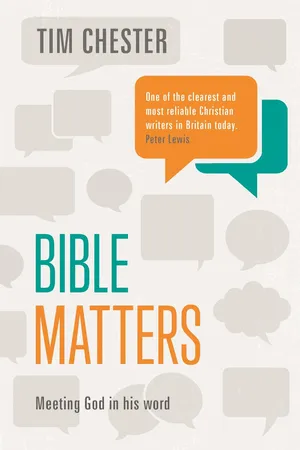
Of course the Bible matters. It is God's word to us. But how do we engage with its message?Tim Chester creates a sense of expectation, causing our reading of the Bible to become a living experience in which we encounter God. Amazingly, this God of the universe speaks to us each day!Here is a personal, clear, intentional and sufficient message for our lives. The Bible is truly unique; it speaks into a myriad of situations and brings us back to the deep joy of the gospel.'Will enrich your encounter with God as you engage with his word.' Elaine Duncan'This is more than useful; it's inspiring.' Julian Hardyman'Tim Chester is one of the clearest, most useful and reliable Christian writers in the UK today... He comes alongside the reader to instruct and to apply his teaching to life in the modern world.' Peter Lewis'Inspirational, profound, realistic... If you can buy only one book on the Bible, buy this one.' Tricia Marnham'Buy, read, recommend, lend, give away!' James Robson
- English
- ePUB (mobile friendly)
- Available on iOS & Android
eBook - ePub
About this book
Information
Topic
Theology & ReligionSubtopic
Religion1
The God who speaks
Tell me about the book you’re reading.
You’re only a few words in, but you already know a fair bit about it. You know it’s about the Bible – the title is a bit of a giveaway. You might remember the author and publisher. You probably read the blurb on the back cover. Maybe you ran your eyes over the contents page. At some point you examined it – perhaps in the shop when you bought it or when someone gave it to you. If you ordered it online, then maybe you read some customer reviews. You can see it and feel it. Some people like the smell of new books, so you may even have sniffed it . . . now most of you have. After you’ve read a couple of chapters you’ll have an idea whether you like it or not. And if you make it to the end, you’ll be able to tell other people about it in an informed way.
It’s easy to examine a book and find out about it. You can investigate it and interrogate it.
Now, I don’t want to alarm you, but there are almost certainly some bacteria on your book. If it’s any comfort, they were probably transferred on to the book (or e-reader) from your hands. Can you tell me about the bacteria on your book? That’s not so straightforward. You can’t see, hear or feel them. Hopefully you can’t smell them either, and I don’t recommend trying to taste them. Nevertheless, with a powerful microscope or some chemical tests, you could find out something about them. Like a book, they’re susceptible to scrutiny.
What about God? Tell me about God.
You might have all sorts of ideas about God. But upon what are they based? You can’t see God through a telescope or under a microscope. You can’t go and knock on his door to ask him some questions. You can’t discover him in the jungle or on the ocean floor. He’s not like other subjects of study. He’s not susceptible to scrutiny.
For one thing, he’s a spirit. He has no body and therefore no physical presence. Even more significantly, he’s outside our universe. The Large Hadron Collider in Switzerland is the world’s largest machine and largest experiment feeding results into the largest network of computers. The irony of all these superlatives is that it’s designed to detect the smallest things we know about – subatomic particles. It’s detecting the after-effects of particle collisions. But no apparatus could be constructed to ‘find’ God, because God doesn’t exist within our material world. What would our experiment look for? In 2012 the Hadron Collider found evidence for the Higgs boson, a particle which had previously only been postulated. It was nicknamed ‘the God particle’. But it wasn’t a ‘piece’ of God or evidence of his existence.
God is beyond our comprehension and outside our field of study. We might postulate his existence as the most likely explanation of effects we can see – things like the complexity of creation or answers to prayer. But we could never prove our hypothesis. We can’t stick God under a microscope or in a test tube.
So left to ourselves, we would remain totally in the dark when it comes to God. We have no way of bridging the gap between us and God.
So my request that you tell me about God should be an impossible task. The only way we can ever know anything about him is if he communicates to us. God himself must bridge the gap. We can’t study him. But maybe he can talk to us.
And God is not silent.
Knowing God is not completely without parallel in our world. Suppose I said, ‘Tell me about yourself.’ Here’s a subject you do know something about. In fact, arguably you’re better informed on this topic than anyone else. The more you tell me about yourself, the more I’ll know about you.
But wait a moment. Do you really want to spill the beans to me? After all, we’ve only just met. It’s up to you what you tell me. How much I discover about your dreams, hopes, ideas, beliefs, desires and plans all depends on how much you tell me. I can’t control what information comes my way. Only torturers can force information from people, and even then the reliability of that information is doubtful. In this sense the speaker is sovereign when we communicate.
It’s the same with God. We can know about him because he speaks to us. But God remains in control of the process. We talk about ‘grasping’ an idea. But we don’t ‘grasp’ God – not even when he reveals himself.
How does God talk to us?
1. God talks to us in creation
We can’t see God. But we can see what he’s done. We can see the impact he’s made. And we don’t have to look very far. Everything that exists points to God. Psalm 19 begins:
The heavens declare the glory of God;
the skies proclaim the work of his hands.
Day after day they pour forth speech;
night after night they reveal knowledge.
They have no speech, they use no words;
no sound is heard from them.
Yet their voice goes out into all the earth,
their words to the ends of the world.
(Psalm 19:1–4)
The skies pour forth speech. They’re like an excited friend whom you can’t shut up. From subatomic particles to vast galaxies, from intricate petals to stunning landscapes, the world is constantly declaring God’s glory.
Creation doesn’t tell us all we need to know about God. But it tells us some important things. Romans 1:20 says, ‘For since the creation of the world God’s invisible qualities – his eternal power and divine nature – have been clearly seen, being understood from what has been made, so that people are without excuse.’ God speaks through creation of his ‘eternal power and divine nature’.
It doesn’t add up to a QED moment for sceptics. Atheists and agnostics have seen a sunset and still they doubt God’s existence.
Maybe you’ve looked out at a beautiful scene or watched some astonishing nature footage on the television and said something like, ‘How can people not believe in God when they see this?’ But sceptics are not blind or stupid. The problem is not that they’re looking in the other direction. They’re not standing at a viewpoint focused on overflowing rubbish bins while you look at the beautiful scenery. It’s not that they think flowers and sunsets and birdsong are ugly. The problem is a moral one. People ‘suppress the truth by their wickedness’ (Romans 1:18). We’ll meet this theme a number of times in our exploration of the Bible and come back to it in the final chapter. We find reasons for discounting the evidence before our eyes because we don’t want to live with the implications of being accountable to God or dependent on him.
But just because we’re not listening doesn’t mean God’s not talking.
The psalmist says,
Day after day they pour forth speech;
night after night they reveal knowledge.
(Psalm 19:2)
All the time, day and night, everywhere we go, the world speaks of God’s power and goodness.
Sometimes small children cover their eyes to ‘make it go away’. It’s as if what they can’t see can’t be seen. Humanity is like this. We cover our ears to God’s voice in creation as if what we can’t hear can’t be there:
Yet their voice goes out into all the earth,
their words to the ends of the world.
(Psalm 19:4)
When we become a Christian, God removes our hands from our ears. Suddenly everything speaks of God. Now we’re able to see his glory in the world. We hear God speaking through creation loud and clear. And what we see and hear is marvellous. The hymnwriter George Robinson put it like this:
Heav’n above is softer blue,
Earth around is sweeter green!
Something lives in every hue
Christless eyes have never seen;
Birds with gladder songs o’erflow,
Flowers with deeper beauties shine,
Since I know, as now I know,
I am his, and he is mine.1
The world comes alive to us in this way because now we see it as a gift from the Creator. We hear his voice speaking of his glory.
2. God talks to us in history
If you’d asked an ancient Israelite to tell you about God, they would have told you a story – the story of the exodus.
At the beginning of the exodus story, Moses encounters God in the burning bush at Mount Horeb. There God reveals his name to Moses: ‘I am who I am’. But it’s the rest of the story that gives this declaration content. Moses imagines the Israelites asking him who it is who has sent him to liberate them. ‘What is his name?’ they will ask. Who is this God who claims to be our God? In response, God not only declares I am who I am; he also promises to perform wonders among the Egyptians (Exodus 3:13–22). In other words, the ultimate answer to the question of God’s identity is the exodus itself. God speaks through the exodus:
To his people: ‘I will take you as my own people, and I will be your God. Then you will know that I am the Lord your God, who brought you out from under the yoke of the Egyptians’ (Exodus 6:7).
To the Egyptians: ‘Then I will lay my hand on Egypt and with mighty acts of judgment I will bring out my divisions, my people the Israelites. And the Egyptians will know that I am the Lord when I stretch out my hand against Egypt and bring the Israelites out of it’ (Exodus 7:4–5).
To all nations: ‘For by now I could have stretched out my hand and struck you and your people with a plague that would have wiped you off the earth. But I have raised you up for this very purpose, that I might show you my power and that my name might be proclaimed in all the earth’ (Exodus 9:15–16).
Through the exodus God spoke to all people of his grace, power and judgment. Again and again in the Bible, God speaks through the way he intervenes in history.
But it’s not just events recorded in the Bible through which God speaks. The events of all human history reveal God. The events of your life reveal God. If you’re a child of God, they’re ...
Table of contents
- Keswick Foundations: Series preface
- Introduction
- 1
- 2
- 3
- 4
- 5
- 6
- 7
- 8
- 9
- 10
- Conclusion
- O Lord our Rock
- Further reading
- KESWICK MINISTRIES
- Notes
Trusted by 375,005 students
Access to over 1.5 million titles for a fair monthly price.
Study more efficiently using our study tools.
Frequently asked questions
Yes, you can cancel anytime from the Subscription tab in your account settings on the Perlego website. Your subscription will stay active until the end of your current billing period. Learn how to cancel your subscription
No, books cannot be downloaded as external files, such as PDFs, for use outside of Perlego. However, you can download books within the Perlego app for offline reading on mobile or tablet. Learn how to download books offline
Perlego offers two plans: Essential and Complete
- Essential is ideal for learners and professionals who enjoy exploring a wide range of subjects. Access the Essential Library with 800,000+ trusted titles and best-sellers across business, personal growth, and the humanities. Includes unlimited reading time and Standard Read Aloud voice.
- Complete: Perfect for advanced learners and researchers needing full, unrestricted access. Unlock 1.5M+ books across hundreds of subjects, including academic and specialized titles. The Complete Plan also includes advanced features like Premium Read Aloud and Research Assistant.
We are an online textbook subscription service, where you can get access to an entire online library for less than the price of a single book per month. With over 1.5 million books across 990+ topics, we’ve got you covered! Learn about our mission
Look out for the read-aloud symbol on your next book to see if you can listen to it. The read-aloud tool reads text aloud for you, highlighting the text as it is being read. You can pause it, speed it up and slow it down. Learn more about Read Aloud
Yes! You can use the Perlego app on both iOS and Android devices to read anytime, anywhere — even offline. Perfect for commutes or when you’re on the go.
Please note we cannot support devices running on iOS 13 and Android 7 or earlier. Learn more about using the app
Please note we cannot support devices running on iOS 13 and Android 7 or earlier. Learn more about using the app
Yes, you can access Bible Matters by Tim Chester in PDF and/or ePUB format, as well as other popular books in Theology & Religion & Religion. We have over 1.5 million books available in our catalogue for you to explore.