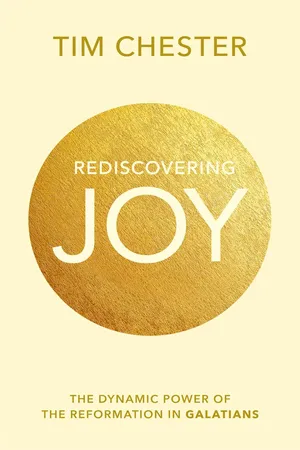
The title, Rediscovering Joy, derives from Galatians 4: 15 (NLT). The Galatians had lost the joy of God's blessing because they had departed from the truths of the gospel. The Reformation - and the book - is an invitation to rediscover the joy of the gospel. Despite the common claim that the Reformation is either out-dated or divisive, its rediscovery of the apostolic message was a rediscovery of joy - a message that is as relevant today as it was 500 years ago and 2, 000 years ago.The book has a strong focus on biblical exposition and pastoral application.
- English
- ePUB (mobile friendly)
- Available on iOS & Android
eBook - ePub
About this book
Information
Topic
Personal DevelopmentSubtopic
Religion1. HOW TO HEAR GOD’S VOICE
(Galatians 1)
Rediscovering the joy of Scripture alone
No movement begins with a single moment. But 31 October 1517 has justifiably come to symbolize the start of the Reformation. This was the date on which Martin Luther nailed his Ninety-five Theses to the door of the Castle Church in Wittenberg. They would have competed with other pieces of paper, for the door served as a kind of public forum – like a modern urban wall covered in posters or a noticeboard on the village green. Luther was trying to instigate a public debate.
The Ninety-five Theses were primarily a complaint about the abuse of indulgences. The medieval Church taught that when most people died, they went to a temporary place of torment called ‘purgatory’, which ‘purged’ you of sin before you graduated to heaven. Indulgences promised to reduce the time you or a loved one spent in purgatory. And the Church sold them for cash. The local archbishop complained about Luther to the Pope, and the Pope threatened to excommunicate Luther. But this opposition simply made Luther more radical. He began to attack the authority of the Pope. So in 1521 Emperor Charles V summoned Luther to defend himself with the promise of safe conduct.
At this time there were no denominations. In Western Europe there was just the one Church of Rome. So on one side of the debate was this Church with all its infrastructure, personnel, wealth, history, power and tradition. It represented every parish church in Europe. On the other side was one man, Martin Luther – one man and his Bible. Luther told the meeting that if anyone could refute his errors from the Scriptures, then he would be the first to throw his writings into the fire. The Imperial Advocate pushed him for an answer: would he recant or not? Luther replied, ‘Unless I am convicted of error by the Scriptures . . . and my conscience is taken captive by God’s word, I cannot and will not recant anything, for to act against our conscience is neither safe for us or open to us. On this I take my stand. I can do no other. God help me. Amen.’1
The most wanted man in Europe
Ten years later a messenger visited the house of Stephen Vaughan, the agent of King Henry VIII in Antwerp. The messenger offered to lead Vaughan to a ‘friend’ who wanted to talk with him. Vaughan pressed him for a name, but without success. Nevertheless, Vaughan followed him through the streets and out beyond the city walls. There in a field was the mysterious stranger. ‘Do you not know me?’ he asked. ‘My name is Tyndale.’
William Tyndale was the most wanted man in Europe. Back in London his translation of the New Testament was being publicly burnt. People found with a copy were being tortured. But Tyndale had heard that the King was interested in negotiating a deal. At a second meeting Tyndale promised that, if the King would allow an English Bible, any English Bible – it didn’t have to be Tyndale’s translation – then he would stop writing and return to England. There the King could do with him as he liked. Tyndale was willing to trade torture and death for the publication of an English Bible. No such undertaking came, and Tyndale never returned home. Four years later he was betrayed by a spy and executed by the emperor.
At stake for both Luther and Tyndale was joy. When Tyndale first published an English New Testament in 1526, he included a reading guide. The New Testament, he said, is the gospel, and the gospel ‘signifies good, merry, glad and joyful tidings, that make a man’s heart glad, and make him sing, dance, and leap for joy’. He added,
Now can the wretched man (that is wrapped in sin, and is in danger to death and hell) hear no more joyous a thing, than such glad and comfortable tidings of Christ. So he cannot but be glad and laugh from the low bottom of his heart, if he believe that the tidings are true.2
There is nothing ‘more joyous’ than the ‘joyous tidings’ in the Bible that make us ‘leap for joy’. You get the picture: the Bible matters because it leads to joy. You might even laugh from ‘the low bottom of your heart’.
The Reformation was the rediscovery of justification by faith alone in the work of Christ. But the foundation of the Reformation was the ultimate authority of Scripture alone. The majority of people, including the most powerful and most educated, said one thing. Scripture taught another. And the Reformers chose Scripture.
Tyndale wrote, ‘The scripture is the touchstone that trieth all doctrines, and by [which] we know the false from the true . . . The scripture is a light, and sheweth us the true way, both what to do and what to hope for; and a defence from all error, and a comfort in adversity.’3 It is God’s word, which ‘is the chiefest of the apostles, and pope, and Christ’s vicar, and head of the Church, and head of the general council’.4 In other words, the authority of the Bible is greater than any human institution or individual.
If we reset the dial of our time machine to first-century Galatia, we’ll discover that it wasn’t a new struggle. Indeed, Paul’s letter to the Galatians was one of the key texts that shaped the Reformation. Galatians 1:6–7 says, ‘I am astonished that you are so quickly deserting the one who called you to live in the grace of Christ and are turning to a different gospel – which is really no gospel at all.’
What was at stake in Galatia and the Reformation was the gospel. The word ‘gospel’ means ‘good news’. The gospel is the good news that our sins are forgiven and we’ve been rescued (1:4). It answers the question: ‘How can we be right with God and escape his judgment?’
But what happens when you have competing answers to that question – as was the case in Galatia, in the Reformation and today? How do we know which is the true gospel? Where’s the true source of joy?
We’ll address this issue by asking a series of connected questions.
1. How do we know what’s true?
In Galatia one answer was: ‘You should submit to the founding church in Jerusalem.’ People had come from Jerusalem telling the Gentiles (the non-Jews) that they needed to be circumcised. How do you know the true gospel? The Jerusalem church will tell you.
Jump in our time machine, head to the sixteenth century and we find the Catholic Church effectively giving the same answer. The only difference is that, because the apostle Peter moved to Rome, it’s now the successor of Peter in Rome, the Pope, who tells us what God wants.
Fast forward to the twenty-first century and we find a new variation on the answer. Today many people say, ‘I’ll follow the one I like best.’ They say things like, ‘I’m not a Christian because I don’t like the idea of a god who sends people to hell.’ That’s about as logical as saying, ‘I don’t believe in wearing a lifejacket because I don’t like the idea of drowning.’ Nevertheless, people think they can determine what’s true on the basis of their preference, as if they construct reality through their decisions.
It’s time to let the engine of the time machine cool down, but not before we make the journey back to find Paul. He answers the question of how we can know what’s true in verses 11–12: ‘I want you to know, brothers and sisters, that the gospel I preached is not of human origin. I did not receive it from any man, nor was I taught it; rather, I received it by revelation from Jesus Christ.’
Paul is contrasting human origins and divine revelation. On the one hand, we have knowledge based on human reason, human tradition or human experience. All of these things lead to some measure of truth. Just think what human beings have discovered, invented and created. But all these sources of knowledge have a limitation, and there’s a clue in that word ‘human’. The problem is not reason, tradition or experience. The problem is human reason, human tradition and human experience. Human beings are made in the image of God, which means we’re capable of amazing feats of discovery. But we’re also fallen sinners, warped by our selfishness, determined not to obey God. And so our knowledge is always flawed. Our understanding is biased against God.
As a result, we need divine revelation. And we need it not just as a top-up to our knowledge, but to realign our knowledge towards God. That’s why Proverbs 1:7 says, ‘The fear of the Lord is the beginning of knowledge.’
Here’s the fundamental issue: when you have to choose, are you going to trust the creature or the Creator, the finite or the infinite, the law-breaker or the Law-Maker, the selfish offspring or the loving Father?
2. Where do we find divine revelation?
How do we know what’s true? God has told us. But of course, that answer leads to another question: where do we find this divine revelation?
The answer is in the testimony or preaching of the first apostles. Verses 7–8 say, ‘Evidently some people are throwing you into confusion and are trying to pervert the gospel of Christ. But even if we or an angel from heaven should preach a gospel other than the one we preached to you, let them be under God’s curse!’ And in case you missed the point, Paul says it a second time in verse 9: ‘As we have already said, so now I say again: if anybody is preaching to you a gospel other than what you accepted, let them be under God’s curse!’
The true gospel is ‘the one we preached’. The ‘we’ here is ‘we apostles’ – the people who had met the risen Christ and been appointed to testify about him. They could personally testify to what they had heard, seen and touched (1 John 1:1–3). In Galatians 1:1, Paul introduces himself by saying, ‘Paul, an apostle – sent not from men nor by man, but by Jesus Christ and God the Father, who raised him from the dead.’ It’s important that Paul’s readers (and that includes us) realize that Paul is God’s messenger conveying God’s message. His gospel is not something he or anyone else made up, but a ‘revelation from Jesus Christ’ (1:12).
We have this apostolic preaching or testimony in the New Testament. We can hold in our hands – amazingly – a message from God. God revealed himself in his Son, Jesus. That revelation in Jesus was promised through the Old Testament prophets and recorded by the New Testament apostles (2 Peter 1:16–21). The Holy Spirit ensured that their testimony is accurate and true (John 14:26; 16:13). So the whole Bible is a message from God. It’s where we hear God’s voice.
So Paul says – and feel the strength – ‘even if we or an angel from heaven should preach a gospel other than the one we preached to you, let them be under God’s curse!’ (1:8, italics mine). Even apostles can’t trump the apostolic preaching. The apostolic testimony is not the apostles’ personal opinion. It’s the Spirit-inspired record of God’s revelation in C...
Table of contents
- INTRODUCTION
- 1. HOW TO HEAR GOD’S VOICE(Galatians 1)
- 2. HOW TO KNOW GOD’S APPROVAL(Galatians 2)
- 3.HOW TO RECOGNIZE GOD’S PEOPLE(Galatians 3 – 4)
- 4. HOW TO ENJOY GOD’S LOVE(Galatians 4)
- 5. HOW TO DO GOD’S WILL(Galatians 5 – 6)
- NOTES
Trusted by 375,005 students
Access to over 1.5 million titles for a fair monthly price.
Study more efficiently using our study tools.
Frequently asked questions
Yes, you can cancel anytime from the Subscription tab in your account settings on the Perlego website. Your subscription will stay active until the end of your current billing period. Learn how to cancel your subscription
No, books cannot be downloaded as external files, such as PDFs, for use outside of Perlego. However, you can download books within the Perlego app for offline reading on mobile or tablet. Learn how to download books offline
Perlego offers two plans: Essential and Complete
- Essential is ideal for learners and professionals who enjoy exploring a wide range of subjects. Access the Essential Library with 800,000+ trusted titles and best-sellers across business, personal growth, and the humanities. Includes unlimited reading time and Standard Read Aloud voice.
- Complete: Perfect for advanced learners and researchers needing full, unrestricted access. Unlock 1.5M+ books across hundreds of subjects, including academic and specialized titles. The Complete Plan also includes advanced features like Premium Read Aloud and Research Assistant.
We are an online textbook subscription service, where you can get access to an entire online library for less than the price of a single book per month. With over 1.5 million books across 990+ topics, we’ve got you covered! Learn about our mission
Look out for the read-aloud symbol on your next book to see if you can listen to it. The read-aloud tool reads text aloud for you, highlighting the text as it is being read. You can pause it, speed it up and slow it down. Learn more about Read Aloud
Yes! You can use the Perlego app on both iOS and Android devices to read anytime, anywhere — even offline. Perfect for commutes or when you’re on the go.
Please note we cannot support devices running on iOS 13 and Android 7 or earlier. Learn more about using the app
Please note we cannot support devices running on iOS 13 and Android 7 or earlier. Learn more about using the app
Yes, you can access Rediscovering Joy by Tim Chester in PDF and/or ePUB format, as well as other popular books in Personal Development & Religion. We have over 1.5 million books available in our catalogue for you to explore.