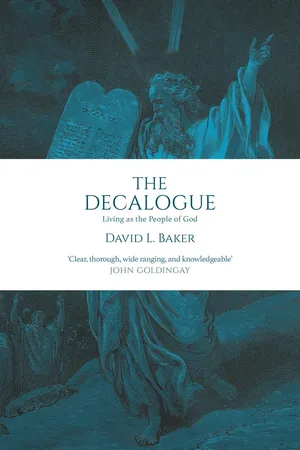
David L. Baker offers a rare and valuable study of the Decalogue, or Ten Commandments, within their biblical and ancient Near Eastern setting. In addition to an informative discussion of introductory and background issues, he gives each commandment focussed attention, offering commentary as well as consideration of its meaning for today.What is the Decalogue? (Shape, form, origin, purpose)
Loving God (1 - 5: loving God, worship, reverence, rest, family)
Loving neighbour (6 - 10: life, marriage, property, truth, coveting)
The Decalogue Today
Bibliography
- English
- ePUB (mobile friendly)
- Available on iOS & Android
eBook - ePub
About this book
Information
Topic
Theology & ReligionSubtopic
Biblical Studies1 FIRST OF ALL
In the first commandment God introduces himself and establishes his identity as the one God who makes all other “gods” pale in significance. He tells us who he is and how important it is to recognize him. All the other commandments follow on from this first core statement. This clear stance on the unity of God is quite distinct compared with Israel’s neighbors.
ONE GOD
Ancient Near East. Ancient Near Eastern societies were almost all polytheistic. In such societies, people believed in many gods—male and female, old and young, powerful and relatively weak. Generally they were thought to be just and wise, though they were also fallible and sometimes incompetent. Their activities were similar to those of human beings: eating and drinking, work and rest, sex and war. Polytheism was inherently tolerant, since each god was believed to have their own role, and people often worshiped several gods. Fourteenth-century Egypt during the reign of Akhenaten was a rare exception, when worship of the sun god Re or Aten was promoted to the exclusion of all others.1
It is commonly stated that Israel’s monotheism was a revolutionary breakthrough, the culmination of intellectual and religious development over many centuries.2 According to von Rad (1957: 208), the insistence on the worship of one God to the exclusion of all others is “unique in the history of religion.” However, there may be vestiges of a much more ancient monotheism, for, according to their myths, most ancient Near Eastern gods were born or created, and their origins can be traced back to one primordial deity.3
While there are few parallels to the Israelite belief in one God, the demand for exclusive loyalty in the first commandment may be compared with ancient Near Eastern treaties where the suzerain who initiates a treaty demands fidelity from his vassal to the exclusion of all others. This demand is often given a historical basis with reference to the suzerain’s benevolence toward his vassal—for example, in Hittite treaties with Amorite kingdoms.4
There are also ancient Near Eastern parallels to the self-presentation formula with which the first commandment begins. For example, several Sumerian and Babylonian law collections begin or end with words like this:
I am Hammurabi, the shepherd, selected by the god Enlil, he who heaps high abundance and plenty, who perfects every possible thing for the city Nippur . . .5
Many West Semitic royal inscriptions have comparable introductions—for example, the well-known Moabite Stone reads,
I am Mesha, the son of Kemosh[-yatti], the king of Moab, the Dibonite . . .6
In each case the formula serves to introduce the author and assert his authority to make the law or decree in question. Comparable formulae are used to introduce gods in oracles addressed to Esarhaddon, the seventh-century king of Assyria:
I am the great divine lady, I am the goddess Ishtar of Arbela, who will destroy your enemies from before your feet.7
First commandment. In a similar way, the Decalogue begins with a self-presentation formula, which introduces the God who speaks these ten “words” to the people of Israel at Mount Sinai:
2I am the Lord your God,8 who brought you out from the land of Egypt, where you were slaves.9 3You shall not have other gods10 besides me.11 (Exodus 20:2–3/Deuteronomy 5:6–7)
The first sentence is considered a prologue in some traditions, while the second sentence forms the first commandment. Others regard the first sentence as the first commandment and the second sentence as part of the second commandment. Still others take the two sentences together as the first commandment, and that seems to me most satisfactory. The first sentence provides the context and motivation for the actual commandment in the second sentence.
First, God introduces himself by name (Ex 20:2a; Deut 5:6a), as on previous occasions when he reveals himself to Moses in the Sinai desert (Ex 3:13–15) and in Egypt (Ex 6:2–8). Where God’s name occurs in the Old Testament, most Christian and Jewish translations replace it with “the Lord,” using small capitals to distinguish it from other uses of the word “Lord.”12 I follow this convention here. This practice dates at least as far back as the Septuagint, where the Hebrew name is translated into Greek as “Lord” (kyrios). The New Testament follows the precedent of the Septuagint in using the title “Lord” instead of the divine name. Since there is no need to distinguish this from the actual name, which never appears, it is printed without small capitals in English Bibles (e.g., Mt 1:20, 22; 3:3; 4:7, 10; Jn 12:13; Rom 10:13; Heb 8:8–9; 1 Pet 3:12).
In Hebrew Bibles, God’s name is written with four consonants (Yhwh), usually supplemented with the vowels of the word “Lord” (adonay) to indicate how it is intended to be read. The name Jehovah is common in older English literature and is still perpetuated by the Jehovah’s Witnesses today. However, this name is a misunderstanding, originating with Christian students of Hebrew in the Middle Ages who tried to pronounce the Hebrew form as it stands (YaHoWaH), not realizing it was intended to be pronounced adonay. The Koren Bible prints the divine name without vowels to eliminate the possibility of mispronunciation in this way. As a result, the original pronunciation of the four-letter Name (Tetragrammaton) has been forgotten, though it is conjectured that it was “Yahweh.”
God’s name (“the Lord”) is supplemented by a statement of who he is: “your God.” The original Hebrew uses the second-person singular, addressing each person individually as well as the people as a whole. This holy God is not remote in heaven, inaccessible to human beings; he makes himself known to Israel as “your God.” In this way he not only tells them who he is but who they are. They are the people of God! This is consistent with the classic formulation of the covenant relationship in one of the earlier revelations of God’s name in Exodus: “I will take you as my own people, and I will be your God” (Ex 6:7).
Next, God reminds the people he is their liberator, the one “who brought you out” (Ex 20:2b; Deut 5:6b). On both previous occasions God reveals his name to Moses and tells him about the plan to liberate his people from slavery in Egypt and take them to the Promised Land (Ex 3:7–12, 16–22; 6:5–6, 8). That liberation is now past history rather than future hope and becomes the basis for a new stage in the relationship between God and his people. Later on, the prophet Hosea recalls the historical link between God’s revelation of his name and liberation of his people, alluding to the first commandment:
I am the Lord your God
from the land of Egypt;
you know no God but me,
and besides me there is no saviour. (Hos 13:4 RSV; cf. Hos 12:9)
The first two lines are identical to the first part of the first commandment (except for the omission of “who brought you out”), as can be seen in the literal translation of the RSV. The following lines allude to the second part of the commandment. Several other texts paraphrase the first commandment in a similar way, in every case linking it with the exodus from Egypt (e.g., Deut 6:12–15; 13:4–5; Judg 6:8–10; 2 Kings 17:35–39; Ps 81:9–10). Incidentally, these paraphrases strengthen the view taken here that both the self-presentation of the God of the exodus and the prohibition of other gods are part of the first commandment.
Finally, after this historical and theological introduction, the commandment itself is simple and uncompromising: “You shall not have other gods besides me” (Ex 20:3; Deut 5:7 DLB). The phrase translated “besides me” has been much discussed. Weinfeld (1991: 276–77) considers six possible meanings, concluding that “in my presence” is the most accurate. Miller (2009: 19–20) lists four meanings, arguing that all are present in the command: “before me,” “beside me,” “besides me,” and “over against me.” In my view, there are two main points. Understood literally, the phrase means that images of other gods are not to be placed in the temple or anywhere else God is present (“before me,” “in my presence,” “beside me”). However, it is surely not limited to the prohibition of pagan images, which are in any case ruled out by the second commandment. More broadly, it means that the people of Israel are not to worship any other god in addition to—or instead of—the Lord (“besides me,” “except me,” “to rival me”). In practice it seems the problem was not so much turning to other gods instead of the Lord (apostasy) as it was worshiping other gods in addition to the Lord (i.e., syncretism; e.g., 1 Kings 11:4–6; 2 Kings 17:33; Jer 7:9–10; Zeph 1:4–6).
Is this monotheism? In the Old Testament world of competing gods and goddesses, it was crucial to determine one’s loyalties. The issue is not framed theoretically in the first commandment. It is not primarily a question about the existence of God: Is the Lord one god among many, or the greatest of all gods, or the only God there is? Rather, it is very practical, calling Israel to decide who they will worship as God (cf. Ex 15:11; 34:14). Their ancestors had been polytheistic (Josh 24:2; cf. Gen 35:2), and the historical and prophetic books repeatedly mention Israelites worshiping other gods. Such worship is consistently condemned by the biblical writers as a turning away from the worship of the one God that was practiced by Abraham and taught by Moses.
The first commandment presupposes polytheism and in that context requires Israel to reject all other gods and worship only One. This is not really a stat...
Table of contents
- PREFACE
- ABBREVIATIONS
- WHAT IS THE DECALOGUE?
- SHAPE
- FORM
- ORIGIN
- PURPOSE
- LOVING GOD
- 1 FIRST OF ALL
- 2 WORSHIP
- 3 REVERENCE
- 4 REST
- 5 FAMILY
- LOVING NEIGHBOR
- 6 LIFE
- 7 MARRIAGE
- 8 PROPERTY
- 9 TRUTH
- 10 LAST BUT NOT LEAST
- THE DECALOGUE TODAY
- LIVING AS THE PEOPLE OF GOD
- BIBLIOGRAPHY
- SEARCH NAMES FOR AUTHORS
- SEARCH ITEMS FOR SUBJECTS
- SEARCH ITEMS FOR SCRIPTURE REFERENCES
- NOTES
Trusted by 375,005 students
Access to over 1.5 million titles for a fair monthly price.
Study more efficiently using our study tools.
Frequently asked questions
Yes, you can cancel anytime from the Subscription tab in your account settings on the Perlego website. Your subscription will stay active until the end of your current billing period. Learn how to cancel your subscription
No, books cannot be downloaded as external files, such as PDFs, for use outside of Perlego. However, you can download books within the Perlego app for offline reading on mobile or tablet. Learn how to download books offline
Perlego offers two plans: Essential and Complete
- Essential is ideal for learners and professionals who enjoy exploring a wide range of subjects. Access the Essential Library with 800,000+ trusted titles and best-sellers across business, personal growth, and the humanities. Includes unlimited reading time and Standard Read Aloud voice.
- Complete: Perfect for advanced learners and researchers needing full, unrestricted access. Unlock 1.5M+ books across hundreds of subjects, including academic and specialized titles. The Complete Plan also includes advanced features like Premium Read Aloud and Research Assistant.
We are an online textbook subscription service, where you can get access to an entire online library for less than the price of a single book per month. With over 1.5 million books across 990+ topics, we’ve got you covered! Learn about our mission
Look out for the read-aloud symbol on your next book to see if you can listen to it. The read-aloud tool reads text aloud for you, highlighting the text as it is being read. You can pause it, speed it up and slow it down. Learn more about Read Aloud
Yes! You can use the Perlego app on both iOS and Android devices to read anytime, anywhere — even offline. Perfect for commutes or when you’re on the go.
Please note we cannot support devices running on iOS 13 and Android 7 or earlier. Learn more about using the app
Please note we cannot support devices running on iOS 13 and Android 7 or earlier. Learn more about using the app
Yes, you can access The Decalogue by David L Baker in PDF and/or ePUB format, as well as other popular books in Theology & Religion & Biblical Studies. We have over 1.5 million books available in our catalogue for you to explore.