- English
- ePUB (mobile friendly)
- Available on iOS & Android
eBook - ePub
Information
Topic
Theology & ReligionSubtopic
Christian Ministry1. PREACHING THAT CHANGES THE CHURCH
David Jackman
There has been no shortage of men, ideas or movements over the past fifty years, whose common desire and motivation has been to change the church. Fashions come and go; experiments flourish and fade; yet any detached observer would surely be justified in concluding that the church, at least in the West, is still in a precarious state: often confused and distracted, seemingly lacking power, marginalized and ignored. It would be a bold (or perhaps naive) voice that claimed the church does not need to change.
Defining the Church
But what do we mean by ‘the church’? Nearly fifty years ago, Martyn Lloyd-Jones was writing, ‘Often one really has to ask about certain gatherings and communities of people whether they are entitled to the name church at all. The church so easily can degenerate into an organisation, or even, perhaps, into a social club or something of that kind.’1 That has clearly not changed, even if those expressions of ‘the church’ have drastically diminished in size. But the aim of this chapter is not to discuss the doctrine of the church, which is far beyond its scope. Instead, we shall focus our discussion on ‘the assembly of the firstborn who are enrolled in heaven’, those who have come ‘to the city of the living God, the heavenly Jerusalem’ and ‘to Jesus, the mediator of a new covenant, and to the sprinkled blood’ (see Heb. 12:22–24).2 This company of those redeemed through the sacrificial death of our Lord Jesus Christ consists of the church triumphant, in God’s immediate presence, and of the church militant here on earth. This vast multitude, which no man can number and whose membership is known only to her head (2 Tim. 2:19), is expressed in time-and-space history both as the church universal and as the church local in each community where it has been planted. It is this company of believing people, gathered by the gospel, affirming the lordship of Christ, born again and indwelt by the Spirit of God that is the church we are concerned with. How does this ‘church’ need to change?
First, let us establish that we need have no fears for its continuance, whatever the attacks and challenges that it may face. ‘I will build my church, and the gates of hell shall not prevail against it,’ Jesus said (Matt. 16:18). Today we rejoice to be able still to affirm, with the apostle Paul, that the word of truth, the gospel, ‘in the whole world . . . is bearing fruit and growing’ (Col. 1:6). John Calvin’s confidence has been amply confirmed over the past five hundred years, when he affirmed, ‘God would not suffer his Church altogether to fall, having once founded it with the design of preserving it for ever; for he forsakes not the work of his own hands.’ He commends to his readers this confidence, ‘that the mutilated body of the Church, which is daily distracted, will be restored to its entireness; for God will not suffer his work to fail . . . The Church, though it may not always be in a flourishing condition, is ever safe and secure, and . . . God will miraculously heal it, as though it were a diseased body.’3 During his earthly ministry our Lord healed many a diseased body by his powerful word and that is the means that he has provided for the healing and changing of his church.
Change Rooted in the Gospel
It is this concept of healing, breathing new life into the people of God, that lies at the heart of the change that needs constantly to be characteristic of both the church and of the individual believer. This roots the life of both the corporate community and the individual firmly in the gospel. For the gospel is about the greatest change of all: from darkness to light, from Satan to God, from death to life (see Col. 1:12–14). Moreover, the New Testament is clear that the new birth is the implantation of the seed of the life of the eternal God within his people, through his indwelling Spirit. These metaphors of birth and planting both imply growth and development, which are lifelong in this world and ultimately reach their fulfilment and completion in the life of the world to come. So Paul writes, ‘I am sure of this, that he who began a good work in you will bring it to completion at the day of Jesus Christ’ (Phil. 1:6). But also, in the same letter, he writes, ‘Work out your own salvation with fear and trembling, for it is God who works in you’ (Phil. 2:12–13). The changes that the church needs to experience are the changes of spiritual growth, of development to maturity, of the restoration of the image of God and of progressive transformation into the likeness of Christ. An increasingly godly church will produce an increasingly hungry world.
Distinctively Different
We need to remember that it has always been God’s purpose that his people, bound to him by covenant grace, should become the light-bearers of divine truth to a broken world. That was the purpose and glory of the incarnation. ‘The light shines in the darkness, and the darkness has not overcome it’ (John 1:5). But that role had been assigned to Israel (‘my firstborn son’, Exod. 4:22) back in Deuteronomy 4:6–7:
Keep them [God’s statutes] and do them, for that will be your wisdom and your understanding in the sight of the peoples, who, when they hear all these statutes, will say, ‘Surely this great nation is a wise and understanding people.’ For what great nation is there that has a god so near to it as the Lord our God is to us, whenever we call upon him?
The distinctiveness of Israel’s holy living was to be a testimony, for the glory of Israel’s God, to the surrounding nations and a magnet to draw them to the uniqueness of Yahweh. In the face of Israel’s failure, God promised an obedient servant through whom his promises to Abraham of blessing for all the families on earth would be fulfilled. ‘I will make you as a light for the nations, that my salvation may reach to the end of the earth’ (Isa. 49:6).
Not surprisingly, when the servant finally appears and begins to gather to himself a new covenant people of God, a new Israel, his kingdom manifesto instructs them, ‘You are the salt of the earth . . . You are the light of the world. A city set on a hill cannot be hidden’ (Matt. 5:13–14). These are all images of influence, of penetration. Further, ‘let your light shine before others, so that they may see your good works and give glory to your Father who is in heaven’ (Matt. 5:16). The unseen heavenly Father penetrates his world through the testimony and witness of the distinctly different, holy lives of his redeemed people. Such a church is ‘fit for purpose’. Its very distinctiveness is a major means of the gospel’s advance. Every act of pale conformity to the world’s culture in which it is planted constitutes a denial of its purpose and a deprivation of its power. If the church is to fulfil the Great Commission to go into all the world to make disciples of all the nations it must authenticate the message by its own transformed character and diligent obedience to all that the Lord has commanded his people. What Christians are shouts so loudly that people do not hear what we say.
Growing in Godliness
We ought, therefore, to develop a clear biblical concept of the changes that need to happen in the church. These may include certain organizational, structural or presentational aspects, but they will not be the most significant areas. The apostles did not ignore issues of church order and governance, but what rings out again and again is their appeal for growth to godly maturity. In Ephesians 4, Paul describes his goal for the church as ‘mature manhood . . . the measure of the stature of the fullness of Christ’ (v. 13). And again, ‘speaking the truth in love, we are to grow up in every way into him who is the head, into Christ’ (v. 15). ‘[L]et us . . . go on to maturity’ is the call of Hebrews 6:1. ‘[O]ne thing I do,’ is Paul’s personal testimony to the Philippians, ‘forgetting what lies behind and straining forward to what lies ahead, I press on towards the goal for the prize of the upward call of God in Christ Jesus’ (Phil. 3:13–14). This, then, is the change that matters most. It is the spiritual growth of the individual, and therefore by implication the sum of them all in the local congregation, into maturity. Like physical growth it is a process. It takes time, but it also takes nourishment and exercise. One of the most motivational verses in the New Testament, in my own experience, has been 2 Corinthians 3:18: ‘And we all, with unveiled face, beholding the glory of the Lord, are being transformed into the same image from one degree of glory to another. For this comes from the Lord who is the Spirit.’ As we do the ‘beholding’, the Spirit will accomplish the ‘transforming’. It is a great promise. But how can it happen and, more especially, what is its relationship to preaching?
Significantly, the verse is set in the context of a longer passage about the ministry of the Spirit, the ministry of life, which is the stewardship God has committed to Paul and which he relates clearly to the preaching of the Word. This is even more obvious in another key passage in Colossians 1:25–29, which is a window into the innermost heart and motivation of the apostle. It is well worth quoting in full. Paul describes himself as
a minister according to the stewardship from God that was given to me for you, to make the word of God fully known, the mystery hidden for ages and generations but now revealed to his saints. To them God chose to make known how great among the Gentiles are the riches of the glory of this mystery, which is Christ in you, the hope of glory. Him we proclaim, warning everyone and teaching everyone with all wisdom, that we may present everyone mature in Christ. For this I toil, struggling with all his energy that he powerfully works within me.
This is the heart of apostolic ministry received from the Lord himself and in this succession we are to take our stand too. The grand aim and objective is to bring all who are under this ministry to maturity (v. 28). The means for this is described as making ‘the word of God fully known’ (v. 25), which means not so much preaching through the whole Bible (though that would be a worthy aim in itself), but preaching Christ as the centre and key to all the Scriptures. ‘Him we proclaim’ (v. 28); that is, the Christ who is ‘in you’ in the present and who is ‘the hope of glory’ for the future (v. 27). The gospel is therefore not only the way in to the Christian life, but the way on as well. Paul’s confidence is entirely in God, honouring his stewardship of the Word as he proclaims (a preaching Word) Christ in all his fullness, which is a major Colossians theme. This is proving to be hard work for Paul, as it always is for every preacher. He speaks about toil and struggle, which are both images of hard, back-breaking labour and expenditure of physical energy; but just as the focus of his content is on Christ, so the ability to keep doing this work is centred on the Holy Spirit who enables it to happen, powerfully working within him (v. 29). In summary, the apostolic confidence is that the Spirit of God takes the Word of God to accomplish the work of God. Perhaps we might add that there is no plan B!
The Key Role of Preaching
We now turn to the practical question of how this challenging but glorious task is to be accomplished. What sort of preaching will produce the desired change? Sadly, there are numerous failed models around, from which doubtless we can learn. In many contexts preaching is at a lamentably low ebb and expectations of anything better have been so eroded that there is frequently a desire to get rid of it altogether. It is outdated, outmoded and out of steam, we are told. But if we accept the authority of Scripture for the content of our faith, it is quite illogical not to accept its instruction about the methodology of its propagation. Proclamation is clearly central to God’s purposes in and through the church and for the church’s witness to the world.
Interestingly, the Bible is more concerned with the ‘what’ of preaching than with the ‘how’. We should not be surprised that contemporary views of preaching reflect the norms of contemporary culture, whether in the preacher or in those who listen. In a recent interview, David Brooks, the American journalist and political commentator, identified the Western cultural shift of the last two decades as a move from self-effacement to the ‘big me’. Consumer society teaches us that our desires are good and should be satisfied. We come ‘to have a tremendous trust in them’ and to pursue self-fulfilment at all costs. Social media exemplifies the self, broadcasting every detail of our lives and thoughts, building ourselves up, if not to win fame then at least to have followers.4 Christians are not immune to these influences. We like to hear the sermons we like and often imagine that we can judge their value on that criterion alone. Preachers like to preach what is popular and to receive as much positive audience reaction as possible. Their greatest fear is that of offending the ‘movers and shakers’ in the congregation. They don’t like controversy and don’t want division. Indeed, their very positions and livelihood may depend upon keeping people happy. So there develops an unstated co-conspiracy between the preacher and the hearers, that nothing will ever be said beyond the bland and predictable. But, of course, this is a recipe for the status quo, or rather for a slow, but inevitable, decline in the spiritual welfare of the congregation. This kind of preaching does not change the church and so the church will not change the world.
The Bible in the Driving Seat
However skilful the communication, however impressive the technology, however exciting the presentation, if the Bible is not in the driving seat of the sermon there will be no lasting change of the sort that the New Testament sees as normal. So the important element is the content of the preaching. The contrast is between the Word of the Lord, which is living and enduring (1 Peter 1:23) and the word of the preacher, which at its best is flawed and transient. That may sound obvious, but it is very easy to slip away from that mooring. If Paul exhorted the Christians in Rome, ‘Do not be conformed to this world, but be transformed by the renewal of your mind’ (Rom. 12:2), what do you think he might say to us in our frenetic world of 24/7 communication, where the secular culture is continually seeking to conform us, with its myriad messages subtly undermining God’s revealed truth? We need to be hearing God’s Word, clearly explained, faithfully taught and engagingl...
Table of contents
- LIST OF CONTRIBUTORS
- FOREWORD
- EDITOR’S INTRODUCTION
- Part I
- 1. PREACHING THAT CHANGES THE CHURCH
- 2. PREACHER AND THEOLOGIAN: THE IDEAL CHRISTIAN COMMUNICATOR
- 3. IS GOD THE ONLY THEOLOGIAN? ‘TRUE BUT NOT EXHAUSTIVE’
- Part II
- 4. THE PRIORITY OF TRUTH – JESUS AND PAUL ON REASON AND TRUTH
- 5. APOLOGETICS – ALWAYS READY
- 6. GOSPEL COOPERATION WITHOUT COMPROMISE
- 7. THE SILENCE OF GOD
- Part III
- 8. WINNING HEARTS AND MINDS IN A SECULAR AGE
- 9. UNIVERSITY MISSIONS AND EVANGELISM TODAY
- 10. DOING MISSIONS WHEN DYING IS GAIN
Trusted by 375,005 students
Access to over 1.5 million titles for a fair monthly price.
Study more efficiently using our study tools.
Frequently asked questions
Yes, you can cancel anytime from the Subscription tab in your account settings on the Perlego website. Your subscription will stay active until the end of your current billing period. Learn how to cancel your subscription
No, books cannot be downloaded as external files, such as PDFs, for use outside of Perlego. However, you can download books within the Perlego app for offline reading on mobile or tablet. Learn how to download books offline
Perlego offers two plans: Essential and Complete
- Essential is ideal for learners and professionals who enjoy exploring a wide range of subjects. Access the Essential Library with 800,000+ trusted titles and best-sellers across business, personal growth, and the humanities. Includes unlimited reading time and Standard Read Aloud voice.
- Complete: Perfect for advanced learners and researchers needing full, unrestricted access. Unlock 1.5M+ books across hundreds of subjects, including academic and specialized titles. The Complete Plan also includes advanced features like Premium Read Aloud and Research Assistant.
We are an online textbook subscription service, where you can get access to an entire online library for less than the price of a single book per month. With over 1.5 million books across 990+ topics, we’ve got you covered! Learn about our mission
Look out for the read-aloud symbol on your next book to see if you can listen to it. The read-aloud tool reads text aloud for you, highlighting the text as it is being read. You can pause it, speed it up and slow it down. Learn more about Read Aloud
Yes! You can use the Perlego app on both iOS and Android devices to read anytime, anywhere — even offline. Perfect for commutes or when you’re on the go.
Please note we cannot support devices running on iOS 13 and Android 7 or earlier. Learn more about using the app
Please note we cannot support devices running on iOS 13 and Android 7 or earlier. Learn more about using the app
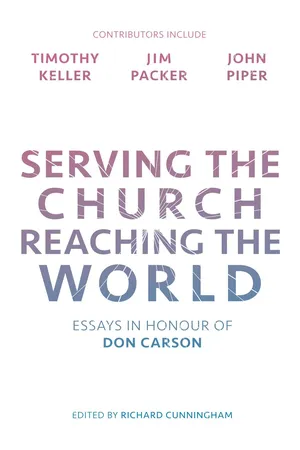
Yes, you can access Serving the Church, Reaching the World by Richard Cunningham in PDF and/or ePUB format, as well as other popular books in Theology & Religion & Christian Ministry. We have over 1.5 million books available in our catalogue for you to explore.