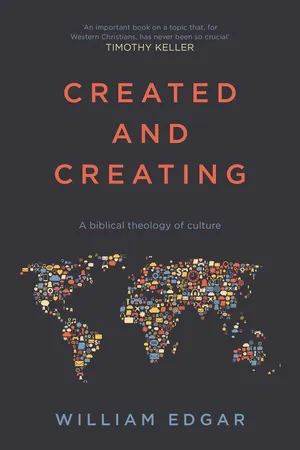
The gospel of Jesus Christ is always situated within a particular cultural context: but how should Christians approach the complex relationship between their faith and the surrounding culture?Should we simply retreat from culture? Should we embrace our cultural practices and mindset? How important is it for us to be engaged with our culture and mindset? How might we do that with discernment and faithfulness?William Edgar offers a biblical theology in the light of our contemporary culture that contends that Christians should -- and indeed, must -- engage with the surrounding culture.By exploring what Scripture has to say about the role of culture and gleaning insights from a variety of theologians -- including Abraham Kuyper, T. S. Eliot, H. Richard Niebuhr and C. S. Lewis -- Edgar contends that cultural engagement is a fundamental aspect of human existence. He does not shy away from those passages that emphasize the distinction between Christians and the world. Yet he finds, shining through the biblical witness, evidence that supports a robust defence of the cultural mandate to 'be fruitful and multiply, and fill the earth and subdue it' (Genesis 1:28).With clarity and wisdom, Edgar argues that we are most faithful to our calling as God's creatures when we participate in creating culture.
- English
- ePUB (mobile friendly)
- Available on iOS & Android
eBook - ePub
About this book
Information
Topic
Theology & ReligionSubtopic
Biblical StudiesPART ONE

PARAMETERS of CULTURE
1
Cultural Analysis
The image of God built into every humanist, no matter how distorted, begins to fear anthropological abstraction.
HARVIE M. CONN
Before we go directly to the Bible, in this chapter we will turn our attention to the field of cultural studies. I should make a few comments about cultural studies. I find it encouraging that in our times culture is being increasingly recognized as of first-order significance. We find a host of public intellectuals and commentators stressing the role of culture in order to understand contemporary life.
Whence Cultural Studies?
Modern cultural studies developed in a particular context. Certainly culture in one sense has replaced a theocentric understanding of the world. In the previous chapter we considered the grand claim by Terry Eagleton that culture is not only what we live by but also what we live for.1 Accordingly, Eagleton admits that the idea of culture in the modern age has become a substitute for “a fading sense of divinity and transcendence.”2 As such, the growth of cultural studies parallels the rise of secularization. Whether we understand secularity as the decline of religious practice, or as a shift in mentalities from believing in God to accepting the plurality of philosophical options, cultural studies arose within the vacuum created by the loss of a sense of the presence of God in the West.
Establishing a truly coherent history of cultural studies is nearly impossible. Accordingly, as Michael Green asserts, with a degree of plausibility, “Any narrative of the ‘development’ of cultural studies (particularly if it stresses founding ‘fathers’ or places) tends to be misleadingly overcoherent.”3 Still, we want to orient ourselves to some of the bolder strokes that have been taken over the previous two hundred years.
Three overlapping phases in cultural studies may be discerned. The first is the view that culture represents an ideal, often equated with civilization. Culture is improvement, or at least protection from lesser forces. The second looks at the social dynamics involved with culture. Here, the power dimension, be it economic, political, or psychological, is described, or even prescribed. Third, culture is broken down into anthropological entities that convey meaning. Thus symbols articulate the values held by a particular society. My design here is not to render a complete survey of these phases. A number of helpful accounts of cultural studies exist, and the reader may benefit from consulting them.4
Civilization, Progress, and Beauty
The so-called father of anthropology, a strong cultural evolutionist, and a committed developmentalist, Sir Edward Burnett Tylor (1832–1917), taught for much of his life at Oxford. He was greatly influenced by Charles Lyell, the Scottish geologist known for his belief in uniformitarianism, the idea that the processes of the past are the same ones we can observe today (as opposed to the “catastrophic” theories current in the nineteenth century). Tylor’s first publication was a result of his 1856 trip to Mexico with his ethnologist friend and fellow Quaker Henry Christy. His notes on the beliefs and practices of the people he encountered were the basis of his work Anahuac: Or Mexico and the Mexicans, Ancient and Modern (1861), published after his return to England. From then on Tylor published on the subject of how “primitive” peoples’ traditions continued to hold sway even in much later stages of development.
Tylor’s most influential work is Primitive Culture (1871). Here and in subsequent writings he set forth the idea that culture is, as it were, adjectival. A people could strive to be “cultured.” People all passed through various stages in an evolutionary development from the primitive to the scientific. Tylor gave us one of the most famous definitions of culture, one that would be influential for at least thirty years: “Culture, or civilization, taken in its broad, ethnographic sense, is that complex whole which includes knowledge, belief, art, morals, law, custom, and any other capabilities and habits acquired by man as a member of society.”5 Notice the key word, “acquired,” which means that there is progress and growth. Notice also that it is a person as a member of society, not simply as an individual, that acquires culture.6 Education was Tylor’s favored way to look for improvement through the different stages. In this early phase of cultural studies, diversity is minimized, since most believed that the human intellect proceeded in the same way everywhere, and that it aspired to the same ends.
Culture for Tylor moved people upward from tradition and toward something more modern and rational. His distinctive idea was that primitive people were motivated by a belief in animism, a vital force present in living organisms. This belief in a vital force, including spiritual beings, was the first phase in the development of religion. Tylor was convinced that such a belief was based on an intellectual error: the confusion of subjective and objective reality. Primitive people wrongly believed the vital force was detachable and capable of independent existence in its own mode. (Dreams, he thought, might be a basis for this error.) This understanding allowed them to believe in a supernatural world. The Christian religion, which Tylor did not much care for, he saw as a later development of this same worldview, perhaps a little more refined, but based on the same error. Science, the third stage, was needed to supersede religion and bring clarity to human history. Having said that, Tylor strongly believed in the equality of all human beings, at least as far as mental capability is concerned. Accordingly, he was an early advocate for racial equality.
The notion of progress is a reflection of the biblical approach to culture, at least in part. When reading the original commandment to “fill the earth and subdue it” (Gen 1:28), it is hard to miss the subtext of growth and development in the original intention. Indeed, the course of history envisioned at the beginning looks to a future that is better than the present (eschatology). Even with the fall, there are still overtones of the advancement of the human race in the different reiterations of this “cultural mandate,” as we shall see. But, of course, any pure idea of progress is an illusion. As Richard Bauckham puts it, “The modern idea of progress undoubtedly has its roots in the Christian tradition, which first taught Western society to envisage history as a meaningful process orientated to the future.” But he quickly adds that because the element of transcendence has been jettisoned, progress has become secularized. Instead of the history of humanity being guided by providence, the modern version credits human mastery. Thus, all mystery is gone, and evil cannot be rectified by human rational means. Indeed, the only real beneficiaries of progress are its putative creators, not the many victims of malevolence and mortality.7
Arnoldianism
No doubt the most influential representative of the civilization model is Matthew Arnold (1822–1888). During the Industrial Revolution a mounting concern about the dangers of reducing the quality of life was felt. Even while material wealth increased, including wages, products, and goods of all kinds, the well-being of workers actually decreased. They would have less leisure time, longer working hours, and less independence.8 Anyone familiar with Charles Dickens’s novels can enter into the world of poverty and oppression found in the Victorian era and experience it as if firsthand. His Bleak House (1853) uncovers the failures of the British Chancery, a court with jurisdiction over matters of equity, trusts, lands, and the like. The characters in this rather complex novel represent the spectrum of British society, from the wealthy nobility to the homeless (Tom-All-Alones). The plot and subplots involve litigation, murder, disease, poverty, and all of the variances of contemporary life. His Hard Times (1854) is a powerful treatment of the industrial working class. Famously, the workers were called “Hands” (appendages, rather than “people”) by the factory owners. Dickens’s stories are never without hope and redemption. He is generally respectful of the Christian religion. Later social critics such as Thomas Hardy and George Gissing were far less optimistic and highly critical of the church.
By all accounts the most important contender for the mission of culture to combat these social conditions was literature. English literature (particularly) was seen to be free from extreme political agendas. Good literature was believed to promote universal human values. While it was not in its nature to promote specific programs or agendas for the improvement of social circumstances, it nevertheless could promote a genuine sympathy for the poor, and a real concern for the working class. As Terry Eagleton rather cynically puts it, literature “could serve to place in cosmic perspective the petty demands of working people for decent living conditions or greater control over their own lives, and might even with luck come to render them oblivious of such issues in their high-minded contemplation of eternal truths and beauties” (a role, he adds, that religion had formally played).9
Easily the most influential advocate of culture as literature in the Victorian age, one whose authority can still be felt, is Matthew Arnold. Arnold wrote in a world similar to Dickens’s. He was a poet and literary critic with insights into anthropology, and is said to have bridged the gap between romanticism and modernism. Though skeptical about traditional Christian faith, he was drawn to what he saw as the aesthetics of Christianity. He loved church rituals and thought of God as a lovely poetic idea, rather than a supernatural being with definite attributes. Religion for him was “morality touched by emotion.”10
Even today we use expressions he coined, often without knowing their provenance. Familiar terms include “Philistines” for those who have no culture, and “Hebraism” for the putative dynamic, less ordered thought of the Jews in contrast to the more logical Greeks. He is also remembered for the expression “sweetness and light” (coined by Jonathan Swift but popularized by Arnold) to mean moral righteousness combined with intelligence (though today we tend to use the expression with a tinge of sarcasm). He puts it this way: “Culture looks beyond machinery, culture hates hatred, culture has one great passion, the passion for sweetness and light.”11
Arnold’s most often quoted statement about culture is that it is “the best which has been thought and said.” It comes from the preface to Culture and Anarchy, a collection of essays brought together in 1869 (the preface was added in 1875).12 The full quote is important to cite, since the context gives it a meaning not fully captured in the bare sentence.
The whole scope of the essay is to recommend culture as the great help out of our present difficulties; culture being a pursuit of our total perfection by means of getting to know, on all the matters which most concern us, the best which has been thought and said in the world, and, through this knowledge, turning a stream of fresh and free thought upon our stock notions and habits, which we now follow staunchly but mechanically, vainly imagining that there is a virtue in following them staunchly which makes up for the mischief of following them mechanically.13
Culture for Arnold promotes human perfection. When humanity acquires the best, then it will be able to begin to achieve moral and intellectual freedom, which will stave off the threat of decadence. The opposite of culture, then,...
Table of contents
- Acknowledgments
- Introduction
- PART ONE
- 1
- 2
- PART TWO
- 3
- 4
- 5
- 6
- 7
- PART THREE
- 8
- 9
- 10
- 11
- 12
- Epilogue
- Bibliography
- Search terms for names
- Search terms for subjects
- Search terms for Scripture references
- Notes
Trusted by 375,005 students
Access to over 1.5 million titles for a fair monthly price.
Study more efficiently using our study tools.
Frequently asked questions
Yes, you can cancel anytime from the Subscription tab in your account settings on the Perlego website. Your subscription will stay active until the end of your current billing period. Learn how to cancel your subscription
No, books cannot be downloaded as external files, such as PDFs, for use outside of Perlego. However, you can download books within the Perlego app for offline reading on mobile or tablet. Learn how to download books offline
Perlego offers two plans: Essential and Complete
- Essential is ideal for learners and professionals who enjoy exploring a wide range of subjects. Access the Essential Library with 800,000+ trusted titles and best-sellers across business, personal growth, and the humanities. Includes unlimited reading time and Standard Read Aloud voice.
- Complete: Perfect for advanced learners and researchers needing full, unrestricted access. Unlock 1.5M+ books across hundreds of subjects, including academic and specialized titles. The Complete Plan also includes advanced features like Premium Read Aloud and Research Assistant.
We are an online textbook subscription service, where you can get access to an entire online library for less than the price of a single book per month. With over 1.5 million books across 990+ topics, we’ve got you covered! Learn about our mission
Look out for the read-aloud symbol on your next book to see if you can listen to it. The read-aloud tool reads text aloud for you, highlighting the text as it is being read. You can pause it, speed it up and slow it down. Learn more about Read Aloud
Yes! You can use the Perlego app on both iOS and Android devices to read anytime, anywhere — even offline. Perfect for commutes or when you’re on the go.
Please note we cannot support devices running on iOS 13 and Android 7 or earlier. Learn more about using the app
Please note we cannot support devices running on iOS 13 and Android 7 or earlier. Learn more about using the app
Yes, you can access Created and Creating by William Edgar in PDF and/or ePUB format, as well as other popular books in Theology & Religion & Biblical Studies. We have over 1.5 million books available in our catalogue for you to explore.