Part 1 addresses three foundational matters: a theology of the word of God; an overview of NT Greek terms related to preaching; the scope and character of NT word ministries. Part 2 concentrates on exegetical studies of sections of NT teaching that relate especially to the post-apostolic context. Part 3 summarizes the exegetical findings, sets them within the context of biblical theology, and addresses some broader theological implications.
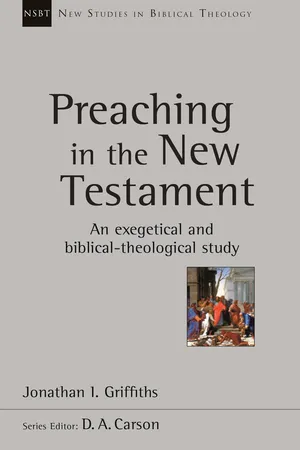
eBook - ePub
Preaching in the New Testament
An Exegetical And Biblical-Theological Study
- English
- ePUB (mobile friendly)
- Available on iOS & Android
eBook - ePub
About this book
Information
Topic
Theology & ReligionSubtopic
Biblical StudiesPart I:
Foundational matters
Chapter One
The word of God in biblical theology
This study will seek to set the New Testament’s presentation of preaching within a wider biblical-theological framework. There can be little doubt that the primary biblical-theological category into which preaching falls is that of the word of God itself. If preaching is a ministry of the word, its character must be shaped fundamentally by the nature of the word itself. Thus our first task is to consider key features of the theological character of the word of God according to Scripture. This overview will not help us to distinguish preaching from other ministries of the word, but it will help us to see what preaching as one ministry of the word will involve and achieve. Although this overview will be brief and non-technical, it will serve an important function for this study. By establishing (or, for many readers, simply recapitulating) the broad parameters and characteristics of the word of God itself according to Scripture, we will be guarded from concluding that all the theological features we will find in the New Testament’s presentation of preaching are unique to preaching. Indeed, we will find that many of the theological features of preaching in the New Testament’s presentation are simply natural outworkings of the Bible’s theology of the word of God itself.
God speaks through his word
Before issuing the well-known charge to Timothy to ‘preach the word’ (2 Tim. 4:2), Paul reminds him that the Bible is ‘breathed out by God’ (2 Tim. 3:16). Scripture has its origin directly in God such that the words of the Bible are God’s words. However, the striking thing we discover as we look more broadly through Scripture to discern the theological character of the word is that God continues to speak today through the words that he once spoke. Scripture is not simply a depository and record of words that God spoke at some time in the past; it is the script that he continues to speak today. Scripture presents itself as a living thing.
We could turn to a number of places within Scripture to see this principle established and affirmed, but the handling of Old Testament Scripture in the book of Hebrews is particularly striking in this regard. The writer of Hebrews repeatedly treats Old Testament texts as being spoken by God in the contemporary context. So he can introduce quotations from psalms written centuries before with the words ‘he [that is, God] says’ (Heb. 1:6, 8). He adds more contemporary colour to a psalm quotation which is introduced as being the word of Jesus, saying that the words of the psalm reflect the feelings and disposition of Jesus: ‘That is why he is not ashamed to call them brothers, saying, “I will tell of your name to my brothers”’ (Heb. 2:11–12). He introduces words from another psalm by saying ‘as the Holy Spirit says’ (Heb. 3:7). God continues to speak the ancient words that he once spoke. That is why Hebrews refers to God’s word as ‘living and active’ (Heb. 4:12).
This truth is vital for us to remember when it comes to any ministry of the word – and particularly when it comes to the ministry of preaching. If it is the word of God that preachers preach, then insofar as they are saying what the Bible passage is saying, it follows that God is speaking and his voice is heard. This truth may be so familiar that it has lost something of its wonder, but it is an extraordinary thing to consider. When preachers open up God’s word and say what it says, God is speaking, and the congregation is hearing his own voice.
God acts through his word
Words are powerful things. It is easy to imagine that words are empty and action is all that counts. But the reality is that in speaking we are acting.1 This is more obviously the case at some times than at others. Consider the words spoken by a man and woman at their wedding ceremony. As they say to each other, ‘I . . . take you . . .’, through those very words they become a married couple.2 Through our words, though, we do things all the time: we reveal our hearts, we redefine relationships with others, we make commitments and we initiate action. The writer of James dramatically points to the power of the tongue to bring about change: ‘How great a forest is set ablaze by such a small fire! And the tongue is a fire, a world of unrighteousness’ (Jas 3:5b–6a).
If human words are powerful, it stands to reason that God’s words should be even more so. The principle that God’s words issue forth in powerful action is established on the very first page of the Bible. In Genesis 1 God speaks the world into being. The repeated refrain of that chapter is simple but awe-inspiring: ‘And God said . . . And there was . . .’ The wonder of the fact that God spoke the world into being was not lost on the Old Testament people of God, but was a cause for reverent praise:
By the word of the Lord the heavens were made,
and by the breath of his mouth all their host . . .
Let all the earth fear the Lord;
let all the inhabitants of the world stand in awe of him!
For he spoke, and it came to be;
he commanded, and it stood firm.
(Ps. 33:6, 8–9)
God not only created the good world by his word; he also brings healing to a broken world through his word. When the afflicted people of God cried out to him for help, ‘He sent out his word and healed them, and delivered them from their destruction’ (Ps. 107:20). When Ezekiel was taken to look upon the valley full of dry bones (picturing the people of God in exile and under the judgment of God), he was called to speak to them that they might live:
So I prophesied as I was commanded. And as I prophesied, there was a sound, and behold, a rattling, and the bones came together, bone to its bone. And I looked, and behold, there were sinews on them, and flesh had come upon them, and skin had covered them . . . So I prophesied as he commanded me, and the breath came into them, and they lived and stood on their feet, an exceedingly great army. (Ezek. 37:7–10)
God by his word brought life to the dead in an act of re-creation hardly less dramatic or miraculous than his creative work in Genesis 1. With this same truth in his mind (and perhaps even remembering this very image) Peter could say to believers that ‘you have been born again, not of perishable seed but of imperishable, through the living and abiding word of God’ (1 Pet. 1:23).
However, there is another side to God’s word. While it can bring salvation, it also effects God’s judgment. To the false prophet who presumes to speak falsehood in his name, the Lord issues this warning and reminder: ‘Is not my word like fire, declares the Lord, and like a hammer that breaks the rock in pieces?’ (Jer. 23:29). Jesus warns that the words he speaks will judge those who hear them but fail to keep them:
If anyone hears my words and does not keep them, I do not judge him; for I did not come to judge the world but to save the world. The one who rejects me and does not receive my words has a judge; the word that I have spoken will judge him on the last day. (John 12:47–48)
This judicial function of the word is reflected in the passage from Hebrews 4 quoted earlier: ‘For the word of God is living and active, sharper than any two-edged sword, piercing to the division of soul and of spirit, of joints and of marrow, and discerning the thoughts and intentions of the heart’ (Heb. 4:12). Ultimately, the judicial power of the word comes to full and dramatic expression in the final judgment, when the enemies of God are judged by Jesus through his word: ‘From his mouth comes a sharp sword with which to strike down the nations, and he will rule them with a rod of iron’ (Rev. 19:15). And so his enemies ‘were slain by the sword that came from the mouth of him who was sitting on the horse, and all the birds were gorged with their flesh’ (Rev. 19:21).
God’s words are active; they always issue forth in God’s action and do his work. By his word, God creates, rules, saves and judges. God’s word is never empty or passive, but always achieves his work.
For as the rain and the snow come down from heaven
and do not return there but water the earth,
making it bring forth and sprout,
giving seed to the sower and bread to the eater,
so shall my word be that goes out from my mouth;
it shall not return to me empty,
but it shall accomplish that which I purpose,
and shall succeed in the thing for which I sent it.
(Isa. 55:10–11)
God is encountered in his word
As we have seen already, from the very first pages of Scripture God makes himself known as a speaking God. One of the great distinguishing marks of the God of the Bible as opposed to the mute idols of the nations is that God speaks (see Isa. 44:6–8). It is therefore unsurprising that God relates to his people primarily through his word. That truth is powerfully illustrated in the architecture of the tabernacle and, later, the temple. At the very centre of the place of meeting between God and his people, within the Most Holy Place, was the ark of the covenant, containing God’s covenant word to his people on the tablets of the law.
Encounters with God in Scripture are often, in essence, encounters with his word. Even where a striking physical manifestation of God’s presence is given, the substance of a meeting is verbal in nature. This is the case in God’s meeting with Moses at the burning bush in Exodus 3. Although the burning bush catches Moses’ attention (Exod. 3:3) and marks the fact that God is present, the essence of God’s presence in the encounter is not so much the bush itself but the word that God speaks. Once God has Moses’ attention, the substance of their encounter is a lengthy conversation (Exod. 3:7 – 4:17). The physical manifestation of God’s presence only draws attention to the central means by which God engages with Moses: that is, by speaking to him.
The same is true for the prophet Elijah in his encounter with God in 1 Kings 19. Elijah is isolated and frightened, and in his goodness the Lord comes to him and makes his presence known to him. The encounter is dramatic, but once again God’s word stands at the very heart of it:
And he said, ‘Go out and stand on the mount before the Lord.’ And behold, the Lord passed by, and a great and strong wind tore the mountains and broke in pieces the rocks before the Lord, but the Lord was not in the wind. And after the wind an earthquake, but the Lord was not in the earthquak...
Table of contents
- Series preface
- Author’s preface
- Abbreviations
- Introduction
- Part I:
- Chapter One
- Chapter Two
- Excursus 1: The identity of the preachers in Philippians 1:14–18
- Chapter Three
- Part II:
- Chapter Four
- Excursus 2: Biblical-theological connections between New Testament preaching and Old Testament prophecy
- Chapter Five
- Chapter Six
- Chapter Seven
- Chapter Eight
- Chapter Nine
- Part III:
- Chapter Ten
- Bibliography
- Search names for authors
- Search terms for Scripture references
- Titles in this series:
- Notes
Trusted by 375,005 students
Access to over 1.5 million titles for a fair monthly price.
Study more efficiently using our study tools.
Frequently asked questions
Yes, you can cancel anytime from the Subscription tab in your account settings on the Perlego website. Your subscription will stay active until the end of your current billing period. Learn how to cancel your subscription
No, books cannot be downloaded as external files, such as PDFs, for use outside of Perlego. However, you can download books within the Perlego app for offline reading on mobile or tablet. Learn how to download books offline
Perlego offers two plans: Essential and Complete
- Essential is ideal for learners and professionals who enjoy exploring a wide range of subjects. Access the Essential Library with 800,000+ trusted titles and best-sellers across business, personal growth, and the humanities. Includes unlimited reading time and Standard Read Aloud voice.
- Complete: Perfect for advanced learners and researchers needing full, unrestricted access. Unlock 1.5M+ books across hundreds of subjects, including academic and specialized titles. The Complete Plan also includes advanced features like Premium Read Aloud and Research Assistant.
We are an online textbook subscription service, where you can get access to an entire online library for less than the price of a single book per month. With over 1.5 million books across 990+ topics, we’ve got you covered! Learn about our mission
Look out for the read-aloud symbol on your next book to see if you can listen to it. The read-aloud tool reads text aloud for you, highlighting the text as it is being read. You can pause it, speed it up and slow it down. Learn more about Read Aloud
Yes! You can use the Perlego app on both iOS and Android devices to read anytime, anywhere — even offline. Perfect for commutes or when you’re on the go.
Please note we cannot support devices running on iOS 13 and Android 7 or earlier. Learn more about using the app
Please note we cannot support devices running on iOS 13 and Android 7 or earlier. Learn more about using the app
Yes, you can access Preaching in the New Testament by Jonathan Griffiths in PDF and/or ePUB format, as well as other popular books in Theology & Religion & Biblical Studies. We have over 1.5 million books available in our catalogue for you to explore.