eBook - ePub
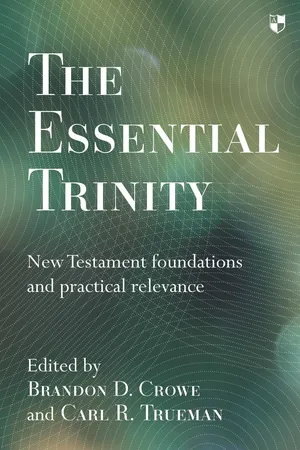
The Essential Trinity
New Testament Foundations And Practical Relevance
- English
- ePUB (mobile friendly)
- Available on iOS & Android
eBook - ePub
About this book
The Trinity is foundational to Christian theology, with immense relevance for practical living. This volume offers trinitarian readings of each New Testament corpus and focuses on the importance of the doctrine for Christian life and ministry.
Information
Topic
Theology & ReligionSubtopic
Christian TheologyPART 1:
NEW TESTAMENT FOUNDATIONS
1. The Trinity and the Gospel of Matthew
Brandon D. Crowe
The Gospel of Matthew provides many insights into the relationship of the Father, the Son and the Holy Spirit. We find that Jesus is the obedient Son of God who enjoys an unparalleled relationship to God the Father. Along with the high Christology of Matthew we also find the presence and activity of the Holy Spirit closely related to both the Father and the Son. We will examine these features in this chapter in the following way. First, we will briefly look at the conception of God the Father in Matthew. Second, we will spend much of the chapter examining the divine Christology of Matthew. Third, we will look at the role of the Holy Spirit in relation to the Father and the Son.
God the Father
We begin with the concept of God as Father.1 When we read of God as Father in Matthew, we are not encountering a new or previously unknown deity, but are reading about the same God of the Old Testament, the covenantal God of Israel. Therefore, we must understand the foundational self-revelation of God in the Old Testament to understand the context for God in Matthew. It will be helpful to delineate three overarching aspects of the theology of Matthew.
First, God is the God of Old Testament Scripture. We can readily see Matthew’s indebtedness to the theological outlook of the Old Testament by observing the frequency with which he quotes from and alludes to the Old Testament throughout his Gospel.2 The number of quotations from the Old Testament is well over fifty (including ten notable fulfilment formula quotations), and allusions and other subtle references are too numerous to count.3 These quotations often point to the role of Jesus in relation to the Old Testament, but we should also not miss their role in underscoring the theological presuppositions established in the Old Testament.
A brief survey of some of the Old Testament texts that Matthew references will give us a sense of his overall understanding of God. Jesus states that God is in control over the affairs of humanity, and even over the created realm (Matt. 6:25–33; 10:26–33), which echoes the descriptions of God we find in the Old Testament as one who cares for his people (Ps. 37:4, 25). God hears the prayers and knows the needs of his children (Matt. 6:5–13), which is consistent with his responsiveness to prayer in the Old Testament (Gen. 25:21; Exod. 3:7–8; 1 Kgs 9:3; 2 Kgs 19:20; 20:5; 2 Chr. 7:1, 12, 15; Pss 6:9; 65:2; 66:19–20; Prov. 15:8, 29; Dan. 9:21). In Matthew we read that God is good to all, and sends rain on the just and the unjust (Matt. 5:45), which is consistent with the psalmist’s poetic reflections on the goodness of God towards all that he has made (Ps. 145:9). Jesus further declares that God resides in the power and holiness of the heavens (Matt. 6:9), which reflects the transcendence of God’s power in the Old Testament (Deut. 4:39; 10:14; 1 Kgs 8:23; Ps. 115:3; Dan. 2:28, 44). In sum, to contextualize what we learn about God in Matthew, we must first of all appreciate the continuity of God’s character with the Old Testament Scriptures.
Second, building on the previous point, in Matthew’s theological outlook God alone is truly God: he has no rivals to his supremacy. God’s dwelling in his glorious, heavenly habitation is consistently explained as the unique prerogative of the God of the Bible. Thus Moses proclaims in Deuteronomy 4:39 that the Lord is God in heaven, and there is no other. Additionally, the heavenly God alone is to be worshipped. We see this explicitly affirmed in Jesus’ response to Satan’s third temptation (Matt. 4:10). When Satan promises Jesus all the kingdoms of the world if he will worship him, Jesus responds by quoting Deuteronomy 6:13, ‘You shall worship the Lord your God and serve him only’ (my tr.). Thus we find in Deuteronomy two fundamental tenets of the New Testament’s understanding of God: God alone is the supreme Creator, and therefore he alone is to be worshipped. We see this again at Caesarea Philippi in Matthew 16. Here, in the ancient city that was the legendary home of the Greek god Pan, Peter affirms Jesus’ identity as the Son of the ‘living God’ (Matt. 16:16). The phrase ‘living God’ highlights the reality and the activity of the biblical God in distinction from idolatrous so-called gods who did not intervene because they were not the Creator. Therefore, they were not to be worshipped (Deut. 5:26; Josh. 3:10; 1 Sam. 17:26, 36; 2 Kgs 19:4; Pss 42:2; 84:2 [84:3 evv]; Jer. 10:10; Hos. 1:10).
It is difficult to overestimate the significance of God’s uniqueness as the Creator who is to be worshipped in Jesus’ day; this was fundamental to the world view of Jewish monotheism4 that emphasized the Creator–creature distinction: God alone is the Creator, and all else falls under the category of ‘creature’ that must not be worshipped. Jesus’ response to Satan in the wilderness is therefore consistent with core beliefs about God from the Old Testament. Indeed, in his temptation Jesus quotes Deuteronomy 6 twice, which is the context for one of the most important monotheistic texts in the Bible known as the Shema (Deut. 6:4). The warnings against worshipping a created being in the Old Testament are numerous and clarion (e.g. Deut. 5:6–10; 9:10–21; Num. 25:1–13; Isa. 40:18–23; 43:10–15; 44:6–20; 45:15–23; 46:1–11). What is remarkable in Matthew, as I will argue in the next section, is the attribution of worship to Jesus in a way that does not in any way undermine the monotheism of the Bible.
Third, and also deriving from the Old Testament, we find in Matthew that although God is the creator of all things, he is also known specifically as the covenantal God of Israel. This means that to understand the contours of God in Matthew we must consider the history of Israel in the Old Testament. Matthew 1:1 begins by invoking two leading figures from Israel’s history, as Jesus is identified as the Son of David and the Son of Abraham. Matthew then includes a genealogy that gives not only the royal lineage of Jesus, but also traces the history of Israel from the humble beginnings of Abraham to the glories of David, to the nadir of the exile, and concludes with the glorious hope of the Messiah. God redeemed his people from Egypt and entered into covenant with them at Mount Sinai (Exod. 19). As the covenant God of Israel, God is known as Father to the nation (e.g. Exod. 4:22–23; Deut. 1:31; 8:5; 14:1–2; 32:4–6, 18–20, 43; Isa. 1:2; Jer. 3 – 4; 31:9, 20; Hos. 11:1). Therefore it is not a completely new development when we find Jesus referring to God as Father throughout Matthew. We already find that the Davidic king was known as God’s son in the Old Testament (Ps. 2:7; 2 Sam. 7:14), which grew organically out of the sonship of the nation as a whole (and indeed, out of the sonship of Adam). God had always been a Father to Israel, though, to be sure, we find Jesus speaking of God as Father with unparalleled intimacy.
In sum, to understand God in Matthew we must look first of all to the Old Testament, where we find that God is the one true God who had entered into covenant with Israel. At the same time, we learn more about God in Matthew than was revealed in the Old Testament. In particular, we learn that God is pre-eminently the Father of Jesus, who is the Son of God in a unique sense. But how does the distinctive sonship of Jesus relate to the existence and worship of the one true God of the Old Testament? This will be the focus of my next section, where I will examine the high Christology of Matthew.
Jesus, divine Son of God
Though we find in Matthew continuity with the character of God in the Old Testament, we must also note the new revelation we encounter in Matthew, particularly as it pertains to the relationship between the Father and the Son. We will see that Jesus as Son of God stands in clear continuity with Israel, but his sonship surpasses what was true of the nation and the king as son of God. Remarkably, in Matthew Jesus the Son is placed on the Creator side of the Creator–creature distinction.
Jesus and Israel as Son of God
We begin with one of the main Christological concepts in Matthew: Jesus as Son of God. To understand Jesus as Son of God we should again look first of all to the Old Testament. God was Father to Israel, and Israel was God’s firstborn son (Exod. 4:22–23), and later this sonship finds particular focus in the Davidic king (2 Sam. 7:14). Thus Jesus’ sonship in Matthew is like Israel as son of God, and like David as son of God. So the first clear reference to Jesus as Son of God in Matthew portrays Jesus’ sonship in the light of Israel’s sonship. In Matthew 2:15 we find Hosea 11:1 applied to Jesus (‘out of Egypt I called my son’, my tr.), which is an Old Testament text that speaks of God’s love for his covenant people. Similarly, Jesus is identified as the beloved Son of God at his baptism (3:17), which may again recall the sonship of Israel, though the filial parallel to Israel is clearer in the temptations of Jesus. In Matthew 4:1–11 Jesus recapitulates the filial temptations of Israel in the wilderness as Jesus’ own sonship is tested. Thus Satan explicitly questions the nature of Jesus’ sonship in the first two temptations (Matt. 4:3, 6). Additionally, Jesus’ first response comes from Deuteronomy 8:3, which derives from a context that underscores God’s fatherly discipline of Israel (Deut. 8:5). Therefore it is commonplace to observe that ‘Son of God’ in Matthew ‘must have to do in part with Jesus as the personification or embodiment of true, obedient Israel’.5
A comparison with the Gospel of Mark highlights the prominence of the Son of God theme in Matthew, since Jesus is identified as Son of God more frequently in Matthew. For example, in addition to the identification of Jesus as Son of God in Matthew 1 – 4, we find Jesus’ sonship confessed by the disciples in Matthew 14:33, it is part of the confession of Peter at Caesarea Philippi (16:16), it is proclaimed by the heavenly voice at both the baptism (3:17) and the transfiguration (17:5), it is part of Caiaphas’s question to Jesus at his trial (26:63), and the sonship of Jesus is also the focus of a round of taunts lobbed at him while nailed to the cross (27:39–43). The Son of God title also points to Jesus’ kingly status, since Jesus is also the Son of David in Matthew (1:1; 9:27; 15:22; 20:30–31; 21:9; 22:42; cf. 2 Sam. 7:14; Ps. 2:7).
Jesus’ privileged relationship with the Father
And yet there is more to the sonship of Jesus than simply recapitulating the history of Israel or fulfilling the hope of the Davidic king. In Matthew we find that Jesus is the Son of God in a way that goes beyond the filial precedents from the Old Testament. Jesus enjoys a unique and privileged relationship with God the Father. This becomes clearer as we move closer to the end of Matthew. Thus we must pay attention to the way that the identity of Jesus is progressively revealed throughout the Gospel, climaxing in the Great Commission (28:18–20).
We begin with the virginal conception and birth of Jesus (1:18–25). We do not find out everything there is to know about Jesus’ special relationship to God in this text, but the whole passage is pregnant with significance. First we read that, in distinction from everyone else in Matthew’s genealogy, no physical father is attributed to Jesus; we read simply that Jesus was begotten (egennēthē) of Mary (1:16). Given the cadence of the genealogy to this point in which every king is begotten by a father, this brief statement regarding Jesus’ conception stands in sharp relief. Jesus’ unique birth receives a bit more explanation in 1:18–25. We read again that Mary was found to be with child (passive voice) before she knew Joseph, her betrothed. At this point Matthew informs us that the child is conceived by the agency of the Holy Spirit (1:18, 20). Nowhere in 1:18–25 do we read explicitly that God is the Father of Jesus, but this reality becomes clearer as Matthew’s narrative progresses, and in the light of the whole Gospel we are on firm ground to identify a Son of God Christology in Matthew 1.6 This Son of God Christology, combined with the role of the (Holy) Spirit in Matthew, indicates that even from the conception of Jesus Matthew is pointing the reader to the remarkable relationship between Jesus and his Father. This special relationship is further underscored with the identification of Jesus as Immanuel, which is translated ‘God with us’ (1:23). I will return to this key theme of Matthew below, but can say by way of introduction that Immanuel is remarkably suggestive nomenclature to use of anyone, especially one who was conceived by the agency of the Holy Spirit in distinction from all other children.
What is introduced in Matthew 1 is therefore clarified as the Gospel progresses. We look next at the baptism of Jesus, which precipitates the opening of heaven, and the divine voice affirming Jesus’ sonship (3:16–17). Remarkably, at the baptism of Jesus the Holy Spirit is again mentioned, and rests upon Jesus in the form of a dove. Moreover, the heavenly, fatherly voice identifies Jesus as his Son in whom he is well pleased, utilizing the term eudokēsa, which may allude to a pre-temporal choice of the Son of God as Messiah.7 But regardless of how one interprets this divine good pleasure, the collocation of Father, Son and Spirit in the baptism of Jesus is remarkable.
We also see Jesus’ privileged relationship to God in the way he speaks of God as ‘my Father’ throughout the Gospel. Jesus speaks about the Father with an intimacy and authority that bespeaks his own privileged relationship to the Father. Thus we read in the Sermon on the Mount that it is only those who do the will of Jesus’ Father that enter into the kingdom of heaven, and this is closely linked with hearing and doing the words ...
Table of contents
- Copyright
- Dedication
- Contributors
- Abbreviations
- Introduction
- PART 1: NEW TESTAMENT FOUNDATIONS
- 1. The Trinity and the Gospel of Matthew
- 2. The Trinity and the Gospel of Mark
- 3. The Trinity and Luke-Acts
- 4. The Trinity and the Gospel of John
- 5. Paul and the Trinity
- 6. Hebrews and the Trinity
- 7. The Trinity and the General Epistles
- 8. An apocalyptic trinitarian model: the book of Daniel’s influence on Revelation’s conception of the Trinity
- 9. The Trinity and the Old Testament: real presence or imposition?
- PART 2: PRACTICAL RELEVANCE
- 10. The mystery of the Trinity
- 11. The Trinity and prayer
- 12. The Trinity and revelation
- 13. The Trinity and worship
- 14. The Trinity and preaching
- Notes
- Search items for Scripture references
Trusted by 375,005 students
Access to over 1.5 million titles for a fair monthly price.
Study more efficiently using our study tools.
Frequently asked questions
Yes, you can cancel anytime from the Subscription tab in your account settings on the Perlego website. Your subscription will stay active until the end of your current billing period. Learn how to cancel your subscription
No, books cannot be downloaded as external files, such as PDFs, for use outside of Perlego. However, you can download books within the Perlego app for offline reading on mobile or tablet. Learn how to download books offline
Perlego offers two plans: Essential and Complete
- Essential is ideal for learners and professionals who enjoy exploring a wide range of subjects. Access the Essential Library with 800,000+ trusted titles and best-sellers across business, personal growth, and the humanities. Includes unlimited reading time and Standard Read Aloud voice.
- Complete: Perfect for advanced learners and researchers needing full, unrestricted access. Unlock 1.5M+ books across hundreds of subjects, including academic and specialized titles. The Complete Plan also includes advanced features like Premium Read Aloud and Research Assistant.
We are an online textbook subscription service, where you can get access to an entire online library for less than the price of a single book per month. With over 1.5 million books across 990+ topics, we’ve got you covered! Learn about our mission
Look out for the read-aloud symbol on your next book to see if you can listen to it. The read-aloud tool reads text aloud for you, highlighting the text as it is being read. You can pause it, speed it up and slow it down. Learn more about Read Aloud
Yes! You can use the Perlego app on both iOS and Android devices to read anytime, anywhere — even offline. Perfect for commutes or when you’re on the go.
Please note we cannot support devices running on iOS 13 and Android 7 or earlier. Learn more about using the app
Please note we cannot support devices running on iOS 13 and Android 7 or earlier. Learn more about using the app
Yes, you can access The Essential Trinity by Brandon Crowe,Carl Trueman in PDF and/or ePUB format, as well as other popular books in Theology & Religion & Christian Theology. We have over 1.5 million books available in our catalogue for you to explore.