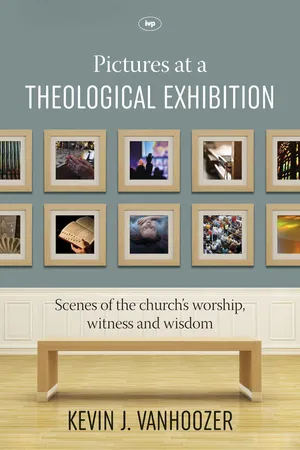
Many Christians are held captive by a picture of the imagination as a purveyor of false images, prone to idolatry. We live in a society fixated on images that have little or no significance. We are surrounded by models of the world that are not in touch with any truth outside of themselves. But we lack the resources to see and imagine things differently.Kevin Vanhoozer calls the church to a more biblical and premodern picture, one that sees every particular person, thing and event in the light of God's act of reconciling the world to himself in Christ. Through essays on the church's worship, witness and wisdom, Vanhoozer shows us how a poetic imagination can answer the questions of life's meaning by drawing our attention to what really matters: the God of the gospel.
eBook - ePub
Pictures at a Theological Exhibition
Scenes Of The Church'S Worship, Witness And Wisdom
- English
- ePUB (mobile friendly)
- Available on iOS & Android
eBook - ePub
Pictures at a Theological Exhibition
Scenes Of The Church'S Worship, Witness And Wisdom
About this book
Information
Topic
Theology & ReligionSubtopic
Christian MinistryNotes
Preface
1Most notably, in The Drama of Doctrine: A Canonical-Linguistic Approach to Christian Theology (Louisville, KY: Westminster John Knox, 2005) and Faith Speaking Understanding: Performing the Drama of Doctrine (Louisville, KY: Westminster John Knox, 2014).
2Elsewhere I advocate a “theological arc” that moves from naïve to illumined understanding of the Bible, with conceptual analysis as a necessary middle stage. See my “Love’s Wisdom: The Authority of Scripture’s Form and Content for Faith’s Understanding and Theological Judgment,” Journal of Reformed Theology 5 (2011): 247-75.
Introduction: The Discarded Imagination
1Eva T. H. Brann, The World of the Imagination: Sum and Substance (Lanham, MD: Rowman & Littlefield Publishers, 1991), 5.
2Plato, The Republic, Book X.
3Jacques Ellul, The Humiliation of the Word (Grand Rapids: Eerdmans, 1985).
4George Ritzer, The McDonaldization of Society (Thousand Oaks, CA: Pine Forge Press, 2000).
5Christian Smith, Soul Searching: The Religious and Spiritual Lives of American Teenagers (Oxford: Oxford University Press, 2005).
6See esp. Ludwig Feuerbach, The Essence of Christianity, trans. George Eliot (Buffalo, NY: Prometheus Books, 1989).
7See Barton Swaim, “Novel Ideas,” Touchstone (November/December 2009): 13-14.
8C. S. Lewis, The Discarded Image: An Introduction to Medieval and Renaissance Literature (Cambridge: Cambridge University Press, 1964), 12.
9Another way of describing the “big evangelical picture” would be to speak of “the biblical metanarrative” or, simply and succinctly, what is “in Christ.”
10Lewis, The Discarded Image, 39.
11See, for example, Arthur Peacocke, A Naturalistic Faith for the Twenty-First Century (Minneapolis: Fortress, 2009) and Philip Clayton, Mind and Emergence: From Quantum to Consciousness (Oxford: Oxford University Press, 2006).
12On the theme of “emergence” in science and religion, see Philip D. Clayton, Adventures in the Spirit: God, World, Divine Action (Minneapolis: Fortress, 2008), part two.
13C. S. Lewis, The Abolition of Man (New York: Macmillan, 1947), 34.
14Lewis, The Discarded Image, 202-15.
15Ibid., 211.
16So George Caird: “In biblical terminology the heart is not the seat of the emotions, but stands for the whole inner self, without any tripartite division of will, intellect, and feelings” (Paul’s Letters from Prison [Oxford: Oxford University Press, 1976], 45).
17For an extended discussion of this claim, see Alison Searle, “The Eyes of Your Heart”: Literary and Theological Trajectories of Imagining Biblically (Milton Keynes and Colorado Springs: Paternoster, 2008), 33-40 and Garrett Green, Imagining God: Theology and the Religious Imagination (Grand Rapids: Eerdmans, 1989), 108-13.
18James K. A. Smith, Desiring the Kingdom: Worship, Worldview, and Cultural Formation (Grand Rapids: Baker, 2009), 25.
19Ibid., 26.
20See Smith’s incipient philosophical anthropology in part one of his book, which defines human beings as “desiring, imaginative animals.” Ibid., 60.
21See, for example, ibid., 52-53. I shall return to this point below in my discussion of the “social imaginary.” Nothing less than biblical authority as it relates to the life of the church is at stake in my debate with Smith over the cognitive status of the imagination.
22By “cognitive” I simply mean what pertains to mental rather than bodily action. In the words of Alan R. White: “To imagine something is to think of it as possibly being so” (The Language of Imagination [Oxford: Basil Blackwell, 1990], 184; emphasis original).
23Jesus’ parables are “metaphoric narratives,” that is, metaphors writ large or extended. See Paul Ricoeur, “Biblical Hermeneutics,” Semeia 4 (1975): 29-148 and Nicholas Perrin, Jesus and the Language of the Kingdom: Symbol and Metaphor in New Testament Interpretation (Minneapolis: Fortress, 1976). We will return to metaphor below.
Table of contents
- Cover
- Contents
- Preface
- Acknowledgments
- Introduction: The Discarded Imagination: Metaphors by Which a Holy Nation Lives
- Foyer: Before the Promenade (Prolegomena)
- Gallery One: Pictures of the Church’s Worship
- Gallery Two: Pictures of the Church’s Witness
- Gallery Three: Pictures of the Church’s Wisdom
- Conclusion: The Man with the X-Rho Eyes
- Notes
- Search names for authors
- Search items for subjects
- Search items for Scripture references
Trusted by 375,005 students
Access to over 1.5 million titles for a fair monthly price.
Study more efficiently using our study tools.
Frequently asked questions
Yes, you can cancel anytime from the Subscription tab in your account settings on the Perlego website. Your subscription will stay active until the end of your current billing period. Learn how to cancel your subscription
No, books cannot be downloaded as external files, such as PDFs, for use outside of Perlego. However, you can download books within the Perlego app for offline reading on mobile or tablet. Learn how to download books offline
Perlego offers two plans: Essential and Complete
- Essential is ideal for learners and professionals who enjoy exploring a wide range of subjects. Access the Essential Library with 800,000+ trusted titles and best-sellers across business, personal growth, and the humanities. Includes unlimited reading time and Standard Read Aloud voice.
- Complete: Perfect for advanced learners and researchers needing full, unrestricted access. Unlock 1.5M+ books across hundreds of subjects, including academic and specialized titles. The Complete Plan also includes advanced features like Premium Read Aloud and Research Assistant.
We are an online textbook subscription service, where you can get access to an entire online library for less than the price of a single book per month. With over 1.5 million books across 990+ topics, we’ve got you covered! Learn about our mission
Look out for the read-aloud symbol on your next book to see if you can listen to it. The read-aloud tool reads text aloud for you, highlighting the text as it is being read. You can pause it, speed it up and slow it down. Learn more about Read Aloud
Yes! You can use the Perlego app on both iOS and Android devices to read anytime, anywhere — even offline. Perfect for commutes or when you’re on the go.
Please note we cannot support devices running on iOS 13 and Android 7 or earlier. Learn more about using the app
Please note we cannot support devices running on iOS 13 and Android 7 or earlier. Learn more about using the app
Yes, you can access Pictures at a Theological Exhibition by Kevin Vanhoozer in PDF and/or ePUB format, as well as other popular books in Theology & Religion & Christian Ministry. We have over 1.5 million books available in our catalogue for you to explore.