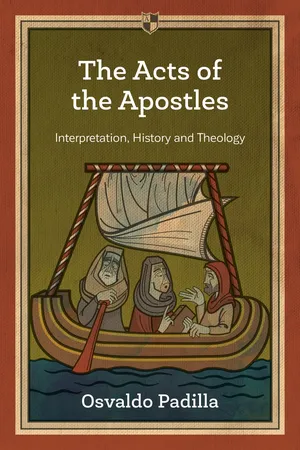
The book of Acts is a remarkable fusion of the historical and theological, and its account of the early church has fascinated theologians and biblical scholars for centuries. Just who was the author of this work? And what kind of book did he write? How do we classify its genre?The Acts of the Apostles provides an advanced introduction to the study of Acts, covering important questions about authorship, genre, history and theology. Osvaldo Padilla explores fresh avenues of understanding by examining the text in light of the most recent research on the book of Acts itself, philosophical hermeneutics, genre theory and historiography. In addition, Padilla opens a conversation between the text of Acts and postliberal theology, seeking a fully orbed engagement with Acts that is equally attuned to questions of interpretation, history and theology.
- English
- ePUB (mobile friendly)
- Available on iOS & Android
eBook - ePub
About this book
Information
Topic
Theology & ReligionSubtopic
Theologyone
Who Wrote Acts?
Who is the author of the Acts of the Apostles? The traditional response, going back firmly to Irenaeus of Lyons, is that the author was an individual by the name of Luke, writer of the Gospel that bears his name, who was also a companion of the apostles and Paul. This is a view that was not significantly contested until the period of the so-called Tübingen school (nineteenth century). Attacks on the traditional view were taken up again with renewed interest around the middle of the twentieth century by individuals such as Philipp Vielhauer. He argued that the theology of Paul as found in his genuine epistles is strikingly different from that presented in the speeches of Acts.1 It was impossible, therefore, to continue holding to the traditional view of Luke as a traveling companion of Paul. Since that period, much of Acts scholarship has rejected the traditional view.2 In addition, the current climate of suspicion toward the motives of the church fathers has made the traditional view of the author of Acts even more difficult to hold.3 Should we thus completely abandon this view as one untenable, given our progress in historical and biblical studies? Or is there still something to be said for the traditional view? Indeed, does it even matter who wrote the Acts of the Apostles?4
Our task in this chapter, then, is to examine the evidence for the authorship of Acts and then ask what impact our conclusion may have for interpretation.
Who Was Luke?
It is quite possible that our earliest extant evidence for an individual named Luke, who, moreover, was connected with the writing of parts of the New Testament, comes from the early Bodmer papyrus 75. At the end of P75 we find the following title: εὐαγγέλιον κατὰ Λουκᾶν. P75 was thought by its editors to range between 175 and 225 CE in date.5 It is the earliest copy of the Gospel of Luke that we possess. Furthermore, it has been argued that P75 evinces a form that is very close to the Alexandrian family as found in Codex Vaticanus.6 Since P75 already connects Luke to the Gospel, then we can cautiously suggest that the linkage between the two may go back earlier into the second century. How far back? This is a question that we will address shortly.
Writing circa 180 CE, Irenaeus, bishop of Lyons, provides some very helpful information on the authorship of the Gospels. Concerning that of the third Gospel and Acts, he makes the following statement: “Luke also, the companion [ἀκόλουθος; sectator] of Paul, set down in writing the gospel preached by him” (Against Heresies 3.1.1). Further on he states: “That this Luke was inseparable from Paul, and his fellow-laborer in the Gospel, he himself makes clear, not boasting, but as bound to do so by the truth itself.” To provide proof of this, Irenaeus then cites a number of passages from what we call today the “we” sections of the Acts of the Apostles (e.g., Acts 16:10-16; 20:6, etc.). He then states: “Being present in all these events, Luke carefully set them down in writing” (Against Heresies 3.14.1). In other words, as the “we” passages demonstrate, Luke was a close companion of Paul and therefore an eyewitness of many of the events in the life of the apostle. But if the “we” passages are not sufficient, Irenaeus then adds support from Paul’s own letters: “That he was not only a follower, but also a fellow-laborer of the apostles, and above all of Paul, Paul himself made clear in the epistles.”7 There follow quotations from 2 Timothy 4:9-10 and Colossians 4:14. From Irenaeus we can thus glean the following information about Luke: (1) He authored the third Gospel; (2) he was a companion of the apostles and Paul; (3) he authored the Acts of the Apostles; (4) he is mentioned by Paul in two of his epistles.
Information on the person of Luke and the authorship of the Gospels and Acts is also found in the so-called Anti-Marcionite preface. There is debate on the exact date of this preface, although it is probably contemporaneous with Irenaeus, if not earlier. Here the connection between a person called Luke and the third Gospel and Acts continues; we also receive some further biographic information on the shadowy figure of Luke. The text reads:
Luke is an Antiochean Syrian, a doctor by trade; he was a disciple of the apostles, and later, having followed [παρακολουθήσας; Latin, secutus] Paul until his death [μαρτυρίου] and having served the Lord single-mindedly, without wife or children, he passed at the age of eighty-four, full of the Holy Spirit. . . . And afterwards the same Luke wrote the Acts of the Apostles.8
This is the first document outside the New Testament that tells us of Luke’s origin and profession as well as his death. This is a tradition that is then found in subsequent authors.9
The final early document to be cited linking Luke-Acts with the individual Luke is the Muratorian Fragment. This document more than likely dates from the last quarter of the second century and probably originated in Rome.10 It thus stems from the same period of the three other documents we have noted above. Although we are missing the beginning and end of the document, fortunately the section on the third Gospel and Acts survives. It reads thus:
The third book of the Gospel is that according to Luke. Luke, the well-known physician, after the ascension of Christ, when Paul had taken with him as one zealous for the law, composed it in his own name, according to the general belief. . . . Moreover, the acts of all the apostles were written in one book. For “most excellent Theophilus” Luke compiled the individual events that took place in his presence.11
To sum up, from this early tradition we can build a stable outline of how Luke was perceived: (1) He was a follower of all the apostles but especially Paul; (2) he was a physician; and (3) he wrote the Gospel of Luke and the Acts of the Apostles. The question that we must ask here is: On what basis were the name “Luke” and the descriptors about him noted above attached to the author of the third Gospel and the Acts of the Apostles? Asked differently, is the patristic tradition generally a result of data about the author that is independent of the New Testament text; or is it no more than inferences from Luke-Acts and other parts of the New Testament? Or is it perhaps a combination of both?
Concentrating on Irenaeus and the early second century, Andrew Gregory, in his meticulously researched Oxford dissertation, concludes that the notices about Luke are the result of Irenaeus’s reading of the New Testament, not external tradition that may have reached him from an earlier period.12 Gregory acknowledges that, with P75 stemming from the third or late second century, and the careful hand of the copyist, it may be possible to move backward and conclude that behind the papyrus there is an old tradition that goes back to the earlier second century. Despite this possibility, Gregory opts for a very conservative conclusion: “Unfortunately we cannot be certain either how skilled (and therefore potentially accurate) were the earliest copyists of the Gospels or the extent to which they may have altered their texts in the light of increasing theological precision in the development of Christian doctrine.”13 He thus dismisses the possibility of knowing with certainty that the joining of the name of Luke to the third Gospel is prior to Irenaeus. Moving to the patristic testimony, Gregory is convinced that the earliest evidence joining Luke with the third Gospel and Acts is that which comes from the pen of Irenaeus. Furthermore, Irenaeus’s arguments are not based on information external to the New Testament but rather are entirely the result of his inferences from Acts and Paul’s letters.14
It may be the case that the earliest notices about the authorship of Luke-Acts stem from Irenaeus and that, furthermore, they are the result of the bishop’s detective type of New Testament interpretation for the sake of apologetics. There are at least two issues, however, that Gregory (and others) has not adequately addressed. These are (1) just how, out of so many available persons in primitive Christianity, did the individual “Luke” come to be associated with Luke-Acts; and (2) can Greco-Roman practices on the cataloguing of books (scrolls) shed any light on the names attached to the Gospels, in our particular case Luke-Acts?
Concerning the first question, the evidence is that at some point the third Gospel and Acts were believed to have been written by Luke. Why this particular individual? For Irenaeus, to be sure, could have deduced from exegesis that the author of Acts was a traveling companion of Paul. But Paul had many companions. Why not associate Luke-Acts with, say, Barnabas, or Silas, or, perhaps more logical given their labor together, Timothy?15 Why, instead, was the two-volume work associated with Luke, a figure not very prominent in the pages of the New Testament?
Henry Joel Cadbury’s answer appears to me to be wholly unsatisfactory. He suggests that “perhaps Luke’s selection was due to a process of elimination.”16 Even if we were to go in this direction, that would certainly leave more than one individual as the potential author—and more likely persons too. In any case, if it were mere guesswork, why would there be such a strong unanimity across diverse geographic regions in the second and third centuries to the effect that the author was Luke? Here the words of Martin Hengel concerning the four Gospels are to the point: “It can therefore also by no means be assumed that at some time . . . before Irenaeus . . . there had been a kind of general ‘council’ of a number of churches in a province at which the four hitherto anonymous writings gained recognition, were given their titles, and were then brought together as a ‘four-Gospel canon.’ Such an idea would be completely anachronistic.”17 Cadbury and Gregory’s hypothesis is weak in what it leaves unexplained.
A more convincing thesis, one that attempts to explain the linkage between the individual Luke and Luke-Acts, is that of Claus-Jürgen Thornton.18 He argues that the statements concerning the authorship of the Gospels in Irenaeus’s third book stem from preexistent traditional material. To buttress this, Thornton suggests that the different order of the Gospels given in Against Heresies 3.1.1, as well as the difference in verb tenses between Matthew, Luke and John on the one hand and Mark on the other, suggest a written tradition from which Irenaeus drew.19 Where could this traditional material come from? Thornton argues that, given the preeminence of the Roman congregation in the second century as well as the list of bishops of Rome that Irenaeus provides in book 3, the tradition probably came from the library of the Roman church.20 He thus reaches the following conclusion:
It has been shown that a series of statements concerning Luke was not first “invented” by Irenaeus. The appellation “Paul’s companion” comes at least from the first third of the second century. The identification of this Luke with the fellow-laborer and physician of Paul is possibly already assumed by Marcion; also, Irenaeus already probably had available the designation “disciple of the apostles.”21
Not all of Thornton’s arguments are equally convincing.22 On the whole, however, they show that it is probable that the notices about the author of the third Gospel and Acts in Irenaeus represent a previously formed tradition, perhaps from the early part of the second century.
One of the curious omissions in research on the possible authors of the Gospels is the lack of work on ancient practices concerning authors and the title of their works. That is, what was the Greco-Roman custom with regard to the naming of written works? The supposition that the Gospels were anonymous from their inception is entrenched in New Testament scholarship. But does it have support from Greco-Roman conventions? Surprisingly, this is a question that has not often been asked. The work of Martin Hengel has sought to fill this gap. Drawing on numerous examples, Hengel shows that the convention was to put the name of the author in the genitive case followed by the title of the work.23 To have a work circulating anonymously would have been the exception. Hengel argues that the same can be expected of the Gospels, with the difference that, as the extant text-critical evidence shows, the title of the work with the assumed author’s name was put in a prepositional phrase using κατά, “according to.” Hengel suggests that the reason for this is that the real “author” of the gospel is Jesus Christ, and the Evangelists simply bear witness to that gospel.24 In addition, Hengel argues from Justin that the Gospels were read in the context of worship. This is an important observation, since it was crucial for the early church that material read in worship come from eyewitnesses of Jesus or their companions. And this would make the issue of names very important. Hengel therefore concludes that the tradition of the Gospel writers found in Irenaeus is an old tradition, predating even Justin.25 Hengel also calls attention to the uniformity of the titles of the Gospels, which goes aga...
Table of contents
- Cover
- Commendations for The Acts of the Apostles
- Title Page
- Copyright
- Dedication
- Contents
- Acknowledgments
- Abbreviations
- Introduction
- 1 Who Wrote Acts?
- 2 The Genre of Acts
- 3 How Luke Writes History
- 4 The Speeches in Acts (Part One): The Speeches in Their Ancient Context
- 5 The Speeches in Acts (Part Two): The Theology of the Speeches
- 6 The Justification of Truth-Claims in Acts: A Conversation with Postliberalism
- Notes
- Bibliography
- Search names for authors
- Search items for subjects
- Search items for Scripture references
- About the Author
Trusted by 375,005 students
Access to over 1.5 million titles for a fair monthly price.
Study more efficiently using our study tools.
Frequently asked questions
Yes, you can cancel anytime from the Subscription tab in your account settings on the Perlego website. Your subscription will stay active until the end of your current billing period. Learn how to cancel your subscription
No, books cannot be downloaded as external files, such as PDFs, for use outside of Perlego. However, you can download books within the Perlego app for offline reading on mobile or tablet. Learn how to download books offline
Perlego offers two plans: Essential and Complete
- Essential is ideal for learners and professionals who enjoy exploring a wide range of subjects. Access the Essential Library with 800,000+ trusted titles and best-sellers across business, personal growth, and the humanities. Includes unlimited reading time and Standard Read Aloud voice.
- Complete: Perfect for advanced learners and researchers needing full, unrestricted access. Unlock 1.5M+ books across hundreds of subjects, including academic and specialized titles. The Complete Plan also includes advanced features like Premium Read Aloud and Research Assistant.
We are an online textbook subscription service, where you can get access to an entire online library for less than the price of a single book per month. With over 1.5 million books across 990+ topics, we’ve got you covered! Learn about our mission
Look out for the read-aloud symbol on your next book to see if you can listen to it. The read-aloud tool reads text aloud for you, highlighting the text as it is being read. You can pause it, speed it up and slow it down. Learn more about Read Aloud
Yes! You can use the Perlego app on both iOS and Android devices to read anytime, anywhere — even offline. Perfect for commutes or when you’re on the go.
Please note we cannot support devices running on iOS 13 and Android 7 or earlier. Learn more about using the app
Please note we cannot support devices running on iOS 13 and Android 7 or earlier. Learn more about using the app
Yes, you can access The Acts of the Apostles by Osvaldo Padilla in PDF and/or ePUB format, as well as other popular books in Theology & Religion & Theology. We have over 1.5 million books available in our catalogue for you to explore.