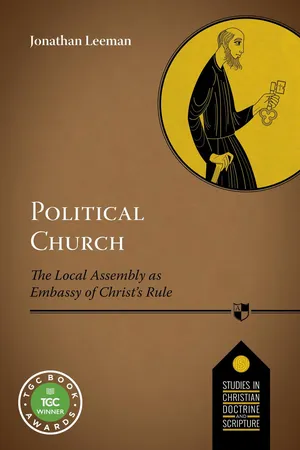
The church is political.Theologians have been debating this claim for years. Liberationists, Anabaptists, Augustinians, neo-Calvinists, Radical Orthodox and others continue to discuss the matter. What do we mean by politics and the political? What are the limits of the church's political reach? What is the nature of the church as an institution? How do we establish these claims theologically?Jonathan Leeman sets out to address these questions in this significant work. Drawing on covenantal theology and the 'new institutionalism' in political science, Leeman critiques political liberalism and explores how the biblical canon informs an account of the local church as an embassy of Christ's kingdom. Political Church heralds a new era in political theology.
- English
- ePUB (mobile friendly)
- Available on iOS & Android
eBook - ePub
About this book
Information
Topic
Theologie & ReligionSubtopic
Christliche Theologie
What Is Politics?
Both this chapter and the next serve the purpose of developing a vocabulary, a prolegomenon. Here the goal is a political prolegomenon; there an institutional one.
The project begins with a little reporting work: What do people mean when they refer to “politics” or the “political”? How are they using the concept? Then, with scribbled notes in hand, we can turn to the Scriptures in subsequent chapters and see how the popular answers stack up against a “fuller political conceptuality” that “pushes back the horizon of commonplace politics and opens it up to the activity of God.”1
If philosophical liberalism is indeed “the overarching mythos of the modern age” and the “political philosophy by which we live,” as advanced in the introduction, then our reporting work should be enhanced by a little background research into the idea of liberalism, particularly the manner in which it divides the political and the spiritual. Further, it is worth exploring how Christians have complemented talk of liberal neutrality toward religion with a spiritual neutrality toward politics, as well as with a concept of religious freedom grounded in the inviolable conscience.
I will also offer some of the incisive criticisms of liberalism that have been leveled by communitarians such as Michael Sandel, as well as feminist and minority-rights theorists. What we will discover along the way is that there is a role for both a narrow and a broad conception of politics.
WHAT IS POLITICS?
Were we to ask the average Westerner both inside and outside the church “What is politics?” I assume that most would answer by pointing to the activities surrounding the institutions of the state that concern the distribution of power. Harold Lasswell’s oft-mentioned book captures this idea in its title, Politics: Who Gets What, When, How.
The line between public and private. If we continued to probe, I assume that both the average citizen and church member would eventually make some type of distinction between our “public” and our “private” lives. Somewhere deep down inside, the Western person “just knows” that the government shouldn’t stick its nose into all of a person’s business.2 “Politics is the activity by which the framework of human life is sustained; it is not life itself,” says political theorist Kenneth Minogue.3 And this is “why despots do not belong in politics.”4 In the totalitarian regimes of the twentieth century, says Minogue, “everything in society was the private property of the despot.”5
This cultural instinct is captured in William Butler Yeats’s 1938 poem “Politics.” At the top of Yeats’s poem is an epigraph of Nazi refugee Thomas Mann’s famous line, “The destiny of man presents its meaning in political terms.” Mann, staring into the ugly face of fascism in Spain, Italy and Germany, as well as communism in Russia, couldn’t help but conclude that everything that people used to call “private” was becoming political. But Yeats didn’t like it. His poem’s narrator concedes that “maybe what they say is true” about all of life being political; but still, “How can I, the girl standing there, / My attention fix / On Roman or on Russian / Or on Spanish politics?”6 The narrator wants assurance that there is more to life than politics. What about art, literature, religion or romance?
The assumption that Minogue, Yeats and my stock Westerner share, the assumption that makes them opposed to the totalitarian regimes of Hitler and Stalin, is the basic assumption of philosophical liberalism: human beings are fundamentally self-governing or autonomous.7 They are fundamentally free to reexamine all their relationships and ends,8 as well as the structures of power and authority in which they find themselves as a matter of historical accident. Further, they should be free from political interference to fix their attention on things other than politics, like art, literature, religion and romance. The autonomous, nonpolitical individual exists hypothetically prior to the state and prior to the person in his or her political capacity. Classically, this prior position is Hobbes, Locke and Rousseau’s “state of nature.” More recently, it is John Rawls’s “original position.”9
Politics in the liberal vision is what happens when this prepolitical person steps out of the private realm and into the public realm where political activities occur. He does this because, as much as he enjoys his privacy, he can’t keep his neighbor from raking her leaves into his yard. He recognizes the need to establish rules for regulating their interactions. Liberal thinkers view the state of nature differently: Hobbes pessimistically as a state of war, Rousseau optimistically as a state of freedom. But in either case a social contract is formed and the individual’s political life begins. John Locke writes, “Whenever therefore any number of men are so united into one society, as to quit every one his executive power of the law of nature, and to resign it to the public, there and there only is a political or civil society.”10 The contract among the classical thinkers is “emphatically not a pact between rulers and ruled . . . but a pact to establish rule. It marks the transition from the ‘state of nature’ to the ‘civil state.’”11 It is the act by which separate individuals, who conceive of themselves as equals or at least are mutually interested in treating one another as equals, “transform themselves or incorporate themselves into an acting unity.”12 Authority or rule must be agreed upon and entered into. Legitimate government is based upon the consent of the governed since, says Locke, people are “by nature all free, equal and independent.”13 The contract for a contemporary Kantian liberal like John Rawls is a little different. It is a hypothetical agreement for establishing the rules of justice, which themselves are the grounds of legitimate political rule.14 The emphasis here is not so much on the origins of politics as on the legitimate basis for politics, which is the consent that all free and rational persons would give in an initial position of equality.15
Either way, liberalism validates Yeats’s hope for life beyond politics (never mind for the moment that “autonomous” is a politically laden term). Liberalism says that there is a public area of our lives, an area in which we are somehow related to the institutions of the state, whether as citizen, judge, soldier, policy maker or executioner, and that this public area is where “politics” transpires. But it also says that there is a private area of our lives, an area which should remain protected from the institutions of the state and its politics. The private nonpolitical world “is that of the family, and of individual conscience as each individual makes his or her own choice of beliefs and interests.”16 Political theorist Chandran Kukathas summarizes all this when he writes, “A political community is essentially an association of individuals who share an understanding of what is public and what is private within their polity. A matter is of public interest if it is something which is generally regarded as an appropriate subject of attention by the political institutions of the society.”17
Public-wide and coercive governance. If politics in the liberal view describes what happens in the public domain, how do we describe the nature of that activity? Political activity involves several components. First, it involves collective decision making or governance, as comes through in Hanna Pitkin’s definition of politics. She writes that politics is “the activity through which relatively large and permanent groups of people determine what they will collectively do, settle how they will live together, and decide their future, to whatever extent this is within their power.”18 Political activity first and foremost is about governance.19
Second, political activity refers to that governance by institutions that are capable of making decisions that bind an entire society, the whole public or population. Another political scientist, Guy Peters, sounds very similar to Pitkin when he writes that politics refers “to that complex set of processes whereby governments come to choose between a variety of collective goals for society and seek to implement them.” But then Peters adds a necessary elaboration: “It follows that ‘politics’ presupposes, at the very least, the existence of a set of institutions of government which is in principle capable of taking and implementing such decisions for the whole of society. Families take decisions like that, as do schools or churches or companies. But they make decisions for themselves, not for whole societies.”20
Yet there is one more element that needs to be added to these first two, which is the idea of legitimate coercive force, at least in a fallen world. Liberals sometimes speak this way only with red faces,21 but
what makes the government’s actions political . . . is not that they are general and public and may or do affect everyone in the society; after all, so are a manufacturer’s decisions when he fixes the prices of his products. The distinctive mark of political action is that it can be enforced, because the government can coerce people into obedience by the threat of physical force, and ultimately by using it.22
For the purposes of this book, force is something that separates a metaphorical use of “politics” like “university politics” from a literal one. Hence, “we therefore exclude from the discipline of Politics the study of the running of such groups and institutions as businesses, trade unions, schools, universities, banks, churches and families, because in none of them may force play a role except with the permission of the state.”23
To sum up, political activity involves a noun characterized by two adjectives: politics involves public-wide and coercive governance.
What is the state? Does this mean that a band of armed robbers are acting “politically” when using force? No, their force is not public-wide or legitimate. A private party cannot legitimately use force apart from the state’s permission. The modern state alone has a monopoly of legitimate violence, as Max Weber famously put it. It is this monopoly of coercive power, in fact, that gives definition to the state. The state, said Ernest Gellner building on Weber, “is that institution or set of institutions specifically concerned with the enforcement of order.” It is an “order-enforcing agency.”24 Political theorist Simon Roberts, being even more explicit about the power over life and death, defines the state as
the presence of a supreme authority, ruling over a defined territory, who is recognized as having power to make decisions in matters of government [and] is able to enforce such decisions and generally maintain order within the state. Thus the capacity to exercise coercive authority is an essential ingredient: the ultimate test of a ruler’s authority is whether he possesses the power of life and death over his subjects.25
In a word, the difference between the power of a band of armed robbers and the power of the state is that the state’s power is authorized.26 The state is said to have authority, which is the right to do things or to demand that things be done.27 Authority in the simplest terms is power legitimately exercised.28 To the modern state belong the legislatures and the courts, the police force and the...
Table of contents
- Cover
- Title Page
- Commendations
- Copyright Page
- Dedication Page
- Contents
- Outline of the Book
- Preface
- Acknowledgments
- Introduction
- 1 What Is Politics?
- 2 What Is an Institution?
- 3 The Politics of Creation
- 4 The Politics of the Fall
- 5 The Politics of the New Covenant
- 6 The Politics of the Kingdom
- Conclusion
- Notes
- Search names for authors
- Search items for subjects
- Search items for Scripture references
- The Studies in Christian Doctrine and Scripture Series
- About the Author
Trusted by 375,005 students
Access to over 1.5 million titles for a fair monthly price.
Study more efficiently using our study tools.
Frequently asked questions
Yes, you can cancel anytime from the Subscription tab in your account settings on the Perlego website. Your subscription will stay active until the end of your current billing period. Learn how to cancel your subscription
No, books cannot be downloaded as external files, such as PDFs, for use outside of Perlego. However, you can download books within the Perlego app for offline reading on mobile or tablet. Learn how to download books offline
Perlego offers two plans: Essential and Complete
- Essential is ideal for learners and professionals who enjoy exploring a wide range of subjects. Access the Essential Library with 800,000+ trusted titles and best-sellers across business, personal growth, and the humanities. Includes unlimited reading time and Standard Read Aloud voice.
- Complete: Perfect for advanced learners and researchers needing full, unrestricted access. Unlock 1.5M+ books across hundreds of subjects, including academic and specialized titles. The Complete Plan also includes advanced features like Premium Read Aloud and Research Assistant.
We are an online textbook subscription service, where you can get access to an entire online library for less than the price of a single book per month. With over 1.5 million books across 990+ topics, we’ve got you covered! Learn about our mission
Look out for the read-aloud symbol on your next book to see if you can listen to it. The read-aloud tool reads text aloud for you, highlighting the text as it is being read. You can pause it, speed it up and slow it down. Learn more about Read Aloud
Yes! You can use the Perlego app on both iOS and Android devices to read anytime, anywhere — even offline. Perfect for commutes or when you’re on the go.
Please note we cannot support devices running on iOS 13 and Android 7 or earlier. Learn more about using the app
Please note we cannot support devices running on iOS 13 and Android 7 or earlier. Learn more about using the app
Yes, you can access Political Church by Jonathan Leeman in PDF and/or ePUB format, as well as other popular books in Theologie & Religion & Christliche Theologie. We have over 1.5 million books available in our catalogue for you to explore.