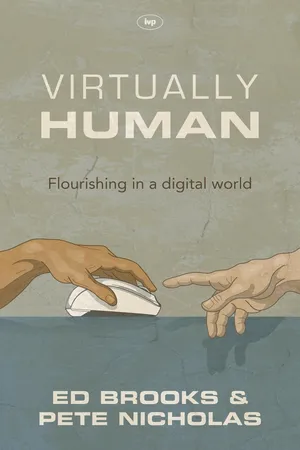
Whether you are an early adopter, a sceptic, or just content to go with the flow, this book will help you navigate the digital world in a way that honours Christ and leads to your growth and the growth of those around you.
- English
- ePUB (mobile friendly)
- Available on iOS & Android
eBook - ePub
About this book
Part 1
1
Just a tool?
Have you ever held off investing in a new technology only to find that it was far better than you had thought it would be? Or ever considered the apps that you would not want to be without? Have you ever felt your smartphone has got in the way of a conversation? Or ever wondered how people manage to stay on the pavement when they never look up from their Snapchat feed? Have you ever marvelled at the way Google maps can help you get exactly where you want to be when you are lost in a city you have never visited before? Have you ever felt a bit too attached to your email? Or wondered whether Facebook is strengthening or weakening your friendships? Have you ever received a message that cheered you up when you felt alone? Or heard from a friend you had lost touch with after he or she found you online?
Life in our digital world is full of these contradictions. If we take time to reflect, it is impossible to be utterly negative or utterly positive about technology. But all these questions raise two more: whom should we thank for the benefits of the technology that we enjoy? And whom should we blame for the bugs?
Different books on technology assign the responsibility in different ways. One common approach focuses on the users. Technology is neutral, this line argues; the heroes or villains in the story are the people involved. We can use technology for great good and great evil. If we get it right we should feel proud, and if we get it wrong we must take the blame.
A second group pushes back. They say this first position doesn’t take account of the power of technology. We are constrained by the way technology is designed. We have no choice but to use it in a certain way. If Facebook leaves us lonely it is a fault with the network, or the technology on which it relies.
If the first approach assigns the responsibility to the users, this second approach casts us as passive recipients determined by technological powers beyond our control. We might thank the designers, or blame them, but the responsibility for the way technology is shaping our lives is largely out of our hands.
Which group is right? To us, neither position seems to capture the reality of what is going on. If we want to get to the bottom of what it means to live well in this world of technology, we are going to have to dive into this debate and consider what technology actually is. Specifically we need to ask: is technology just a tool? Is it neutral?
Now, this clearly isn’t the only book exploring the nature of technology and how it is shaping our lives. This is a hot topic with an abundance of books and blog posts devoted to it. But there are two important features of our approach that are distinct from what you might find elsewhere. First, we are committed to going beyond the polarization between pro- and anti-technology voices that is a feature of much current discussion. Facebook, for example, is neither wholly good nor wholly bad. But if that is the case, how should we approach how we interact with it? Our decisions rest on discernment, which means we need to understand how the blessing and the bugs of technology are related. The second distinctive feature of the approach in this book is that we are committed to engaging with technology in the world under God. If it seems unnecessary or counter-intuitive to bring God into the story of technology, we hope it won’t as you read on.
This may well seem counter-intuitive to you. At one time it was widely believed that progress in science and technology made belief in God irrelevant, if not irrational. We still breathe this cultural air. However, more recently the ‘God is dead’ story of secularism has had to be retracted. Technology simply hasn’t consigned questions of spirituality and belief in God to history. How could it when technology is often seeking to frame answers to the ‘big questions’ of life? Questions that deal with the existence and nature of God. Purely secular understandings of technology are therefore bound to be limited.
So our approach is not secular – that is already clear – but neither is it vaguely spiritual. To take God seriously as God, his place in the conversation must be at the beginning. What other place can we assign to the Author of creation? What is more, we believe that the God of creation is the God who took flesh in Jesus Christ (John 1:14) and is now present by the Holy Spirit (John 14:16–17). With Christians through the last two millennia we believe that he has revealed his will in the Scriptures given to the church (2 Timothy 3:16). We won’t be defending these beliefs here since there are plenty of other good books that do that.1 Instead, we will be taking this Christian understanding as our foundational assumption. Our aim is to show how a Christian understanding of the world makes sense of technology, and how a Christian approach to technology can lead us to flourish in our digital world.
At times our Christian convictions will be more explicit than at others, but they are informing our thinking throughout. We begin in this chapter by raising some essential questions about the nature of technology and how it operates in society. If you read this wanting more explicitly Christian content then be patient; it is coming. Later chapters actively seek to bring our understanding of technology within the Christian story of life in the world. If you read those scratching your head and asking what Jesus has to do with smartphones or social media, we hope you will be persuaded as the book goes on that the answer is, ‘everything’.
Digging a bit deeper
Imagine I am out for a romantic meal with my wife. We are at our favourite restaurant, having a dinner date together for the first time in a few weeks. As we sit down, I take my iPhone out of my pocket and put it on the table. I just place it there. I don’t refer to it. I don’t use it. It’s just there. Now let’s ask the question again: is it neutral? Of course not! Putting the phone on the table has reshaped the environment. Even if she says nothing, my wife is now thinking: ‘Why did he take his phone out? Is he expecting a call? Does he want to check his messages? Doesn’t he want to speak to me? Is his phone more interesting to him than I am?’
Martin Heidegger was a famous German philosopher in the twentieth century who thought deeply about technology. He was convinced that technology was not neutral, and to back up his point he used an illustration about mining (his name sounds like ‘digger’, so it’s a memorable example).
Heidegger’s point was that once we have the technology of mining, we view every field in a different way, as a possible mine. We approach the field with the question: what resources might be buried underneath it? Could we mine it? Would it be better to mine it or leave it as a field?
The point of both illustrations is this: it seems counter-intuitive, but the essence of technology is, in fact, not anything technological. In a deep sense, technology is not simply about microchips and fibre-optics and lines of computer code. Technology is like a frame through which we see the world, which then becomes the world in which we live.
‘The digger’ is a pretty deep thinker(!) and he says lots of other things, some of which are more helpful than others. If we learn this one thing from him, we will have learnt well: technology is not neutral.
Everywhere we remain unfree and chained to technology, whether we passionately affirm or deny it. But we are delivered over to it in the worst possible way when we regard it as something neutral; for this conception ... makes us utterly blind to the essence of technology.2
This may seem like an overstatement. Surely I’m not chained to technology! But think carefully for a moment. What he is saying is that if we are unconscious about the way that technology frames the world, if we are unthinking about its real impact on us and think of it as ‘just a tool’, then isn’t there an important sense in which we are blind to its true power? Think of the way even everyday words have been changed by technology: web, friend, surfing, like, blackberry, connect, search, refresh, text, feed, status (to mention a few). Changing terms that millions of people use every day is a quite remarkable manifestation of power. It is even more powerful when it is done and few of us notice!
Just a tool?
English satirist and broadcaster Charlie Brooker is someone we might expect to be a firm techno-sceptic. He is the author of a dystopian television series, Black Mirror, which explores (sparing few sensibilities) the impact of technology on life in the modern world. But Brooker is no techno-phobe. He, and his actors, are obsessed with their ‘black mirrors’:
The show isn’t anti-technology. I’m quite techno and gadgety. I hope that the stories demonstrate that it’s not a technological problem we have. It’s a human one. Human frailties are maybe amplified by it. Technology is a tool that has allowed us to swipe around like an angry toddler.3
‘Technology is a tool.’ What problems there are with technology are problems with the people using it. That sounds pretty plausible. Plausible enough, in fact, to have acquired a large number of followers and been given a name: ‘instrumentalism’. Sir Tim Berners-Lee is credited as the person who invented the World Wide Web. In an interview in 2005, fifteen years after his groundbreaking work in a Genevan science laboratory, he was asked to evaluate the achievement of his invention. His response reveals his hopes for the future as well as his own understanding, which is a good example of the ‘instrumentalist’ approach:
It’s a new medium, it’s a universal medium and it’s not itself a medium which inherently makes people do good things, or bad things. It allows people to do what they want to do more efficiently. It allows people to exist in an information space which doesn’t know geographical boundaries. My hope is that it’ll be very positive in bringing people together around the planet, because it’ll make communication between different countries more possible.4
If we are inclined to agree with Charlie Brooker and Sir Tim Berners-Lee, that isn’t surprising; there is surely something to the instrumentalist argument that is attractive. Even though it can appear to be pretty down on people as the cause of the problems, it is a kind of pessimism that hides a deeper optimism under the surface. If people are the problem, people can be the solution too. After all, on this view, we are the ones in control.
Isn’t this very biblical too? The Bible is quite clear that we are on shaky ground when we start to think of problems in the world as ‘out there’. We human beings make and use technology, so don’t any problems ultimately come back to us? Well yes, but before we go too far with this view, we need to be careful lest we forget our German lesson: we may not be neutral, but technology isn’t neutral either.
Those who oppose the ‘technology is a tool’ understanding often point to the way technology seems to be the driving force in changing society. Think about how Facebook is changing the way we relate, or how Internet browsing is influencing our attention span, or how instant messaging has meant we talk less on the phone, or how Twitter is feeding our appetite for instant news updates.
‘The medium is the message’ said Marshall McLuhan, arguing that the way in which communication takes place changes the content of the message. The different forms of media, in other words, are not just passive tools; they themselves carry a depth of meaning that shapes society. Neil Postman is a student of McLuhan who takes on this understanding in his book, Amusing Ourselves to Death. He argues that cultural decline in the second half of the twentieth century was due to the decline of the ‘Age of Typography’ and the ascendance of the ‘Age of Television’:
This change-over has dramatically and irreversibly shifted the content and meaning of public discourse, since two media so vastly different cannot accommodate the same ideas. As the influence of print wanes, the content of politics, religion, education, and anything else that comprises public business must change and be recast in terms that are most suitable to television.5
This understanding of technology, underlining the importance of the means of communication, also seems plausible. It too has its own name: ‘technological determinism’.
This seems to have important biblical grounding as well. We would not expect technology to be value neutral, because God has not made the world value neutral. In the opening chapter of Genesis (even before human beings are created) we are told six times that ‘God saw that it was good’ (1:4, 10, 12, 18, 21, 25). One view that is prevalent in technology is that the material in the world is neutral and we give it value by our creative activity. But if the world is ingrained with value from the moment of its creation, then it is little wonder that technology is not neutral either.
So which is right: instrumentalism (technology is just a tool) or determinism (technology is in the driving seat)?
Surely both contain important points that we need to take on board. The technologies we adopt are made by groups of people with goals in mind. They are aiming to achieve certain ends: to make life quicker, cheaper, more relationally connected. So there is a ‘tool-like’ function to technology. The Internet was the result of the US military’s need for a communications network that could withstand nuclear attack in the Cold War. The Google search engine was developed as a more fruitful way of finding useful information from the Web. Facebook was intended to connect students at Harvard. The World Wide Web itself was designed by Sir Tim Berners-Lee as a way of sharing research findings among nuclear physicists. So Nicholas Carr writes, ‘Every technology is an expression of human will. Through our tools, we seek to expand our power and control over our circumstances – over nature, over time and distance, over one another.’ He adds, ‘It certainly appears that, as the instrumentalists claim, our tools are firmly under our control.’6
But, as Carr goes on to point out, the determinist case is also persuasive. We surely do seek to assert our will on the world through technology, but aren’t we already constrained by the technological world in which we live? And once we start using these ‘tools’ we have designed, don’t they inevitably shape us and the way we see the world?
Though we’re rarely conscious of the fact, many of the routines of our lives follow paths laid down by technologies that came into use long before we were born. It’s an overstatement to say that technology progresses autonomously – our adoption and use of tools are heavily influenced by economic, political, and demographic considerations – but it isn’t an overstatement to say that progress has its own logic, which is not always consistent with the intentions or wishes of the toolmakers and tool users. Sometimes our tools do what we tell them to. Other times, we adapt ourselves to our tools’ requirements.7
We like to think that we are in control of the world, but we are aware that so often we are not. It is empowering to imagine we are riding through the world towards a horizon we choose for ourselves, creating technology to serve our own vision of life. The reality is often closer to the observation made by Ralph Waldo Emerson: ‘Things are in the saddle / And ride mankind.’8
As we go through this book we need to remember both these insights. First, technology is not just a tool; it changes the way we view the world and profoundly impacts us, often in ways we are not fully aware of. But second, we need to take responsibility as the architects and ‘users’ of technology for the ways we use it in God’s world.
All technology tells a story
A large part of technology’s appeal is the story of life that modern technology brings with it. The most successful gadgets, websites and apps are the ones that persuade us of our need for them by showing us the life of blessing that they make possible. Look at the ads – they don’t major so much on technical specifications as on giving a vision of human flourishing where the product is the crucial component. It is the way in which the latest iPad can empower you to interact with the world and shape reality that is its selling point. For Apple, in particular, the beauty of design is intended to mirror the power of the creative harmony its products can bring to your life.
On the surface, each advert and each new technology of the digital age has its own story. Under the surface, the stories have a unity in the story of freedom that belongs to the late-modern world. The message is that whoever you are, wherever you come from, you alone define yourself, you alone write the script that you will follow through life. You are free (as the Nike slogan goes) to ‘write the future’. Steve Jobs summed it up in his speech to the graduating class at Stanford University in 2005:
Your time is limited, so don’t waste it living someone else’s life. Don’t be trapped by dogma – which is living with the results of other people’s thinking. Don’t let the noise of others’ opinions drown out your own inner voice. And most important, have the courage to follow your heart and intuition. They somehow already know what you truly want to become. Everything else is secondary.9
This is the appeal of the digital world: there is no story pre-written; rather, with the power of technology, we can all code our own. The thing is (and we’re not just trying to be clever here) that the ‘life is a blank-page story’ is, of course, itself a story. We could call it the ‘no-story story’. It doesn’t sound too interesting when put like that. But it is amazing how it has captured our cultural imagination!
‘Everyone can publish, and broadcast, and create; we just need to follow our heart.’ One of our aims in this book is to pull back the curtain on this story. We will find much good that we will want to affirm. We will also need to raise some important questions. The best bits of this story, we will see, are actually part of a greater story of life.
A story of humanity
Finally, a really important thing for us to notice as we start to explore the story of life in the digital world is that it is a story about humanity. People are the central characters, and the gadgets of technology play a part only so far as they promise to improve or threaten to challenge our story.
The key issue is not so much, ‘What can technology do?’ as, ‘What can technology do for us?’ As with all the big stories of life, questions about who we are as human beings, and who we are becoming, lie right at the heart of things.
Nick ...
Table of contents
- Contents
- Foreword
- Acknowledgments
- Introduction
- Part 1
- 1 Just a tool?
- 2 What’s the story?
- 3 The interface
- Part 2
- 4 I tweet therefore I am
- 5 The social network
- 6 Real time
- 7 Virtual sex
- 8 Searching for knowledge
- Conclusion: Truly human
- Notes
Trusted by 375,005 students
Access to over 1.5 million titles for a fair monthly price.
Study more efficiently using our study tools.
Frequently asked questions
Yes, you can cancel anytime from the Subscription tab in your account settings on the Perlego website. Your subscription will stay active until the end of your current billing period. Learn how to cancel your subscription
No, books cannot be downloaded as external files, such as PDFs, for use outside of Perlego. However, you can download books within the Perlego app for offline reading on mobile or tablet. Learn how to download books offline
Perlego offers two plans: Essential and Complete
- Essential is ideal for learners and professionals who enjoy exploring a wide range of subjects. Access the Essential Library with 800,000+ trusted titles and best-sellers across business, personal growth, and the humanities. Includes unlimited reading time and Standard Read Aloud voice.
- Complete: Perfect for advanced learners and researchers needing full, unrestricted access. Unlock 1.5M+ books across hundreds of subjects, including academic and specialized titles. The Complete Plan also includes advanced features like Premium Read Aloud and Research Assistant.
We are an online textbook subscription service, where you can get access to an entire online library for less than the price of a single book per month. With over 1.5 million books across 990+ topics, we’ve got you covered! Learn about our mission
Look out for the read-aloud symbol on your next book to see if you can listen to it. The read-aloud tool reads text aloud for you, highlighting the text as it is being read. You can pause it, speed it up and slow it down. Learn more about Read Aloud
Yes! You can use the Perlego app on both iOS and Android devices to read anytime, anywhere — even offline. Perfect for commutes or when you’re on the go.
Please note we cannot support devices running on iOS 13 and Android 7 or earlier. Learn more about using the app
Please note we cannot support devices running on iOS 13 and Android 7 or earlier. Learn more about using the app
Yes, you can access Virtually Human by Ed Brooks,Pete Nicholas in PDF and/or ePUB format. We have over 1.5 million books available in our catalogue for you to explore.