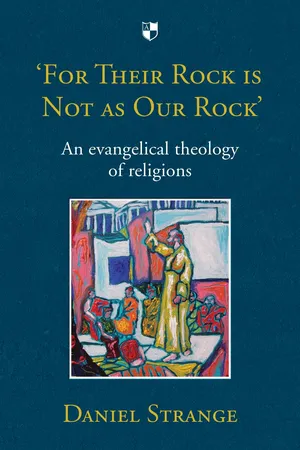
The reality of our post-Christendom, post-colonial, post-Holocaust, post-9/11, multi-ethnic and multicultural context has meant that, more than ever, Christians are acutely aware of the questions posed not simply by the existence of other religions, but also by their apparent flourishing. If secularization is still alive and well, then, seemingly, so too is society's sacralization. Hence, the theology of religions is arguably the issue for mission in the twenty-first century. However, there has been little evangelical theology that offers a detailed, comprehensive and biblically faithful analysis that deals with not only the question of salvation but also questions of truth, the nature and history of human religiosity, and a host of practical issues pertaining to apologetics and contextualization.In this ambitious interdisciplinary study, which synthesizes close exegesis, biblical theology, systematics and insights from the social sciences, Daniel Strange examines the origins, development and idolatry of the 'religious Other', and explores how the gospel of Jesus Christ is its 'subversive fulfilment'. He concludes with a missiological postscript and some pastoral perspectives on the purpose of other religions in God's providence.
- English
- ePUB (mobile friendly)
- Available on iOS & Android
eBook - ePub
About this book
Information
Topic
Theology & ReligionSubtopic
Christian Theology1. The task before us: Christians in a world of the religious Other
Introduction
We live in a strange world, a world which presents us with tremendous contrasts. The high and the low, the great and the small, the sublime and the ridiculous, the beautiful and the ugly, the tragic and the comic, the good and the evil, the truth and the lie, all these are heaped in unfathomable interrelationship. The gravity and the vanity of life seize on us in turn. Man weeping is constantly giving way to man laughing. The whole world stands in the sign of humour, which has been well described as a laugh in a tear. The deepest cause of this present world is this: because of the sin of man, God is continually manifesting his wrath and yet, by reason of His own good pleasure, is always revealing His grace also . . . Curse and blessing are so singularly interdependent that the one sometimes seems to become the other. Work in the sweat of the brow is curse and blessing at once. Both point to the cross which at one and the same time is the highest judgement and the richest grace. And that is why the cross is the mid-point of history and the reconciliation of all antitheses.
(Herman Bavinck)1
The post 9/11, 7/7, multi-ethnic and multicultural Britain in which I live is indeed often very strange, leaving many evangelical Christians bewitched, bothered and bewildered by the tremendous contrasts presented to them. Starting with the positives, certain aspects of plurality are not to be feared but rather celebrated as a blessing from the triune God whose very being is characterized by diversity in unity and unity in diversity. Ecclesiologically, many like me will have been edifyingly challenged and enriched from being part of local multi-ethnic church families which at their best demonstrate the rich diversity of gospel expression as opposed to what could be a bland mono-ethnic uniformity. However, at the public level confusion often abounds as we try to make our way in a society that imagines and then creates cultural artefacts such as ‘winterval’,2 and ‘mega-mosques’. Such confusion is increasingly mixed with terror, be it a terror attack in Woolwich, London,3 together with the almost inevitable reprisals over the following days,4 or those simply terrified by such events and who just cannot believe such things can be happening in our green and pleasant land. At an international level conflict and casualties continue in Afghanistan, and as I write, the Middle East situation is as volatile as ever, with Syria and Egypt taking their turn in the spotlight. Our media networks not only look on with incredulity and frustration but often look down with disdain, calling for ‘solutions’, ‘peace’, ‘tolerance’ and ‘security’.
In a fevered climate such as this, for us as evangelical Christians to continue to defend and proclaim the uniqueness and exclusivity of Jesus Christ as the way, the truth and the life, as the only name under heaven by which we must be saved, and as the ‘reconciliation of all antitheses’ often appears to those both inside and outside the church as exacerbating misunderstanding, marginalization and oppression. Both intellectually and morally such claims – sounding naive, offensive, arrogant and imperialistic – are an apologetic embarrassment in communicating Christian truth to its late-modern cultured despisers. For in liberal Western culture generally there continues to be a deep implausibility structure regarding such claims, with ‘defeaters’ being legion.5 Despite strong sociological support that testifies worldwide to the withering of secularization and the flourishing of sacralization,6 the catch-all term of ‘religion’ into which we are often unceremoniously dumped continues to be seen by many (both at the level of popular conversation and academic discourse) not as the solution, but as the problem.7 Far from being a blessing, we are seen as an instantiation of the curse.
What may be worse still, though, is that we have become an irrelevance. For many we are simply religious relics, an uncomfortable memory of a more primitive religiosity now reinterpreted as the times of ignorance and infancy when Christians did not know any better because they did not know other religions any better. To put it another way, in the world we are told we all want, which lauds inclusive plurality, equality, tolerance and peace, and in the story that we tell ourselves about who we are, where we have come from and where we are going, a perceived ‘exclusive’ Christianity is at best given the role of the villain – worse, given the role of the pantomime villain (because militant Islam has taken the part of the real villain) or, even worse still, is not even deemed worthy to have a part in the story, even a bit part. The legacy of the gospel’s impact on Western culture has been airbrushed out.
As evangelical believers, who continue to affirm the ‘scandal of particularity’, how do we respond in such a hostile context? While we may not succumb to the siren of pluralism, there remain some unhelpful responses that do us little good. The first could be called ‘timid acquiescence’. While we believe in the exclusivity of Jesus Christ, when faced with criticism of such views we either downplay exclusivity completely or affirm it, but rather apologetically and with not a little embarrassment. The second could be called ‘bold arrogance’. Here there is a tendency when questioned simply to trot out verses like Acts 4:12 and John 14:6 with little explanation or apologetic defence (because we don’t have one), or to give the impression of ‘self-righteousness’, implying we have achieved total enlightenment on these issues and that there are simple and easy answers when it comes to this topic. We use a machete to bludgeon when what is needed is a scalpel to subvert. While these approaches may be doctrinally orthodox, none are winsome or persuasive. Perhaps a better approach, and one in keeping with the tenor of much apologetic teaching in the New Testament, is one that both defends and proclaims Christian exclusivity with what might be called a ‘bold humility’, a stance that seeks first to understand the world of religion and religions through a biblical worldview before then applying unique and satisfying gospel truth to a world of pseudo-gospels that promise much but can never ultimately deliver. We are to give a reason for the hope that we have, but to do so with gentleness and respect (1 Pet. 3:15). In other words, fortiter in re, suaviter in modo (boldy in action, gently in manner).
1. Describing the tasks of an evangelical theology of religions
In a recent article addressed to evangelical pastors I outlined a three-point ‘to do’ list that might begin to move us into this stance:8
- Develop and deploy a biblically rich and nuanced theology of religions.
- Discern and denounce the arrogance and intolerance of pluralism.
- Demonstrate and display, in both word and deed, the unique power of the gospel to change lives and communities.
Concerning the second and third points, there have been some encouraging signs in recent years that evangelicals are becoming more confident and starting to shift the weight from back-foot defence to front-foot attack. In the Reformed tradition one prominent example of someone at the forefront of this move is the teaching, preaching and leadership of Tim Keller, pastor of Redeemer Presbyterian Church, New York.9
First, and concerning the unmasking of pluralism, Keller, crucially at a popular level, disseminates and communicates the work of Christian philosophers such as Alvin Plantinga.10 Plantinga deals not with the truth of exclusivism but rather the propriety or rightness of exclusivism against claims that such a position ‘is irrational, or egotistical and unjustified, or intellectually arrogant, or elitist, or a manifestation of harmful pride, or even oppressive and imperialistic’.11 He groups such charges into two categories: moral objections (that exclusivism is arbitrary and arrogant) and epistemic objections (that exclusivism is irrational and unjustified). In both cases Plantinga shows that these common objections to exclusivism are not necessary objections, and even if they are valid, they equally apply to other positions with the result that so-called ‘non-exclusive’ positions become guilty of self-referential incoherence.
Using this insight, Keller demonstrates that far from demonstrating epistemic humility, pluralism is epistemologically arrogant in its claims. Newbigin’s commentary on the infamous ‘pluralist’ illustration based on the ancient fable of the blind man and elephant, is also cited:12
In the famous story of the blind man and the elephant, so often quoted in the interest of religious agnosticism, the real point of the story is constantly overlooked. The story is told from the point of view of the king and his courtiers, who are not blind but can see that the blind men are unable to grasp the full reality of the elephant and are only able to get a hold of part of the truth. The story is constantly told in order to neutralise the affirmation of the great religions, to suggest that they learn more humility and recognise that none of them can have more than one aspect of the truth. But of course, the real point of the story is exactly the opposite. If the king were also blind there would be no story. The story is told by the king, and it is the immensely arrogant claim of one who sees the full truth which all the world’s religions are only groping after. It embodies the claim to know the full reality which relativizes all the claims of the religions.13
The practical application here is that Keller is able to equip Christians to respond to a number of objections non-Christians often raise regarding the exclusive claims of Christ:
- You say ‘no one has the right to have the whole truth’, but your view assumes you have the whole truth, an absolute vantage point to look down and interpret all religions. Tell me, where did you get this insight from exactly? Where does your superior knowledge come from?
- You say ‘no one should try to convert them to their religion’, but you want me to convert to your story with its own understanding of god and reality. On what basis?
- You say that ‘Christian belief is too culturally conditioned to be “truth” and that if you were born in Morocco, you wouldn’t even be a Christian but a Muslim’, but the same is true for you. If you were born in Morocco, you wouldn’t be a religious pluralist. Do you think you are wrong because you’ve come from a particular culture? It’s just not fair to say, ‘All claims about religions are historically conditioned except the one I’m making just now.’14
The result is a ‘levelling of the playing field’, showing that pluralism (and other worldviews) are in some ways exclusive and have their own interpretation of a god (or gods) and reality, which they seek to convince others of and ‘convert’ them to.
Secondly, and with the above point established, Keller now asks which exclusive set of beliefs actually delivers the world we all want: delivers lasting peace, delivers tolerance, delivers loving relationships and peaceful behaviour. His answer is that it is only the unique and exclusive good news of historic, orthodox Christianity that has the power to change lives, communities and cultures. Concentrating on 1 John 4:1–12, Keller argues that it is precisely the unique aspects of...
Table of contents
- Acknowledgments
- Autobiographical prologue
- Abbreviations
- 1. The task before us: Christians in a world of the religious Other
- 2. Homo adorans: Reformed theological foundations for interpreting the religious Other
- 3. The curious case of remnantal revelation: gleanings on the origins of the religious Other
- 4. Towards a religio-genesis: Babel and the nations in the development of the religious Other
- 5. No other gods before me: the idolatry of the religious Other in the Old Testament
- 6. The perilous exchange: the idolatry of the religious Other in the New Testament
- 7. ‘For their rock is not as our rock’: the gospel as the ‘subversive fulfilment’ of the religious Other
- 8. ‘A light for the Gentiles’: missiological implications of ‘subversive fulfilment’
- 9. ‘But i have raised you up for this very purpose . . .’: pastoral perspectives on the purpose of the religious Other
- Conclusion
- Bibliography
- Search items for Scripture references
- Search items for authors
- Search items for subjects
- Notes
Trusted by 375,005 students
Access to over 1.5 million titles for a fair monthly price.
Study more efficiently using our study tools.
Frequently asked questions
Yes, you can cancel anytime from the Subscription tab in your account settings on the Perlego website. Your subscription will stay active until the end of your current billing period. Learn how to cancel your subscription
No, books cannot be downloaded as external files, such as PDFs, for use outside of Perlego. However, you can download books within the Perlego app for offline reading on mobile or tablet. Learn how to download books offline
Perlego offers two plans: Essential and Complete
- Essential is ideal for learners and professionals who enjoy exploring a wide range of subjects. Access the Essential Library with 800,000+ trusted titles and best-sellers across business, personal growth, and the humanities. Includes unlimited reading time and Standard Read Aloud voice.
- Complete: Perfect for advanced learners and researchers needing full, unrestricted access. Unlock 1.5M+ books across hundreds of subjects, including academic and specialized titles. The Complete Plan also includes advanced features like Premium Read Aloud and Research Assistant.
We are an online textbook subscription service, where you can get access to an entire online library for less than the price of a single book per month. With over 1.5 million books across 990+ topics, we’ve got you covered! Learn about our mission
Look out for the read-aloud symbol on your next book to see if you can listen to it. The read-aloud tool reads text aloud for you, highlighting the text as it is being read. You can pause it, speed it up and slow it down. Learn more about Read Aloud
Yes! You can use the Perlego app on both iOS and Android devices to read anytime, anywhere — even offline. Perfect for commutes or when you’re on the go.
Please note we cannot support devices running on iOS 13 and Android 7 or earlier. Learn more about using the app
Please note we cannot support devices running on iOS 13 and Android 7 or earlier. Learn more about using the app
Yes, you can access For Their Rock is not as Our Rock' by Daniel Strange in PDF and/or ePUB format, as well as other popular books in Theology & Religion & Christian Theology. We have over 1.5 million books available in our catalogue for you to explore.