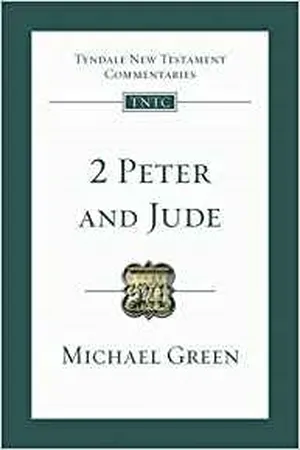
The Second Letter of Peter and the Letter of Jude both address false teaching - teaching that affects behaviour. The recipients had within their midst people whose lives contradicted the gospel that was preached. They defiled the love-feasts; they were themselves immoral and minimized the importance of law in the Christian life. They scoffed at the parousia and were fond of their own rhetoric. Michael Green offers a penetrating analysis that sets both letters in their historical context and shows their relevance to life today.
- English
- ePUB (mobile friendly)
- Available on iOS & Android
eBook - ePub
About this book
Information
Topic
Teología y religiónSubtopic
Cristianismo2 Peter: Commentary
Chapter One
a. Introduction and greeting (1:1–2)
1 Simon Peter. At the outset of a letter which will have to involve a good deal of rebuke, the author first identifies himself and then presents his credentials.
The combination of the two names appears to be a primitive trait; it is found in Matthew 16:16; Luke 5:8, and often in John (e.g. 21:15–17, where Jesus three times addresses his penitent disciple by his patronym, because the name Peter, ‘man of rock’, was so inappropriate at that juncture to one who had denied his Master). Some have seen in this combination of the two names an attempt to appeal both to Jewish and to Gentile readers, but it is hard to see any signs of different groups of recipients in the letter itself. Others think, with more probability, that the double name, if significant at all, is meant to draw the reader’s attention from the Jewish fisherman to the Christian apostle, from the old life to the new, from Simon, the name given him at his entry into the Old Covenant, to Peter, his distinctively Christian name.
The form ‘Symeon’, attested by Sinaiticus and Alexandrinus, is to be preferred to the normal spelling, Simon, attested by Vaticanus and Papyrus 72. It is the old Hebrew form, which is found elsewhere only in the Apostolic Decree (Acts 15:14) framed by James, the leader of the Jerusalem church. This Hebraism impresses some critics as a hallmark of authenticity (Bigg, Mayor, Zahn, James). Barnett, however, thinks it betrays ‘the pseudonymity of the letter. The author clearly wishes to be identified with the author of 1 Peter.’ He fails to explain why the pseudepigrapher clumsily chose a form of introduction different from that in 1 Peter, and why this supposedly deliberate archaism of Symeon never recurs in the pseudo-Petrine literature of the second century. J. A. T. Robinson is impressed by the Hebraism, and uses it to support his view that the Epistle was actually penned by Jude, the Lord’s brother. It would be natural, if so, that he should refer to ‘Symeon’ in precisely the same way as did his brother James in the Apostolic Decree (Acts 15:14).
The writer’s credentials are twofold. He is both a servant (i.e. ‘bondslave’) and apostle of Jesus Christ. Personal humility, so noticeable in 1 Peter, is combined with a sense of the authoritativeness of his apostolic position, and with good reason (see Matt. 10:40; John 20:21–23). ‘Apostle’ stresses his solidarity with Christ, ‘servant’ with his readers. The latter term prepares the way for his statement that they have obtained a faith as precious as ours. There is no distinction between believers. All alike are sinners who owe their presence in the heavenly city to the amnesty of the King. Isotimos can mean ‘of equal value’. Here it probably means ‘of equal standing’ (Abbott-Smith ‘equally privileged’). There is a political nuance to the word: there are no second-class citizens in God’s kingdom. The faith in question appears to be, pace Boobyer, not the faith as a body of doctrine, which would scarcely make sense in the context, but the faith or trust which brings a man salvation as he grasps the proffered hand of God. Faith is the God-given capacity to trust him, available alike to Jew and Gentile, to apostle and twentieth-century Christian. This equality of opportunity and status is all due to the righteousness of our God which refuses to make distinctions between the various recipients of his mercy and love. Peter’s use of righteousness (dikaiosynē) has none of the forensic overtones which we find in Paul. As in 1 Peter (2:24; 3:12, 14, 18; 4:18), so in this Epistle (2:5, 7–8, 21; 3:13) the word has the ethical associations which we find given to it in the Old Testament; here it means the fairness, the justice of God.
The phrase our God and Saviour Jesus Christ raises the question whether Peter is distinguishing God and Christ, or is in fact calling Jesus God. From the grammatical aspect, the two nouns are bound together in Greek by a single article, which strongly suggests that a single Person is meant. As Bigg points out, ‘it is hardly open for anyone to translate in 1 Peter 1:3 ho theos kai patēr by “the God and Father”, and yet here decline to translate ho theos kai sōtēr by “the God and Saviour”.’ Furthermore, in the other four cases where Peter writes of our Lord and Saviour (1:11; 2:20; 3:2, 18), it always clearly refers to Jesus. When Peter wishes to distinguish the two Persons (1:2) his construction is quite different: the knowledge of God and of Jesus our Lord. Probably, therefore, the author is calling Jesus God here. It is objected that nowhere in the Epistles is Jesus unambiguously called God. This may mean no more than that the New Testament writers were careful to guard against ditheism for, quite apart from some probable instances of the attribution ‘God’ to Jesus (John 1:1; 20:28; Rom. 9:5; 2 Thess. 1:12; Titus 2:13; Phil. 2:6; Heb. 1:8; 1 John 5:20), the early Christians were utterly convinced that Jesus embodied God. To claim with Paul that ‘in Christ all the fulness of the Deity lives in bodily form’ (Col. 2:9) is even more emphatic than simply calling Jesus God.
The word Saviour 1 is used here because Peter is building his plea for Christian development and his attack on Christian licence upon the fact that his readers have found salvation. It is the conviction of the whole Bible that every believer belongs to a God who saves. Saviour is one of the great names of God in the Old Testament. Peter is in fact boldly taking the Old Testament name for Yahweh and applying it to Jesus, just as he did in his sermon on the day of Pentecost (Acts 2:21).
2. Peter’s prayer for his readers is identical with that in 1 Peter 1:2. Grace and peace were Paul’s constant prayer for his Christian friends (Rom. 1:7; 1 Cor. 1:3; 2 Cor. 1:2, etc.), based, no doubt, upon the characteristic Greek and Hebrew greetings respectively. This is no barren formula to Peter, however, for he makes both the experience of God’s peace and the reception of his grace (or help) to be dependent upon the deep knowledge of God and of Jesus. In so doing, he is at one with both John and Paul. John 17:3 states emphatically that eternal life consists in knowing God and Jesus Christ whom he has sent; while Paul, who had for many years enjoyed this knowledge of God in Christ, still cherished the longing to know his Master better (Phil. 3:8, 10). For Christ’s gifts, such as grace and peace, cannot be enjoyed in independence of himself.
No doubt the insertion of knowledge here (it is not used in the greeting in 1 Peter) has a polemical thrust. It occurs three other times in 2 Peter (1:3, 8; 2:20). Elsewhere, apart from a single reference in Hebrews (10:26), it appears only in the later Epistles of Paul where it comes fifteen times. Peter was writing to people who claimed a real knowledge of God and of Christ, but continued in immoral behaviour. Knowledge may have been a catch-phrase of theirs which Peter takes up and fills with authentic Christian content. True knowledge of God and Christ produces grace and peace in the life; what is more, it produces holiness (v. 3). The whole New Testament unites in denouncing a profession of faith which makes no difference to behaviour.
The exact significance of the compound noun, epignōsis (as compared with the simple gnōsis), is disputed. Thus J. Armitage Robinson in his commentary on Ephesians 2 thought the difference between them to be that between abstract (gnōsis) and particular (epignōsis) knowledge. J. B. Lightfoot, however, defined epignōsis as a ‘larger and more thorough knowledge’ than gnōsis.3 In 2 Peter, at all events, Lightfoot’s understanding is more apposite than Robinson’s; for in each of the occurrences it is epignōsis of Jesus Christ that Peter is talking about. It is ‘the decisive knowledge of God which is implied in conversion to the Christian religion’ (Bultmann). A deeper knowledge of the Person of Jesus is the surest safeguard against false doctrine.
Of God and of Jesus our Lord. Many MSS read simply ‘in knowledge of our Lord’, possibly correctly. The shorter reading is generally preferable; it fits the singular his of verse 1:3; and elsewhere in this Epistle it is Jesus alone who is the object of knowledge (epignōsis). P72 omits the and, thus indicating one divine Person, Jesus and Lord. It is noteworthy that right at the outset of this letter Peter should strike the note of that knowledge of God and of Jesus Christ as Lord which is brought about in conversion, and issues in a life not of libertinism and error, but of growing conformity to the mind and life of Christ.
b. The Christian’s privileges (1:3–4)
The punctuation of these verses is a puzzle. Either, we may put a comma after verse 2, in which case verses 3 and 4 explain the greeting: grace and peace are multiplied in knowing him because God has given us all we need. Or we may put a full stop after verse 2. There is then no main verb in the sentence. Unless, therefore, the that (4) represents an old use of the imperative ‘see that you become’, we should regard the sentence as an anacoluthon; Peter began his sentence but never ended it grammatically. If so, NIV is correct in simply omitting the ‘that’.
3. The apostle is making their divine call the ground for his appeal for holy living. Christ has taken the initiative in calling them to himself (cf. Eph. 2:8). It is not entirely certain whether Jesus or the Father is conceived of as issuing the call and offering the divine power. There is a similar ambiguity in 1 John 2:28f. But Jesus is the last person mentioned, and so the glory and goodness are more appropriate to him than the Father. In either case, the point is that the One who calls, enables. He does not give us all we might like, but all that we need for life and godliness (cf. 1 Thess. 4:7f.). These gifts are enshrined in Jesus Christ himself, and in getting to know him we enjoy the power to live a holy life. But what is it that attracts a man to Jesus? His own unique (idiā) ‘glory and excellence’ (RSV). Jesus Christ calls men by his moral excellence (aretē 4) and the total impact of his Person (doxa 5). Perhaps Peter is looking back to the life of Jesus which made such an impression on him that he once cried, ‘Go away from me, Lord; I am a sinful man!’ (Luke 5:8), and that one of the major themes in his First Epistle was the imitation of Christ. No doubt he is thinking, too, of the glory of Jesus which shattered him at the transfiguration, to which he refers in verse 17. But it was not only the transfiguration which revealed the impact of Jesus’ Person. It was his whole life. That is why John was able to say ‘we have seen his glory, the glory of the one and only [Son], who came from the Father’ (John 1:14). It is not without significance that these two words, aretē and doxa, belong to God in the Old Testament (Isa. 42:8, 12, LXX); Peter claims them for Jesus, through whom the divine excellence and glory have been supremely manifested.
The text is once again uncertain. Some MSS read ‘through … his glory and goodness’ (dia, ‘through’, would be an easy mistake for idiā, ‘by his own’). They are wrong, for idios is a characteristic word of 2 Peter; it is used seven times in the Epistle. The datives are instrumental, by not ‘to’ (RSV).
4. There seem to be verbal allusions to 1 Peter in the words ‘call’, ‘glory’ and ‘excellence’ (goodness, NIV). Unusually, it does not seem to be God the Father who calls us in this instance, but Jesus himself, as in the Gospels. His person attracts men: his power enables them to respond. And, as 2 Clement v. 5 put it later, ‘the promise of Christ is great and marvellous.’ He is echoing Peter’s words here: he has given us his very great and precious promises. How has Christ done this? Through these, i.e. his own glory and goodness. The divine virtue and transcendent goodness manifested in Jesus both constitute and validate the call to come and participate in the divine nature. We are promised a share in his moral excellence during this life, and of his glory hereafter. For, taken together, the triple agency of the promises, the power and the person of the Lord Jesus regenerate a man and make him a sharer in God’s own nature, so that the family likeness begins to be seen in him.
But there must be the proper response to all this. We have already seen the place of faith (1:1). Now he speaks of its correlative, fleeing the world. By the world Peter means society alienated from God by rebellion (2:20; cf. 1 John 2:15–17; 5:19). We participate in the divine nature only after we have escaped or turned our backs on (note the decisiveness of the aorist participle) that attitude (cf. Jas 1:21). On the problems associated with this phrase and participating in the divine nature see Introduction, pp. 33f. The ancient world was haunted by the conception of phthora, corruption. The transitoriness of life, the pointlessness of it all, oppressed many of the best thinkers in antiquity (as it does today). Peter tells them that there is a way of escape—through Jesus Christ.
What contrasts these verses contain! Corruption and life and godliness; evil desires and knowledge of him who called us. Like Paul, Peter begins with the theological indicative. They are in God’s family; they have left the world; they possess precious promises; they know Christ. That is the basis for his ethical imperative, which comes so strongly in the succeeding verses. They must become in practice what they already are in God’s sight.
These two verses abound in rare and daring words. Peter is very subtly using language uncommon in the New Testament but full of meaning in the pagan world, as we know from Jewish literature and the Carian inscription.6 The false teachers laid emphasis on knowledge; so Peter stresses that the object of knowledge in the Christian life is the Lord who calls men. They thought that knowledge dispensed with the need for morality, so Peter emphasizes two words common in pagan circles for ethical endeavour, eusebeia (godliness) and aretē (goodness). They appear to have thought that holiness of living was impossible (see 2:19–20), so Peter speaks to them of the divine power, a Hebrew periphrasis for God. Rival pagan schoolmen asserted that you escaped from the toils of corruption (phthora) by becoming participants in the divine nature either by means of nomos (‘lawkeeping’) or physis (‘nature’). Peter takes up their language, and replies that it is by sheer grace. Did the false teachers, Gnosticwise, suggest that their adherents became more godlike as they escaped the trammels of the material world? Far from it, says Peter. Participation in the divine nature is the starting-point, not the goal, of Christian living. He writes to those who have escaped from the seductive allegiance to society at odds with God.
Peter is assuredly sailing very close to the wind in using pagan language in this polemical way; it is not surprising that his letter has been treated with great misgiving in many quarters as a result. The most daring phrase of all is, of course, participate in the divine nature, which has a deliberately Hellenistic ring about it, for this polemical reason.7 But in substance it is saying much the same as John 1:12. Peter does not mean that man is absorbed into the deity; that would at the same time dissolve personal identity and render impossible any personal encounter between the individual and God. But as in 1 Peter, he speaks of a real union with Christ. If we are partakers of Christ’s sufferings (1 Pet. 4:13), and partakers of the glory that shall be revealed (1 Pet. 5:1), it is because we are partakers of Christ. What Peter is saying here, though couched in this unusual form, is just the same in content as Paul’s claim in Romans 8:9; Galatians 2:20; John’s, in 1 John 5:1; and his own, in 1 Peter 1:23. It paves the way for Ignatius, a few years later, to say that Christians ‘partake in God’. To repent, believe and be baptized into Christ is, so the whole New Testament asserts, to enter into a totally new relationship with God, in which he b...
Table of contents
- Tyndale New Testament Commentaries
- 2 Peter and Jude
- Contents
- General Preface
- Author’s preface to the first edition
- Author’s preface to the second edition
- Chief Abbreviations
- Select Bibliography
- Introduction
- 2 Peter: Analysis
- 2 Peter: Commentary
- Chapter Two
- Chapter Three
- Jude: Analysis
- Jude Commentary
- Notes
Trusted by 375,005 students
Access to over 1.5 million titles for a fair monthly price.
Study more efficiently using our study tools.
Frequently asked questions
Yes, you can cancel anytime from the Subscription tab in your account settings on the Perlego website. Your subscription will stay active until the end of your current billing period. Learn how to cancel your subscription
No, books cannot be downloaded as external files, such as PDFs, for use outside of Perlego. However, you can download books within the Perlego app for offline reading on mobile or tablet. Learn how to download books offline
Perlego offers two plans: Essential and Complete
- Essential is ideal for learners and professionals who enjoy exploring a wide range of subjects. Access the Essential Library with 800,000+ trusted titles and best-sellers across business, personal growth, and the humanities. Includes unlimited reading time and Standard Read Aloud voice.
- Complete: Perfect for advanced learners and researchers needing full, unrestricted access. Unlock 1.5M+ books across hundreds of subjects, including academic and specialized titles. The Complete Plan also includes advanced features like Premium Read Aloud and Research Assistant.
We are an online textbook subscription service, where you can get access to an entire online library for less than the price of a single book per month. With over 1.5 million books across 990+ topics, we’ve got you covered! Learn about our mission
Look out for the read-aloud symbol on your next book to see if you can listen to it. The read-aloud tool reads text aloud for you, highlighting the text as it is being read. You can pause it, speed it up and slow it down. Learn more about Read Aloud
Yes! You can use the Perlego app on both iOS and Android devices to read anytime, anywhere — even offline. Perfect for commutes or when you’re on the go.
Please note we cannot support devices running on iOS 13 and Android 7 or earlier. Learn more about using the app
Please note we cannot support devices running on iOS 13 and Android 7 or earlier. Learn more about using the app
Yes, you can access 2 Peter & Jude by Michael Green in PDF and/or ePUB format, as well as other popular books in Teología y religión & Cristianismo. We have over 1.5 million books available in our catalogue for you to explore.