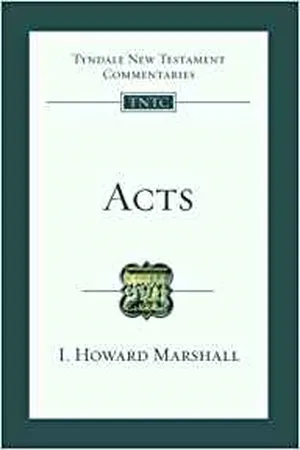
In the book of Acts, the story of Jesus begun in the Gospel of Luke broadens into the story of the Holy Spirit, guiding the fledgling church to proclaim the saving reality of Jesus. While attentive to Luke's roles as a literary artist and theologian, I. Howard Marshall focuses primarily on Luke's role as a historian. He provides the reader with an accurate, balanced and holistic picture of the church's monumental first years as it sought to fulfil Christ's mandate to preach the gospel to the ends of the earth.This classic commentary has been completely retypeset and presented in a fresh, vibrant new large paperback format, with new global branding.
- English
- ePUB (mobile friendly)
- Available on iOS & Android
eBook - ePub
About this book
Information
Topic
Theology & ReligionSubtopic
Christianity2. The Church and the Jewish Authorities (3:1–5:42)
a. The healing of a lame man (3:1–10)
The main theme of Acts 3–5 is the way in which the witness of the first Christians brought them into conflict with the Jewish leaders, who fruitlessly attempted to put a stop to their preaching. Two such incidents are recorded (3:1–4:31; 5:12–42) which are separated by an account of one of the internal problems of the Christian community (4:32–5:11). On each occasion the power of the apostles to perform miracles led to an attempt by the Jews to stop them. There is sufficient similarity between the two stories (along with other material in chapters 1–2) to make some scholars suspect that we have two separate but parallel accounts of the same basic events, but the differences are sufficient to outweigh the similarities. The first incident falls into three parts. The story of a miracle is followed by an explanatory discourse by Peter (compare the similar pattern found several times in the Gospel of John, e.g. John 6:1–24/25–59), and then by the story of the arrest of the apostles.
The healing story itself is similar to those related in the Gospels, but is related with a fair amount of detail. Peter is able to do the kind of thing that Jesus did by acting in the name of Jesus: thus the continuity between the ministry of Jesus and the witness of the church is expressed. One may also note how this incident and others in the career of Peter have counterparts in the career of Paul (14:8–10). But the main point in the story is the continuing power of the name of Jesus to perform the same gracious and healing acts which were signs in the Gospels of the coming of the kingdom or rule of God.
1. The story provides an example of the wonders and signs mentioned in 2:43 and takes place in the context of the visits to the temple mentioned in 2:46. The ninth hour, 3.00 pm, was the time of the afternoon sacrifice which was accompanied by prayer by the congregation (2:46 note). The mention of John alongside Peter has puzzled some commentators, since he plays no significant part in the story, and it has been suspected that his name is an addition to the story (cf. verse 4, where it is almost an afterthought), perhaps to provide two witnesses to defend the Christian cause before the Sanhedrin later in the story. But the presence of John can equally well be historical in view of the early Christian habit of working in pairs and of the association of John (the son of Zebedee, Luke 5:10) with Peter (1:13); since no convincing reason for the addition of the name has been given, it probably rests on tradition.
2. The occasion for the healing miracle arose from the presence of a man who was being carried at the same time by his friends in order that he might be laid down to beg at the entrance to the temple. Since the giving of alms was a particularly meritorious act in Jewish religion, it would be appropriate for a beggar to place himself where pious people might be expected to pass on their way to worship. The fact that the man had been lame from birth underlines the wonder of the miracle which was about to be performed. Some uncertainty surrounds the identity of the Beautiful Gate of the temple. There are three possibilities: (1) The ‘Shushan’ Gate which was on the east side of the wall enclosing the whole of the temple; it gave access from outside the temple to the Court of the Gentiles. (2) Within the Court of the Gentiles was the Court of the Women, to which there was an access on the east side; only Israelite men and women were allowed within this court. Josephus tells us that the ‘Nicanor’ Gate (otherwise known as the Corinthian Gate, and made of bronze) was situated here, and most scholars regard this as the Beautiful Gate. (3) From the Court of the Women a further gate led to the Court of Israel, into which only Jewish men were admitted. The rabbinic sources call this the Nicanor Gate, but there is some evidence that their picture of the temple is a confused one. Most scholars adopt view (2).1 Christian tradition from the fifth century favours view (1), but it has been pointed out that the east gate of the temple complex would have been a poor place for collecting alms; far more people would enter the temple from the west side, direct from the city.
3–5. The beggar began to call out for alms from the people entering the temple, and these included Peter and John. They replied by suggesting that they would have something to offer him, and the man then directed his attention to them. The description is perhaps a little pedantic at first sight, but Stählin, p. 59, rightly comments that the narrative shows how the beggar’s usual feelings of uncertainty, expressed in a combination of pressing entreaty and of indifference resulting from frequent disappointment, are replaced by a genuine expectation of receiving something. What could have been simply the occasion of mechanical charity is turned into a personal encounter as the lame man and the apostles look intently at one another.
6. Peter’s reply, with its deliberate word-order ‘Silver and gold I do not have’ (NIV), would initially disappoint the hopes that had been raised, but it was swiftly followed by an offer of something better. What Peter could offer was healing, and this he gave by commanding the man to walk. ‘In the name of Jesus’ (2:38 note) here means ‘by the authority of Jesus’. Similar formulae were used in ancient magic, but that does not make Peter’s phrase into a magic formula. Here the thought is of the continuing power of Jesus which has been bestowed upon the apostles; Jesus himself had no need to appeal to a higher authority such as the name of God (see further 3:16; 4:10). It is to be noted that Peter did have access to silver and gold (2:45); the point was that in this case he could offer something better that went to the root of the man’s problem. The story is in no sense a prohibition of giving material help to the poor and needy, nor should it be used to suggest that the church should offer spiritual salvation rather than physical or material help—it is after all physical healing rather than spiritual salvation which is given here! There is, however, a lesson about the church’s priorities.
7–8. Peter’s invitation was accompanied by a hand outstretched to raise the beggar to his feet, and the miracle took place as the man’s joints were cured and became active. He was able not merely to stand, but to walk and leap for joy, and his first action, when healed, was to accompany the apostles into the temple and praise God in thankfulness for what had happened to him. As in the lifetime of Jesus, so now the scripture was being fulfilled: ‘then shall the lame man leap like a hart’ (Isa. 35:6).
9–10. The sight of the once-lame man walking and praising God was proof to the crowds that he had been truly cured. He was such a well-known figure after his years of begging that there could be no doubt about his identity and therefore about the reality of the cure. Although a description of wonder and amazement is a stereotyped feature at the end of the story of a miracle (e.g. Luke 4:36; 5:9, 26; 7:16), this is precisely the reaction that would be expected. Such a reaction, however, is not necessarily the same thing as faith in the One who performed the miracle; one can be impressed by the spectacular without responding to what it signifies, the power and the grace of God.
b. Peter explains the incident (3:11–26)
The pattern of incidents on the day of Pentecost repeats itself as the unusual event is followed by a speech of Peter to the astonished people, which begins by explaining what has just happened. In this case Peter again begins by dealing with a possible misunderstanding of the situation and then proceeds to explain how the power of Jesus, raised from the dead, has healed the man. He seizes the opportunity to press home the point that it was the Jesus whom the Jews had killed who had been glorified by God and was now still active. There the speech might have stopped, having accomplished its immediate purpose, but Peter was too keen an evangelist to let a valuable opportunity slip. Having already begun to convict his hearers of their share in putting Jesus to death, he went on to argue that they had acted ignorantly. In reality God was accomplishing his plan for the Messiah, and so it was now possible for the Jews to repent and look forward to the blessings associated with the return of Jesus. This appeal was reinforced by an appeal to prophecy: Jesus was the prophet whose coming was foretold by Moses. Disobedience to him would lead to judgment. At the same time, however, those who were listening to Peter were the inheritors of God’s covenant and had, as it were, first claim on the blessings brought by Jesus. Let them, then, turn away from their wickedness and accept Jesus as the Messiah. Although nothing is said explicitly, there is probably the implication that if the Jews will not listen, the blessings of the gospel will be offered elsewhere.
The particular interest of this sermon lies in the way in which it gives further teaching about the person of Jesus, describing him as God’s servant, the Holy and Righteous One, the Author of life and the prophet like Moses. This indicates that a considerable amount of thinking about Jesus, based on study of the Old Testament, was taking place. While some scholars would attribute this maturity of thinking to Luke himself, there is good reason to believe that it belongs to the primitive church, in the first years of whose existence there took place an unparalleled development in theological thinking. The other main theological element in the speech, the association of blessings with the parousia, is unparalleled, and this is a further sign that here we have primitive tradition.
11. The healed man kept close to his benefactors, and the people came towards them in crowds when they reached the colonnade of Solomon which ran along the east side of the Court of the Gentiles. If the man had been healed at the Shushan Gate, this would be immediately adjacent. If the healing took place on the way into the Court of the Women, then we must presume that by this time Peter and his companions were on their way out again. This would be natural enough, since the Court of the Women would be a less suitable place for a public meeting, and Luke saw no need to fill in every detail of the actors’ movements.
12. Peter grasped the opportunity to explain the significance of what had happened. If what follows represents what Luke thought that he probably would say, rather than being a summary of his remarks, it certainly catches the spirit of the occasion. Peter seizes on the way in which the crowds were quite naturally gazing at John and himself as the possessors of the remarkable power which had healed the man. They would have regarded them either as being possessed of remarkable powers of their own or as being so devout that God would respond to their prayers with miraculous signs. But, whatever they thought, Peter wanted to direct their attention away from the apostles to the source of the miracle.
13. The immediate explanation does not come until verse 16; first of all, Peter had to set the scene. Ultimately what had happened was due to the action of God, the very same God who had revealed himself to the patriarchs and constituted himself the God of the people of Israel; the reason for stressing this will become apparent in verses 25f. This God had glorified his servant, a phrase drawn from Isaiah 52:13, the first verse of the last and most important of the passages dealing with the Servant of Yahweh. In other words, prophecy was now being fulfilled, for Peter was claiming that what had happened to Jesus was the divine glorification of God’s Servant. The identification of Jesus as the Servant is found in 3:26, 4:27, 30. These are the only places in the New Testament where the name is applied to him, but the prophecies about the suffering of the Servant are cited or alluded to in Mark 10:45; 14:24; Luke 22:37; John 12:38; Acts 8:32f.; 1 Peter 2:22–24; and elsewhere. This combination of references suggests a primitive understanding of Jesus which is remarkably absent from the Letters and later writings.
It might seem odd to declare that Jesus had been glorified as God’s Servant. After all, he had died on a gallows. But Peter insisted that this had taken place because of the action of the Jews themselves in denying him when he was on trial before Pilate, even though Pilate regarded him as innocent of any capital crime and wanted to release him (cf. 13:28).
14–15. Peter presses home his point against the Jews. He has already dwelt on the enormity of the Jews’ action in condemning an innocent man to death. Now he emphasizes that the One who was thus denied by the Jews was Holy and Righteous. It is not clear whether these would have been regarded by the Jews as attributes of some particular person or functionary. The full phrase ‘the holy one of God’ is used of Elisha (2 Kgs 4:9) and Aaron (Ps. 106:16), and is used in a unique way of Jesus as a confession by demons (Mark 1:24) and men (John 6:69); it recurs as a designation of Jesus in 1 John 2:20 and Revelation 3:7, and this suggests that Christians regarded it as a title for the Messiah. Here, however, the point may be simply to underline the fact that Jesus belonged in a special way to God (cf. Luke 1:35; Acts 4:25, 27). Similarly, the use of righteous stresses the moral uprightness of Jesus (7:52; 22:14; 1 John 2:1); there may well be a link with the description of God’s Servant in Isaiah 53:11. By contrast, it was a murderer, Barabbas, whom the Jews wished to have released by Pilate (Luke 23:25). Then once again the contrast is made with Jesus who is called the Author of life. The word archēgos recurs in 5:31 (cf. Heb. 12:2) where it has more the sense of a leader, but here (cf. Heb. 2:10) it seems to mean ‘source’ or ‘originator’. The thought of salvation as life (both words represent the same Aramaic word) is found here and in 5:20; 11:18; 13:46, 48; here there is probably a deliberate antithesis with you killed. But God raised him from the dead—this was his ‘glorification’ (verse 13)—as the apostles could testify.
16. Against this background the healing of the lame man could now be understood. The Greek construction is obscure and the sentence is repetitious. Two basic points are clearly made, however. First, the miracle which resulted in a well-known man being made perfectly sound in body before the very eyes of the crowd depended on the power associated with the name of this Jesus. Second, this power became effective through faith in the name of Jesus. Such faith was possible through Jesus: the proclamation of his power made it possible for people to believe. True, we are not told in the story that the man displayed faith, but the way in which he praised God after his cure could well imply this; alternatively, the faith might be that of Peter. In any case, any suggestion that there was something magical about the miracle is deliberately ruled out.2
17. The immediate occasion of the speech has now been dealt with. But, having already spoken of the guilt of the Jews in this section, Peter could not leave the matter there, and he now moves over into the specifically evangelistic and hortatory part of the speech. He begins by conceding that what the Jews and their leaders had done to Jesus sprang from ignorance (13:27; cf. 1 Cor. 2:8) and, therefore (it is implied), it could be forgiven (Luke 23:34; 1 Tim. 1:13). The unspoken thought is that, if the Jews now fail to admit their sin committed in ignorance and repent of it, it will become a witting sin which is much more culpable (the Mosaic law made no explicit provision for atoning for such sins).
18. Yet what the Jews did in ignorance had in reality furthered the plan of God, foretold by the prophets, that the Messiah should suffer (2:23; 17:3; 26:22f). Luke is fond of the phrase all the prophets (3:24; 10:43; Luke 24:27), but we may well ask how references to the suffering of the Messiah can be found in literally all the prophets. The phrase is doubtless to be taken hyperbolically. Since the Old Testament nowhere speaks of a suffering Messiah (even the term ‘Messiah’ does not occur as a title in the Old Testament) we should probably think primarily of the teaching about the suffering of God’s Servant (Isa. 53), and also of other passages in the prophets and the Psalms which may have been taken as typological or prophetical of the sufferings of the Messiah (Jer. 11:19; Dan. 9:26; Zech. 13:7; Pss. 22, 69); this would give us material from three of the four books of the ‘latter prophets’ (Isaiah, Jeremiah, and the Book of the Twelve; omitting Ezekiel) and also from the Psalms.
19. God’s action has now created the conditions in which the Jews may repent and be forgiven for their sins. The meaning of repent (2:38) is clarified by the addition of turn again (RSV) or rather ‘turn to (sc. God)’ (so other modern versions). This verb signifies the act of turning away from one’s former way of life, especially from the worship of idols, to a new way of life, based on faith and obedience to God (9:35; 11:21; 14:15; 15:19; 26:18, 20; 28:27; cf. Isa. 6:10; Joel 2:12–14). The immediate result will be the ‘blotting out of their sins’; the list of accusations against them will be obliterated (cf. Col. 2:14), which is another way of saying that their sins are forgiven (2:38).
Two further results will follow. The first (verse 19b in RSV, NEB; verse 20a in GNB, NIV) is that times of refreshing will come from the Lord. This is a unique phrase which commentators generally take to refer to the final era of salvation. If so, the plural times may perhaps indicate the length of the period in question (cf. perhaps the ‘times of the Gentiles’, Luke 21:24). There may be a link with the ‘times’ in 1:7 associated with the restoration of the rule of God for Israel.
20–21. The second result will be the coming of Jesus from heaven. He is described as ‘the Messiah foreordained for you’, i.e. for the Jews; some scholars have taken this to mean that Jesus has been foreordained to become the Messiah at the parousia, the implication being that this is a piece of primitive Christology which envisaged Jesus as becoming Messiah only in the future at the parousia. But this is a faulty understanding of the text. It states rather that the Jesus who will return at the parousia is the one who had already been ordained as the Messiah for the Jews. That is to say, the coming of the ‘messianic age’ or the future kingdom of God, for which the Jews longed, was dependent upon their acceptance of Jesus as the Messiah. Yet the parousia would not happen immediately. It could not in any case take place until the times of the fulfilment of all that God had spoken by the prophets right back from the beginning. The word ‘fulfilment’ (RSV establis...
Table of contents
- Tyndale New Testament Commentaries
- Acts
- Contents
- General Preface
- Author’s preface
- chief Abbreviations
- bibliography
- introduction
- analysis
- commentary
- 2. the church and the jewish authorities (3:1–5:42)
- 3. the church begins to expand (6:1–9:31)
- 4. the beginning of the gentile mission (9:32–12:25)
- 5. the mission to asia minor and its aftermath (13:1–15:35)
- 6. paul’s missionary campaign in macedonia and achaia (15:36–18:17)
- 7. paul’s missionary campaign in asia (18:18–20:38)
- 8. paul’s arrest and imprisonment (21:1–28:31)
Trusted by 375,005 students
Access to over 1.5 million titles for a fair monthly price.
Study more efficiently using our study tools.
Frequently asked questions
Yes, you can cancel anytime from the Subscription tab in your account settings on the Perlego website. Your subscription will stay active until the end of your current billing period. Learn how to cancel your subscription
No, books cannot be downloaded as external files, such as PDFs, for use outside of Perlego. However, you can download books within the Perlego app for offline reading on mobile or tablet. Learn how to download books offline
Perlego offers two plans: Essential and Complete
- Essential is ideal for learners and professionals who enjoy exploring a wide range of subjects. Access the Essential Library with 800,000+ trusted titles and best-sellers across business, personal growth, and the humanities. Includes unlimited reading time and Standard Read Aloud voice.
- Complete: Perfect for advanced learners and researchers needing full, unrestricted access. Unlock 1.5M+ books across hundreds of subjects, including academic and specialized titles. The Complete Plan also includes advanced features like Premium Read Aloud and Research Assistant.
We are an online textbook subscription service, where you can get access to an entire online library for less than the price of a single book per month. With over 1.5 million books across 990+ topics, we’ve got you covered! Learn about our mission
Look out for the read-aloud symbol on your next book to see if you can listen to it. The read-aloud tool reads text aloud for you, highlighting the text as it is being read. You can pause it, speed it up and slow it down. Learn more about Read Aloud
Yes! You can use the Perlego app on both iOS and Android devices to read anytime, anywhere — even offline. Perfect for commutes or when you’re on the go.
Please note we cannot support devices running on iOS 13 and Android 7 or earlier. Learn more about using the app
Please note we cannot support devices running on iOS 13 and Android 7 or earlier. Learn more about using the app
Yes, you can access Acts by Howard Marshall in PDF and/or ePUB format, as well as other popular books in Theology & Religion & Christianity. We have over 1.5 million books available in our catalogue for you to explore.