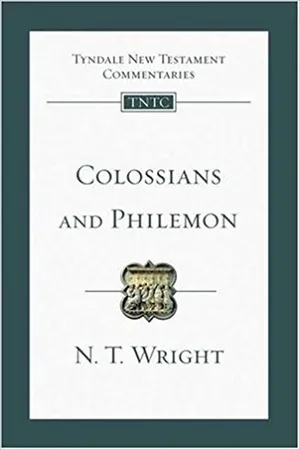
Colossians presents a picture of Christ who is 'the firstborn over all creation' and has disarmed and triumphed over the powers and authorities. The letter also appeals to its readers to seek humble maturity, a maturity not possible apart from the person and work of Jesus Christ. N. T Wright's stated goal is to 'to give the text back to the reader uncluttered by a mass of glosses'.In Philemon, Paul makes a personal appeal to a fellow believer to receive a runaway slave, Onesimus, in love and forgiveness. For Wright, it is 'an acted parable of the gospel itself'. This classic commentary has been completely retypeset and presented in a fresh, vibrant new large paperback format, with new global branding.
- English
- ePUB (mobile friendly)
- Available on iOS & Android
eBook - ePub
About this book
Information
Topic
Theology & ReligionSubtopic
ChristianityCOLOSSIANS: COMMENTARY
1. OPENING GREETING (1:1–2)
Letters today have the sender’s name at the end. In Paul’s day, it came at the beginning, and was followed by a greeting to the recipients. The form is ‘Paul; to the church in Colosse; greeting’. But the apostle has, as usual, expanded traditional style to set, right away, the scene and tone for what he wishes to say.
1. Paul does not come before the Colossians simply as a private individual, but as an apostle of Christ Jesus. Unlike most of the other apostles, he had not been a follower of Jesus during his earthly ministry; but he had been appointed, through his own vision of the risen Lord, to an office which, like theirs, gave him a special authority not only in churches he had founded himself but even in those which, like that in Colosse, he had not. It is this God-given authority which undergirds the continuing use of his writings as authoritative Scripture in the church. The supporting claim, that this apostleship came about by (literally ‘through’) the will of God, is not merely an indication of the ultimate source of this authority, but a linking of Paul’s task to the over-arching divine plan of salvation which, prepared in the Old Testament and brought to a climax in the life, death and resurrection of Jesus Christ, was now being put into effect through the world-wide mission in which Paul had been allotted a key initiating role (see below, on 1:23).
Timothy our brother is included in the greeting, here and in the opening verses of 2 Corinthians, Philippians, 1 and 2 Thessalonians and Philemon. Among the most prominent of Paul’s partners, travelling companions and assistants, Timothy shared a close bond of affection and mutual understanding with Paul, which is of course reflected in the two letters addressed to him personally, as well as in, e.g., 1 Corinthians 16:10–11; Philippians 2:19–23.
2. The letter is addressed to the holy and faithful brothers in Christ at Colosse; not that Paul is differentiating between them and other Christians who were not ‘holy and faithful’ (‘brother’ is a frequent New Testament term for ‘fellow-Christian’, reflecting the fact that the church understood itself from the start as a family), but he looks at the church, with all its imperfections, from God’s point of view (compare 1 Cor. 1:4–9, in the light of the rest of that letter). ‘Holy’ could be an adjective, as in NIV; it could be a noun (‘saints’), as in RSV (‘the saints and faithful brethren’); but even if this were so it would be quite wrong to see two different groups here. The ‘and’ would be, as often, explanatory (‘the saints, i.e. the faithful brethren’). Paul often refers to Christians as ‘saints’, indicating thereby not an advanced level of holiness but the fact of being, through faith and baptism (see below, on 2:12), set apart from the world for God. The terms belong to the church as a whole, seen as the true people of God, the ‘real Israel’.1 The word ‘faithful’ is probably not to be taken in the sense of ‘having Christian faith’—one could have deduced that from the fact that Paul calls them ‘brothers’—but in the sense of ‘firmly committed’, ‘steadfast’. The two phrases ‘in Christ’ and ‘in Colosse’ (‘at’ in NIV translates the Greek en, ‘in’) are nicely balanced in the Greek, standing on either side of the central phrase ‘holy and faithful brothers’. This encourages us to take ‘in Christ’ in a locative sense, i.e. neither merely as a synonym for ‘Christian’ nor in a sense of ‘mystical absorption’, but as referring to the Messiah, the anointed King, in whom the true people of God find their identity. To be described as ‘in Christ’ and ‘in Colosse’ is to be located with precision in the purposes of God, as a member both of his true people and of that particular earthly community where one is called to service and witness.
Paul is writing to the Colossians with one great desire—that they should grow into full Christian maturity. It is in that light that his greeting is to be understood: grace and peace to you from God our Father2 (this is an adaptation of conventional greetings formulae). ‘Grace’ sees Christian life and growth as the free gift of God; ‘peace’, with the overtones of the Hebrew word šālôm, encompasses not merely personal ‘peace’ of mind and heart, but all the wider blessings of belonging to God’s covenant family. The scene is set for a letter through which Paul intends, by his writing, to be a means of that grace, and so to bring about that rich and mature peace (see e.g. 3:15).
2. INTRODUCTION OF PAUL AND HIS THEME (1:3–2:5)
This long introduction is often split up into almost unrelated parts (with 1:15–20 in particular being disassociated from the rest). But it is in fact a complex whole, at the end of which Paul is ready to move in to the heart of the letter. In it all, Paul is really introducing himself, so that the young church will understand that his writing to them at this time is simply one outflowing of his total God-given ministry. He says, in effect, ‘this is how I am thanking God for you’ (1:3–8), ‘this is how I am praying for you’ (1:9–23) and ‘this is what I am doing for you’ (1:24–2:5). In introducing himself like this he lays foundations for the main thrust of the letter, the maturity in Christ into which he hopes the Colossians will grow. Theologically, these foundations look like this: he tells the church that he thanks God for founding it (1:3–8), that he wants them to thank God for his great plan of salvation (1:9–20) and to appreciate where they fit into it (1:21–23) as well as the role of his own ministry within it (1:24–2:5). The ‘therefore’ of 2:6 shows that he is at that point ready to build on this carefully-laid foundation, bringing together God’s gospel, the Colossian situation and his own vocation.
The exhortation of 2:6 (‘just as you received Christ Jesus as Lord, continue to live in him’) is therefore much more than the rather obvious piece of advice which, taken out of context, it might appear to be. We will know, in fact, that we have understood 1:3–2:5 correctly when we discover that it has prepared us to give 2:6 its full value. When Paul there mentions ‘Christ’, the word is no mere empty cipher: it is the Christ of 1:15–20, in whom is true maturity (1:28), who is himself ‘the mystery of God’ (2:2), God’s eternal secret plan for creating and redeeming the world. This large view of Christ must be kept in mind throughout.
A. Thanksgiving (1:3–8)
Paul is able to address the Colossians as ‘brothers in Christ’, and to hope with confidence for God’s grace and peace to be given to them, because he knows that God has already been at work amongst them. His characteristic way of mentioning this is not simply to remark that he has heard of their conversion, but to tell them that he thanks God for it. His extended introductory thanksgivings and intercessions—or rather, introductory descriptions of thanksgivings and intercessions—are thus an important feature of many of his letters (this is particularly true of Colossians, where thanksgiving forms an important theme: see 1:12ff.; 2:7; 3:15, 16, 17; 4:2). They are not ‘asides’, devotional musings detached from the main emphasis of the letter. They form, quite deliberately, the logical basis for what is to come. They illustrate, in addition, the principle they state. What is worked for must first be prayed for. The source of all peace is grace.
The detailed structure of the thanksgiving in verses 3–8 highlights the same point in a more precise way. After the initial statement that he is in constant prayer for them (v. 3), which is reiterated in v. 9 when Paul tells them the content of these intercessions, he outlines what it is that he thanks God for when he remembers them (vv. 4–5) and how it is that these things have come about (vv. 6–8). The paragraph gives us a valuable insight into Paul’s understanding of how God’s grace operates. The gospel, seen almost as a personified force, is at work in the world through those commissioned to proclaim it; where its truth is recognized and its command obeyed, it bears fruit. In a world where many varied ‘religious experiences’ were on offer, Paul gives the Colossians the theological framework of understanding within which they will be able to make sense of what God has been doing in their lives. Without this framework, experience remains ambiguous and even potentially misleading.
3. Though NIV and RSV both take always with we thank God, it goes more naturally in the Greek with when we pray for you: Paul is continually praying about the church in Colosse, and whenever he does so he thanks God. It is likely that the word ‘always’ indicates regularity, not that such prayers occupied all Paul’s waking hours; he does not pray haphazardly or only when the mood takes him, but keeps regular hours of prayer (probably morning, noon and evening), and the church in Colosse is always mentioned. In this discipline of thanksgiving and intercession he was simply continuing a practice ingrained since his childhood—though of course (he would say) filling that practice with new content.
By praying to the God of Abraham, Isaac and Jacob as the Father of our Lord Jesus Christ, he is indicating that subtle but far-reaching development in his belief about God which took place when, on the road to Damascus, he was confronted with the fact that the God he had worshipped all his life had vindicated as Christ (i.e. Messiah) the Jesus whom he, Paul, had regarded as an impostor. Though Judaism knew God as Father, the precise nature of his paternal love could not be conceived until it had been revealed in the cross of the Messiah. Nor could that cross be understood, conversely, until it became clear that it was the climax of the saving plan of the God of Israel, and that therefore this God had now exalted the crucified one and given him the title ‘Lord’ (Greek kyrios). The familiar composite title for Jesus (‘our Lord … Christ’) is not, then, merely a heaping up of honorific phrases, but a very precise statement of who Jesus is from God’s, and the church’s, point of view. For Paul this meant nothing less than a new vision of God himself, which naturally began, as here, to be reflected in the nature and content of his prayers.1
4. As in various other passages (1 Cor. 13:13; 1 Thess. 1:3; 5:8), Paul draws together the three virtues of faith, hope and love. These are the things in the Colossian church for which he thanks God, both because they are fine and lovely in themselves and because they are signs of that new life which is springing up in Colosse: signs of peace and hence evidences of grace. But, unlike 1 Corinthians 13:13 (but like the two references in 1 Thessalonians), the order is ‘faith—love—hope’. The phrase is not a mere formula, thrown in for effect, but a genuine statement in which each word counts. Each quality has its part to play in the development of the letter’s thought (for faith, see 1:23; 2:7; for love, 1:8, 13; 2:2; 3:14; for hope, 1:23, 27).
Each is now further described. Faith is not just (as often today) any religious belief. It is defined as faith in Christ Jesus. This phrase (which could have the connotation of the sphere in which faith operates rather than, as an English reader tends to assume, the object of faith) is one of Paul’s regular shorthand ways of describing characteristically Christian faith.2
Faith, for Paul, includes not only personal trust and commitment, but also the belief that certain things are true (see e.g. Rom. 10:9). These are brought together in, for instance, Romans 4:24 (belief in the God who raised Jesus). The present context emphasizes the truth of the gospel as something to be heard and acknowledged with the mind (vv. 5–6), and so stresses if anything the ‘belief’ side, though by no means at the expense of ‘commitment’. ‘Belief’, if genuine, is more than just mental assent to truths.
For Paul, the sure sign of grace at work was the fact of a loving community created out of nothing: of a love not restricted to those with whom one has a natural affinity, but which extends to all the saints. It is this—perhaps after all in keeping with 1 Corinthians 13–which Paul singles out in verse 8 as the main element in the news brought to him by Epaphras.
5. Hope here apparently refers not so much to the state or activity of hoping as to the thing hoped for. It is the hope that is stored up for you in heaven (cf. 1 Pet. 1:4, and especially 2 Tim. 4:8). But how is the ‘hope’ connected to the previous verse? RSV (‘because of the hope’) preserves the ambiguity of the original, while NIV has attempted to clarify it by paraphrasing: ‘the faith and love that spring from the hope …’ If this is correct—as grammatically it may be—it is an interesting and unusual idea. Paul normally sees faith and love, and hope, as together springing from the gospel, the facts about Jesus Christ. But the further references in 1:23, 27 may indeed suggest that Christian hope had formed a central part of Epaphras’ initial preaching in Colosse. This element in Christianity would be quite new, and very attractive, for a pagan of the first century. So NIV may well have caught Paul’s underlying meaning. The solid facts about the future hope of Christians are a powerful motivation for constant faith and costly love in the present. Paul does not say here what precisely it is that Christians hope for: it is not completely clear whether he envisages a heavenly realm already in existence waiting to be enjoyed by believers, or whether he simply refers to God’s intention, and promise, concerning the bliss which he will give to his people. Galatians 4:26, however, encourages us towards the former view.
Paul uses the mention of hope as a bridge from the description of Christian existence in verses 4–5a to the description—still within the overall thanksgiving—of how this new life came about. The ‘hope’ is that which you have already 3 heard about in the word of truth, the gospel. ‘The gospel’, for Paul, is an announcement, a proclamation, whose importance lies in the truth of its content. It is not, primarily, either an invitation or a technique for changing people’s lives. It is a command to be obeyed 4 and a power let loose in the world (cf. Rom. 1:16–17), which cannot be reduced to terms of the persuasiveness or even the conviction of the messenger. It works of itself to overthrow falsehood. It is, of course, quite likely that Paul has in mind a contrast with the false claims he opposes in chapter 2.
6. As Paul looks at the young church, what he sees is what God is doing: for, in personifying ‘the gospel’, he is really using a paraphrase to refer to the divine action through the gospel (and, of course, through its proclaimers, as in v. 7). The gospel has come to you: God has reached out to them, has visited them with his saving power, as indeed all over the world this gospel is producing fruit and growing. Paul does not, of course, mean that every square mile of the inhabited earth has been evangelized (see below, on 1:23). From his perspective as a converted Pharisee the important point was that the salvation promised in the Old Testament had now been unleashed upon the world irrespective of geographical or racial barriers. His own missionary activity was an embodiment of this truth, as Ephesians 2:11–3:13 indicates. It is in that sense that the individual churches are ‘representatives’ of the Gentile world as a whole. They were for Paul a sign and promise of the universal scope of God’s saving purposes and hence of still greater things to come.
The gospel, treated metaphorically as a person at the start of verse 6, now becomes a plant which, like the good seed in the parable, bears fruit and grows.5 This is one of those points where, in the light of the chapter as a whole (see below, on 1:10 and 1:15ff.), we may be permitted to hear overtones or echoes from an important Old Testament passage. In Genesis 1, the initial statement of the creation of the world by the God of Israel, the command is given to the animal kingdom that it should ‘be fruitful and increase in number’ (1:22). This is repeated (1:2...
Table of contents
- Tyndale New Testament Commentaries
- Colossians and Philemon
- CONTENTS
- general preface
- Author’s preface
- Chief abbreviations
- Bibliography
- COLOSSIANS: INTRODUCTION
- COLOSSIANS: ANALYSIS
- COLOSSIANS: COMMENTARY
- 2. INTRODUCTION OF PAUL AND HIS THEME (1:3–2:5)
- 3. THE APPEAL FOR CHRISTIAN MATURITY (2:6–4:6)
- 4. FINAL GREETINGS (4:7–18)
- PHILEMON: INTRODUCTION
- PHILEMON: COMMENTARY
- 2. THANKSGIVING AND PRAYER (4–7)
- 3. THE REQUEST (8–22)
- 4. CLOSING GREETINGS (23–25)
- Footnotes
Trusted by 375,005 students
Access to over 1.5 million titles for a fair monthly price.
Study more efficiently using our study tools.
Frequently asked questions
Yes, you can cancel anytime from the Subscription tab in your account settings on the Perlego website. Your subscription will stay active until the end of your current billing period. Learn how to cancel your subscription
No, books cannot be downloaded as external files, such as PDFs, for use outside of Perlego. However, you can download books within the Perlego app for offline reading on mobile or tablet. Learn how to download books offline
Perlego offers two plans: Essential and Complete
- Essential is ideal for learners and professionals who enjoy exploring a wide range of subjects. Access the Essential Library with 800,000+ trusted titles and best-sellers across business, personal growth, and the humanities. Includes unlimited reading time and Standard Read Aloud voice.
- Complete: Perfect for advanced learners and researchers needing full, unrestricted access. Unlock 1.5M+ books across hundreds of subjects, including academic and specialized titles. The Complete Plan also includes advanced features like Premium Read Aloud and Research Assistant.
We are an online textbook subscription service, where you can get access to an entire online library for less than the price of a single book per month. With over 1.5 million books across 990+ topics, we’ve got you covered! Learn about our mission
Look out for the read-aloud symbol on your next book to see if you can listen to it. The read-aloud tool reads text aloud for you, highlighting the text as it is being read. You can pause it, speed it up and slow it down. Learn more about Read Aloud
Yes! You can use the Perlego app on both iOS and Android devices to read anytime, anywhere — even offline. Perfect for commutes or when you’re on the go.
Please note we cannot support devices running on iOS 13 and Android 7 or earlier. Learn more about using the app
Please note we cannot support devices running on iOS 13 and Android 7 or earlier. Learn more about using the app
Yes, you can access Colossians & Philemon by NT Wright in PDF and/or ePUB format, as well as other popular books in Theology & Religion & Christianity. We have over 1.5 million books available in our catalogue for you to explore.