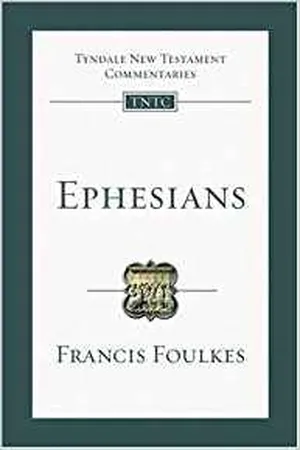
Unlike Paul's letters to the Galatians or the Corinthians, the letter to the Ephesians contains almost no clues about the situation and issues its recipients faced. Nevertheless, the letter vividly depicts how God's will revealed in Christ reorients believers' lives toward unity, mutual respect, submission and love - in short, new life in Christ. Francis Foulkes expounds with clarity and ease the letter's central themes and emphases.This classic commentary has been completely retypeset and presented in a fresh, vibrant new large paperback format, with new global branding.
- English
- ePUB (mobile friendly)
- Available on iOS & Android
eBook - ePub
About this book
Information
Topic
Theology & ReligionSubtopic
ChristianityCommentary
1. Introduction (1:1–23)
a. Greeting (1:1–2)
1. All Paul’s letters begin in a similar way. Following the style of the letter-writing of the day, he mentions first the writer, then the readers, and then comes the greeting. But the conventional manner of the time is lifted to a higher level. Writer and readers are described from the standpoint of their relationship to God in Christ; and the conventional greeting has become a Christian benediction.
Apostle is the title Paul most frequently gives himself. As meaning basically ‘one sent’, it speaks of the great privilege, but also of the divine compulsion, of the commission laid upon him. He could not think of himself in his relationship to others except in terms of his being sent to all with the gospel (cf. 2 Cor. 5:16). He is what he is by the will of God; and this is no mere permission, as the use of the same word in verses 5, 9 and 11 makes clear. It is God’s positive purpose that makes Paul a man under authority, and enables him to write with authority. He is always at pains to stress that his calling is due to no personal merit (cf. 1 Cor. 15:9; Gal. 1:13–15; 1 Tim. 1:12–16); his authority is not self-assumed. Both are entirely of God (cf. especially Gal. 1:1); and on that fact he relies, especially when his mission is challenged.
The frequent New Testament designation of Christians as saints is the first of a number of words in chapter 1 whose meaning can be understood fully only by a consideration of their Old Testament background. The saints are the holy ones, hagioi. In Old Testament days the tabernacle, the temple, the sabbath, and the people themselves were holy as they were consecrated, or set apart, for the service of God. People are not ‘saints’ in this sense by personal merit; they are set apart by God, and in consequence they are called to live in holiness. Thus the word expresses at once the privilege and the responsibility of the calling of every Christian, not the attainment of a select few. As we have seen in the Introduction when considering the destination of the letter, the words at Ephesus are absent from some of the best MSS, and yet grammar almost certainly requires a place-name in the original.1 So we have concluded that it is likely that Ephesus was only one of a number of places to which this letter was sent.
The faithful (pistoi), a term often used for Christians in the New Testament, may mean those who have faith, or those who show fidelity. Here both ideas may be included; they are believers and their calling is to faithfulness. They are those who believe in the Lord, but the phrase in Christ Jesus means much more than alluding to the object of their faith. The phrase, so frequently used by Paul, especially in this letter, sums up very much of his understanding of the gospel. It, or an equivalent, is used eleven times in verses 1–14 alone. Christians not only have faith in him; their life is in him. As the root in the soil, the branch in the vine (cf. John 15:1ff.), the fish in the sea, the bird in the air, so the place of the Christian’s life is in Christ. Physically his or her life is in the world; spiritually it is lifted above the world to be in Christ (cf. Col. 3:1–3). We have a pointed juxtaposition of two phrases as Paul addresses his readers in Colossians 1:2 as ‘in Christ’ and ‘in Colossae’. There is the implication that wherever Christians may be, in whatever difficult environment, threatened by materialism or paganism, in danger of being engulfed by the power of the state or overwhelmed by the pressures of non-Christian life, they are in Christ. This is not mysticism, but is intended to express the very practical truth that Christians, if faithful to their calling, will not try to be self-sufficient, or to move beyond the limits of the purpose and control and love of Christ, nor will they turn to the world for guidance, inspiration and strength. They find all their satisfaction and their every need met in him, and not in any other place nor from any other source. This description of the Christian’s life is implied in the expression being ‘baptized into Christ Jesus’ (Rom. 6:3), as baptism is the outward sign of entrance into such a life. It also involves the truth that the Christian’s corporate existence is in the body of Christ which is his church.
2. The common Greek greeting was chairein (see Acts 15:23; 23:26; Jas 1:1); here Paul uses the cognate word charis (grace). Peace was the common Hebrew greeting (šālôm). It was used, for example, when the seventy were sent out by the Lord (Luke 10:5). As in all his greetings, Paul brings grace and peace together, and the two may be said to sum up all the gifts of Christ. The greeting has thus become a blessing, or a prayer that his readers may know fully the free, undeserved favour of God, restoring them to himself, and adding to them all that they need (see further on 3:2 for charis); and that they may know peace with God, peace in their hearts, and peace with one another. The two words are in fact twin themes of the letter, as of the gospel of Christ itself. The grace and peace come from God our Father, as the source of all things, and the Lord Jesus Christ, who by what he has done has brought them to humanity.
b. Praise for God’s purpose and blessings in Christ (1:3–14)
3. Now, after his brief greeting, and before he expresses his thanks for the welfare of those to whom he is writing (vv. 15–16), the apostle goes straight into a great paean of praise—one long sentence, impossible to analyse, in which each successive thought crowds in on the one before. There is no predetermined order in the enumeration of the blessings; the contemplation of one leads naturally to the next—election from the very beginning; sonship by adoption; redemption, which means forgiveness; insight into God’s all-embracing purpose; the privilege (both for Jews and Gentiles) of becoming his people; and the sealing of the Spirit, which is the guarantee of the final inheritance. Three particular notes sound right through this great doxology. First, from eternity to eternity God works all things according to his perfect plan. All history, all people, all that exists in heaven and on earth are included in his purpose. Past, present and future are all embraced in this doxology, and the work of Father, Son and Holy Spirit. Secondly, that purpose is fulfilled in Christ, and thus in him every blessing that men and women can have is found. Thirdly, its goal is the very practical one, that God’s people should live ‘to the praise of his glorious grace’ (v. 6).
The paragraph begins in the form of a Jewish benediction. In the New Testament the word blessed (eulogētos) is used only of God. He alone is worthy to be blessed. People are blessed when they receive his blessings; God is blessed when he is praised for all that he freely bestows on humanity and on his world. Above all he is blessed as the God and Father of our Lord Jesus Christ (cf. Rom. 15:6; 1 Pet. 1:3; Rev. 1:6); for he is revealed to us supremely in Christ who, as Son, is the perfect image of the Father (see John 1:18 and Heb. 1:1–3).
The Greek translated who has blessed is an aorist participle, which may refer to a particular occasion in the past when those blessings were first received, or when he brought them to humanity; but the tense is not of necessity to be pressed. With every spiritual blessing suggests that from him comes one continuous flow of blessing, and this is to be conceived, not chiefly in terms of the material gifts of which we think most readily, but in terms of the spiritual that transcend but include the material, for the true appreciation of the things we see is dependent on our enjoyment of the things of the Spirit.
This is made clearer still by the defining phrase that follows, in the heavenly places. The phrase speaks of an ‘invisible spiritual environment, as contrasted with the visible, tangible environment we call earth. It is the realm of all the unseen forces, good and evil, which struggle to dominate the individual and corporate life’ of humanity (Caird). Five times the phrase is used in this letter. Christ is said to be exalted to be ‘in the heavenly places’ (1:20); the wisdom of God is being made known to the principalities and powers ‘in the heavenly places’ (3:10); the same phrase is used of the sphere of the spiritual conflict against the forces of evil (6:12); and, most closely connected with the subject here, in 2:6 Christians are said to be ‘raised up’ and made to ‘sit with him in the heavenly places in Christ Jesus’. Their life is lifted above the commonplace. It is in the world, but it is also in heaven, unlimited by the material things that pass away (cf. Phil. 3:20). Life now, if it is life in Christ, is in the heavenly realm.
4. The purpose of God is shown to be not of this earth but of heaven by the fact that it existed before the foundation of the world. Election, as Calvin said, is ‘the foundation and first cause’ of all blessings. And the doctrine of election runs through the whole Bible. Israel was chosen, not for any merit, but to be the means of the fulfilling of the eternal purpose of God (see Deut. 7:6–8; Isa. 42:1; 43:20–21). In the New Testament the principle of election is confirmed, but there is no longer a national limitation—a truth that this letter later develops and expounds. This doctrine of election, or predestination, is not raised as a subject of controversy or speculation. It is not set in opposition to the self-evident fact of human free will. It involves a paradox that the New Testament does not seek to resolve, and that our finite minds cannot fathom. Paul emphasizes both the sovereign purpose of God and our free will. He took the gospel of grace and offered it to all. Then to those who had accepted the gospel he set forward the doctrine of election for two reasons, both of which we find linked similarly together in John 15:16; Romans 8:29; 2 Thessalonians 2:13; 2 Timothy 1:9 and 1 Peter 1:2. Firstly, Christians need to realize that their faith rests completely on the work of God and not on the unsteady foundation of anything in themselves. It is all the Lord’s work, and in accordance with his plan, a plan that reaches back before the foundation of the world. There is, therefore, no place for human boasting. Secondly, God has chosen us that we should be holy and blameless before him (cf. 5:27 and Col. 1:22). Election is not simply to salvation, but to holiness of life. We were ‘created in Christ Jesus’, 2:10 is to express it, ‘for good works, which God prepared beforehand, that we should walk in them’. We were ‘predestined to be conformed to the image of his Son’ (Rom. 8:29).
The ideal and goal of the Christian life, therefore, is perfect holiness (cf. Matt. 5:48), expressed in its positive aspect as dedication of life (see on v. 1), and negatively as freedom from every fault. Behind the word amōmous, used similarly in Philippians 2:15, and here translated blameless (RV ‘without blemish’), lies a use in connection with Old Testament sacrifices. Only a perfect animal could be offered to God (e.g. see Lev. 1:3, 10). So, as Hebrews 9:14 puts it, Christ offered himself morally and spiritually ‘without blemish’ to God (cf. 1 Pet. 1:19). The life of the Christian is also to be ‘without blemish’, not merely by human standards but before him who is the witness of all that anyone does, and thinks, and says. (For this same emphasis of the apostle on human life lived every moment in the sight of God, see Rom. 1:9; 2 Cor. 4:2; Gal. 1:20; 1 Thess. 2:5.)
5. The words in love may be taken either with what follows or with what precedes, and the differing opinions of translators and commentators ancient and modern indicate that it is not possible to be dogmatic regarding the intention of the writer. RSV translates He destined us in love to be his sons (cf. NIV). This may be right; at least it is a truth that this whole section emphasizes. But the position of the phrase, and its use elsewhere in the letter for human love rather than God’s love (3:17; 4:2, 16; 5:2), support the rendering accepted by the AV, RV and NEB. The point, then, is that holiness of life is only made perfect in and through love (cf. 1 Thess. 3:12–13).
For destined RV has ‘foreordained’; the Greek proorisas means literally ‘marked out beforehand’. It is simply another word that expresses the fact that God’s plan for his people is from eternity. That plan is, as AV literally renders it, ‘the adoption of children by Jesus Christ to himself’. Men and women were created for life in fellowship with God, as children with the Father (Gen. 1:26; Acts 17:28). By sin that privilege was forfeited, but by grace, in and through Christ, restoration to sonship is made possible (John 1:12). Adoption is the best way to describe this (cf. Rom. 8:15, 23; Gal. 4:5), because adopted children have their position by grace and not by right, and yet are brought into the family on the same footing as children by birth.
What God has done was according to the purpose of his will. Both expressions here speak of his purpose and sovereign love. Purpose (eudokia) has two meanings in Scripture. It is sometimes the goodwill felt towards a person (cf. Luke 2:14); but where there is no reference to a person who feels this goodwill, it means simply ‘purpose’, as fits the context here and in verse 9 (cf. Matt. 11:26)—though there may be a suggestion of the first meaning as well. Markus Barth (AB) puts it, ‘The happiness that accompanies a radiant good will is implied. Those singing God’s praise … respond to God’s pleasure in doing good.’
6. In this verse we have the phrase to the praise of his glorious grace, which occurs again in this section in verses 12 and 14 as ‘the praise of his glory’—like the refrain at the end of successive stanzas of a poem. Translating the noun in Greek by the adjective glorious may lose some of the force. God’s glory implies his revelation of himself, and ‘the glory of his grace’ (AV) is ‘his self-disclosure as a gracious God’ (Stott; cf. Exod. 33:18–19; 34:5–7). As Israel was chosen to live to his praise (Isa. 43:21), so those who in Christ are received as his people must show forth the Father’s nature of grace and thus glorify him (cf. 5:1; Matt. 5:45; Luke 6:35). The word grace is too full of meaning for Paul to pass over lightly (cf. v. 7 and 2:7). It must be qualified. The Greek verb charitoō, used in the clause which he freely bestowed on us in the Beloved, is from the noun charis (grace). (Cf. the constructions in vv. 19, 20; 2:4 and 4:1.) Sometimes it has been taken to mean ‘the grace with which he has made us gracious’; so Chrysostom (quoted by Abbott) says, ‘it is as if one were to take a leper and change him into a lovely youth’. But it is more in accord with the context to take it as ‘the favour with which he has favoured us’, or, as RSV, the grace which he freely bestowed on us. It is the objective grace of God which is in mind, God’s undeserved favour towards us, rather than any virtue that we derive.
This, it is emphasized again, is in Christ who is the Beloved. The description was used as a name for Israel, and so came to be used as a title of Israel’s greatest representative, the Messiah. But its literal meaning is not lost (cf. Matt. 3:17 and 17:5) as the parallel expression in Colossians 1:13—‘the Son of his love’ (RV)—indicates. As Dale puts it, ‘Christ dwells for ever in the infinite love of God, and as we are in Christ, the love of God for Christ is in a wonderful manner ours.’
7. The blessing of redemption follows, for our prior need of grace is of redeeming, restoring grace. Such redemption is found in Christ—not merely through rum, but by coming to live in him (cf. Rom. 3:24; Col. 1:14). Again the Old Testament provides the background for our understanding. There, provision was made for the redemption of lands or persons that had passed from their original owner to become the property of another (see Lev. 25:25–27, 47–49; Num. 18:15). The people of Israel, moreover, were themselves essentially a redeemed people. They had been slaves in Egypt, and later, through their own sinfulness, in Babylon as well. Yet God had redeemed them, and by redemption they were made his people (Exod. 15:13; Deut. 7:8; Isa. 48:20; 52:9). The fundamental idea of redemption is that of the setting free of a thing or a person that has come to belong to another. Sometimes, in both Old and New Testaments, there is no specific reference to the price paid for redemption, and in some places the word has the basic sense of release (e.g. Luke 21:28; Rom. 8:23; Heb. 9:15). But Paul’s mind often dwelt on the thought of the costliness of redemption, and in a number of places in the New Testament this is obviously present (see Acts 20:28; 1 Cor. 6:20; 1 Pet. 1:18–19; Rev. 5:9).
We cannot say here that Paul speaks explicitly of the cost of redemption, but he says immediately that it is through his blood. Nor would he have hesitated to say that what is the means of liberation is in fact also the price. In the case of the Passover, a sacrifice was associated with the redemption of the people. The primary object of most of the old sacrifices, however, was the setting aside of sin. Instilled deeply into the consciousness of the people was the fact that sin could not be set aside lightly. Sin required sacrifice: ‘without the shedding of blood there is no forgiveness of sins’ (Heb. 9:22; cf. Lev. 17:11). Christ fulfilled the need expressed throughout the Old Testament sacrifici...
Table of contents
- Tyndale New Testament Commentaries
- Ephesians
- Contents
- General Preface
- Author’s preface to the first edition
- Author’s preface to the second edition
- Chief Abbreviations
- Bibliography
- Introduction
- Analysis
- Commentary
- 2. Life In Christ (2:1–3:21)
- 3. Unity in the Body of Christ (4:1–16)
- 4. Personal Standards (4:17–5:21)
- 5. Relationships (5:22–6:9)
- 6. Conclusion (6:10–24)
Trusted by 375,005 students
Access to over 1.5 million titles for a fair monthly price.
Study more efficiently using our study tools.
Frequently asked questions
Yes, you can cancel anytime from the Subscription tab in your account settings on the Perlego website. Your subscription will stay active until the end of your current billing period. Learn how to cancel your subscription
No, books cannot be downloaded as external files, such as PDFs, for use outside of Perlego. However, you can download books within the Perlego app for offline reading on mobile or tablet. Learn how to download books offline
Perlego offers two plans: Essential and Complete
- Essential is ideal for learners and professionals who enjoy exploring a wide range of subjects. Access the Essential Library with 800,000+ trusted titles and best-sellers across business, personal growth, and the humanities. Includes unlimited reading time and Standard Read Aloud voice.
- Complete: Perfect for advanced learners and researchers needing full, unrestricted access. Unlock 1.5M+ books across hundreds of subjects, including academic and specialized titles. The Complete Plan also includes advanced features like Premium Read Aloud and Research Assistant.
We are an online textbook subscription service, where you can get access to an entire online library for less than the price of a single book per month. With over 1.5 million books across 990+ topics, we’ve got you covered! Learn about our mission
Look out for the read-aloud symbol on your next book to see if you can listen to it. The read-aloud tool reads text aloud for you, highlighting the text as it is being read. You can pause it, speed it up and slow it down. Learn more about Read Aloud
Yes! You can use the Perlego app on both iOS and Android devices to read anytime, anywhere — even offline. Perfect for commutes or when you’re on the go.
Please note we cannot support devices running on iOS 13 and Android 7 or earlier. Learn more about using the app
Please note we cannot support devices running on iOS 13 and Android 7 or earlier. Learn more about using the app
Yes, you can access Ephesians by Francis Foulkes in PDF and/or ePUB format, as well as other popular books in Theology & Religion & Christianity. We have over 1.5 million books available in our catalogue for you to explore.