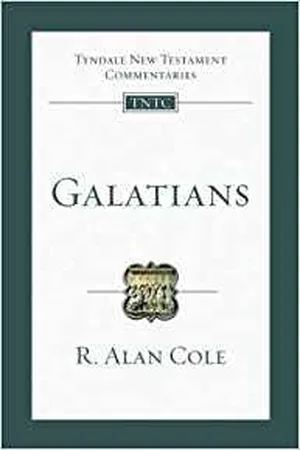
In Galatians, the apostle Paul makes his most passionate and direct appeal for a gospel free of ethnic or ritual exclusion. Paul's gospel is that of salvation through Christ alone - in him there is 'neither Jew nor Greek, slave nor free, male nor female, for you are all one in Christ Jesus'. By placing Paul's discussion firmly within its historical context, R. Alan Cole illuminates the potency and power of Paul's message to the Galatian church. This classic commentary has been completely retypeset and presented in a fresh, vibrant new large paperback format, with new global branding.
- English
- ePUB (mobile friendly)
- Available on iOS & Android
eBook - ePub
About this book
Information
Topic
Theology & ReligionSubtopic
ChristianityCommentary
1. The Argument from Experience (1:1–2:21)
a. Greeting (1:1–5)
‘Paul, an apostle, not an apostolate from humans, nor through any human, but through Jesus Christ and God the Father, who raised him from among the dead, and all the Christians with me here, to the churches of Galatia: grace to you, and peace, from God our Father and the Lord Jesus Christ, who gave himself for our sins, to take us out of this present wicked age, in accordance with the will of our Father-God, to whom be the glory for ages of ages. Amen.’
1. Paul is the sender of this letter: the one simple word is quite enough to introduce him to the recipients, to whom he was obviously well known. Any letter of the time will begin with the name of the sender, closely followed by that of the recipient. Normally, the bulk of the letter will then be written by a scribe,1 and it will only be in the closing lines that the author will pick up the stylus himself, and add a sentence or two in autograph. Forgery was a danger even in the days of Paul himself: certainly, in the sub-apostolic days, ‘pseudepigraphy’ became a menace.2 Even without such evidence, it is certain that the Galatians were in no doubt as to the writer of this letter: from beginning to end, the letter breathes Paul. Not only has it been described as an earlier ‘rough draft’ of Romans,3 it also contains so many other Pauline idiosyncrasies that, along with Philippians and the Corinthian correspondence, it has always been regarded as belonging to the indisputably Pauline ‘core’. Even those who nowadays attempt to solve the problem of authenticity by the use of computers usually start with this letter as base, although this only shows their belief in its genuineness, not the genuineness of the letter itself.
Paul (in its full form of Paulus or Paullus) is a common enough Roman surname (never a praenomen or distinguishing name), found frequently in classical literature, inscriptions and papyri, as BAGD shows. Even in the New Testament, the Sergius Paulus of Acts 13:7 bears it. Originally an aristocratic Roman name, it was later borne by many newly enfranchised citizens, whether because their ancestors had originally been slaves of some member of this house, or as a compliment to some provincial governor of that name. Perhaps we may compare the way in which third-world Christians, when wanting to take a ‘foreign’ name in addition to their own, will frequently adopt either that of a much-loved missionary, or of some prominent foreign statesman. Beyond the fact that Paul was born a Roman citizen, we know nothing of the origins of citizenship in his family.4 He certainly had no drop of Roman blood in his veins; but none made the proud name of Paullus more illustrious.
It is just possible that Paul was not even the name used by his enfranchised family, but chosen by him because of its assonance with his Jewish name, Saul. Many instances of this sort of assimilation occur in the New Testament: for instance, the Hebrew ‘Simeon’ (Acts 15:14) appears in Greek form as Simon (Matt. 16:17). We do not know whether Paul continued to be known as Saul in Jewish-Christian circles; it is very likely. Certainly when Simon Peter is mentioned in Jewish Christian contexts he is more commonly called ‘Simeon’ or ‘Cephas’, the latter being the Semitic name corresponding to ‘Peter’.5 Nevertheless, it is only before the first missionary journey that Luke uses the name ‘Saul’ to describe the apostle of the Gentiles. After Acts 13:9, he is always ‘Paul’, and this is the name that he himself uses in all his letters. It is as though his acceptance of the Gentile mission to which his conversion led him demanded the renunication of his Jewish past (although see 1 Cor. 9:20, ‘to the Jews I became as a Jew’). His Jewish name, with its reminder of Saul, the first king of Israel, the pride of Benjamin, stands for that heritage. When writing to what are presumed to be Gentile, not Jewish, converts in Galatia, the Gentile name ‘Paul’ has peculiar appropriateness. He is reminding them that for Christ’s sake he had already identified himself with them (4:12), or ‘become as you are’.
But Paul is also an apostle, apostolos. In spite of all the theological battles over this word in recent years, it is probably best to leave it, in this transliterated Greek form, untranslated, although etymologically it corresponds to the Latin term ‘missionary’, which might well be used for it. A term like ‘emissary extraordinary’ may recapture some of the atmosphere, but is too clumsy for use. To us, the word ‘apostle’ means first and foremost the twelve men chosen by Christ to be near him, and whom he might send on his tasks (Mark 6:7). But the Scriptures merely say that Christ named the twelve ‘apostles’ (Luke 6:13); that is, he used an existing word to make clear their status and functions. Within Judaism, the corresponding word was well defined; a šālîaḥ meant a special messenger, with a special status, enjoying an authority and commission that came from a body or person other than the person himself.6 So in the days of the New Testament the word ‘apostles’ had a meaning far wider than ‘the twelve’, or ‘the eleven’ after the defection of Judas. It is used of the twelve, but it can also be used of James the brother of the Lord, who is not found in any list of the twelve, and also of a wider, indefinite group, called ‘the apostles of the churches’7 (2 Cor. 8:23, RSV mg.; cf. Rom. 16:7).
Yet Paul uses the word here deliberately to make a point, not merely to inform them that this letter is from ‘Paul the missionary’ as distinct from any other Paul. It is from Paul the apostle as distinct from a body at Jerusalem, the members of which equally call themselves apostles. Yet to him, ‘apostle’ is not so much a title of office as a description of function and he makes that plain by what follows.
His apostolate, he tells them, is not from men nor through man (NIV, ‘by man’). It has neither human source nor human agency (NEB, ‘not by human appointment or human commission’). There is probably no significance in the change from men to man. Paul may be recalling, however, that a Jewish apostolos or šālîaḥ, to use the Semitic form, although usually representing an individual, would sometimes be sent from a group (perhaps the Sanhedrin), and would in that case have received a commission from the high priest or some similar high official. When Paul went on his journey to Damascus, his Jewish commission or ‘apostolate’ had been of this nature (Acts 9:1). No longer is it so; now, his Christian apostolate is through Jesus Christ and God the Father. It is therefore from this source that he has received his commission. It is impossible to say how far the title ‘Christos’ (originally a passive form from chriō, ‘I anoint’) had already advanced in the direction of becoming a proper name, as it is in modern English; usually in the New Testament, when it has no definite article, it is so treated. When it has the definite article, it is probably better to translate as ‘the Messiah’ or ‘the Anointed’, although it is uncertain how much of this sense the Gentile Christians would have understood. But the important thing is that for Paul the source of his authority is Christ; and this Christ is a Christ deliberately set side by side with God. Among ancient witnesses, only Marcion the heretic here omits the clause and God the Father; and this was certainly from doctrinal considerations on his part.
In Paul’s writings, it is rare to find any bare or unqualified reference to God. God is usually further characterized at once as the one who has revealed himself in such-and-such a way. Normally for Paul, this revelation is in connection with his work in and through Christ; and this passage is no exception to the rule. He is the God who raised him from the dead: this is the normal New Testament form of expression, rather than saying, as we do, that Christ rose from the dead. Always in the New Testament, the resurrection of Christ is central to the Christian faith. Since Paul sees the Christian life in terms of sharing in the death and resurrection of Christ, the resurrection has an even greater relevance for him.8
Why does Paul describe himself as this sort of apostle? Certainly not in direct opposition to the apostles at Jerusalem, for they did not owe their commission to humans any more than he did. They too could have claimed that they were appointed by Christ, in accordance with the will of God the Father. Rather, Paul’s aim is to show that his apostolate stands or falls with theirs, for it rests on exactly the same basis. It is extremely unlikely that any of the Jerusalem apostles ‘stood on their dignity’ as against Paul, but it is highly likely that some of their more enthusiastic followers did so, on their behalf. We know, for instance, that these extremists seem to have accused Paul of being no true apostle, or, at best, a self-appointed one (1 Cor. 9:2; 2 Cor. 11:5). No-one who reads the story of his conversion could take seriously this charge of self-appointment; perhaps this is why Paul more than once refers to the story of his conversion in his defence (Acts 22 and 26). Indeed, the whole of the first part of Galatians will be an appeal to past experience, first and in particular to Paul’s own spiritual pilgrimage, and secondly to the history of his relations with the Galatian churches.
To put it in modern terms, the validity of Paul’s apostolate is being questioned. He replies by showing that, put in this way, the question is invalid since, in asking it, the questioners implicate themselves also. If the Jerusalem apostolate and Paul’s apostolate to the Gentiles, and, indeed, Peter’s apostolate to the Jews, have all one and the same source, how can such a question even arise? It was, it is true, the sort of question that greatly exercised first-century Judaism. Both John the Baptist and Christ had been asked by what official authority they acted. Both had made the same answer, whether explicitly or implicitly; it was by the authority of God (John 1:25 and Mark 11:27–33). Their ministry found its proof and vindication in the working of God through them, and this is Paul’s thought too. The proof of the ‘validity’ of his ministry is to be found in the working of the Holy Spirit that accompanies it, in the results of a ministry rather than in its antecedents.9 If any at Jerusalem should challenge this, they would at once be aligning themselves with Jewish theology rather than Christian. Paul’s apostolate and his gospel belong together: that is the reason for the introduction of the topic here.
2. Paul wants to show that he does not write alone. All the brethren who are with me (NEB, ‘I and the group of friends now with me’), also join in the salutation. Much study has been devoted to ‘Paul’s travelling circle’ in recent years, of which Judge’s book 10 is one example. While it is true that there are a group of Christians whose names appear constantly in the New Testament in connection with that of Paul on his travels, we should beware of seeing him as some sort of wandering Hellenistic philosopher, surrounded by a circle of pupils. The more casual translation of the NEB given above may well be correct, rather than any translation which would emphasize the distinction between an assumed ‘inner circle’ of Paul’s friends and the main body of the church, usually called ‘the saints’. But ‘friends’ is inadequate as a translation for adelphoi, ‘brothers’. The word has a long history in Judaism, as may be seen from the Old Testament. In the new Christian family, it took on a richer and deeper meaning. Brothers, sisters, saints, chosen, Nazarenes, Galileans: the names used for Christians were many, but the sense of ‘belongingness’ was common to all of them. True, Paul often does associate some younger member of his circle with himself in the writing of a letter. But it is unlikely in most cases that the association extends further than the greeting, the more so as in verse 6 Paul will drop at once into the first person singular. Probably he merely wishes to show the Galatians that he does not stand alone in opposition to the Judaizing heresy that has crept into the churches of Galatia; he speaks for the whole Christian church, from which he writes, wherever it is: that is the point of saying ‘all the brothers’ (NIV).
The letter is addressed to the churches of Galatia. This was a perfectly adequate address in its day, but has puzzled scholars greatly since. For a summary of different views as to its meaning see the Introduction, pp. 20ff.11 Whatever the exact geographic location, the phrase clearly refers to a number of local ekklēsiai or ‘churches’, which form part of the one great ekklēsia or church. This is consonant with Pauline usage throughout. If the letter is a circular, the question arises as to whether only one copy was sent, or several. If only one copy was sent, presumably the various local churches were expected to hand it on from one to another when read, possibly first making a transcript themselves. In view of 6:11, where stress is laid on Paul’s handwriting, it seems improbable that there was more than one original autograph copy. Paul elsewhere exhorts local churches to pass on and share with one another similar apostolic letters of general interest and relevance.12 If the recipients were ‘South Galatians’, we know of at least four such local churches, and there may well have been more.
3. The greeting from Paul is Grace to you and peace. The juxtaposition of these two nouns is thoroughly Jewish and was now to become thoroughly Christian. It is therefore a mistake to see here a junction of the Hellenic and Semitic worlds.13 It seems as if Paul at first had only intended to say ‘Grace be to you’, and then added ‘and peace’, almost as an afterthought. Since, for Paul, charis (‘grace’) is almost synonymous with ‘Jesus Christ’, for he knows nothing of impersonal grace, and since we enjoy peace with God through Christ, the distinction is not great. ‘Peace’ is the Greek eirēnē, the promised gift of Christ to his troubled disciples (John 14:27); it corresponds to Hebrew šālōm, that spiritual well-being that comes from a right relationship with God. Wherever Arabic has brought the greeting ‘salaam’ into other languages across the world, there is a verbal echo of this great truth.
This grace and peace come from God the Father and our Lord Jesus Christ. It is probable that by the common construction known as chiasmus (which could be translated as an ‘x-shaped’ construction), the source of grace is seen as Christ, and the source of peace as God the Father. Again, however, the main theological point is the close association of Christ with God. Indeed, the use of the word Kyrios, ‘Lord’, as a title of Christ would in itself be sufficient to assure this. Much study has been devoted to this Greek word, the one chosen by the early translators into Greek of the Hebrew Bible to stand for the divine name YHWH, which might not be pronounced by the pious Jew, and for which the Hebrew ʾadōnai, ‘my Lord’, had already been substituted. Kyrios varied in meaning from the polite ‘sir’, used in formal address to a stranger, to the full sense of ‘Lord’, in confession of the deity of Christ. When the early Christians used the phrase, ‘Jesus is Lord’, as a baptismal confession, they cannot have meant less than this.14
4. As Paul has particularized God the Father as the one who raised Jesus Christ from the dead, so here he particularizes Christ as the one who gave himself for our sins. NEB has ‘sacrificed himself’, but this seems to give dontos too narrow a meaning, correct though the interpretation may be. Is Paul thinking of the unique and crucial self-giving of Christ on the cross as hyper, ‘on behalf of’, our sins? If so, then the thought must be that of the Mosaic sin-offering. Or does he think of the continuous and exemplary self-giving of Christ throughout his whole life? In that case, the suffering servant of Isaiah 53 must be in his mind. But there is no contradiction between the two, and both ideas may be included here. This is not so much here a theological definition, as it is a confession of infinite indebtedness to Christ.15
This self-giving of Christ is always seen in the New Testament as producing a positive result. Here, the purpose is stated as to deliver us (NIV, ‘rescue us’) from the present evil age. The division between ‘the present age’ and ‘the age to come’ was familiar to every Jew, and therefore to the Christian. What we are accustomed to translate as ‘everlasting life’ means literally ‘life of the age (to come)’. As in John’s Gospel (John 12:31), the thought that this present age is under the power of the evil one is frequent. Thus, what Christ’s death has done is to transfer the Christian from one age to the other, from the sphere of Satan’s power to that of God. While still living physically in this present evil age, therefore, we enjoy already the life of the age to come. This is for Paul the victory of the cross. But it is just possible that the Judaizing heresy that was troubling the Galatians also made great play of the Greek word aiōn, ‘age’, as the later Gnostics certainly did.16 In that case, Paul would be deliberately using a word familiar to his opponents, and showing how even this is caught up into the wonder of the Christian gospel. There are two ways of defeating an opponent which are used by Paul. One way is to show that the ideas propounded are incompatible with revealed Christianity; the other way is to show how they are not only embraced but also transcended within the gospel.
But lest he should, even unintentionally, give the impression that atonement was the unaided activity of God the Son, Paul hastens to add that all this was ‘in accordance with the will of the God who is also our Father’ (for there is only one article for both Theou, God, and Patros, Father). Here is no possibility of an unreal antithesis between a harsh Father and a loving Son. The action of the Son was the very proof of the Father’s love, as John 3:16 makes clear. Christ came to fulfil the Father’s will, and thus to reveal him. The concept of to helēma, the will of God, is one of the most profound concepts in the whole New Testament. This rescues our Christian calling from being merely subjective response, and roots it deep in the plan of God.
5. To any Jew, it was natural to slip into reverential bĕ...
Table of contents
- Tyndale New Testament Commentaries
- Galatians
- Contents
- General Preface
- Author’s Preface to the First Edition
- Preface to the Second Edition
- Chief Abbreviations
- Introduction
- Analysis
- Commentary
- 2. The Argument from Theology (3:1–5:1)
- 3. The Argument from Results (5:2–6:18)
- Notes
Trusted by 375,005 students
Access to over 1.5 million titles for a fair monthly price.
Study more efficiently using our study tools.
Frequently asked questions
Yes, you can cancel anytime from the Subscription tab in your account settings on the Perlego website. Your subscription will stay active until the end of your current billing period. Learn how to cancel your subscription
No, books cannot be downloaded as external files, such as PDFs, for use outside of Perlego. However, you can download books within the Perlego app for offline reading on mobile or tablet. Learn how to download books offline
Perlego offers two plans: Essential and Complete
- Essential is ideal for learners and professionals who enjoy exploring a wide range of subjects. Access the Essential Library with 800,000+ trusted titles and best-sellers across business, personal growth, and the humanities. Includes unlimited reading time and Standard Read Aloud voice.
- Complete: Perfect for advanced learners and researchers needing full, unrestricted access. Unlock 1.5M+ books across hundreds of subjects, including academic and specialized titles. The Complete Plan also includes advanced features like Premium Read Aloud and Research Assistant.
We are an online textbook subscription service, where you can get access to an entire online library for less than the price of a single book per month. With over 1.5 million books across 990+ topics, we’ve got you covered! Learn about our mission
Look out for the read-aloud symbol on your next book to see if you can listen to it. The read-aloud tool reads text aloud for you, highlighting the text as it is being read. You can pause it, speed it up and slow it down. Learn more about Read Aloud
Yes! You can use the Perlego app on both iOS and Android devices to read anytime, anywhere — even offline. Perfect for commutes or when you’re on the go.
Please note we cannot support devices running on iOS 13 and Android 7 or earlier. Learn more about using the app
Please note we cannot support devices running on iOS 13 and Android 7 or earlier. Learn more about using the app
Yes, you can access Galatians by R Alan Cole in PDF and/or ePUB format, as well as other popular books in Theology & Religion & Christianity. We have over 1.5 million books available in our catalogue for you to explore.