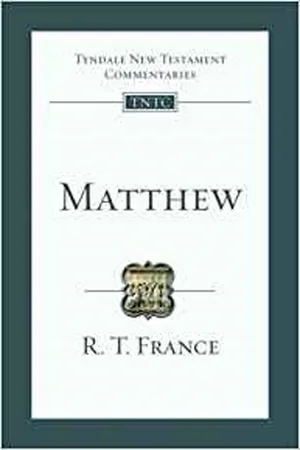
Matthew - the visit of the Magi, the Sermon on the Mount, the Great Commission: these are only a few of the well-known passages that draw readers specifically to Matthew's gospel. Yet it begins with a forbidding list of unknown names and apparently irrelevant 'begettings'. In fact, the early church may have placed Matthew first in the New Testament because it more fully than any other Gospel provides a Christian perspective on the relation between the church and the Jews, an issue that is still important today. R. T. France tackles this and other key issues in the Gospel with clarity, reliability and relevance.This classic commentary has been completely retypeset and presented in a fresh, vibrant new large paperback format, with new global branding.
- English
- ePUB (mobile friendly)
- Available on iOS & Android
eBook - ePub
About this book
Information
Topic
Theology & ReligionSubtopic
ChristianityCommentary
1. The Birth and Preparation of Jesus (1:1–4:16)
The analysis of the Gospel given above (pp. 67–72) has shown that 4:17 marks the beginning of the first main phase of Jesus’ public ministry. In these preceding chapters Matthew introduces the Jesus whose ministry he is going to describe. Who is this Jesus, and where does he come from? So chapters 1–2 explain his origin, and 3:1–4:16 outlines his preparation immediately before he appeared in public.In all this, Matthew is primarily concerned to show Jesus as the one in whom the hopes of the Old Testament find their fulfilment. Six times in these chapters we find the formula ‘This was to fulfil what the Lord had spoken by the prophet’ or the like, introducing the ‘formula-quotations’ (see pp. 42–44) which are a special feature of Matthew’s Gospel; and the quotations so introduced do not relate to specific things which Jesus did, but to more general characteristics, his name and birth (1:22–23) and the geographical location of his birth, childhood and ministry (2:5–6, 15, 17–18, 23; 4:14–16). Matthew thus demonstrates that the overall framework of Jesus’ preparation for his ministry corresponds to the pattern laid down in the Old Testament. Moreover, as the commentary will make clear, every section of these chapters, whether it includes a formula-quotation or not, is heavily weighted to showing the correspondence of Jesus’ preparation to the Old Testament pattern.
Alongside this very striking concentration on introducing Jesus as the fulfilment of the Old Testament runs a higher note: Jesus is the Son of God. This, one of the main themes of Matthew’s Gospel as a whole, is clearly implied by his stress on the conception of Jesus by the Holy Spirit (1:18, 20), and by the name Immanuel, ‘God with us’ (1:23), and becomes explicit in 2:15 and 3:17, from which it is taken up to become the central theme of the testing of Jesus in 4:1–11.
Thus by the time the reader comes to 4:17 he is well prepared to see this Jesus not just as a preacher of God’s message, but as the Messiah to whom the whole Old Testament revelation pointed forward, and even more than that, as the Son of God. There is no literary suspense; in these opening chapters Matthew has laid his theological cards on the table, and he expects the reader to come to the account of Jesus’ ministry with this orientation already decided.
A. The birth and childhood of Jesus (1:1–2:23)
The subject-matter of these chapters is, as the heading indicates, the beginning of Jesus’ life. But a better description of their aim and contents would be ‘scriptural proofs of the Messiahship of Jesus’. The genealogy concentrates on linking Jesus to David, whose ‘son’ the Messiah was to be, and fits him into the whole development of God’s purpose of salvation in the Old Testament. Then the remaining 31 verses, dealing with Jesus’ birth and childhood, contain no less than five of Matthew’s eleven formula-quotations, as well as a sustained parallel between the origins of Jesus and of Moses, and other allusions to Old Testament passages.
The very deliberate scriptural orientation of Matthew in these chapters is seen when they are compared with the infancy narratives of Luke (1–2). Luke tells delightful stories, with living characters, in whom he is clearly interested for their own sake. He sets the scene for Jesus’ life in the history and expectations of the Jewish people, provides a sketch of his family background, and gives us such meagre information as we possess on his growth as a child. Matthew, by contrast, provides merely the basic facts of Jesus’ birth, the visit of the Magi, and his family’s geographical movements, only so far as is needed to show the historical application of his chosen scriptural texts. Even the visit of the Magi, Matthew’s most elaborate story, is in fact, as we shall see, carefully related to bring out the theme of Jesus’ fulfilment of prophecy. His striking emphasis on geographical locations in chapter 2 leads in each case directly to an appropriate Old Testament text.1
So obvious is Matthew’s preoccupation with Scripture fulfilment in these chapters that it is sometimes suggested that the ‘facts’ that he relates are themselves the product of his own imaginative study of the Scriptures (and, in Gundry’s view, his free adaptation of an earlier form of the stories of Luke 1–2), so that the virgin birth, the Magi, the flight to Egypt and the slaughter of the children are fictitious stories suggested to Matthew’s lively imagination by the texts around which he relates them. This seems the more plausible when it is noted that none of the events recorded in chapter 2 is mentioned in the rest of the New Testament (unless Gundry is right in deriving them from the Lucan stories) or independently anywhere else, beyond the location of Jesus’ birth in Bethlehem and his later residence in Nazareth, and the basic historical datum of Archelaus’ succession to his father, Herod the Great.
It cannot be maintained, however, that there is any improbability in the basic features of these stories in the light of the historical circumstances of the time. What we know of the cult of astrology, of Herod’s character and his political vulnerability, and of the rule of Archelaus fits in well with Matthew’s narrative, and the choice of Egypt as a place of refuge by a suspect Jewish family is entirely probable. It is in such details as the moving star and the angelic warnings, not in the outline of the stories themselves, that historians are likely to find difficulties.
The suggestion that Matthew created these stories out of the Old Testament texts around which they are woven is not easy to maintain when it is noted that several of the Old Testament texts explicitly quoted are not ones which would naturally be associated with Messianic fulfilment. Indeed their character is such that it is hard to see why they should ever have been introduced into a Christian account of Jesus’ origins unless the facts themselves suggested them. Hosea 11:1 and Jeremiah 31:15 (Matt. 2:15, 18) in particular have in themselves no obvious reference to Jesus, and there is no indication that either was interpreted Messianically at the time; and the ‘quotation’ in Matthew 2:23 does not appear in the Old Testament at all! The only conceivable reason for introducing these texts is that it was already known that Jesus went to Egypt, that there was a slaughter of children, and that Jesus’ home was in Nazareth, and that scriptural justification was desired for these elements in his background.
In fact the aim of the formula-quotations in chapter 2 seems to be primarily apologetic, explaining some of the unexpected features in Jesus’ background, particularly his geographical origins. It would be a strange apologetic which invented ‘facts’ in order to defend them!2
i. The genealogy of Jesus the Messiah (1:1–17)
To us, a genealogy may seem a very tedious way to begin a book, and a waste of space. To the Jewish world in which Matthew belonged it was a matter of importance, as a glance at the numerous genealogies of the Old Testament makes clear. But Matthew is not merely conforming to Jewish literary convention. The way he presents his genealogy shows that it introduces several important strands into his presentation of Jesus as the Messiah. 1. It places Jesus fully in line with the history of Old Testament Israel, as one famous name after another reminds the reader of the forward movement of God’s saving purpose. 2. By organizing that history into a regular scheme of three groups of fourteen generations (see on 1:17), it indicates that the time of preparation is now complete, and that in Jesus the time of fulfilment has arrived. 3. By tracing Jesus’ descent through the royal line of Judah, it stakes his claim to the title ‘King of the Jews’ (see p. 45). 4. It establishes his status as ‘son of David’, not only by emphasizing David’s place in the genealogy (see on 1:6), but, perhaps, by a play on the name of David in the use of the number fourteen (see on 1:17). 5. The mention of certain ‘irregularities’ in the ancestry of the royal line of Judah serves to counter objections to the manner of Jesus’ birth (see on 1:3–6). The genealogy is thus a vital part of the conception of Matthew’s introductory section. It is ‘a résumé of salvation history, of God’s way with Israel’.3
Luke’s version of the genealogy of Jesus (Luke 3:23–38) differs considerably from that of Matthew, not only in that it goes further back (to ‘Adam, the son of God’, thus putting Jesus in the context of the whole human race, not just the Jewish nation), but in the names it includes. From Abraham to David there is close agreement, but from David the two lists diverge, as Matthew follows the line of succession to the throne of Judah from Solomon, whereas Luke’s list goes through Nathan, another son of David, and converges with Matthew’s only for the two names of Shealtiel and Zerubbabel until Joseph is reached. That either Matthew or Luke simply invented the names he records is neither consistent with their known concern for detail, nor is there any obvious motive for it. We do not know what source Matthew used for the period after Zerubbabel, nor Luke for the whole period from David to Joseph; we can only assume that the family had preserved records, or at least memories, of its ancestry.4 But how could family records supply two genealogies so different?
The suggestion that Luke’s list is in fact the genealogy of Mary, the real human parent of Jesus, is unlikely. Not only does Luke state quite clearly that he is giving the genealogy of Joseph, the ‘supposed’ father of Jesus (3:23), but it was not the practice to trace a genealogy through the female line (as distinct from occasionally mentioning the mother in a patrilineal genealogy). A more probable explanation of the difference is that while Luke records the actual physical genealogy of Joseph, Matthew records the line of succession to the throne, the ‘official’ genealogy.5 This would not necessarily pass from father to son, but would remain within the family. (The verb he uses for beget [gennaō] is used of a relationship which is not genetic in 1 Cor. 4:15; Philem. 10, and the same metaphor was used of the relationship between a Rabbinic teacher and his pupil. Cf. also Ps. 2:7.) It is certainly not impossible that the lines should converge at two points (Shealtiel and Joseph) in a period of 1,000 years. But any solution must remain tentative.6
1. The book of the genealogy (biblos geneseōs) would remind a Jewish reader of Genesis 2:4; 5:1, where the same phrase is used in the Greek Old Testament. (The similar phrase ‘these are the generations [geneseis] of’ occurs also in Gen. 6:9; 10:1; 11:10, 27, etc. introducing both formal genealogies and narratives.) Matthew’s use of genesis would therefore suggest that the coming of Jesus is a new beginning, a new creation. (See Davies, pp. 67–73.) The phrase serves here to introduce vv. 2–16. Verses 1 and 17 (which again highlights the three key names of Abraham, David and Christ) thus provide a formal framework for the genealogy, picking out its main relevance: Jesus is son of Abraham, a true Jew; he is son of David (see on 9:27), and as such he is the Christ (see pp. 45–46; in this context of introducing Jesus as the fulfilment of Old Testament hopes it must carry its full theological meaning, ‘the Messiah’). It is possible that, like some of the similar formulae in Genesis, 5:1 is intended to introduce not only the formal genealogy but also the following narrative, as far as 1:25, 2:23, or even 4:16. It is sometimes regarded, less plausibly, as the superscription to the whole Gospel. But its primary function is to provide with v. 17 the framework for the genealogy. In v. 18 the story proper is introduced, with the same word genesis (now in the different sense of ‘origin’) used to link it to the formal opening in v. 1.
2. The list as far as v. 6a follows that of 1 Chronicles 1:34; 2:1–15. Cf. Ruth 4:18–22. The brothers of Judah are mentioned probably to show Jesus’ solidarity with the twelve patriarchs of Israel.
3–6. The mention of a mother alongside a father occurs also in Old Testament genealogies; cf. 1 Chronicles 1:32; 2:17–21, 24, 26, etc. The mention of Tamar as the mother of Perez and Zerah is in fact derived directly from 1 Chronicles 2:4, and that of Bath-sheba in v. 6 from 1 Chronicles 3:5. But the four mothers selected for mention form a striking group. Probably all four were non-Jews (Tamar was a local girl, so presumably a Canaanite, Gen. 38:11, 13–14; Bathsheba was the wife of a Hittite), indicating Matthew’s interest in the universal relevance of Jesus’ coming (cf. the Magi of 2:1–12); and in each case there were at least suspicions of some form of marital irregularity, though all four were in fact vindicated by God’s subsequent blessing. They form an impressive precedent for Jesus’ birth of an unmarried mother from an obscure background. Rahab is otherwise unknown as mother of Boaz; presumably the harlot of Jericho (Josh. 2:1, etc.) is in Matthew’s mind, though this identification poses chronological problems.
6. David’s status as the king, the one in whom the family first achieved royalty, is stressed. Cf. vv. 1 and 17 for the emphasis on David as the key figure in Jesus’ genealogy.
7–12. The list follows 1 Chronicles 3:10–17 and Ezra 3:2. Three kings are omitted in v. 8, probably Ahaziah, Joash and Amaziah, though the same Greek form (Ozeias) is used in some MSS of the Greek Old Testament for both Ahaziah and Uzziah (= Azariah). Confusion based on the similarity of the names may account for the omission, but Matthew’s scheme of three times fourteen generations (v. 17) suggests that it was deliberate. The lists must in any case be deliberately selective, like many Old Testament genealogies (which also use the verb ‘beget’, here translated was the father of); Jehoiakim is omitted between Josiah and Jehoiachin (Jechoniah), and the following 600 years are covered in only thirteen generations. Matthew has only 27 generations after David, compared to Luke’s 42.
16. Joseph’s father according to Luke 3:23 was Eli. Jacob was presumably his adoptive father, or, if we are right in seeing Matthew’s as the list of the throne succession, a relative to whom Joseph ‘succeeded’ in the absence of a son of his own. After Joseph the regular formula ‘begat’ (egennēsen) is dropped, and Joseph is listed simply as the husband of Mary, of whom (the Greek pronoun is unambiguously feminine) Jesus was born (egennēthē, passive). This new phraseology makes it clear that Matthew does not regard Jesus as Joseph’s son physically, and vv. 18–25 will explain this at length. The genealogy is thus clearly intended to be that of Jesus’ ‘legal’ ancestry, not of his physical descent. This reading of the text is attested by practically all Greek manuscripts. A few MSS and versions carry a later reading designed to emphasize the virgin birth still further: ‘Joseph, to whom being betrothed the virgin Mary gave birth to Jesus’ (egennēsen can also be used of the mother’s ‘giving birth’). Only a single MS of the Old Syriac version reads ‘and Joseph, to whom the virgin Mary was betrothed, begat Jesus …’. This is in fact verbally very close to the previous reading, and in the absence of other support is now generally regarded as a corruption of it.7 It could hardly have been written by the Matthew who went on to write vv. 18–25!
17. Here is the first example of Matthew’s tendency to arrange his material in groups, usually of three or seven (see pp. 59–60). The genealogy is arranged in three groups of twice-seven. (In fact the first and last groups contain only thirteen generations; Matthew’s observation here is theological rather than statistical!) One purpose is certainly to highlight two essential turning-points in the history of Israel, and of the Davidic line: the accession of David to kingship, and the loss of that kingship at the Babylonian exile; now in the coming of Jesus, son of David, that kingship is to reach its appointed goal. The rounded symmetry of the scheme indicates that the period of preparation is now complete. But there may well be a further nuance in that the numerical values of the Hebrew letters of the name David add up to fourteen (D = 4, W = 6, D = 4). Revelation 13:17–18 is the only clear New Testament parallel to this sort of calculation, known as Gematria (but see also Epistle of Barnabas 9:8, a very early Christian work), but it is well attested in Rabbinic circles, and the clear emphasis on David through the genealogy suggests it may be in Matthew’s mind. If he did not do it deliberately, he would probably have been delighted to have it pointed out to him!8
ii. The origin and name of Jesus the Messiah (1:18–25)
These verses do not relate the birth of Jesus, but explain his origin (the virgin conception) and his name in relation to a spec...
Table of contents
- Tyndale New Testament Commentaries
- Matthew
- Contents
- General preface
- Acknowledgments
- Abbreviations
- Introduction
- Analysis
- Commentary
- 2. Public Ministry in and Around Galilee (4:17–16:20)
- 3. Private Ministry in Galilee: Preparing the Disciples (16:21–18:35)
- 4. Ministry in Judea (19:1–25:46)
- 5. The Death and Resurrection of Jesus (26:1–28:20)
Trusted by 375,005 students
Access to over 1.5 million titles for a fair monthly price.
Study more efficiently using our study tools.
Frequently asked questions
Yes, you can cancel anytime from the Subscription tab in your account settings on the Perlego website. Your subscription will stay active until the end of your current billing period. Learn how to cancel your subscription
No, books cannot be downloaded as external files, such as PDFs, for use outside of Perlego. However, you can download books within the Perlego app for offline reading on mobile or tablet. Learn how to download books offline
Perlego offers two plans: Essential and Complete
- Essential is ideal for learners and professionals who enjoy exploring a wide range of subjects. Access the Essential Library with 800,000+ trusted titles and best-sellers across business, personal growth, and the humanities. Includes unlimited reading time and Standard Read Aloud voice.
- Complete: Perfect for advanced learners and researchers needing full, unrestricted access. Unlock 1.5M+ books across hundreds of subjects, including academic and specialized titles. The Complete Plan also includes advanced features like Premium Read Aloud and Research Assistant.
We are an online textbook subscription service, where you can get access to an entire online library for less than the price of a single book per month. With over 1.5 million books across 990+ topics, we’ve got you covered! Learn about our mission
Look out for the read-aloud symbol on your next book to see if you can listen to it. The read-aloud tool reads text aloud for you, highlighting the text as it is being read. You can pause it, speed it up and slow it down. Learn more about Read Aloud
Yes! You can use the Perlego app on both iOS and Android devices to read anytime, anywhere — even offline. Perfect for commutes or when you’re on the go.
Please note we cannot support devices running on iOS 13 and Android 7 or earlier. Learn more about using the app
Please note we cannot support devices running on iOS 13 and Android 7 or earlier. Learn more about using the app
Yes, you can access Matthew by RT France in PDF and/or ePUB format, as well as other popular books in Theology & Religion & Christianity. We have over 1.5 million books available in our catalogue for you to explore.