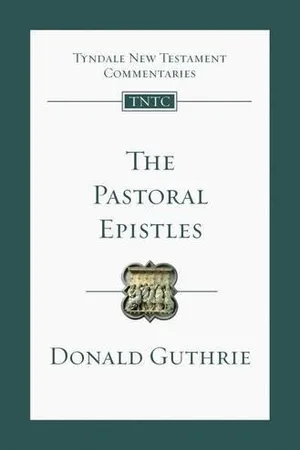
In his letters to Timothy and Titus, the apostle Paul is concerned with church order, defending correct doctrine and passing on the faith. Donald Guthrie's introduction to the volume, along with a helpful appendix, provides a strong defence of Pauline authorship of the Pastoral Epistles, setting them in the distinct historical context of Paul's later ministry. Guthrie's commentary bears out the idea of faith seeking understanding: he has drunk deeply from the pastoral wisdom in these letters, and in turn he offers us a deeper understanding of Paul's message to the church.
- English
- ePUB (mobile friendly)
- Available on iOS & Android
eBook - ePub
About this book
Information
Topic
Theology & ReligionSubtopic
Christianity1 Timothy: Analysis
1. THE APOSTLE AND TIMOTHY (1:1–20)
- Salutation (1:1–2)
- The contrast between the gospel and its counterfeits (1:3–11)
- The apostle’s personal experience of the gospel (1:12–17)
- The apostle’s charge to Timothy (1:18–20)
2. WORSHIP AND ORDER IN THE CHURCH (2:1–4:16)
- The importance and scope of public prayer (2:1–8)
- The status and demeanour of Christian women (2:9–15)
- The qualifications of church officials (3:1–13)
- Overseers (3:1–7)
- Deacons (3:8–13)
- The character of the church (3:14–16)
- Threats to the safety of the church (4:1–16)
- The approaching apostasy (4:1–5)
- Methods of dealing with false teaching (4:6–16)
3. DISCIPLINE AND RESPONSIBILITY (5:1–6:2)
- Various age groups (5:1–2)
- Widows (5:3–16)
- Widows in need (5:3–8)
- Widows as Christian workers (5:9–10)
- Younger widows (5:11–16)
- Elders (5:17–20)
- Timothy’s own behaviour (5:21–25)
- Servants and masters (6:1–2)
4. MISCELLANEOUS INJUNCTIONS (6:3–21)
- More about false teachers (6:3–5)
- The perils of wealth (6:6–10)
- A charge to a man of God (6:11–16)
- Advice to wealthy men (6:17–19)
- Final admonition to Timothy (6:20–21)
1 Timothy: Commentary
1. The Apostle And Timothy (1:1–20)
a. Salutation (1:1–2)
1. Following his general usage, Paul commences with a declaration of his own authority in order to make unmistakable the authority of the message he teaches. His design is semi-official as well as personal, for Timothy himself would need no such reminder of the apostle’s authority.
The word apostle must be given its narrower meaning of ‘membership of the apostolic circle’. It may well be that some at Ephesus had questioned Paul’s authority, and his claim to this title would therefore immediately correct any misconceptions about his official position in the church. The order of the title Christ Jesus may be preferred because for Paul the revelation of the heavenly Messiah was of primary importance. Yet the apostle’s use is far from consistent (cf. Rom. 1:1; 1 Cor. 1:1).
This idea of authority is intensified by the use of the expression by the command of God. Paul is more fond of saying ‘by the will of God’ (as in 2 Tim. 1:1), but he uses the present expression (kat’ epitagēn) in Romans 16:26 to bring out the compulsion of the divine commission (see also 1 Cor. 7:6 and 2 Cor. 8:8). He can never, in fact, forget that he is a man under orders.
It is unusual for Paul to speak of God our Saviour, since, apart from the Pastorals, he always attributes the title to Christ. But here his mind dwells on the ultimate source of Christian salvation. The title is fashioned on a familiar Old Testament conception, which would spring naturally from the apostle’s theological background. It would also have a contemporary significance in that the term Saviour (sōtēr) was used in the cult of emperor worship and was being applied to the infamous Nero. Perhaps an implied contrast may be found in the apostle’s use of the possessive our. The omission of the article in the Greek may mean the word had by this time become an accepted Christian title.
The linking of Christ Jesus our hope to the former statement adds weight to the apostle’s introduction and throws light on his theological position. The co-ordination of Father and Son as sources of the apostle’s authority points to his conviction about the deity of Christ (cf. Simpson). The Greek word translated hope (elpis), used in a Christian sense, conveys an element of absolute certainty which is generally lacking in the modern use of the English word.
2. The apostle’s description of Timothy as my true son in the faith (gnēsios means ‘genuine, sincere’) is striking evidence of the intimate Christian relationship between the two men. There was nothing spurious about Timothy’s standing in the faith. While there is no article in the Greek phrase, which could therefore be translated ‘in faith’, it is preferable to interpret the phrase as referring to the gospel. Timothy stood in the same tradition as Paul himself. The father-son terminology to express the master-disciple relationship was widespread in contemporary society, especially in the mysteries (cf. Dibelius-Conzelmann). It took on new meaning, however, when related to the Christian faith.
It is interesting to note that Paul uses his fullest formula of salutation, adding to his usual grace and peace the idea of mercy. The same triad is found in Paul elsewhere only in 2 Timothy 1:2. As Bernard well expressed it, ‘Even grace will not give peace to man, unless mercy accompany it; for man needs pardon for the past no less than strength for the future.’ As in the opening verse, so here, the source of this triad of blessings is given as God and Christ (from God the Father and Christ Jesus our Lord). Christ is the mediator of all the blessings which the Father bestows.
b. The contrast between the gospel and its counterfeits (1:3–11)
3. Paul’s thoughts flow so rapidly that he forgets to reach the grammatical end of the sentence begun in this verse. NIV renders it As I urged you … stay there in Ephesus, which at least captures the sense if not the precise grammatical construction. It is not certain what force the Greek verb parakaleō should have here. Both NIV and RSV prefer the stronger meaning (i.e. urged), but it is not impossible that the gentler ‘encouraged’ might not fit the context better. The apostle recalls the commission already given to Timothy for the younger man’s encouragement.
The reference to Ephesus need not imply that Paul had himself recently been there, since the Greek participle poreuomenos (present tense) may indicate that he left Timothy en route for Ephesus and charged him to stay there. It seems most likely that this occasion belongs to the period subsequent of the Acts history (see Introduction, pp. 24ff.), although there have been persuasive arguments put forward for allotting the incident within the Acts framework. The apostle’s words suggest that there was some reluctance on Timothy’s part to remain at Ephesus, which was one of the most important of the Asiatic churches, both strategically and culturally. His somewhat timid nature may well have shrunk from so onerous a task.
Timothy is now reminded that he is himself a man of authority. He has a definite commission to hold the false teachers in check, and it is evident that Paul expects him to take a strong line with them, as is shown by the verb translated command (parangellō), a military term which means literally to pass commands from one to the other. Not to teach false doctrines any longer suggests that there was already in existence a recognized standard of Christian doctrine (see Introduction, pp. 47ff.). These words give a timely warning to our modern age against the quest for novelties in Christian teaching.
4. The false teaching is next characterized as myths and endless genealogies. Nothing could be farther removed from the serious content of the gospel. The irrelevance of the spurious doctrine is in direct contrast to the edification which should result from true Christian teaching.
Many scholars see in genealogies a clear reference to second-century gnostic emanations. But there seem stronger reasons to suppose that the anonymous false teachers were members of a sect attracted by the more speculative aspects of Judaism. In Titus 1:14, where the same word myths (mythoi) occurs, they are described as Jewish, and there is a strong presumption that Paul has the same kind of people in mind here. An example of the way in which Jewish delight in such speculation led to the compilation of mythical histories based on the Old Testament is found in the Jewish book of Jubilees.1 It was inevitable that methods so unrestrained (endless, aperantos, may be understood in this sense) would lead to further controversies, and the whole unprofitable business impressed the apostle with its utter futility. No wonder he contrasts it with God’s work—which is by faith. The Greek word translated work (oikonomia) properly means ‘the office of stewardship’ (e.g. the position held by the manager of an estate) but came to be used in the more general sense of ‘administration’, which is the general Pauline use (cf. 1 Cor. 9:17; Eph. 3:2, 9). There is a contrast here between two activities, not two world-views. Paul has just stressed the pointlessness of the false teaching and now contrasts this with the discipline which belongs to faith. RSV renders the phrase ‘the divine training’, which captures some idea of the discipline needed for God’s work.
5. The command or injunction (again a military term parangelia is used) could possibly indicate the Mosaic Law, in which case the implication would be that these false teachers had misconceived its true purpose; but it is more likely that the Christian’s moral obligations are in mind. By the goal of this command is meant its purpose (RSV has ‘the aim of our charge’). Certainly for the Christian the goal of all exhortations in practical affairs is love, which was in all probability conspicuously lacking in these speculative reasoners, whose main purpose was their own intellectual satisfaction.
The apostle then makes clear the source of this love. The preposition ek, which is translated from, forcibly draws attention to its origin in a threefold aspect.
1. A pure heart. This is a fundamental requisite. Taken over from the Old Testament, the word heart stands for the totality of man’s moral affections, and without purity there, nobility of character is clearly impossible. Jesus reserved a special promise for the pure in heart (Matt. 5:8) and spoke of the pruning of the vine as an illustration of the cleansing of believers through the word (John 15:3).
2. A good conscience. The Greek word for conscience (syneidēsis) indicates literally ‘joint knowledge’, and came to be used of the facility to distinguish between right and wrong. The right operation of this facility was given special prominence in Paul’s theology. By way of contrast, Timothy is later reminded that apostasizers are those whose consciences are branded (1 Tim. 4:2). This conscience-concept was well known in Hellenistic culture, but acquired under Christian usage a broader application (cf. Simpson).
3. A sincere faith. Faith which is merely a pretence without solid foundation may well have been evident in the false teachers. What was important was the genuineness of what was professed.
This triad of sources for love has caused some scholars to question the authenticity of the passage, on the grounds that for Paul faith was sufficient of itself. While it may be true that no exact parallel to this use of faith is extant in Paul’s writings, there is no reason to doubt that Paul would have endorsed the statement that love proceeds from faith. In his great hymn of love, he links love with faith and hope, although subordinating the latter two to the former (1 Cor. 13:13). In any case, his use of faith there is closely allied to the use here.
6. This Christian triad has clearly been neglected by certain people. They have wandered away and turned. The two vivid verbs imply that having missed the mark (astocheō), they inevitably turned off course (ektrepō). By losing their Christian bearings they drifted into trackless waste, for life without this triad of virtues not only lacks love, but produces no more than meaningless chatter. The word translated meaningless talk (mataiologia) sums up the irrelevance which formed one of the main features of the false teaching.
7. The desire to be teachers of the law is a mark of the Jewish character of these men, whose main interest seems to have been to rival contemporary Rabbinical exegesis, rather than to expound the gospel. Paul brings a scathing indictment against instructors so unfitted for their task; they are both unintelligent and ignorant. They have no grasp of the sacred content of the text, and when they speak, their words are as meaningless to themselves as to others. The profundities of Christian truth must never become muffled in meaningless subtleties, a fault which those who indulge in allegorical interpretations do not always succeed in avoiding.
8. The mention of the law in verse 7 leads the apostle to discuss the law and its purpose. He grants that it possesses certain useful functions when used properly (nomimōs, a word which strictly means ‘lawfully’). This adverb, found only here and in 1 Timothy 2:5 in the New Testament, furnished the key to the statement concerning the law. The law must be restricted to its primary purpose—the restraint of evil-doing. In this sense it may be described as good, and it is significant that the Greek word used is kalos rather than agathos, since the former draws attention, not only to excellence of intrinsic quality, but also to beauty of outward form. The apostle is far from decrying the noble precepts of the Mosaic law, but is emphatically opposing the futilities of much Pentateuchal speculation. He goes on, in fact, to describe the various classes for whom the law is especiall...
Table of contents
- Tyndale New Testament Commentaries
- The Pastoral Epistles
- Contents
- General preface
- Author’S Preface To The First Edition
- Author’S Preface To The Second Edition
- Chief Abbreviations
- Select Bibliography
- Introduction
- 1 Timothy: Analysis
- 1 Timothy: Commentary
- 2. Worship And Order In The Church (2:1–4:16)
- 3. Discipline And Responsibility (5:1–6:2)
- 4. Miscellaneous Injunctions (6:3–21)
- 2 Timothy: Analysis
- 2 Timothy: Commentary
- 2. Thanksgiving (1:3–5)
- 3. Encouragement From Experience (1:6–14)
- 4. Paul And His Associates (1:15–2:2)
- 5. Directions To Timothy (2:3–26)
- 6. Predictions Of The Last Days (3:1–9)
- 7. Further Exhortations To Timothy (3:10–17)
- 8. Paul’s Farewell Message (4:1–18)
- 9. Concluding Salutations (4:19–22)
- Titus: Analysis
- Titus: Commentary
- 2. Qualifications Of Church Officials (1:5–9)
- 3. The Cretan False Teachers (1:10–16)
- 4. Regulations For Christian Behaviour (2:1–10)
- 5. The Theological Basis for Christian Living (2:11–3:7)
- 6. Closing Admonitions (3:8–11)
- 7. Personalia And Conclusion (3:12–15)
- Appendix
- Notes
- Titus: 5. The Theological Basis for Christian Living (2:11–3:7)
Trusted by 375,005 students
Access to over 1.5 million titles for a fair monthly price.
Study more efficiently using our study tools.
Frequently asked questions
Yes, you can cancel anytime from the Subscription tab in your account settings on the Perlego website. Your subscription will stay active until the end of your current billing period. Learn how to cancel your subscription
No, books cannot be downloaded as external files, such as PDFs, for use outside of Perlego. However, you can download books within the Perlego app for offline reading on mobile or tablet. Learn how to download books offline
Perlego offers two plans: Essential and Complete
- Essential is ideal for learners and professionals who enjoy exploring a wide range of subjects. Access the Essential Library with 800,000+ trusted titles and best-sellers across business, personal growth, and the humanities. Includes unlimited reading time and Standard Read Aloud voice.
- Complete: Perfect for advanced learners and researchers needing full, unrestricted access. Unlock 1.5M+ books across hundreds of subjects, including academic and specialized titles. The Complete Plan also includes advanced features like Premium Read Aloud and Research Assistant.
We are an online textbook subscription service, where you can get access to an entire online library for less than the price of a single book per month. With over 1.5 million books across 990+ topics, we’ve got you covered! Learn about our mission
Look out for the read-aloud symbol on your next book to see if you can listen to it. The read-aloud tool reads text aloud for you, highlighting the text as it is being read. You can pause it, speed it up and slow it down. Learn more about Read Aloud
Yes! You can use the Perlego app on both iOS and Android devices to read anytime, anywhere — even offline. Perfect for commutes or when you’re on the go.
Please note we cannot support devices running on iOS 13 and Android 7 or earlier. Learn more about using the app
Please note we cannot support devices running on iOS 13 and Android 7 or earlier. Learn more about using the app
Yes, you can access The Pastoral Epistles by Donald C Guthrie in PDF and/or ePUB format, as well as other popular books in Theology & Religion & Christianity. We have over 1.5 million books available in our catalogue for you to explore.