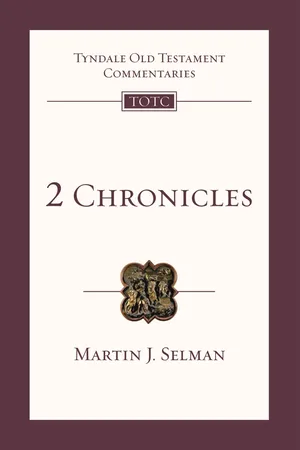
The Chronicler addressed an Israel separated from its former days of blessing by a season of judgment. The books of 1 and 2 Chronicles bring a divine word of healing and reaffirm the hope of restoration. The Chronicler's theme is straightforward - the promises of God revealed in the Davidic covenant are as trustworthy and as effective as the God who first uttered them.
- English
- ePUB (mobile friendly)
- Available on iOS & Android
eBook - ePub
About this book
Information
Topic
Theology & ReligionSubtopic
ChristianityCommentary
2. THE KINGDOM OF DAVID AND SOLOMON (1 Chr. 10:1–2 Chr. 9:31)
F. Solomon prepares for the temple (2 Chr. 1:1–2:18)
Despite the break between 1 Chronicles and 2 Chronicles, the account of Solomon basically continues the story of David. The reigns of the two kings are really a single unit, as Solomon’s involvement in David’s temple preparations has illustrated (1 Chr. 22, 28–29). The sense of partnership continues here, particularly in several passages unique to Chronicles where David is linked with Solomon (e.g. 2:3, 7; 3:1; 6:42; 7:10; 8:14). Another sign of this co-operation is the way the Davidic covenant is developed (1 Chr. 17), with Solomon fulfilling the first stage of God’s promises by ascending David’s throne and building the temple (especially 2 Chr. 6:4–11; cf. also 1:8–9; 5:4–11; 6:14–17; 7:17–18). The covenant theme in fact underlies Chronicles’ entire presentation of Solomon, which is much more concerned with Solomon’s significance in the purposes of God than listing the major events of Solomon’s life. It is for this reason that Chronicles has left out many important features found in the Kings account, such as Solomon’s personal details. Included in the omissions are not only the negative aspects like his polygamy, his idolatry, and his military disasters (1 Kgs 11:1–40), but also his accession (1 Kgs 1–2), his famous wise ruling (1 Kgs 3:16–28), his administration and wisdom (1 Kgs 4:1–34), and even some of the details of the building of the temple (e.g. 1 Kgs 6:4–19; 7:27–37) and the royal palace (7:1–12).
By removing those elements deemed unnecessary to his purpose, Chronicles has produced a simplified but distinctive portrayal of this king. This is best demonstrated by setting out the total structure of Solomon’s reign, which shows a basic chiastic formation:
1:1–17 Solomon’s wisdom, wealth, and fame
2:1–18 Solomon prepares for the temple
3:1–5:1 Construction of the temple
5:2–7:22 Dedication of the temple
8:1–16 Solomon completes the temple and other building work
8:17–9:28 Solomon’s wisdom, wealth, and fame
This layout immediately reveals a number of inner connections. Clearly the actual building and dedication of the temple form the centre of the account (chapters 3–7). However, an obvious link between chapters 1–2 and 8–9 is also evident, and further examination confirms that the temple theme extends even to these opening and closing chapters. This is most easily seen in Solomon’s correspondence with Hiram (ch. 2) which is directly concerned with temple preparations, but it emerges too from the parallel passage (8:1–16) where the nationwide building work is understood as the extension and completion of the temple project. Additional confirmation comes from a series of editorial markers, several of which are wholly or in part the Chronicler’s own contribution (cf. 2:1; 3:1; 5:1; 7:11; 8:16). Even the outer parts of the structure support the same theme. The description of Solomon worshipping at the Tent of Meeting (ch. 1) clearly anticipates his worship at the temple (cf. e.g. 1:6 with 5:6; 7:5–7), while the temple provides the chief evidence of Solomon’s divinely given wisdom (1:12; cf. 9:4). In fact, Solomon’s wealth and wisdom (1:1–17; 8:17–9:28) are best understood as a theme parallel to that of the temple, since they are all visible symptoms of the effectiveness of God’s kingdom in human affairs (cf. 1 Chr. 28:5–6; 29:11; 2 Chr. 9:8). In comparison with Kings, therefore, where the temple is merely the central section in a varied narrative about Solomon (1 Kgs 5:1–9:9, i.e. four and a half chapters out of eleven), the Chronicler has given it such prominence that it completely dominates his account.
In addition to the basic chiastic structure, the Chronicler has used several other literary patterns. The central chapters have a consecutive arrangement, dealing with the construction of the building (ch. 3), its furnishing and equipping (ch. 4), the installation of the ark (ch. 5), the dedicatory prayer (ch. 6), and God’s response (ch. 7). The effect is to make chapter 7 the climax of the entire temple account, and indeed of the entire work of the Chronicler. Comparison with Kings also reveals that Chronicles is more interested in the temple’s significance than in its architecture. Another literary scheme is the request—response pattern, of which there are three major examples. Explicit answers to Solomon’s requests are given not only by God (cf. 1:8–10 and 1:11–12; 6:14–42 and 7:12–21) but even by a pagan king (2:3–10, 11–16). The first two examples show clearly that prayer works! A further pattern is that of fulfilment, which has both literary and theological features. Again, three different examples must suffice. Firstly, God’s promises of wisdom, wealth, and fame are fulfilled in Solomon’s own life (8:17–9:31). Secondly, Solomon testifies that God’s covenant promises to David have been fulfilled in specific ways (6:4–11). Finally, Solomon’s temple is repeatedly shown to fulfil the principles underlying Moses’ Tent or tabernacle. For instance, Solomon and the temple architect Huramabi follow in the tradition of Bezalel and Oholiab who were responsible for the Tent’s construction, Solomon like Moses carries out the divinely revealed blueprint, and the shekinah glory which dominated the opening ceremonies for the Tent has the same effect at the temple dedication. All these examples provide ample evidence of the Chronicler’s creativity and flexibility as an author.1
Alongside the major themes of covenant and temple, a number of other emphases are worth noting. Far from exhibiting a ritualistic approach to religion, there is a strong emphasis on God’s sovereignty and presence. He is unique in heaven as well as on earth, and exercises his freedom to invade the temple and disrupt its services at his own convenience (e.g. 2:5–6; 5:13–14; 6:14, 18; 7:1–3). He is also a God who reveals his will directly in a way that surpasses his people’s expectations (1:7–12; 7:12–21). Worship is another major interest, where prayer and sacrifice form a regular partnership. Prayers occur at key points, such as 1:8–10; 6:14–42, and these serve as encouragements to everyone, whether Israelite or not (cf. 6:32–33), to seek God in prayer for themselves (cf. 1:5; 7:14). Sacrifice frequently takes place alongside prayer. God accepts the temple as a ‘house of sacrifice’ (cf. 7:12), and the regular pattern of sacrificial worship (2:4; 8:12–15) is just as important as the special dedicatory offerings (5:6; 7:1, 5, 7). Worship, however, is acceptable only if it is offered in a wholehearted spirit (6:7–8, 14, 30; 7:10), providing further evidence of the Chronicler’s concern for the heart as well as the form of worship. Despite the preoccupation with Solomon, Chronicles does not lose sight of Israel’s role. In some passages (1:2, 3, 5; 9:8), Israel as a whole is given greater prominence than in Kings, as are the Levites in 5:11–13. Their contribution is also underlined in passages such as 5:2–3, 6; 6:3, 12–13, 22–39; 7:8–10. Solomon’s wisdom, wealth, and fame (1:1–17; 8:17–9:31) as a sign of God’s blessing is also shared by the people as reflected glory.
Finally, the Davidic-Solomonic era serves as a standard for Israel’s future life. Covenant obedience, which includes the Mosaic as well as the Davidic versions, provides the measure against which all must be compared (e.g. 6:16–17; 7:17–22). However, Chronicles’ real emphasis is to underline that God’s forgiveness is constantly and unexpectedly available to anyone who comes to him in humble repentance. The prime motive for prayer in the temple is that there is always hope for sinners, as God affirms in his remarkable promises in 7:12–16. Such is the background against which the rest of Israel’s history will unfold (chs. 10–36).
i: Solomon’s splendour (1:1–17)
‘God … said to him, “Ask for whatever you want me to give you” ’ (1:7).
1:2–13a—cf. 1 Kings 3:4–15
1:13b—cf. 1 Kings 4:1
1:14–17—cf. 1 Kings 10:26–29
This chapter presents a rather different introduction to the reign of Solomon than do the books of Kings. Instead of the prolonged account of Solomon’s accession (1 Kgs 1–2), which may have a possible allusion in verse 1, the reader is brought immediately to an account of Solomon’s wisdom and wealth. It is almost a commentary on 1 Kings 10:23. Apart from a brief introduction underlining how the blessings of David’s reign continued under Solomon, the main part of the chapter falls into two parts, both of which are based on separate passages from Kings: (a) Solomon’s gift of wisdom (vv. 2–13); (b) Solomon’s wealth (vv. 14–17).
Two threads connect these apparently independent subjects. The first is that both wisdom and wealth are gifts of God. This is made abundantly clear by God’s answer to Solomon’s prayer (vv. 11–12), for which David’s prayer (cf. 1 Chr. 29:10–16) was more than adequate preparation. The second is the temple, indicated by the fact that this chapter is followed immediately by the preparations for building the temple. The temple offers the primary example of Solomon’s exercise of wisdom and the most significant use of his wealth.
All this arises from the picture of Solomon at worship. As one who offers sacrifices and especially as a man of prayer, Solomon shows himself to be suitably qualified to build a temple which will be a ‘temple for sacrifices’ (2 Chr. 7:12; cf. 2:6) and a ‘house of prayer’ (Isa. 56:7; cf. 2 Chr. 6:40; 7:14, etc.). In fact, the portrayal of the worshipping Solomon is the main focus of the chapter, since his wisdom and wealth result from his praying. Chronicles again shows that prayer is a vital ingredient of successful kingship as well as of acceptable worship (cf. 1 Chr. 16:8–36; 17:16–27; 29:10–19; 2 Chr. 6:4–42; 20:6–12).
In all this, Solomon provides an excellent model for Christians. The task of building and developing God’s church is not something that can be undertaken by human resources alone. Indeed, God has specifically given the gifts of his Holy Spirit for the building up of his church (1 Cor. 12:7; 14:12), and himself lives among his people for the same purpose (Eph. 2:22). The gift of wisdom is paramount in this undertaking. It is both a primary requirement of leadership, as Solomon demonstrates (vv. 10–11; cf. Paul’s description of himself as a ‘wise master builder’, 1 Cor. 3:10, AV), and is available to all who ask for it in faith (Jas 1:5–7).
Material wealth is not, of course, promised to the New Testament church in the same way as wisdom. This chapter demonstrates quite clearly, however, that from time to time it can be part of God’s gifts, though the Old Testament as well as the New Testament would also add that riches are fundamentally ‘uncertain’ (cf. 1 Tim. 6:17; Luke 12:13–21; Ps. 49). Although it is doubtful whether any of the New Testament churches could be described as rich in worldly terms, they did have a number of wealthy members (e.g. Matt. 27:57; Rom. 16:23). Even Paul had learned at times to be ‘in plenty’ (Phil. 4:10–13). But they would find greater value in aiming at contentment, and Paul was also confident that whatever the church’s needs were, they would be met through God’s ‘glorious’ riches in Christ Jesus’ (Phil. 4:19).
a. Solomon’s kingdom established (1:1). Every phrase in this verse illustrates that David’s blessings continued under Solomon, as indicated by the addition of son of David to the original text (1 Kgs 2:46b). David also had been ‘strengthened’ (cf. REB, NEB) at the beginning of his reign (cf. 1 Chr. 11:10), God was with him, had made him great (1 Chr. 11:9), and made him exceedingly great (also 1 Chr. 29:25). This continuity is not just the result of instituting a dynasty, but of God keeping his promises about establishing David’s house (cf. vv. 8–9; 2 Chr. 6:3, 10; 1 Chr. 17:23–27). David’s prayers that God would be ‘with you’ (1 Chr. 22:11, 16, 18; 28:20) have also been instrumental in bringing this situation about. ‘Strengthened his hold’ (REB, NEB; cf. established himself, NIV, NRSV, RSV) occurs several times in the introduction to a king’s reign (1 Chr. 11:10; 2 Chr. 12:1; 15:8; 17:1; 21:4; 25:3). Where details are supplied in other passages, some kind of conflict is always involved, almost certainly indicating that the phrase summarizes Solomon’s difficulties in making his throne secure (cf. 1 Kgs 1–2).
b. Solomon’s worship (1:2–6). The gathering at Gibeon is described quite differently from the record in 1 Kings 3:4ff. Whereas the earlier version speaks only of Solomon’s personal relationship with God, here all Israel (cf. 1 Chr. 29:23, 24, 25) or the whole assembly (cf. v. 5) is involved with him. This is typical of the Chronicler, who constantly emphasizes the people’s unity under their leader (cf. 1 Chr. 13:1–6; 15:25–29). The event has become a public enterprise, as if to encourage ordinary people of future generations that they too would receive a response from God when they sought him through his temple (cf. 2 Chr. 6:21–40; 7:13–16). Most of the officials listed in verse 2 also occur at 1 Chronicles 28:1, stressing continuity with David, and, though mention of the judges is slightly unexpected, they too had a continuing role in Israel (cf. 1 Chr. 26:29; 2 Chr. 19:8–11). ‘Gave an order’ (v. 2, GNB) is preferable to the usual but misleadingly mild spoke to (NIV, etc.).2
The incident has been deliberately modelled on Chronicles’ account of David’s plans to restore the ark to Jerusalem (1 Chr. 13:1–6). In addition to the parallel of all Israel and the whole assembly (vv. 2, 3, 5; cf. 1 Chr. 13:2, 4, 5, 6), the two passages are linked by references to the officials (v. 2, cf. 1 Chr. 13:1), the mention of the ark (v. 4), and especially the verb ‘sought’ (v. 5, RSV; enquired of, NIV; cf. 1 Chr. 13:3). As with verse 1, the element of continuity from David to Solomon is underlined, with Israel worshipping God by means of the Tent (v. 3) and the bronze altar (v. 5) in the same way as David worshipped before the ark.
Comparison with the parallel account in 1 Kings 3, by contrast, reveals several significant changes. Kings’ distinctly apologetic approach to the high place at Gibeon (1 Kgs 3:2–3; 2 Chr. 1:3, 13; cf. also 1 Chr. 16:39–42; 21:29) is replaced by a strenuous effort to treat the Gibeonite sanctuary with the greatest possible respect. In Chronicles, it is the site of God’s Tent of Meeting (cf. Dillard, ‘tent for meeting God’) and the bronze altar (v. 5), and is authenticated by Moses (v. 3) and Bezalel (v. 5), the chief architect of the Tent (cf. Exod. 31:2; 35:30; 36:1, 2; 37:1; 1 Chr. 2:20).3 The changes may not be as drastic as they appear, however. The issue of the ‘high places’ was no longer as pressing in the Chronicler’s day as it had been around the beginning of the exile when Kings was compiled, and Chronicles’ much more extensive account of preparations for the temple made it very clear that Gibeon’s days were numbered. David’s experience had also indicated that the future lay with Jerusalem rather than Gibeon (1 Chr. 21:30–22:1). Further, the stress here on the separation of the Tent at Gibeon from the ark in its own tent i...
Table of contents
- Tyndale Old Testament Commentaries
- 2 Chronicles
- Contents
- General preface
- Chief Abbreviations
- Analysis
- Commentary
- 3. THE KINGDOM OF JUDAH (2 Chr. 10:1–36:23)
Trusted by 375,005 students
Access to over 1.5 million titles for a fair monthly price.
Study more efficiently using our study tools.
Frequently asked questions
Yes, you can cancel anytime from the Subscription tab in your account settings on the Perlego website. Your subscription will stay active until the end of your current billing period. Learn how to cancel your subscription
No, books cannot be downloaded as external files, such as PDFs, for use outside of Perlego. However, you can download books within the Perlego app for offline reading on mobile or tablet. Learn how to download books offline
Perlego offers two plans: Essential and Complete
- Essential is ideal for learners and professionals who enjoy exploring a wide range of subjects. Access the Essential Library with 800,000+ trusted titles and best-sellers across business, personal growth, and the humanities. Includes unlimited reading time and Standard Read Aloud voice.
- Complete: Perfect for advanced learners and researchers needing full, unrestricted access. Unlock 1.5M+ books across hundreds of subjects, including academic and specialized titles. The Complete Plan also includes advanced features like Premium Read Aloud and Research Assistant.
We are an online textbook subscription service, where you can get access to an entire online library for less than the price of a single book per month. With over 1.5 million books across 990+ topics, we’ve got you covered! Learn about our mission
Look out for the read-aloud symbol on your next book to see if you can listen to it. The read-aloud tool reads text aloud for you, highlighting the text as it is being read. You can pause it, speed it up and slow it down. Learn more about Read Aloud
Yes! You can use the Perlego app on both iOS and Android devices to read anytime, anywhere — even offline. Perfect for commutes or when you’re on the go.
Please note we cannot support devices running on iOS 13 and Android 7 or earlier. Learn more about using the app
Please note we cannot support devices running on iOS 13 and Android 7 or earlier. Learn more about using the app
Yes, you can access 2 Chronicles by Martin J Selman,Martin Selman in PDF and/or ePUB format, as well as other popular books in Theology & Religion & Christianity. We have over 1.5 million books available in our catalogue for you to explore.