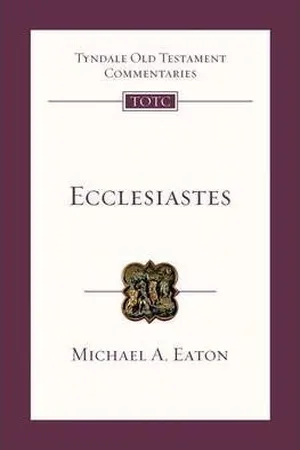
Scholars have long wrestled with the gloomy pessimism and striking omission of any mention of Yahweh in this portion of the Wisdom literature. After setting forth the issues related to the text, authorship, date and canonicity of the book of Ecclesiastes, Michael Eaton assesses its purpose and structure. He then provides a passage-by-passage analysis that attempts to account for the oddities of the text and to show its contemporary relevance.
- English
- ePUB (mobile friendly)
- Available on iOS & Android
eBook - ePub
About this book
Information
Topic
Teologia e religioneSubtopic
CristianesimoCommentary
1. Pessimism: Its Problems And Its Remedy (1:1–3:22)
In the opening chapters the thought passes from exposing a problem (1:2–2:23) to presenting a basic outline of its solution (2:24–3:22). The problem is that of life itself. If viewed without reference to God (‘under the sun’), the world in which we find ourselves is a chaos without meaning or progress (1:2–11); neither wisdom (1:12–18) nor pleasure (2:1–11) will enable us to live contentedly. Over both hangs a dark shadow: the inevitability of death (2:12–23). Thus the Preacher lays the foundation for commending a God-centred view of life by presenting a critique of all forms of secularism, whether theoretical (‘There is no God’; cf. Ps. 14:1) or pragmatic (‘I don’t care about God’). To any who maintain a viewpoint other than the faith of Israel he asks in effect: Do you realize what follows from your view of life?
The Preacher himself sees life as more than the sum of what is seen ‘under the sun’; the problems of life are given us by God (cf. 1:13). The pessimistic viewpoint, however, is unaccompanied by any practical faith in a God who may be trusted. With this earth-bound horizon it despairs of finding meaning or satisfaction in life. The Preacher will have his readers see the grimness of the pessimist viewpoint before he points to a life that derives from God himself (2:24–3:22).
a. Title (1:1)
1. Son of David, king in Jerusalem refers to Solomon, but the artificial name ‘Mr Preacher’ (for so it might be paraphrased) shows that the writer is not seriously claiming to be Solomon. The book is a write-up of Solomon’s story; later we shall be told that the originator of the material was a careful writer, a wise man, a collector of proverbs (12:9–12).1
b. The pessimist’s problems (1:2–2:23)
i. The failure of secularism (1:2–11). The Preacher undermines confidence in the secular view of life by inviting his readers to face some basic facts: the futility of life (v. 2), its consequences for man (3), the impossibility of getting rid of the earthly realm which embodies the problem (4), and the implications all this has for man’s view of nature (5–7) and history (8–11). It is a practical, not necessarily a full-blown intellectual, secularism that is in view. For there is a secularism of indifference or timidity, as well as of philosophy. Equally it is not to be thought that opinions are being presented as ‘merely’ the secular viewpoint, and not as in fact true. For the Preacher these are facts, but they are not the whole truth. He can describe his own life as a ‘vain life’ (7:15), but his outlook includes more than the earthly realm.
2. Vanity of vanities is a Hebrew superlative: ‘Utter vanity!’ Vanity (hebel) includes (i) brevity and unsubstantiality, emptiness (NEB), spelt out in Job 7 where the ‘vanity’ (v. 16, Heb.) of man’s life is a ‘breath’ (v. 7), an evaporating cloud (v. 9), soon to be ended (v. 8) and return no more (vv. 9f.); (ii) unreliability, frailty, found also in Psalm 62 where God, a ‘Rock’ and a ‘high tower’ (v. 6), is compared with man who is ‘vanity’ (v. 9), a ‘leaning wall’ and a ‘tottering fence’ (v. 3); (iii) futility, as in Job 9:29 (Heb.), where ‘in vanity’ means ‘to no effect’; (iv) deceit (cf. Jer. 16:19; Zech. 10:2).2 Ecclesiastes includes each of these emphases. All is untrustworthy, unsubstantial; no endeavour will in itself bring permanent satisfaction; the greatest joys are fleeting. Between 1:2 and 12:8 the Preacher will echo this key statement about thirty times, showing that his book is in fact its exposition. Vanity characterizes all human activity (1:14; 2:11): joy (2:1) and frustration (4:4, 7–8; 5:10) alike, life (2:17; 6:12; 9:9), youth (11:10) and death (3:19; 11:8), the destinies of wise and foolish (2:15, 19), diligent and idle (2:21, 23, 26).
All is literally ‘the whole’. All earthly experience, seen as a unit, is ‘subject to vanity’ (cf. Rom. 8:20). The same expression occurs in the Hebrew of 1:14; 2:11, 17; 3:1, 19; 12:8. A qualification is found in v. 3 (‘under the sun’), repeated in 1:14; 2:11, 17; and, with variation, 3:1. It is only to one seeking satisfaction in disregard of God that the Preacher’s message stops at ‘All is vanity’. For any who adopt his total world-view he has a note of encouragement. When a perspective of faith is introduced, ‘All is vanity’ is still true, but it is not the whole picture; ‘under the sun’ it is the whole truth. When, in 2:24–3:22 and intermittently thereafter, new factors are brought in (the generosity of God, divine providence, divine judgment), the ‘vanity’ of life is not obliterated or forgotten; but the new factors transform the perspective and turn pessimism into faith. This prefigures the New Testament perspective in which the believer is ‘outwardly … wasting away’ (2 Cor. 4:16), is ‘subjected to vanity’ and ‘groans’ with creation ‘right up to the present time’ (Rom. 8:20–22). Yet he ‘knows’ what is happening (Rom. 8:22), ‘gazes’ at a different perspective (2 Cor. 4:18), ‘waits’ for something different (Rom. 8:25). The new perspective does not cancel out the old; the believer is living in an overlap. But the new perspective revolutionizes his outlook.
3. This verse explains the consequences of earthly futility for mankind himself. Gain (yitrôn) is a commercial term; life ‘pays no dividends’ (Jones). If the earthly realm is subject to vanity, there is no hope of finding ultimate gain or satisfaction from its resources alone. Labour (‘āmāl) may denote physical toil (Ps. 127:1) or mental anguish (Ps. 25:18). In Ecclesiastes the emphasis is generally on the actual labour of human endeavours (especially in 2:10f., 18–23), but the mental-emotional aspects of human labour must also be borne in mind here. This accords with the use of ‘āmāl elsewhere: Joseph’s ‘anguish’ of mind (Gen. 41:51), the ‘misery’ from which Israel was delivered (Num. 23:21, NIV), Job’s ‘trouble’ (Job 3:10).3 If our view of life goes no further than ‘under the sun’, all our endeavours will have an undertone of misery.
In the Old Testament under the sun occurs only in Ecclesiastes (1:3, 9, 14; 2:11, 17, 18, 19, 20, 22; 3:16; 4:1, 3, 7, 15; 5:13, 18; 6:1, 5, 12; 8:9, 15 [twice], 17; 9:3, 6, 9 [twice], 11, 13; 10:5). It has links with other ancient writings, for it occurs in Phoenician, Elamite and Greek writings.4 Vanity characterizes man and the realm he occupies and dominates. If his resources are entirely this-worldly, ‘No profit’ is the motto over all he does. There is another realm altogether, the Preacher will contend later (5:2), when he will speak of God who may be approached and worshipped (5:1–7). Meanwhile the abyss of pessimism has to be explored.
4. Mankind’s problem is further aggravated by the contrast between the brevity of life and the apparent permanence of the earthly realm (cf. Ps. 90:4f., where man is as effective as a midnight watch, as energetic as sleep, as enduring as grass). Thus the inherent vanity of the earthly realm gives no hope of change. Goes … comes … remains represent Hebrew participles and imply continuity of action, ‘is continually going … coming … remaining’. For ever means that ‘under the sun’ there is no conceivable end to the problem of earthly futility.
5–7. These verses amplify vv. 2–4 in terms of creation. Though a hubbub of activity, it is devoid of progress. There is no gain for man in his toil; similarly there is no gain for creation in her toil. Three examples are given: the repetitious cycles of the sun, like a runner on a circular track; the wind blowing round its circuits to no apparent purpose; the waters gushing into the seas without ever finding their task accomplished.
For Old Testament orthodoxy, creation rings with the praises of the LORD. Creation is his. Clouds, storms, thunder, lightning, all are within his control. The fertility of men, animals and plants are his to withhold or to give. He sets the bounds to the seas, orders summer and winter, makes the sun rule the day, the moon the night, and brings out the stars by number.5 But, says the Preacher, take away its God, and creation no longer reflects his glory; it illustrates the weariness of mankind. When Adam fell, creation fell (Gen. 3:17–19). If man is weary, creation is weary with him. If our outlook is merely ‘under the sun’, no doxology can arise to one who is ‘in heaven’ (Eccl. 5:2). The prophets’ hope of mankind redeemed and an earthly paradise regained (Isa. 11:6–9; 65:17–25) cannot stand on secular premises.
Hastens (RSV) translates a verb meaning ‘to gasp, pant, sniff’. It depicts the sun as weary, like ‘a runner breathing heavily in the race’.6 The repeated participles of v. 6, going … turning … turning … going, themselves give a feeling of monotony. In v. 7, RSV to the place where the streams flow is correct. The thought is not that rivers return to their source (AV, NIV; NEB emends the text with the same ideas as a result), rather that rivers perpetually flow but make no progress in filling the sea.
8. The argument is taken a step further. Despite the fact that creation is active to the point of inexpressible exhaustion, it is incapable of providing secular man with any lasting satisfaction. Full of weariness is best taken passively (‘wearied’) rather than actively, following its clear meaning in its other occurrences (Deut. 25:18; 2 Sam. 17:2). All things may be translated ‘All words’, which would emphasize that the dissatisfaction of man is beyond words (cf. NAB All speech is laboured). That thought comes in the next phrase, but here the common translation carries the argument forward more clearly.
This ‘under the sun’ viewpoint again contrasts with that of the Old Covenant believer, who loved creation and saw in it the majesty of God’s name,7 looked with admiration at the skies,8 pondered the lessons taught by animals, wind, grass and trees,9 and sang to the glory of God because of what he saw and heard.10 He saw nature sing for joy,11 and knew that God’s control of creation was part of his redemption at the time of the exodus.12 Taking their cue from Solomon,13 the wise men also gloried in creation and used its object-lessons for their own purposes.14 The Preacher’s point is that all this is lost in an ‘under the sun’ viewpoint; all that is left is nature in a state of exhaustion.
The verb has … its fill (śāba‘) normally refers to the ‘satisfying’ of physical hunger (e.g. Exod. 16:8, 12), but here refers to being emotionally and psychologically satisfied (RSV).
9–10. These verses amplify vv. 2–4 in terms of hope. If God is left aside, and life viewed ‘under the sun’, there can be nothing new; history is a closed circuit. Neither circumstances (what has been) nor human endeavours (what has been done) can change. This too contrasts with Israelite orthodoxy. The Hebrew believed history was controlled by God. ‘Shall calamity befall a city and the LORD has not done it?’ (Amos 3:6). The severe trials that befell Joseph and Job were attributed to God (Gen. 50:20; Job 42:2). Nebuchadrezzar was God’s servant (Jer. 25:9), Cyrus his anointed (Isa. 45:1). Redemption consists of acts of God in history (cf. Ps. 106). Revelation involves authorized interpreters to predict God’s acts before they happen, and to expound them after. History is travelling to a goal, the Day of the LORD, when he will complete his purpose, redeem his people and judge his enemies.15
Again, the Preacher’s point is that this cannot be viewed secularly. Consider life ‘under the sun’ and the concept of God’s ruling from heaven no longer holds good. No-one can appeal to God to ‘look down’ and intervene (Isa. 63:15). There can be no redemption, for no new factor can be introduced. The heavenly realm is the source of what is really new, the psalmist’s ‘new song’ (Ps. 96:1) and the prophet’s ‘new thing’ (Isa. 43:19).
In v. 10 an objection is anticipated: what about that which is observably new? The answer is, it is illusory. The similarity to Greek, especially Stoic, thinking has often been pointed out. Von Rad thinks that the Preacher capitulated to secular philosophy at this point.16 But the Preacher’s identification with an earthbound horizon is only part of his exposition; the vertical perspective is yet to come.
11. This stage of the argument closes by considering mankind’s approach to life in the light of the pessimistic evaluation of history in vv. 9f. Nihilism not only dominates his outlook, it also works itself out in life. Past events are forgotten; future events will be forgotten. Here remembrance, deriving from the verb ‘remember’, means ‘remembering and acting accordingly’, a well-attested usage. Nehemiah’s prayer ‘Remember me for good’ (Neh. 13:31) pleads that God’s actions may arise out of his past promises (cf. Gen. 40:14; Exod. 20:8).17
Commentators have debated whether the translation should read ‘former people’ (NIV, Lys and others) or former things (RSV). The first has parallels in 2:16 and 9:15, but here vv. 9f. are dealing with history more generally. Aalders (following Thilo) is surely right in thinking the antithesis needless. In the light of the word ages in v. 10,...
Table of contents
- Tyndale Old Testament Commentaries
- Ecclesiastes
- Contents
- General Preface
- Author’s preface
- Chief Abbreviations
- Introduction
- Analysis
- Commentary
- 2. Life ‘Under The Sun’ (4:1–10:20)
- 3. The Call To Decision (11:1–12:8)
- 4. Epilogue (12:9–14)
- Postscript
Trusted by 375,005 students
Access to over 1.5 million titles for a fair monthly price.
Study more efficiently using our study tools.
Frequently asked questions
Yes, you can cancel anytime from the Subscription tab in your account settings on the Perlego website. Your subscription will stay active until the end of your current billing period. Learn how to cancel your subscription
No, books cannot be downloaded as external files, such as PDFs, for use outside of Perlego. However, you can download books within the Perlego app for offline reading on mobile or tablet. Learn how to download books offline
Perlego offers two plans: Essential and Complete
- Essential is ideal for learners and professionals who enjoy exploring a wide range of subjects. Access the Essential Library with 800,000+ trusted titles and best-sellers across business, personal growth, and the humanities. Includes unlimited reading time and Standard Read Aloud voice.
- Complete: Perfect for advanced learners and researchers needing full, unrestricted access. Unlock 1.5M+ books across hundreds of subjects, including academic and specialized titles. The Complete Plan also includes advanced features like Premium Read Aloud and Research Assistant.
We are an online textbook subscription service, where you can get access to an entire online library for less than the price of a single book per month. With over 1.5 million books across 990+ topics, we’ve got you covered! Learn about our mission
Look out for the read-aloud symbol on your next book to see if you can listen to it. The read-aloud tool reads text aloud for you, highlighting the text as it is being read. You can pause it, speed it up and slow it down. Learn more about Read Aloud
Yes! You can use the Perlego app on both iOS and Android devices to read anytime, anywhere — even offline. Perfect for commutes or when you’re on the go.
Please note we cannot support devices running on iOS 13 and Android 7 or earlier. Learn more about using the app
Please note we cannot support devices running on iOS 13 and Android 7 or earlier. Learn more about using the app
Yes, you can access Ecclesiastes by Michael Eaton in PDF and/or ePUB format, as well as other popular books in Teologia e religione & Cristianesimo. We have over 1.5 million books available in our catalogue for you to explore.