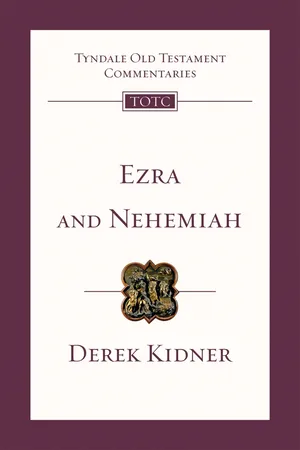
"The chequered story of the Kings, a matter of nearly five centuries, had ended disastrously in 587 B.C. with the sack of Jerusalem, the fall of the monarchy and the removal to Babylonia of all that made Judah politically viable. It was a death to make way for a rebirth." So begins Derek Kidner in this introduction and commentary to the books of Ezra and Nehemiah which chart the Jews' return from exile to Jerusalem and the beginnings of that rebirth. As the drama unfolds, we see how international politics, nationalist pride, wise leadership, political intrigue and opportunism, internal dissension and compromise all shape events. But above all and through all we see the good hand of God at work.The original, unrevised text of this volume has been completely retypeset and printed in a larger, more attractive format with the new cover design for the series.
- English
- ePUB (mobile friendly)
- Available on iOS & Android
eBook - ePub
About this book
Information
Topic
Theology & ReligionSubtopic
ChristianityCommentary On Ezra
Ezra 1–6 A Temple From The Ruins
The greater part of this book, though it bears the name of Ezra, tells of the pioneers who came back from exile to Jerusalem a whole lifetime before him. We shall not meet Ezra till chapter 7. By then, some eighty years of settling into the old country will have gone by, and he will come as a consolidator and reformer; not a temple builder like his predecessor Zerubbabel, nor a rebuilder of city walls like his younger contemporary, Nehemiah.
First, then, in chapters 1–6 we read of what awaited the earliest homecomers from Babylon: how they attempted to carry out the commission to build a new Temple; how they ran into local opposition and gave up the attempt for nearly twenty years; how they rallied at last and completed it, against a background of threats and political manoeuvres. The threats were defied, the manoeuvres were self-defeating, and this part of the story ends on a high note of rejoicing.
More than half a century was to separate that first climax from the events of chapter 7, but an earlier digression (4:6–23) will have filled in enough of the picture to show us that the Jews meanwhile continued to be bitterly resented by their neighbours; enough, too, to prepare us for the devastating opening to the book of Nehemiah.
Apart from that foretaste, the present group of chapters, Ezra 1–6, covers a single generation, 538–516 BC, and is concerned with one great enterprise, the rebuilding of the house of God: a theme which it shares with two of the prophets of the day, Haggai and Zechariah.
Ezra 1. Liberty!
1:1–4. Word from the King
1. This opening verse has the characteristic solidity and depth of biblical history writing, with its interest both in the external details of an event and in opening up its inner meaning. The event is datable (538 BC), and can take its place among the new policies that flowed from the fall of one empire and the rise of another. But while Cyrus had his own good reasons for what he did (see below), the Lord had his; and these were, as ever,1 the heart of the matter and the key to the future.
It was the Lord, we learn, who stirred up Cyrus to act, as he would also stir a group of exiles to respond (5). It was the same Lord who, unknown to Cyrus, had already ‘stirred’ him,2 years before, to begin his march across the world, and had smoothed his road to victory with exactly this in view. His most significant achievement, against all human reckoning, was not to win an empire but ‘to build my city and set my exiles free’ (Isa. 45:13).
More than this, God had given his word to Judah that the exile would be over in a mere seventy years, ‘to give you’, as he said, ‘a future and a hope’ (Jer. 25:12f.; 29:10f.).3 And God was better than his word. It was barely fifty years since 587 BC, the year when Jerusalem had fallen. There had been a deportation before this (597), and a token one as far back as 605 (2 Kgs 24:10–17; Dan. 1:1ff.), but even the longest of these spans fell short of the allotted seventy years. It was not the last time that God’s mercy would shorten the days of trial (Matt. 24:22).
So a proclamation was made. This (if it followed the normal pattern) would be shouted by heralds in the principal towns of the empire, and possibly placarded as well.4 But whether or not the writing was on public view, it was preserved in the records, together with administrative details for the implementing of the decision. How much was to hang on this fact would emerge twenty years later in the events of chapter 6.
2, 3. The famous Cylinder of Cyrus throws an interesting light on this decree. The inscription (see p. 21) tells of his allegiance to Marduk, the chief god of Babylon, and of his respect for the gods of his subject peoples. Whereas their images had been treated as trophies by his predecessors, he now restored them to their ‘sacred cities’, rebuilt their temples and repatriated their worshippers. He expressed the hope that these gods would therefore pray for him daily to the gods of Babylon: Bel, Nebo and above all, Marduk.
From his own standpoint, then, to have the house of the God who is in Jerusalem 5 rebuilt was but one instance of a consistent policy. More than one of his successors would show the same concern for correct religious protocol (see pp. 20ff.). The homage paid in verse 2 to the Lord was doubtless a diplomatic courtesy, yet sincere enough in its way. It was important to frame the decree correctly for each repatriated group, and the God of heaven was how the Jews described their deity. Moreover to a polytheist of Cyrus’s wide sympathies it would seem clear that all the gods had willed his triumph; therefore each in his proper context could be thanked for it.
According to Josephus, however (Ant. xi. 1), Cyrus had been shown the prophecy of Isaiah 44:28, which names him, and was eager to fulfil it. While this is not impossible,6 it has no corroboration; and Cyrus’s own inscription shows that any knowledge he may have had of the Lord was nominal at best. Isaiah 45:5f. insists that to know the Lord involves acknowledging no god beside him.
4. To a devout Jew there were two expressions here to quicken his interest. One was the word for survivor, which in Hebrew would call to mind Isaiah’s insistent message that ‘a remnant’ would return (cf. Isa. 10:20ff.). The other was an echo of the Exodus, in the call to the neighbours of the pilgrims to speed them on their way with silver and gold and other gifts, just as the Egyptians had done centuries before (Exod. 12:35f.) It would chime in with Isaiah’s songs about a second Exodus (Isa. 43:14ff.; Isa. 48:20f., etc.), which lifted the whole enterprise on to the highest level.
Besides these voluntary gifts there were to be payments and releases from the royal treasury, specified in a separate document which found its way into the royal archives. This record was to play a vital part in a later crisis, as recounted in chapter 6; meanwhile the safe return of the Temple vessels forms the climax of the present chapter.
1:5–11. Treasures to Jerusalem
5. Nearly two hundred years after the kingdom of Israel had disintegrated, the remains of the little kingdom of Judah, which had always included some members of the other tribes,7 still had some cohesion and could rightly bear the name of Israel (cf. 1:3b; 2:2b). Now the Lord, as though to emphasize that he is not the God of the big battalions,8 stirred only a remnant of this remnant into action. This whittling down of numbers and power, ever since the heyday of the kings, is reminiscent of his way with Gideon’s army and, later, with the crowds of Galilee and Judea. But the more obvious emphasis is on the word stirred, echoing what was said of Cyrus in verse 1, to make it doubly clear that this enterprise was from the Lord. Otherwise, as Psalm 127 shows, the builders and the watchmen would have done their work in vain.
6. On this echo of the Exodus story, see on verse 4. That verse shows also that the term freely offered refers to gifts for the Temple itself, the rest being evidently meant for the pilgrims. There was no question, incidentally, of their refusing this money from unbelievers; rather, as Haggai 2:7f. would point out, since the treasures of all nations were the Lord’s, they were his to command.9
7. In the absence of images to restore as in the case of other religions (see on verses 2–4), the Temple vessels, or articles (the word is very general), made an obvious substitute. The written order for their return, and for the Temple’s rebuilding at the royal expense, is preserved in 6:1–5.
8. The names of the two officials give us a glimpse of the new and the old régimes now combined. Mithredath is a Persian name in honour of Mithras the sun god (‘Mithras has given’),10 and the word that describes him as treasurer is also Persian. The name Sheshbazzar on the other hand is probably connected with the conquered nation’s sun god, the Babylonian Shamash.
Sheshbazzar is better described as chief or (NEB) ‘ruler’ than as prince, for the Hebrew word carries no necessary implication of royal descent. The question of his identity is discussed in Appendix 2, pp. 153ff. There is a view that Sheshbazzar was a second name for Zerubbabel, used in all transactions with the ruling power (cf. other re-namings, e.g. 2 Kgs 24:17; Dan. 1:7). Alternatively Sheshbazzar and Zerubbabel may have been, respectively, the official and unofficial leaders of the enterprise. Neither view is without its difficulties.
9–11. From this prosaic inventory (and the textual problems it now presents to us—see ‘Additional note’ below) it is left to us to picture what it may have meant to see this consecrated gold and silver brought out into the light of day, every piece of it a witness to God’s sovereign care and the continuance of the covenant. The political kingdom had perished, but not the ‘kingdom of priests’. The businesslike transfer of articles, ‘counted out’ (8) from one custodian to another, may have been outwardly undramatic, but it was momentous. The closing words of the chapter, from Babylonia to Jerusalem, mark one of the turning-points of history.
Additional note on the list of vessels, 1:9–11
There are obscurities here in both the vocabulary and the figures. Basins (ʾăgartĕlê) is a loan-word, a fact which may mean that the author was using an inventory compiled by a foreigner (cf. perhaps the archives mentioned in 6:1ff.). Censers (cf. 1 Esdras 2:13) is one of many guesses at the Hebrew maḥălāpîm. RV has ‘knives’, LXX ‘changes’ (of raiment? i.e. priestly robes?). The word does seem to derive from √ḥlp to change, but probably means either ‘duplicates’ or ‘varieties’ (cf. NEB).
The problem of the figures is that in the Hebrew text (supported by LXX) the separate items add up to less than half the recorded total. Therefore RSV (unlike AV, RV, JB, NEB) follows the tidier figures of 1 Esdras 2:13f. (see RSV mg. for the details). In defence of the Hebrew text one might argue that the named items are only a selection; but verse 10b mentions ‘a thousand other vessels’, which should take care of the remainder. So it seems that either the total or the components have been misunderstood (if signs were used for the numerals), or miscopied.11 There may be a pointer to textual damage in the Hebrew word mišnîm (10), whose normal meaning, ‘double’ or ‘second’, is not compellingly relevant here.12 It is thought by many to be the remains of a numeral; 1 Esdras 2:13, adopted by RSV, has ‘two thousand’ at this point.13 These are speculations; but few commentators doubt that the author was drawing on an actual list, whose original form showed the completeness of the hand-over of Temple vessels.14
Ezra 2. The pilgrims
This chapter, however uninviting it may seem, is a monument to God’s care and to Israel’s vitality. The thousands of homecomers are not lumped together, but (in characteristic biblical fashion) related to those local and family circles which humanize a society and orientate an individual. Such is God’s way, who ‘setteth the solitary in families’ (Ps. 68:6, AV, RV). And for the people’s part, their tenacious memory of places and relationships, still strong after two generations in exile, showed a fine refusal to be robbed of either their past or their future.
So these were living portions of Israel, roots and all, for replanting. But the fundamental motive for this careful grouping was not social but religious. This is the holy nation, given a new chance to live up to its calling. There can be nothing casual in its preparations. Not only must every priest have his credentials (61–63) but every member too (59f.), whether as a true-born Israelite or as belonging to a constituent household (65) or guild (cf. 43–58)—or again (as we learn later, 6:21) as a convert. It was something more than antiquarianism which would impel Nehemiah, nearly a hundred years later, to make this long catalogue the check-list for his regrouped community, and to reproduce the whole of it in his memoirs (Neh. 7:5–73).
The final paragraphs show another aspect of Israelite vitality (68f.) and another glimpse of a structured community which had a well-marked variety of components (70) and a God-given centre of unity (3:1).
2:1, 2a. The leaders
The section headings below will show how orderly an account, group by group, this chapter gives of the return. For its general interest, see the paragraph above; the notes that follow are mostly on minor points of detail.
1. The province (mĕdînâ) in question is Judah, a small district within the great administrative area known as Beyond the River, i.e. Syria and Palestine (see on 4:10). Judah was perhaps carved out of adjacent districts and newly granted an identity of its own—for Sheshbazzar was arriving there as governor (cf. 5:14). If so, the ruffled feelings of officials shorn of part of their command may have helped to set the hostile tone which they and their successors tended to adopt. And at the local level the collective word used here for exiles, the gôlâ, was to become something of an irritant, as a term which marked off the community that had been through its ordeal in Babylon from the rather suspect multitude that had escaped that purging.
2a. There are eleven names here, but Nehemiah’s copy of the list preserves one more, that of Nahamani (Neh. 7:7), which has evidently dropped out of this verse in the course of copying. The choice of twelve, like that of the twelve apostles, was a tacit declaration that the community they led was no mere rump or fragment but the embodiment of the people of Israel (note the final words of this verse) and the corporate inheritor of the promises. Compare the reminder of the Exodus noted at 1:4, and the offering of ‘twelve bulls for all Israel’ in 8:35.
Zerubbabel, a grandson of king Jehoiachin,15 was the natural leader of such a company, whether his position at this stage was official or unofficial.16
Jeshua the High Priest (Zech. 3:1), whose name (in Greek, ‘Jesus’) is spelt Joshua in Haggai and Zechariah, was Zerubbabel’s fellow-leader. So close, indeed, was this partnership that it was seen by Zechariah as the foretaste of the pe...
Table of contents
- Tyndale Old Testament Commentaries
- Ezra and Nehemiah
- Contents
- General preface
- Author’s preface
- A Selection Of Dates
- Chief Abbreviations
- Introduction
- Commentary On Ezra
- Ezra 7–10 The Plumb-Line Of The Law
- Commentary On Nehemiah
- APPENDICES
Trusted by 375,005 students
Access to over 1.5 million titles for a fair monthly price.
Study more efficiently using our study tools.
Frequently asked questions
Yes, you can cancel anytime from the Subscription tab in your account settings on the Perlego website. Your subscription will stay active until the end of your current billing period. Learn how to cancel your subscription
No, books cannot be downloaded as external files, such as PDFs, for use outside of Perlego. However, you can download books within the Perlego app for offline reading on mobile or tablet. Learn how to download books offline
Perlego offers two plans: Essential and Complete
- Essential is ideal for learners and professionals who enjoy exploring a wide range of subjects. Access the Essential Library with 800,000+ trusted titles and best-sellers across business, personal growth, and the humanities. Includes unlimited reading time and Standard Read Aloud voice.
- Complete: Perfect for advanced learners and researchers needing full, unrestricted access. Unlock 1.5M+ books across hundreds of subjects, including academic and specialized titles. The Complete Plan also includes advanced features like Premium Read Aloud and Research Assistant.
We are an online textbook subscription service, where you can get access to an entire online library for less than the price of a single book per month. With over 1.5 million books across 990+ topics, we’ve got you covered! Learn about our mission
Look out for the read-aloud symbol on your next book to see if you can listen to it. The read-aloud tool reads text aloud for you, highlighting the text as it is being read. You can pause it, speed it up and slow it down. Learn more about Read Aloud
Yes! You can use the Perlego app on both iOS and Android devices to read anytime, anywhere — even offline. Perfect for commutes or when you’re on the go.
Please note we cannot support devices running on iOS 13 and Android 7 or earlier. Learn more about using the app
Please note we cannot support devices running on iOS 13 and Android 7 or earlier. Learn more about using the app
Yes, you can access Ezra and Nehemiah by Derek Kidner in PDF and/or ePUB format, as well as other popular books in Theology & Religion & Christianity. We have over 1.5 million books available in our catalogue for you to explore.