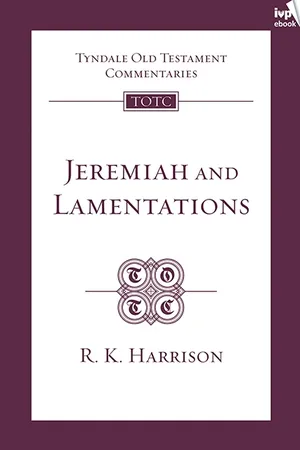
Despite the themes of doom and destruction, the primary message of Jeremiah is one of the love and grace of a God who never gives up on those he has called to be his own. The prophet's life is characterized by suffering, but he points to a new beginning, a new covenant and a new hope, eventually made possible through the unique Suffering Servant. Lamentations powerfully expresses personal and national suffering. Yet, even in these utterances of desperate grief, there are glimpses of hope. Hetty Lalleman opens up these fascinating books for today's readers.
- English
- ePUB (mobile friendly)
- Available on iOS & Android
eBook - ePub
About this book
Information
Topic
Theology & ReligionSubtopic
ChristianityCommentary
A. PROPHECIES RELATING TO CURRENT HISTORY AND DOMESTIC MATTERS (1:1–45:5)
1. Prophecies occurring between 625 BC and the fourth year of Jehoiakim (1:1–20:18)
Jeremiah is the most notable of the Hebrew prophets because of the almost impossible mission which God assigned to him. His task was to try to recall the people of Judah to an observance of divine law at a time when they were poised on the brink of national and spiritual catastrophe. For many years the influence of pagan Canaanite worship had exerted a corrupting effect upon the Judeans, as it had done earlier in the northern kingdom. Religious apostasy had been followed by social and moral decay, and it fell to Jeremiah to present the implications of the Sinai covenant fearlessly in a desperate attempt to stem the tide of destruction. But because the nation was indifferent and rebellious by turns, Jeremiah soon found that he had acquired a reputation for pessimism and gloom. For his fidelity to his vocation he was rejected, hated, persecuted, and even feared by those whom he was most anxious to recall to covenant spirituality. Such a prophetic mission demanded a keen and continuing sense of vocation, supported by courage, faith and determination. The first chapter describes the circumstances connected with his call as a prophet.
1:1–19. Jeremiah is called and commissioned
1–3. Superscription. Prophecies generally commence with some indication of authorship and date as a means of setting God’s message in historical perspective.
1. The oracles which follow are described as words, but this term can also be translated ‘matters’, ‘incidents’ and ‘affairs’ as well as ‘words’ or ‘sayings’. The opening phrase thus refers both to the prophecies of Jeremiah and the various events in his career. The name Jeremiah may mean ‘the Lord exalts’ or ‘the Lord founds’, and was borne by other biblical personages (cf. 2 Kgs 23:31; Neh. 10:2; 1 Chr. 5:24). Jeremiah’s father, Hilkiah, was a member of a priestly family which may have ministered in the temple after the reformation of Josiah in 621 BC. This Hilkiah was not the High Priest who officiated under Josiah (cf. 2 Kgs 22:4). Anathoth, the home of Jeremiah, was located near the modern Anata, a village about three miles north-east of Jerusalem. It was in Benjaminite territory assigned to the Levites (Josh. 21:18), and was repopulated after the exile.
2. This verse describes the point at which the word of the Lord became a matter of great personal importance to Jeremiah. As a boy he may well have been familiar with priestly practices, but in any case there is no evidence that he ever served as a priest. It is possible, however, that what he observed in the cultus as a young man influenced his attitude towards the priesthood in subsequent days. His future life and thought were moulded to a large extent by an early acquaintance with the utterances of the eighth-century BC prophets such as Amos, Hosea, Isaiah and Micah, and probably also by the lives and sayings of Elijah and Elisha. Hosea especially seems to have gripped the imagination of the young Jeremiah with his striking illustrations of divine love for wayward Israel. In subsequent oracles Jeremiah was to employ the century-old imagery of Hosea which described Israel’s apostasy as harlotry or adultery. The approximate date of Jeremiah’s call to prophetic office was 627 BC, the thirteenth year of Josiah.
3. Josiah reigned for another sixteen years after Jeremiah’s call, being succeeded by Jehoahaz, Jehoiakim, Jehoiachin and Zedekiah. Jehoahaz and Jehoiachin were probably omitted in this verse because their reigns were so short, comprising only three months each. The captivity of Jerusalem occurred in 587 BC, but Jeremiah continued his prophetic ministry for some time after that event.
4–10. The call of Jeremiah. God assured the prophet that he was predestined for his task, a factor which formed the basis for his unshakable conviction that his mission was indeed of divine origin. Yet despite this assurance Jeremiah still needed constant spiritual support to enable him to proclaim God’s word to an unheeding, rebellious nation. As the prophecy unfolds, the way in which Jeremiah found strength by constant communion with God will become evident. As the crisis of exile draws near, his initial diffidence is replaced by a degree of boldness and forthrightness in proclaiming the divine word which shows that, as a person, he has grown in wisdom and understanding. Jeremiah dramatically depicts a servant who is faithful (cf. 1 Cor. 4:2), and whose fidelity is ultimately vindicated (Matt. 10:22). As such his life exemplifies the stability and constancy which the individual Christian ought to exhibit (cf. Eph. 6:13). It is through testing that faith grows.
4–5. Jeremiah was ‘foreknown’ in the best Pauline sense (cf. Rom. 8:29–30), while the imagery of sanctification (AV) parallels the promise made to Zacharias, the father of John the Baptist (Luke 1:15). There is nothing haphazard about the choice of Jeremiah as a divine messenger to Israel. Indeed, God had formulated each step of the process himself from conception to consecration, with an intimate awareness both of the need and the one who should meet it. Under such circumstances Jeremiah had little choice but to submit to his high calling. God’s chosen vessels are often long in the making, as for example in the case of Moses, and they emerge at the strategic moment, the most notable instance of this being Christ himself (Gal. 4:4). The phrase to the nations indicates the universality of Hebrew prophecy (cf. 25:15–29).
6–7. The young Jeremiah protests his timidity and lack of experience, but to no avail. His emotional conflicts seem to begin with his call, and this verse illustrates the tension arising from his reluctance to undertake the task committed to him and the assurance from God that he had already been furnished with the requisite moral and spiritual powers. The Hebrew for youth (RSV) can also mean a ‘child’ or ‘infant’ (Exod. 2:6; 1 Sam. 4:21), and also a ‘young man’ (Gen. 14:24; 34:19), the sense of ‘youth’ being obviously intended here.
8. The command ‘fear not’ was given on many occasions in Scripture to the Lord’s servants, including Abraham (Gen. 15:1), Moses (Num. 21:34; Deut. 3:2), Daniel (Dan. 10:12, 19), Mary (Luke 1:30), Simon (Luke 5:10) and Paul (Acts 27:24). Fear is one of the most paralysing of human emotions, and can only be dispelled fully by the love of Christ (cf. 1 John 4:18). This verse indicates that God always supports his servants in the missions assigned to them (cf. Exod. 3:12). While Jeremiah will not be free from opposition and even physical danger, he will survive all difficulties, because God will be with him to sustain him.
9–10. By touching the young prophet’s mouth God symbolizes the communication of the divine message. The incident is reminiscent of the sanctification of Isaiah (Isa. 6:7). After Jeremiah had felt the touch of the Master’s hand he was ready to begin his prophetic ministry. Note here that there is no disparity between God’s words and those of the man Jeremiah. The ‘word of faith’ was near him, in his mouth and in his heart (Rom. 10:8). God can now proclaim his sovereign will to the nations with Jeremiah acting as spokesman. There is a decidedly negative emphasis here which sets the tone for most of the prophecy. What is corrupt in the nation must be uprooted and torn down, for only then can God undertake to build and to plant anew. Calamity was therefore an inevitable occurrence as long as the nation pursued its sinful ways. However, the fact that God spoke of renewal furnished some ground for hope of restoration at some future period. This is a paradigm of the spiritual life, for God has first to remove the sin before the sinner can begin to grow in grace and in the knowledge of Jesus Christ (cf. Eph. 4:15; 2 Pet. 3:18).
This section depicts in a sensitive and appealing manner the intimacy existing between God and his chosen servant. As elsewhere in Scripture God is revealed as a communicating deity who respects human individuality, speaks to people at their own level of understanding, and uses language whose intent cannot possibly be mistaken. He is also prepared for an intelligent response and will listen to explanation or argument, whether framed in the stammering tongue of Moses or the lengthy expostulations of Job. Response, however, is the important consideration when God has spoken to man, and Jeremiah, though perhaps slow and unwilling, was nevertheless by no means deficient in this respect. The thought that his very existence was a conscious part of divine purpose and not an incidental biological occurrence must have given him a special sense of destiny. This in turn doubtless contributed to his determination to fulfil his prophetic mission regardless of personal considerations.
11–16. Two visions. These incidents occurred early in his ministry, though at what precise point or how far apart is hard to say. They were probably quite separate from the call, but taken together with that occurrence they helped Jeremiah to authenticate his commission both to himself and others. By professing to ‘see’ what God had said to him, the prophet, like Amos (Amos 1:1; 8:1f.) and Isaiah (Isa. 2:1), was able to show how he experienced the divine word at this stage.
11–12. The first vision has a positive ring to it, having as its subject an almond rod, the first tree to bud in spring. There is a play on MT almond rod (šāqēd, ‘waker’) and šōqēd (watching over), which illustrates the promptness with which God keeps his promises. Just as the early stirring of the almond heralded springtime, so the spoken word pointed to its own rapid fulfilment. Like Amos, Jeremiah had an appreciation of nature (cf. 2:10; 8:7; 12:8f.; 14:4–6, etc.), and was aware that it could function as a divine agent.
13. The second vision had a more sinister tone to it, and may have been separated from the first by an interval of weeks or months. Again the prophet ‘sees’ a specific object designed to convey a definite meaning, the details of which, however, only become evident subsequently. The pot described as boiling (RSV) was a large vessel used for cooking or washing1 and placed upon glowing embers which were fanned by the wind. It was facing away from the north (RSV), literally, ‘its face from the side of the north’, implying that its contents would spill southwards from Syria into Palestine.2
14–15. Jeremiah here gives his first prophetic intimation of impending disaster. His chilling warning that it would be set loose on the land from a northerly direction would make his hearers apprehensive immediately about the political situation in Assyria. Ashurbanipal, the last great Assyrian ruler, died about the time of Jeremiah’s call (see Introduction, Section 2), and within a decade the empire which had terrorized the Near East was on the brink of dissolution. For Judah, which was a buffer state between Egypt and the northern powers, the future was ominous. In the prophecy God stated that he was summoning the northerners as agents of his judgment. Apart from Egyptian incursions, the Hebrews were accustomed to the idea of disaster breaking out upon them from the north, and in his graphic prediction Jeremiah stated that each of the kings would set his throne at the entrance of the gates of Jerusalem and other fortified cities in Judah. While this could refer to the Scythian invasion,3 it seems more probable that the allusion to Jerusalem under siege is to subsequent Babylonian attacks.4
16. These conquerors are divine agents carrying out God’s sentence upon the Judeans for their crime of following pagan gods rather than the ideals of the Sinai covenant. The verb qṭr (burn incense) is used elsewhere of the burning of fat in sacrificial offerings (1 Sam. 2:16; Ps. 66:15), the offering of meal (Amos 4:5), or the burning of incense. The tensions of syncretism between Baal worship and Israelite monotheism have now reached a climax. Jeremiah is here in harmony with other pre-exilic prophets in denouncing those who bow down before their own handiwork (cf. Isa. 46:6f.). Idolatry is just one consequence of being conformed to this world (Rom. 12:2, AV), and Jeremiah makes it clear, as Christ also did, that it is impossible to serve God and mammon (Matt. 6:24; Luke 16:13).
17–19. Exhortation and promise. The apprehension felt by the prophet is met by a forthright command to be fearless, reminiscent of that given to Joshua (Deut. 31:6–8; Josh. 1:6–9). If Jeremiah loses his courage, God will shatter him for his disobedience and lack of faith, for with him, as with the Christian, whatever would not be of faith would be sin (Rom. 14:23). Though everyone would be against him God would be beside him and would make him impregnable. The Christian is bidden in exactly the same manner to stand fast (cf. Eph. 6:14) so that he will be a reliable and faithful servant at all times.
18. The imagery of structural reinforcement is applied to the moral and spiritual stand which Jeremiah has to take. God’s promised presence (cf. 1:8) assures him that he will be as impregnable as a fortification, as strong as an iron pillar (cf. Judg. 16:29) and as resistant to attack as bronze walls. Such sterling qualities are necessary for the Christian also if he is to succeed in withstanding all the assaults of the devil. The people of the land (AV, RSV), MT ‘am hā’āreṣ, are probably the principal landowners here rather than the general populace as in some other cases.5
19. This is one of the richest assurances that the Lord’s servant can have. It correctly ascribes the source of spiritual victory to God rather than man, and encourages the embattled believer to look consistently to the author and finisher of the faith once delivered to the saints (cf. Heb. 12:2). It also throws some light on the implications of spiritual conversion for individual personality. Here, as in verse 17, Jeremiah was warned that if he made alleged personal defects an excuse for failing to discharge his duties properly, he would be disgraced by God through those very weaknesses. As one called and sanctified, he now receives the assurance that his witness will not be impaired by any of the evil consequences of natural disability. When a man accepts Christ by faith he becomes a new creation (2 Cor. 5:17), and through sanctification of the Spirit grows up in Christ to maturity (cf. Eph. 4:13–15). Thus personality transformation through spiritual rebirth and renewal (Rom. 12:2) is mandatory for eternal salvation. Christ’s atonement is intended to save from self as well as from sin (cf. Gal. 2:20).
2:1–13. Israel’s past love recalled
This chapter is a powerful sermon dealing with apostasy, and was delivered with all the zeal of an evangelist, as is evident from the power and vitality of the language. While it is not easy to date precisely, the address seems most probably to have come from an early period in Jeremiah’s ministry (cf. the mention of Egypt in 2:16, 18, 36). The imagery is much like that of Hosea, while the call for repentance is set firmly against the background of the historic covenant and its obligations. This address is an illuminating illustration of the way in which God spoke to ancient Israel through the prophets. It is not a detached, orderly presentation of historical fact such as the scholar or the archivist might have entertained, but a passionate yet controlled appeal to the nation to turn from idolatry and surrender to the claims of her ancestral God. The rhetorical nature of the chapter seems indicated by such things as the change of metre (2:4–13) and the person of address (cf. 2:2f., 14–19 and 4:13, especially in MT). This material was doubtless included in the original scroll compiled by Baruch (cf. 36:32), the general aim of which was to show how consistently Jeremiah had foretold the destruction of Jerusalem, even in the comparatively undisturbed days following Josiah’s reformation.
1. Precisely how the word came is not stated, but Jeremiah makes it apparent that th...
Table of contents
- Tyndale Old Testament Commentaries
- Jeremiah and Lamentations
- Contents
- General preface
- Author’s preface
- chief Abbreviations
- short bibliography
- JEREMIAH
- ANALYSIS
- Commentary
- B. ORACLES AGAINST FOREIGN NATIONS (46:1–51:64)
- C. HISTORICAL APPENDIX (52:1–34)
- LAMENTATIONS
- ANALYSIS
- COMMENTARY
- 2. SECOND DIRGE (2:1–22)
- 3. THIRD DIRGE (3:1–66)
- 4. FOURTH DIRGE (4:1–22)
- 5. FIFTH DIRGE (5:1–22)
Trusted by 375,005 students
Access to over 1.5 million titles for a fair monthly price.
Study more efficiently using our study tools.
Frequently asked questions
Yes, you can cancel anytime from the Subscription tab in your account settings on the Perlego website. Your subscription will stay active until the end of your current billing period. Learn how to cancel your subscription
No, books cannot be downloaded as external files, such as PDFs, for use outside of Perlego. However, you can download books within the Perlego app for offline reading on mobile or tablet. Learn how to download books offline
We are an online textbook subscription service, where you can get access to an entire online library for less than the price of a single book per month. With over 1.5 million books across 990+ topics, we’ve got you covered! Learn about our mission
Look out for the read-aloud symbol on your next book to see if you can listen to it. The read-aloud tool reads text aloud for you, highlighting the text as it is being read. You can pause it, speed it up and slow it down. Learn more about Read Aloud
Yes! You can use the Perlego app on both iOS and Android devices to read anytime, anywhere — even offline. Perfect for commutes or when you’re on the go.
Please note we cannot support devices running on iOS 13 and Android 7 or earlier. Learn more about using the app
Please note we cannot support devices running on iOS 13 and Android 7 or earlier. Learn more about using the app
Yes, you can access Jeremiah & Lamentations by R K Harrison in PDF and/or ePUB format, as well as other popular books in Theology & Religion & Christianity. We have over 1.5 million books available in our catalogue for you to explore.