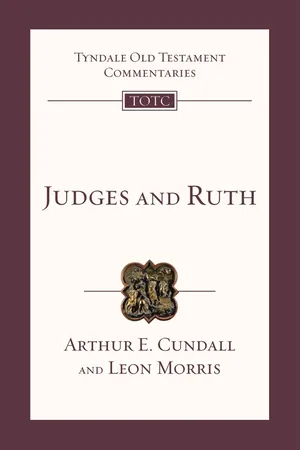
The book of Judges presents Israel's human frailty, the nation's need for both spiritual and political deliverance, and God's use of flawed human leaders to guide and preserve his chosen people through a dark period of their history. The book of Ruth tells a smaller story within this larger narrative, showing God quietly at work in the lives of a few pious individuals, remaining true to his covenant and his people. Cundall and Morris place each book in its historical and canonical context, not only rendering each useful for scholarly study but also demonstrating their contemporary relevance.
- English
- ePUB (mobile friendly)
- Available on iOS & Android
eBook - ePub
About this book
Information
Topic
Theology & ReligionSubtopic
ChristianityCommentary
1. The incomplete conquest of Canaan (1:1–2:5)
a. The conquest of southern Canaan (1:1–21)
These verses supplement the account of the Conquest preserved in the book of Joshua and as such are of great value. Some of the difficulties concerning the interrelationship of the accounts have already been dealt with in the Introduction.1
1:1a. Introduction. As the death of Joshua is dealt with in greater detail in 2:6–9, the most likely explanation of the first section of this verse is that it is the title and general introduction to the whole book; i.e. it is concerned with the history of the post-Joshua age. 1:16–2:5 actually deal with events during the lifetime of Joshua but are presented in such a way as to provide the background for the main part of the book of Judges.
1:1b–7. Initial success. The tribes of Judah and Simeon were blood-brothers (Gen. 29:33–35) and are uniformly depicted as acting in the closest relationship. The inheritance of Simeon was within the borders of Judah (Josh. 19:1) and it appears certain that Simeon soon lost its tribal identity, being absorbed in the more powerful tribe. After the consolidation of a secure base in the central highlands it is likely that the individual tribes were allowed a certain freedom of action in conquering and occupying their own allotted territory, although it may be surmised that Joshua kept these individual thrusts as integral parts of the overall strategy. No certain location can be given to the scene of the first success of Judah and Simeon, although Bezek has been tentatively identified with the modern Khirbet Bezqa in the vicinity of Gezer, west-north-west of Jerusalem. Adoni-bezek (the name means ‘lord of Bezek’) has been confused with Adoni-zedek of Joshua 10:1, a confusion increased by the LXX which has Adoni-bezek in both verses. But in Joshua, Adoni-zedek is said to be the king of Jerusalem and the leader of the southern confederation of Canaanite cities against the Gibeonites, who had entered into an alliance with the Israelites. In Judges Adoni-bezek was defeated at Bezek and was brought to Jerusalem after being mutilated.
1b. Enquiry is made of the Lord as to which tribe or tribes should lead against the Canaanites. This enquiry doubtless involved the manipulation of the oracle, the exact form of which is uncertain but which probably consisted of small, flat, inscribed stones which were used rather akin to the dice in modern games, the various combinations allowing for alternative answers. This method appears unsatisfactory to the Christian who has the Holy Spirit to guide and direct him, but it was widely used throughout the Ancient Near East and is found in New Testament times before the descent of the Spirit of God at Pentecost (Acts 1:24–26). It was firmly believed that the Lord controlled this device and made known his will thereby. Cf. Proverbs 16:33, ‘The lot is cast into the lap, but the decision is wholly from the Lord.’
2. The Lord’s answer indicated his sovereignty. There was much hard fighting ahead, but the final outcome of the conflict was not in doubt.
4. The term Canaanites usually designates all the inhabitants of the land at the time of the Israelite invasion. Occasionally a distinction is made between the Canaanites and the Amorites, the former being noted as occupying the valleys and coastal plain and the latter as dwelling in the mountains (e.g. Num. 13:29). The Perizzites are unknown, but as they are mentioned in conjunction with the Canaanites it is likely that they were an aboriginal group rather than merely the local name of the Canaanite population.
6, 7. The mutilation of Adoni-bezek not only humiliated him, but rendered him an impotent cripple who could not wield any weapon effectively. Such treatment, which to the modern reader seems so harsh, and was only infrequently employed by Israel, was accepted almost philosophically by the king, such was the strength of the lex talionis. The law of ‘an eye for an eye and a tooth for a tooth’ was set aside by Christ (Matt. 5:38, 39). The reference to seventy kings (RSV) is doubtless hyperbolic, indicating a great, rather than a precise, number. The incapacitated ruler of Bezek was no longer a danger to the Israelites and was brought to Jerusalem by his own followers, where he died. But the security of the city where he found refuge was soon to be shattered by the same army that had defeated him so decisively.
1:8. Jerusalem. The city of Jerusalem is one of the oldest cities in the world, having been occupied almost continually for a period of 5,000 years. Archaeological investigation of its lower levels has been hampered because of this continuous occupation, but it is certain that it existed c. 3000 BC, when it was little more than a mountain fortress on the hill Ophel, south of the present Temple area. It is mentioned in Egyptian execration texts of the nineteenth century BC and in the Tell-el-Amarna correspondence of the fourteenth century BC, when it was an important city-state. There is no reason to doubt that the Salem over which Melchizedek ruled as priest-king is to be identified with Jerusalem (Gen. 14:18). Its capture and destruction recorded here is complicated by the reference in verse 21 that Benjamites did not drive out the Jebusites from Jerusalem, and by Joshua 15:63 which notes that Judah did not expel the Jebusites from Jerusalem. Probably the city, after its destruction, was not occupied by the Israelites and was subsequently reoccupied by the Jebusites. Or, less likely, it may have been recaptured by the Canaanites because of its important position on a main line of communication (see the note on verse 35). The centre of the tribe of Judah was located much further south in Hebron. The apparent confusion between Judah and Benjamin can be readily explained on this hypothesis, for as the city of Jerusalem lay close to the dividing-line between the two tribes, when it was reoccupied by the Jebusites it formed an enclave, a ‘no man’s land’ between the two that either might legitimately acquire, although, strictly speaking, it was part of the possession of Benjamin (Josh. 18:16). It was not conquered again until the time of David (2 Sam. 5:6ff), when it became the politically acceptable capital of both the northern and southern sections of his kingdom largely because it was on ‘neutral’ territory. It must be remembered that the Israelites were not sufficiently strong numerically to occupy all the territory and cities they conquered (Exod. 23:29, 30; Deut. 7:22–24).
1:9–20. To the south and west of Jerusalem. The AV of verse 9, in the mountain, and in the south, and in the valley, does not make sufficiently clear that these refer to the three major divisions of the southern part of the land. The first is the hill country (RV, RSV) which describes the mountainous region between Jerusalem and Hebron; the second, the South (RV) or Negeb (RSV), is the semi-arid area between Hebron and Kadesh-barnea; the third, the lowland (RV, RSV), often called the Shephelah from the Hebrew word used here, is the region of foothills running north and south between the coastal plain and the central mountain range. There is here a summary (amplified in the following verses) of the movements of Judah and her allies.
10. Kiriath-arba means ‘city of four’, pointing to its probable origin in a federation of four cities, a view strengthened by the fact that Hebron itself means ‘confederacy’ or ‘association’. It can readily be appreciated that such unions were made because of the mutual strength they afforded in time of need (cf. Josh. 9:17; 10:3). Hebron, 19 miles south-south-west of Jerusalem, had associations with Abraham (Gen. 13:18, etc.). Later on it was to be the capital of Judah during the first seven years of David’s reign (2 Sam. 5:5). Sheshai, Ahiman and Talmai are described in verse 20 as ‘the three sons of Anak’. The Anakim, being proverbial for their great stature, were feared by the Israelites (cf. Deut. 9:2).2 Tradition uniformly associates Caleb with Hebron (Josh. 14:6ff.; Judg. 1:20). Possibly it was that portion of the land which was his particular responsibility to reconnoitre when the spies went on their mission (the detail of Num. 13:22 indicates a source in either Caleb or Joshua himself).
11. Debir, 11 miles south-west of Hebron and strategically situated between the Negeb and the Shephelah, was the next principal target. The earlier name Kiriath-sepher, meaning ‘the city of books’ or ‘city of records’, has found no convincing explanation although it may suggest that it was the repository of a library like those of the great Mesopotamian cities. Debir, the modern Tell Beit Mirsim, is one of the more important centres of archaeological interest. It was a strongly defended city, approximately 7½ acres in extent, which was destroyed by fire c. 1220 BC. No break in occupation followed, but the architecture and culture in the succeeding decades was of a greatly inferior standard.
12–15. (Cf. Josh. 15:15–19.) It is not clear in this section whether Othniel was the nephew or the younger brother of Caleb: the grammatical connection permits either alternative. Caleb is called ‘the son of Jephunneh the Kenizzite’ (Num. 32:12). The Kenizzites were an Edomite clan (Gen. 36:11) associated with the tribe of Judah. It is of considerable interest and significance to observe that both Caleb and Othniel were able to rise to positions of prominence in this truly classless society. Caleb, whose pedigree went back to Edom rather than to Israel, was a prince in Judah and was actually chosen as its representative in the reconnaissance of Canaan (Num. 13:2, 3, 6). Caleb, although an old man, had shown conspicuous bravery in the capture of Hebron; now, at Debir, it was Othniel’s turn and his success was rewarded by his marriage to Achsah. The city appears to have been given to Othniel and his bride as an inheritance, but Achsah asked of her father a dowry, a field with springs of water, so essential in such a semi-arid area.
16. The adjectival Kenite cannot refer to an individual without the article, which suggests that a name has dropped out, probably either Jethro (as in Codex Vaticanus) or Hobab (as in Codex Alexandrinus). The Kenites were a nomadic group closely connected with the Amalekites (cf. 1 Sam. 15:6); but whereas the latter had shown themselves the implacable foes of the Israelites (Exod. 17:8–16), the former had lived harmoniously with them. A further difficulty arises because, while Hobab is connected with the Kenites (Judg. 4:11), Jethro is elsewhere associated with the Midianites (Exod. 18:1). An explanation may be found in the nomadic character of the Kenites whose wanderings could associate them with both the Amalekites and the Midianites. Another well-known difficulty is the relationship between Reuel, Jethro and Hobab (cf. Exod. 2:18; 3:1; Num. 10:29; Judg. 4:11). The Hebrew words for ‘father-in-law’ and ‘brother in law’ have exactly the same consonants, and as the system indicating the vowel sounds was not completed until the sixth to the ninth, centuries AD, some confusion does exist. The most plausible explanation is that Hobab is synonymous with Jethro as Moses’ father-in-law and that Reuel was a remote ancestor.
The city of palm trees elsewhere indicates Jericho (3:13), but that identification is ruled out here by the context. Possibly it was located at the southern end of the Dead Sea. Arad was approximately 16 miles due south of Hebron, in a very desolate region. An earlier Canaanite king of Arad had enjoyed limited but short-lived success against the Israelites when they first approached the Promised Land, before their lack of faith led them to fall back into the wilderness (Num. 21:1–3). The Amalekites were to be found in this area and many scholars emend the people to read ‘the Amalekites’ (the Hebrew word ‘people’ is formed with the first two consonants of the word ‘Amalek’), suggesting that the Kenites settled in the vicinity of the Amalekites, with whom, as has been noted, they were closely connected.
17. The verse recalls the earlier incident (alluded to in the note on the preceding verse) recorded in Numbers 21:1–3, which some scholars feel should precede the mission of the spies (Num. 13, 14), since in Numbers 14:45 the defeated Israelites fall back upon Hormah, suggesting its capture at an earlier date. In any case there is no need to suggest confusion between the two accounts, nor to maintain that they prove a separate invasion, from the south, by Judah and her associates. Archaeology shows that some towns (e.g. Debir) were destroyed more than once, and the forty years between these events would have given Hormah a chance to re-establish itself. The continuity of occupation at a particular site is influenced strongly by such factors as availability of building materials, ease of defence and an adequate water supply. Hormah, located about 20 miles south-west of Hebron, has a name derived from a verb meaning ‘to devote to destruction’, i.e. to destroy everything, animate and inanimate, as an offering to the gods (the custom was widely observed by nations other than Israel). The background of this custom is the religious one of covenantal obligation or promise to the deity. Its apparent brutality is mitigated by the fact that it did eliminate many of the evils associated with war, e.g. pillaging, raping, etc.
18, 19. The two verses, taken together, appear contradictory, since Gaza, Ashkelon and Ekron were on the low-lying coastal plain indicated in verse 19. Probably the Israelites, having taken these towns and their suburbs (AV coast refers to ‘suburbs’ or territory, RSV), were forced back into the hill-country where the Canaanites could not employ their chariots effectively. The Israelites feared the chariot as a weapon of war and rarely matched the Canaanites in combat waged on level ground, unless, as in the battle noted in Judges 4, 5, the chariots were immobilized as a result of torrential rain (5:4, 5). Thus Judah took possession of the hill country, but he could not drive out the inhabitants of the plain (RSV). The Canaanites, and later on the Philistines, were able to work in iron, whereas Israel did not emerge from the Late Bronze Age until the time of David. It is likely that verse 19 is a general reference including both Canaanites and Philistines. Later on the Israelites viewed the use of chariots with reserve, as indicating dependence upon human power rather than the divine might (e.g. Ps. 20:7). David was quite unable to utilize the chariots captured from Hadadezer (2 Sam. 8:4) and not until Solomon’s reign was effective use made of this weapon (1 Kgs 9:19; 10:26). We should all be better off today if we bore in mind that, in an age when the chariot has long since been superseded as a weapon of warfare, a faithful (and righteous) reliance upon the Lord is the stoutest weapon in the armoury of a nation or an individual.
The reference to Gaza, Ashkelon and Ekron relates to a period before the main Philistine settlement in the coastal plain. The Philistines were part of a complex migratory movement from the Aegean area a generation or so after Israel’s entry into the land (i.e. c. 1200 BC). These ‘people of the sea’ settled in large numbers in the coastal plain. Egypt, keeping them at bay with difficulty, allowed them to settle and form their pentapolis (Ekron, Ashdod, Ashkelon, Gaza and Gath). This does not preclude the probability of earlier, but smaller, settlements of Philistines noted in Genesis 21:32; 26:1.
1:21. The Benjamites and Jerusalem. (See note on verse 8.) The Jebusites were the Canaanite inhabitants of Jerusalem and its immediate environs, Jebus being an alternative name of the city (19:10, 11). The reference to this day does not necessarily involve a date before David’s capture of Jerusalem (2 Sam. 5) about 993 BC, since the Jebusite population was allowed to continue in the city after its capture (cf. 2 Sam. 24:16).
b. The capture of Bethel (1:22–26)
This ancient account of the capture of Bethel raises the question of its connection with the narrative of the Conquest in Joshua, which nowhere tells of the capture of Bethel but which includes the men of Bethel as allies of the men of Ai (Josh. 8:17). The two cities were very close together (Josh. 8:9, 12), but archaeology shows clearly that the site of Ai was unoccupied from c. 2200 BC. It is unlikely that a mistake has been made in the identification of the site or that a Middle or Late Bronze Age town has been completely eroded. This problem has led many to conjecture that the names Ai and Bethel were used to refer to the same place, or, less likely, that the men of Bethel used the ruins of Ai (the name itself means ‘a ruin’) as an armed outpost against the advancing Israelites. The involvement of all the men of both cities (Josh. 8:17) demands some correlation of the two accounts. The sending up of spies is a point that both have in common (1:23–25; Josh. 7:2, 3), but this was a stratagem frequently employed by the Israelites, as in the case of Jericho (Josh. 2:1ff.). There is a broad parallel with the campaign against Jericho in that the informer and his family escaped the destruction which overtook the town. Notice, as in the case of Judah (1:2–4), that the presence of the Lord (22) was the guarantee of victory. Bethel, associated with the patriarch Jacob (Gen. 28:19), was to become one of the principal sanctuaries of the period of the judges. Afterwards, following the death of Solomon and the Disruption, it became the national shrine of the northern kingdom. Its name means ‘house of God’, usin...
Table of contents
- Tyndale Old Testament Commentaries
- Judges and Ruth
- Contents
- General preface
- Judges
- Author’s preface
- Chief Abbreviations
- Selected Bibliography
- Introduction
- Analysis
- Commentary
- 2. Israel in the period of the Judges (2:6–16:31)
- 3. Appendices (17:1–21:25)
- Ruth
- AUTHOR’S PREFACE
- Chief Abbreviations
- INTRODUCTION
- Analysis
- Commentary
- 2. The Return to Judah (1:6–22)
- 3. Ruth the Gleaner (2:1–23)
- 4. The Marriage (3:1–4:22)
Trusted by 375,005 students
Access to over 1.5 million titles for a fair monthly price.
Study more efficiently using our study tools.
Frequently asked questions
Yes, you can cancel anytime from the Subscription tab in your account settings on the Perlego website. Your subscription will stay active until the end of your current billing period. Learn how to cancel your subscription
No, books cannot be downloaded as external files, such as PDFs, for use outside of Perlego. However, you can download books within the Perlego app for offline reading on mobile or tablet. Learn how to download books offline
Perlego offers two plans: Essential and Complete
- Essential is ideal for learners and professionals who enjoy exploring a wide range of subjects. Access the Essential Library with 800,000+ trusted titles and best-sellers across business, personal growth, and the humanities. Includes unlimited reading time and Standard Read Aloud voice.
- Complete: Perfect for advanced learners and researchers needing full, unrestricted access. Unlock 1.5M+ books across hundreds of subjects, including academic and specialized titles. The Complete Plan also includes advanced features like Premium Read Aloud and Research Assistant.
We are an online textbook subscription service, where you can get access to an entire online library for less than the price of a single book per month. With over 1.5 million books across 990+ topics, we’ve got you covered! Learn about our mission
Look out for the read-aloud symbol on your next book to see if you can listen to it. The read-aloud tool reads text aloud for you, highlighting the text as it is being read. You can pause it, speed it up and slow it down. Learn more about Read Aloud
Yes! You can use the Perlego app on both iOS and Android devices to read anytime, anywhere — even offline. Perfect for commutes or when you’re on the go.
Please note we cannot support devices running on iOS 13 and Android 7 or earlier. Learn more about using the app
Please note we cannot support devices running on iOS 13 and Android 7 or earlier. Learn more about using the app
Yes, you can access Judges & Ruth by Arthur E Cundall,Leon Morris in PDF and/or ePUB format, as well as other popular books in Theology & Religion & Christianity. We have over 1.5 million books available in our catalogue for you to explore.