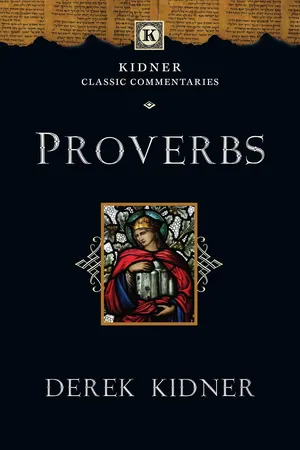
Proverbs - a book full of wisdom, and yet a book demanding all one's wisdom to understand. Derek Kidner has not only provided a running commentary on the whole of Proverbs, but has also included two helpful study aids: a set of subject guides that brings together teaching scattered throughout the book, and a short concordance that helps to locate lost sayings (in territory notoriously hard to search) and encourages further subject studies. In short, this volume is a wise person's guide to wisdom.
eBook - ePub
Proverbs
About this book
Information
Topic
Theology & ReligionSubtopic
ChristianityCommentary
Title, Introduction And Motto (1:1–7)
1:1. The title
The proverbs: the opening noun (mišlê) gives the book its name in the Hebrew Bible as in ours. The Heb. term (in the singular, māšāl) basically means ‘a comparison’ (e.g. the sharp simile such as—at random—11:22; 12:4; or the full-grown allegory of Ezek. 17:2ff.; cf. Judg. 9:8ff.), but it came to stand for any kind of sage pronouncement, from a maxim or observation (see the middle chapters, passim) to a sermon (e.g. chapter 5), and from a wisecrack (Ezek. 18:2) to a doctrinal revelation (Ps. 49:4). See also the companion terms in verse 6.
Solomon: see Introduction, p. 22.
1:2–6. The introduction: the benefits of the book
The prize it offers is wisdom (2a) and still further wisdom (5); the path of this progress is marked by the verbs of this paragraph, which repay study; and the many aspects of wisdom are displayed by the nouns of verses 2–5 (on which there is detailed comment in the subject-study: Wisdom, pp. 34f.).
6. A proverb: see on verse 1; ‘and a satire’:1 this meaning is indicated by Habakkuk 2:6, the only other Old Testament occurrence of the word, and by the parent verb ‘to scorn’, e.g. 1:22. Dark sayings is the word used of Samson’s riddle (Judg. 14:12) and of the Queen of Sheba’s tests (1 Kgs 10:1), indeed of anything enigmatic, which needs interpreting: Numbers 12:8 (cf. 1 Cor. 13:12); Ezekiel 17:2; Habakkuk 2:6.
So the secondary purpose of Proverbs is to introduce the reader to a style of teaching that provokes his thought, getting under his skin by thrusts of wit, paradox, common sense and teasing symbolism, in preference to the preacher’s tactic of frontal assault.
1:7. The motto
This is also the motto of the Wisdom writings in general, and reappears, in substance, in 9:10; 15:33; Psalm 111:10; Job 28:28.
The beginning (i.e. the first and controlling principle, rather than a stage which one leaves behind; cf. Eccl. 12:13) is not merely a right method of thought but a right relation: a worshipping submission (fear) to the God of the covenant, who has revealed himself by name (the Lord, i.e. Yahweh: Exod. 3:13–15). Knowledge, then, in its full sense, is a relationship, dependent on revelation and inseparable from character (‘wisdom and training’, 7b). When we fence off (as we must) limited fields of knowledge for special study, the missing context must be remembered, or our knowing is precocious and distorted, as at the fall, and we end by knowing less (cf. 3:7; Rom. 1:21, 22), not more.
1. A Father’s Praise Of Wisdom (1:8–9:18)
1:8–19. ‘If sinners entice thee …’
The two ways of verse 7 are now seen to lie at the reader’s feet: the vivid details, the fatherly earnestness, and the insistence that the final outcome should be faced (cf. note on 5:4), are typical of the teaching style of this group of chapters, 1–9. (On the law of thy mother [8], see note on 3:1, and subject-study: The family, p. 45.)
The first way (8, 9) has none of the flashy appeal of the second (10–19): it offers nothing material, only the hard-won beauty and authority (9; cf. Gen. 41:42) of goodness (cf. 3:22; 4:9; and note on 3:3). With the description of the second way, the sting is in the tail. The proposal of 11–14 owes its attractiveness to its offer (in common with all temptation) of a quick route to ersatz excitement and power (the youth pictures himself a person to be reckoned with, instead of patronized and kept in his place) and, above all, of acceptance as ‘one of the gang’. After the defiant verse 11, verse 16 seems to carry little weight—until the trap is sprung in 18. Verse 19, clinching the lesson, brings out the necessary connection between gaining the world and losing one’s soul—for to live for one’s takings is even more corrupting than to wield power, since one has already, by definition, dethroned justice and mercy, to leave appetite as master.1
1:20–33. Wisdom’s impassioned appeal
This passage is the first of many in which wisdom 2 is personified; the most far-reaching of these is chapter 8. Here the open proclamation, heard above the noise of the market, significantly balances the domesticity of verse 8, to make it clear that the offer of wisdom is to the man in the street, and for the business of living, not to an élite for the pursuit of scholarship.
The forceful verbs of 20–24, and the depicting of lost opportunity in 24–33, create a climate of urgency; the verbs of rejection in 22, 24, 25, make the issue hinge solely on the individual’s choice. If, elsewhere in the book, fool and scorner appear to be fixed types, it is their fault, not their fate: they are eating of the fruit of their own way (30, 31).
21. Concourse: the Heb. suggests hubbub; there is no need to emend it (with RSV) to the somewhat similar Heb. word for walls which the LXX evidently read.
26. I … will laugh is not an expression of personal heartlessness, but of the absurdity of choosing folly, the complete vindication of wisdom, and the incontestable fitness of the disaster. Cf. Psalm 2:4.
28. Seek … early (AV), or diligently (RV, RSV): the expression translates the single word šiḥar, to seek. The note of earnestness or earliness is suggested by its probable connection with šaḥar, dawn (cf. the thought, but not the terminology, of Jer. 44:4; Ps. 130:6). This is supported by Proverbs 13:24b, where the thought of being in time or in earnest makes better sense than that of bare seeking.
32. Turning away (AV, RSV) is more accurate than RV’s backsliding, as also in Hosea 14:4, etc. Complacence (RSV) is preferable to the objective prosperity (AV, RV). Contrast with this the justified peace of mind of the responsive, in 33.
2:1–22. Wisdom as treasure and safeguard
2:1–5. Wisdom, hard-won. This is the essential counterpart to 1:20ff., where wisdom was clamouring to be heard. Here it is the pupil who must clamour (3). Yet the search, strenuous as it must be, is not unguided. Its starting-point is revelation—specific (words) and practical (commandments); its method is not one of free speculation, but of treasuring and exploring received teachings so as to penetrate to their principles (see the verbs of 1–5); and its goal, far from being academic, is spiritual: the fear of the Lord … the knowledge of God (5). With these two phrases verse 5 encompasses the two classic Old Testament terms for true religion—the poles of awe and intimacy.
2:6–9. Wisdom, God-given. What you find, then (5), is what he gives (6); discovery and revelation are inseparable. This paragraph goes on to show that to know the Lord is also to know how to live; the synonyms for wisdom lead up to tûšiyyâ (7), ‘sound sense’ or effectiveness (it can denote both the quality itself and its outcome, cf. subject-study: Wisdom, 1 (3), p. 34). As this practical note is prominent in Proverbs, it is important to mark how verses 7–9 pile up moral nouns, to put it beyond doubt that the success in view is right conduct. These lovers of wisdom are saints (8: ḥăsîdîm: loyal sons of the covenant).
2:10–22. Wisdom, moral safeguard. Verses 10, 11 show how God imparts the protection envisaged in 7b, 8, and verses 12–15, 16–19, illustrate the temptations, through evil men and evil women, against which it avails.
The process is that wisdom and knowledge, when they become your own way of thinking, and your acquired taste (10), will make the talk and interests of evil men alien to you (12–15). Even the adventuress with her smooth words (16, RSV, see note below) will show up at once as false—as both quitter (17) and, precisely, femme fatale (18, 19): who offers a taste of life, and sells you death.
14, 15. Various synonyms for what is ‘twisted’ occur throughout the book (often translated froward (ness) in AV). Probably both of the main implications of the idea are to be understood: i.e. devious(ness) and perverse(ness) (RV, RSV).
16. Loose woman … adventuress (RSV). Both these terms mean lit. ‘foreigner’ or stranger; i.e., in such a context (cf. 17b), ‘one who is outside the circle of [a man’s] proper relations, that is, a harlot or an adulteress’ (Toy). Cf. The Instruction of Ani (see Introduction, p. 20): ‘Be on thy guard against a woman from abroad … a deep water, whose windings one knows not, a woman who is far away from her husband’ (ANET, p. 420a).
17. The friend (RV; rather than AV’s guide): i.e. her husband. The word denotes close companionship: cf. 16:28; 17:9; Psalm 55:13; cf also, in a context of spiritual adultery, Jeremiah 3:4. The covenant of her God: i.e. his covenant with Israel, including in its obligations the seventh commandment. The wording of the phrase is against its referring merely to a marriage covenant as in Malachi 2:14.
18. Sinks down (RSV): this is the literal sense of the verb, and a vivid touch. But a grammatical difficulty suggests that we should translate it: ‘she sinks down to death [which is] her home’ (cf. RV mg). On death, see subject-study: Life and death p. 51.
21, 22. The land … the land (RV, RSV): cf. Psalm 37:9, etc., where the primary thought is of the land promised to God’s people. We may translate it earth (AV), but viewed as the Lord’s and his people’s.
3:1–35. The wholehearted disciple
Whereas chapter 2 emphasized the moral stability which grows with wisdom, chapter 3 particularly promises serenity. This is seen as the fruit of a thoroughgoing godliness, three aspects of which mark the main divisions of the chapter.
3:1–10. Glad commitment. The kernel of this section (and of the chapter) is found in 5, 6; but the childlike trust to be seen there is rooted in sound teaching (1–4) and expressed by bold obedience (e.g. 9).
1. Tôrâ, the word for law (AV, RV), fundamentally means ‘direction’; cf. RSV: teaching. Where it occurs unqualified (28:9; 29:18) it is clearly the divine law (it is also the Jewish term for the Pentateuch); but my law, ‘thy mother’s law’ (1:8), etc., refer to the present maxims and to the home teachings, based indeed on the law, but not identical with it.
3. Bind them … write them: cf. 1:9; 6:21; 7:3—striking expressions for glorying in, meditating on and (7:3) acting by these principles. The literalism with which later Judaism understood the similar language of Deuteronomy 6:8, 9 is excluded by these verses, and indeed by Exodus 13:9.
4. Understanding (šekel, shrewdness) seems a slightly inappropriate reward here, and RSV ‘corrects’ it to repute (by reading Heb. šēm for šekel). But there seems no reason why the Heb. noun, like its parent verb, should not mean success (AV mg.; cf. Ps. 111:10, AV mg.) when the context suggests it. See note on 2:7, and subject-study: Wisdom, 1 (3), pp. 34f.
5. Trust … lean: these two words may be even closer together in thought than appears at first sight. G. R. Driver argues 3 that the Heb. for trust had originally the idea of lying helplessly face downwards—an idea preserved in Jeremiah 12:5b ...
Table of contents
- Tyndale Old Testament Commentaries
- Proverbs
- Contents
- General preface
- Author’s Preface
- Chief Abbreviations
- Introduction
- Subject-Studies
- Analysis
- Commentary
- 1. A Father’s Praise Of Wisdom (1:8–9:18)
- 2. Proverbs of Solomon (10:1–22:16)
- 3a. Words Of Wise Men (22:17–24:22)
- 3b. Further Words Of Wise Men (24:23–34)
- 4. Further Proverbs Of Solomon (Hezekiah’s Collection) (25:1–29:27)
- 5. Words Of Agur (30:1–33)
- 6. Words of King Lemuel (31:1–9)
- 7. An Alphabet of Wifely Excellence (31:10–31)
- A Short Concordance to the Authorized Version of The Proverbs
Trusted by 375,005 students
Access to over 1.5 million titles for a fair monthly price.
Study more efficiently using our study tools.
Frequently asked questions
Yes, you can cancel anytime from the Subscription tab in your account settings on the Perlego website. Your subscription will stay active until the end of your current billing period. Learn how to cancel your subscription
No, books cannot be downloaded as external files, such as PDFs, for use outside of Perlego. However, you can download books within the Perlego app for offline reading on mobile or tablet. Learn how to download books offline
Perlego offers two plans: Essential and Complete
- Essential is ideal for learners and professionals who enjoy exploring a wide range of subjects. Access the Essential Library with 800,000+ trusted titles and best-sellers across business, personal growth, and the humanities. Includes unlimited reading time and Standard Read Aloud voice.
- Complete: Perfect for advanced learners and researchers needing full, unrestricted access. Unlock 1.5M+ books across hundreds of subjects, including academic and specialized titles. The Complete Plan also includes advanced features like Premium Read Aloud and Research Assistant.
We are an online textbook subscription service, where you can get access to an entire online library for less than the price of a single book per month. With over 1.5 million books across 990+ topics, we’ve got you covered! Learn about our mission
Look out for the read-aloud symbol on your next book to see if you can listen to it. The read-aloud tool reads text aloud for you, highlighting the text as it is being read. You can pause it, speed it up and slow it down. Learn more about Read Aloud
Yes! You can use the Perlego app on both iOS and Android devices to read anytime, anywhere — even offline. Perfect for commutes or when you’re on the go.
Please note we cannot support devices running on iOS 13 and Android 7 or earlier. Learn more about using the app
Please note we cannot support devices running on iOS 13 and Android 7 or earlier. Learn more about using the app
Yes, you can access Proverbs by Derek Kidner in PDF and/or ePUB format, as well as other popular books in Theology & Religion & Christianity. We have over 1.5 million books available in our catalogue for you to explore.