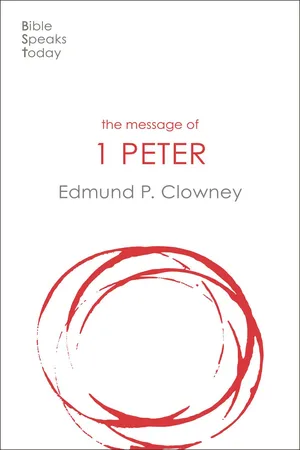
The message of Peter's first letter turned the world upside-down for his readers. He saw the people of the young church of the first century as strangers, aliens who were only temporary residents, travellers heading for their native land. Peter speaks to our own pilgrimage when he tells of suffering now and glory to come. Stormy seasons of persecution were beginning for the church in Asia Minor. These storms rage on in the modern world. Edmund Clowney believes that no true Christian can escape at least a measure of suffering for Christ's sake. Out of his firsthand knowledge as an apostle of Christ, Peter shows us what the story of Jesus' life means for us as we take up our cross and follow him.
- English
- ePUB (mobile friendly)
- Available on iOS & Android
eBook - ePub
About this book
Information
Print ISBN
9781789742183
Topic
Theology & Religion1 Peter 1:1–2
1. The apostle to the Jews blesses God’s true people
1. He greets them with blessing
Greetings cards are big business in the USA and the UK. They crowd long display racks, but for all their variety the cards still repeat standard formulas of greeting. There are only a limited number of ways to say ‘Get well soon’ or ‘Happy birthday’.
But Christians, and especially Christian apostles, may think of greetings as more than formalities. Early Christians did use the common greeting ‘Wish you joy!’1 But Peter, Paul and John salute the church with greetings that become blessings; a wish for joy becomes an apostolic pronouncement of grace.2 The Old Testament form of this blessing is on the lips of David: ‘May the Lord now show you kindness and faithfulness.’3 The New Testament heightens the meaning of God’s mercy and grace. Grace ‘signifies God’s love in action in Jesus Christ on behalf of sinners’.4
What makes a greeting a blessing? Peter gives the answer in the words that precede his blessing. It is the work of the Spirit. When a minister of God’s word pronounces a blessing at the end of a service of worship, it is the action of God’s Spirit that gives power to the words. Grace is a gift; God is the giver. Our words of blessing are not magic; they do not communicate grace by their own power, or because we speak them. But when they are spoken in faith to the people of God, God honours them. They are much more than wishes; more, even, than prayers. They declare God’s own favour towards those who are in Christ.
Coupled with grace in apostolic greetings is peace. Grace transforms the greeting of the Greeks; peace gives new meaning to ‘shalom’, the salutation of the Hebrews. The priests of the Old Testament pronounced God’s blessing of peace upon the people: ‘the Lord turn his face towards you and give you peace’ (Num. 6:26). Sinful Israel forfeited that blessing and brought upon itself the judgment of captivity. But the prophets foresaw a day when God would deliver his people, not only from their oppressors, but from their sins (Mic. 7:14–20). God himself would be their Saviour: ‘O Lord, you will ordain peace for us, for indeed, all that we have done, you have done for us.’5
Simon Peter, the Galilean fisherman, knew the Prince of Peace of whom Isaiah spoke. In the upper room at the Last Supper, and again after the resurrection, Jesus had blessed the disciples with his peace.6 That peace was not the political peace that the people expected the Messiah to bring. The world, Jesus said, could not give it or take it away. The Messiah’s peace was given in the shadow of the cross. Jesus gave his peace not only in spite of the cross, but because of the cross. By his death he bore the judgment of God’s just wrath and made peace not only between Jew and Gentile, but between God and human beings.
Peter’s brief greeting, Grace and peace be yours in abundance, gives in miniature the whole message of his letter. He writes to those who already feel the scorn and malice of an unbelieving world. Writing from Rome under the Emperor Nero, Peter knows that they will experience much worse. Can he really pronounce peace in abundance to those who are only beginning to discover the suffering to which Christians are called? Peter writes for that very purpose. Once he had fought to defend the shalom of the Messiah. Under the olive trees of Gethsemane, he drew his sword to resist those who came to arrest Jesus. But Jesus had made him sheath his weapon after one misdirected stroke. Peter wanted to fight because he feared that the death of Jesus would end all hope of victory, all hope of the Messiah’s peace. But the death of Jesus had done the opposite. It had accomplished the salvation of God’s Anointed. Now Peter, the apostle of the risen Lord, can pronounce peace; the peace that comes, not by the sword, but by the cross. His letter expands on the blessing that is distilled in his greeting.
Peter prepares for his letter by identifying himself and his readers. We are struck by a contrast; he says so much about them and so little about himself. Peter is simply an apostle of Jesus Christ. He makes no claim to be a prince among the apostles, but neither does he feel any need to justify or defend his apostolic office, as Paul had occasion to do. Peter’s calling as an apostle would be well known wherever the gospel had been preached. Peter was one of the twelve chosen by Jesus to be with him (Mark 3:14–19). He was the first to confess, in the name of all, that Jesus is the Christ, the Son of the living God. To him Jesus replied, ‘You are Peter, and on this rock I will build my church, and the gates of Hades will not overcome it’ (Matt. 16:16, 18).
To be sure, Peter is not the foundation rock apart from his confession. Christ’s words are addressed to the Peter who has received revelation from the Father in heaven (Matt. 16:17). When Peter a little later rebukes Jesus for speaking of the cross, Jesus does not call him Peter, but rather Satan. He has become the rock in a different sense; not the rock of foundation, but a rock to stumble over.7
Neither may Peter be isolated from the Eleven. Jesus grants to them all the power of the keys of the kingdom that he gave to Peter. The church is not built on Peter as an isolated stone, but upon the foundation of the apostles and prophets, those who like Peter have received the revelation of Christ.8
At the same time, neither may we separate Peter’s confession from Peter. Jesus does not build his church on a confession in the abstract, but on the confessing apostle. To Peter’s word ‘You are the Messiah,’ Jesus replies, ‘You are Peter.’ Peter had recognized Jesus, the Messiah; Jesus will recognize Peter, the rock. To Peter is given the calling to open the gates of the kingdom to Jewish and Gentile believers. He does so at Jerusalem in the midst of the Eleven, and at Caesarea as one of the eyewitnesses of the resurrection.9 Peter has a prominent role to fulfil as an apostle and an eyewitness, but he is not given a higher authority than that of other apostles. It is enough for Peter, in this letter, to identify himself as an apostle; he bears witness not to himself, but to Christ as the chief cornerstone of God’s spiritual temple (2:5–8).
Peter’s witness is strong. He knows what he has seen and heard; he knows, too, his appointment by Jesus, and the revelation from the Father that has equipped him to serve. Simon Peter the fisherman can put the rabbis to shame; he can stand before rulers to give a reason for the hope that he has.10 He does so as Christ’s apostle, rejoicing in the faith of those who have not seen and yet have believed (1:8).
Peter is Christ’s apostle, too, in giving inspired and authoritative teaching to the church. When we think of Peter as the author of this letter, we may at first be disappointed. Why did not Peter report to us more of the words of Jesus, more of his miracles? What scenes from the life of Jesus Peter could have painted! Every Bible student notices how similar Peter’s first letter is to the letters of Paul. But Paul was never with Jesus in the synagogue of Capernaum, or in a fishing boat on the lake, or in the upper room at Jerusalem. How can Peter fail to draw on his days with Jesus as he writes to people who have never seen the Lord?
As we saw in the Introduction, the absence of such personal references has led some scholars to conclude that Peter could not have written the letter.11 Yet it is presumptuous, to say the least, for us to imagine that we know what the apostle must have written. More than that, it shows a misunderstanding of Peter’s witness as an apostle and of his particular purpose in writing.
As an apostle, Peter shared with others in teaching the faith (Acts 2:42). He did not desire to attract a personal following of those who would relish his distinctive insights or experiences. He was one of a company charged by the risen Christ to testify that ‘he is the one whom God appointed as judge of the living and the dead’ (Acts 10:42). The teaching of Jesus during his ministry, and especially in the forty days between his resurrection and ascension, moulded the apostolic tradition. The gospel that Paul received (1 Cor. 15:3) was the apostolic deposit, the pattern of sound teaching that proclaimed the fulfilment of the Old Testament promises in Christ. The apostolic message was not a melange of individual testimonies prepared as the Twelve spoke for five minutes each on ‘what the resurrection means to me’. Rather, it was the Lord’s interpretation of his own work in the light of his own word; he must ‘suffer these things and then enter his glory’.12 Peter preached the apostolic message at Pentecost; the church was established in the tradition of apostolic teaching (Acts 17:2–3). Peter continues to teach this in his letter. It is a message saturated with the Old Testament, a message that proclaims the fulfilment in Christ of all that the prophets promised.13
Peter’s purpose in writing this letter is not to give a first announcement about the words and works of Jesus. Peter’s preaching on that subject is reflected in the Gospel of Mark.14 Neither does Peter address one local church in order to deal with its particular problems (as Paul often does). Rather, his purpose is to deepen the understanding of the whole Christian church in Asia Minor so that believers may face the testings that await them with strong hope in Christ. His letter may reflect the teaching he and others would give to prepare new converts for baptism. Some passages may echo hymns or credal statements from the apostolic period. What is clear throughout is that Peter teaches the common doctrine of the apostolic testimony.
We do well to remember the authority of Peter as an apostle. Jesus taught with unique authority as the Son of God, but he also commissioned his apostles to teach in his name. He promised his Spirit to bring his words to their memory and to teach them other things after his resurrection.15 The church is built upon the foundation of the apostles and prophets because they received the revelation of Christ.16 The office of the apostle does not and cannot continue, for the apostles were eyewitnesses of Christ’s resurrection (Acts 1:21–22). Peter, as an apostle, together with Silas, a prophet, laboured with other apostles and prophets to lay the foundation of the church. Together they taught the doctrine that Jesus committed to them in the Spirit. The church is apostolic today to the extent that it remains upon the doctrinal foundation established by the apostles. No-one today can claim the authority of an apostle, whether by virtue of ecclesiastical office or of charismatic enduement. The work and calling of the apostle are finished in witnessing to the final revelation of God in Jesus Christ. He is the final Prophet, just as he is the final Priest, and Peter writes to bear authoritative witness to him.
Why are we drawn to Peter’s letter? Certainly, it is fascinating to read a genuine document written by one who knew Jesus so well. Today, as in Peter’s time, there are storms of persecution rising against the church. Never was it more important to understa...
Table of contents
- GENERAL PREFACE
- Author’s preface
- Chief abbreviations
- Introduction
- 1 Peter 1:1–2
- 1 Peter 1:3–12
- 1 Peter 1:13 – 2:3
- 1 Peter 2:4–10
- 1 Peter 2:11–20
- 1 Peter 2:21 – 3:7
- 1 Peter 3:8–22
- 1 Peter 4:1–11
- 1 Peter 4:12–19
- 1 Peter 5:1–11
- 1 Peter 5:12–14
- Appendix A
- Appendix B
- Appendix C
- Study guide
- Notes
- NIV Bible Speaks Today
- The Bible Speaks Today: Old Testament series
- The Bible Speaks Today: New Testament series
- The Bible Speaks Today: Bible Themes series
Trusted by 375,005 students
Access to over 1.5 million titles for a fair monthly price.
Study more efficiently using our study tools.
Frequently asked questions
Yes, you can cancel anytime from the Subscription tab in your account settings on the Perlego website. Your subscription will stay active until the end of your current billing period. Learn how to cancel your subscription
No, books cannot be downloaded as external files, such as PDFs, for use outside of Perlego. However, you can download books within the Perlego app for offline reading on mobile or tablet. Learn how to download books offline
Perlego offers two plans: Essential and Complete
- Essential is ideal for learners and professionals who enjoy exploring a wide range of subjects. Access the Essential Library with 800,000+ trusted titles and best-sellers across business, personal growth, and the humanities. Includes unlimited reading time and Standard Read Aloud voice.
- Complete: Perfect for advanced learners and researchers needing full, unrestricted access. Unlock 1.5M+ books across hundreds of subjects, including academic and specialized titles. The Complete Plan also includes advanced features like Premium Read Aloud and Research Assistant.
We are an online textbook subscription service, where you can get access to an entire online library for less than the price of a single book per month. With over 1.5 million books across 990+ topics, we’ve got you covered! Learn about our mission
Look out for the read-aloud symbol on your next book to see if you can listen to it. The read-aloud tool reads text aloud for you, highlighting the text as it is being read. You can pause it, speed it up and slow it down. Learn more about Read Aloud
Yes! You can use the Perlego app on both iOS and Android devices to read anytime, anywhere — even offline. Perfect for commutes or when you’re on the go.
Please note we cannot support devices running on iOS 13 and Android 7 or earlier. Learn more about using the app
Please note we cannot support devices running on iOS 13 and Android 7 or earlier. Learn more about using the app
Yes, you can access The Message of 1 Peter by Edmund Clowney in PDF and/or ePUB format. We have over 1.5 million books available in our catalogue for you to explore.