The crucifixion of Jesus Christ is presented in all four Gospels, and occupies considerable space in the overall narrative. How could the life, let alone the death, of one man 2, 000 years ago be the salvation of the human race? The biblical explanation is that the crucified one was the Son of God, acting and suffering in cooperation with God the Father and God the Holy Spirit. This is the primary answer to 'the scandal of particularity'. The death of this one person has universal, inclusive and cosmic significance, because in him the Creator acts and suffers. Further, there is the special relationship between Christ and humanity: he was 'with' us, and he was 'for' us.
The grandeur of the cross lies in the fact that here the incarnate Son of God offered himself in our place, bearing the penalty for our sin. The cross achieved expiation, propitiation, reconciliation, justification, redemption, forgiveness and victory. No single one of these tells the whole truth, nor do all of them together exhaust the meaning of the cross. Macleod shows that these concepts are interrelated and interdependent, and that together they give a coherent picture of the wonderful salvation wrought by Jesus at Calvary.
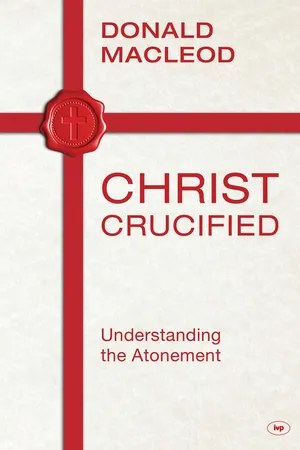
- English
- ePUB (mobile friendly)
- Available on iOS & Android
eBook - ePub
About this book
Information
Topic
Theology & ReligionSubtopic
ChristianityPART 1
THE WAY OF THE CROSS
1. A MAN OF SORROWS
The apostles clearly saw it as their duty not only to proclaim the cross, but to explain it. St Paul, for example, speaks of both the word (logos) of the cross (1 Cor. 1:18) and the word (logos) of reconciliation (2 Cor. 5:19). Yet the cross is not in the first instance a doctrine, but a fact, and no interpretation of the fact can make the suffering of Christ more or less awful than it actually was. Whether we speak of the cross as penal, piacular, expiatory, propitiatory, vicarious, substitutionary, exemplary, liberating or conquering makes no difference to what Jesus had to endure. The cross remains a fact. With this fact the church, and indeed the whole world, has to reckon; and with this fact all our thinking about the atonement must begin.
The centrality of the cross
The story of the cross is proclaimed in all four canonical Gospels, and the first thing that strikes us is how much space it occupies in the overall narrative. Mark, for example, devotes eight of his sixteen chapters to the last fateful journey following Peter’s confession at Caesarea Philippi, and one-fifth of his material is taken up with the story of the crucifixion itself. The same focus on the cross appears in Matthew, who again makes the confession at Caesarea Philippi pivotal. In Luke, Caesarea Philippi is placed in chapter 9, while no fewer than four-and-a-half chapters (19:28 – 23:56) are devoted to events between the triumphal entry and the resurrection. John omits all reference to key events such as the baptism, the temptations, the transfiguration and the institution of the Lord’s Supper, concentrating, from chapter 7 onwards, on Jesus’ last visit to Jerusalem. He devotes chapters 13 to 17 to the last night of Jesus’ life, and two chapters (18–19) to the crucifixion.
It is clear from these details that the evangelists had no interest in writing conventional biographies of Jesus. His childhood, adolescence, education and early manhood, so central to modern biography and psychology, are passed over in almost total silence. Instead, the proportions of the Gospel narratives underline the centrality of the cross in the evangelists’ understanding of Jesus’ mission; and that understanding was derived from Jesus himself. In Mark 10:45, for example, he declared that the very reason for his coming was to give his life as a ransom for many, and according to John 10:18 the commission he had received from the Father was to lay down his life. From this point of view the Gospels strike exactly the same note as St Paul: ‘We preach Christ crucified’ (1 Cor. 1:23). Precisely for this reason, the proportions we find in the Gospels become the criterion for all interpretations of Christianity. However important the teaching of Jesus, it was not there that his primary significance lay. It lay in his death. Muslims may glory in the teaching of their prophet. Christians glory in the death of theirs (Gal. 6:14).
The climax of his suffering
A word of caution is needed here, however. The centrality of the cross must not beguile us into ignoring a second striking feature of the story of the passion: the cross was but the climax of Jesus’ suffering. His whole life, from the cradle to the tomb, was suffering. The principle underlying this was that from the moment of his birth Jesus was identified with sinful humanity, and all the circumstances of his life reflected the fact that he was bearing the sin of the world (John 1:29). In solidarity with us, he was ‘the Man of Sorrows’ (Isa. 53:3, KJV).
This is not to say that his life was one of unrelieved gloom. There were moments when he rejoiced in spirit (Luke 10:21), there was the satisfaction of doing his Father’s will and there was the constant anticipation of ‘the joy that was set before him’ (Heb. 12:2). But none of this detracts from the fact that his whole life involved suffering. The tension is underlined by the circumstances of his birth. At one level its glory is attested by the miracle of the virgin conception and such other signs as the acclamation of the angels, the adoration of the shepherds and the visit of the Magi. At another, the details paint a picture of lowliness, poverty and exclusion. The condescension already implicit in the incarnation is aggravated by his being laid in a manger and by all that was implied in the fact that there was no room in the inn.3 Shortly afterwards, the family are forced to flee to Egypt. On their return, they have to reside in Nazareth, out of which there could come nothing good (John 1:46). In the eyes of the Jewish elite this would forever define him as a provincial. He clearly had few educational opportunities; in later life, in fact, people were well aware that he had never had a formal education and were amazed that nevertheless he could teach (John 7:15). The Christian imagination has lingered lovingly over the image of him as a carpenter, and the image itself has cast lustre over that noble trade. But nothing is heard of Joseph after Jesus’ visit to the temple at the age of twelve, and his total absence from the accounts of the public ministry strongly suggests that Jesus lost his father at an early age.
Once the public ministry commences, the pressures and privations are immediately obvious. They begin with the temptations in the desert, underlining the fact that though Jesus was free from sin he was not free from temptation. On the contrary, he was tempted just like ourselves ‘in every way’ (Heb. 4:15). Behind the phraseology, sanitized by centuries of quotation, lies the harsh reality that Jesus was dogged and harassed by the Prince of Darkness throughout his life. But there were more mundane pressures as well, and they clearly took their toll, even of his physical appearance: so much so that he could be taken for a fifty-year-old (John 8:57) when he was scarcely thirty. He was poor beyond our imagining, owning only the clothes he stood in; homeless, without a pillow for his head; oppressed by crowds demanding a sign and plying him with endless questions; often exhausted, as when he lay dead to the world in the stern of a tiny fishing boat caught in the eye of a fearful storm (Mark 4:38). He was misunderstood by his family, who feared for his sanity; pursued by the sick and their desperate relatives; stalked by the Pharisees with their undisguised hostility and their sly coadjutors with their entrapping conundrums (Mark 12:13). His whole life followed a pattern of rejection: rejection in ‘his own country’, Nazareth; rejection by the religious establishment; rejection by public opinion, always fickle; and rejection, at last, by his disciples, who all forsook him and fled.
Add to these the sheer horror of life among sinners for one so morally and spiritually sensitive. We skip lightly over the words, ‘made his dwelling among us’ (John 1:14), forgetting that he had come ‘from highest bliss, down to such a world as this’4: a world where he was surrounded on all sides by the sights of misery and wickedness, the sounds of profanity and blasphemy, and the stench of poverty, death and corruption.
That had been the story so far. Pontius Pilate was the climax, not the commencement, of his suffering. It is tempting to surmise that because of Jesus’ inner strength he was able to rise easily above such pressures and continue on his way unruffled and serene. But Jesus’ endurance and courage were not those of the insensitive and unfeeling. The pressure hurt, and sometimes there were tears (John 11:35), sometimes anger (Mark 3:5), and sometimes an almost mortal sorrow (Mark 14:34). This is what undergirds the sympathy highlighted in Hebrews 4:15: Jesus was tested in every way, just as we are.
Dawning realization
Yet apart from the divine identity of the sufferer and his remaining sinless despite the full force of temptation there is little that is unique in the catalogue of Jesus’ sufferings prior to Gethsemane. They express his solidarity with us, but do not set him apart from us. What sets him apart is his cross: not only a cross, but his cross, a road no-one had travelled before and no-one has travelled since. The full horror of it would have dawned on Jesus only gradually, and only carefully and gradually did he introduce the subject to his disciples. His mother doubtless shared with him the mysterious words spoken to her at the annunciation. These had made plain his messianic destiny, as had the words spoken by Elizabeth (Luke1:42–43) and by Simeon (Luke 2:29–32), but they had also made plain that he would be ‘a sign spoken against’; and Mary had been warned of a sword that would one day pierce her soul (Luke 2:35).
We can be sure, too, that Mary had introduced him to the prophets. He would have read his own destiny in their delineations of the Messiah, not least in those neglected passages which spoke so clearly of his suffering and death. He may at first have pondered, like the Ethiopian eunuch, ‘Who is the prophet talking about, himself or someone else?’ (Acts 8:34); or, like the angels, probed the great predictions of the suffering of Messiah and the glory that would follow, wondering to what, and to when, and to whom they referred (1 Pet. 1:11). As he read, the Spirit of his Father would have guided him and led him to the core truths of messianic suffering: that one day he would be led like a lamb to the slaughter; that he was called to give his life a ransom for many; that the sword of Yahweh would strike him; and that at the end even his heavenly Father would forsake him.
Jesus embarked on his public ministry with these thoughts already firmly impressed on his mind, and his forebodings may well have been conformed at his baptism, when the voice from heaven spoke words which were at one level so comforting, at another so disturbing. Here the Father acknowledges him as his beloved Son, but in words clearly reminiscent of the command to Abraham: ‘Take your son, your only son, whom you love – Isaac...and sacrifice him...as a burnt offering on a mountain that I will show you’ (Gen. 22:2). He was to be God’s Isaac. The words of John the Baptist, spoken shortly afterwards, confirmed that this was indeed the path Jesus was to tread. He was the Lamb of God, bearing the sin of the world (John 1:29).
From the very beginning of his public ministry Jesus’ own utterances betray not only the expectation of a violent death, but his perception that this death was the very heart and purpose of his mission. The earliest recorded reference to it is in Mark 2:20. In the context, Jesus is being challenged as to why his disciples never fast. He answers with a rhetorical question: how can the guests fast while the bridegroom is still with them? But he adds, ‘the day will come when the bridegroom will be taken from them, and on that day they will fast’. This verb, apairō, occurs twice in the Septuagint version of Isaiah 53:8, referring to the violent death of the Servant:
By oppression and judgment he was taken away.
Yet who of his generation protested?For he was cut off from the land of the living;
for the transgression of my people he was punished.
Though the word does not always imply the use of force, the context here clearly requires it; and its use by Jesus makes plain that he set out on his mission fully aware that it would end violently.
Peter’s confession at Caesarea Philippi marks a watershed, Jesus judging that the time has now come to speak explicitly of his violent end: ‘The Son of Man must suffer many things and be rejected by the elders, the chief priests, and the teachers of the law, and...be killed and after three days rise again’ (Mark 8:31–32). The sequel is fascinating. Peter finds the whole concept of messianic suffering abhorrent, just as he would later find the idea of the foot washing (John 13:8), and says, in effect, ‘Don’t talk such rubbish!’ Jesus’ response is sharp, almost harsh, as if Peter had touched a raw nerve: ‘Get behind me, Satan!’ The disciple’s words clearly presented a temptation, a temptation with which Jesus was already wrestling and which would come to its climax in Gethsemane (Mark 14:36). How plausible, for a moment, must Peter’s argument have seemed! He was the Messiah; the Messiah should not suffer; he could bypass the suffering, then! It all seemed so logical, and to think that it came from a disciple! It was its very plausibility that made Jesus angry and drew from him the harshest rebuke he ever directed at an individual. Later, as they make their way through Galilee, Jesus brings up the same subject again (Mark 9:32), but the disciples still don’t understand, and they are afraid to ask. ‘Possibly,’ comments C. E. B. Cranfield, ‘they understood enough to know that to know more would be painful. Possibly they could see that the subject was painful to Jesus himself.’5
In the Gospel of John the clearest allusion Jesus makes to his impending death is in chapter 12: ‘Unless a grain of wheat falls to the ground and dies, it remains only a single seed. But if it dies, it produces many seeds’ (12:24). The most remarkable thing about these words is their context: ‘The hour has come for the Son of Man to be glorified’ (John 12:23). This is the paradox of the cross. ‘Without the “death” of the seed,’ wrote C. H. Dodd, ‘no crop: without the death of Christ, no world-wide gathering of mankind.’6 By dying, Christ brings life to millions. By dying, he is glorified. This is linked to John’s use of the verb, hypsoō. In Philippians 2:9 Paul uses it (with the prefix hyper) to express the hyper-exaltation of Jesus, but John uses it of his crucifixion. This is particularly clear in John 12:32, ‘I, when I am lifted up from the earth, will draw all people to myself.’ John himself adds the explanatory comment, ‘he said this to indicate the kind of death he was to die’. It would involve, quite literally, his being lifted up. The following verse makes plain how the crowd understood the words: ‘We have heard from the Law that the Messiah will remain for ever, so how can you say, “The Son of Man must be lifted up”?’ They clearly heard the words as if they meant, ‘the Son of Man must be hanged’. Yet, as Carson points out, John has chosen this precise verb because it is ambiguous.7 Jesus is not only ‘lifted up’ on the cross, he is also ‘lifted up’ (exalted) to glory. The point of contact between the idea of crucifixion and the idea of exaltation is clear enough. The cross involves physical elevation and for that very reason becomes a symbol of the personal spiritual elevation of the Messiah. But it is not mere symbolism. Through the cross Jesus will return (bringing human nature with him) to the glory he had with the Father before the world was (John 17:5). This is why, on the eve of the crucifixion, Jesus can pray that the Father would glorify the Son, and he would do so because ‘the hour’ had come: the hour when the Father would glorify his name (John 17:1).
The story of the foot washing is also prefaced by a reference to ‘the hour’: Jesus knew that ‘the hour had come for him to leave this world and go to the Father’ (John 13:1). The foot washing as such does not contain any direct allusion to the cross. It is an acted parable to highlight what is meant by the attitude or ‘mindset’ (Phil. 2:5) of a servant: the willingness to perform the lowest-grade task for our equals and even for our supposed inferiors. It is precisely in this attitude that Jesus, knowing that he had come from God and was returning to God (John 13:3), is at his most ‘matchless, God-like and divine’.8 This immediately relates it to the cross. There is no service that Jesus is not prepared to render, whatever the cost, and Jesus now fully appreciates the cost. He must love ‘to the end’ (eis telos). This is the point of no return, where he knows the price of love and steels himself to face it. Love will not merely wash feet. It will lay down its life.
All of this gradually-dawning realization finally overwhelms Jesus in Gethsemane. But before Gethsemane comes the transfiguration and it is important to see it in its original context, closely linked to the cross. During his earthly ministry Jesus’ divine identity was normally veiled by his human form and by his low, servile condition. Now for a brief moment the veil is removed, his whole appearance changes and the underlying morphē of the divine briefly breaks through the veil of the human. The disciples become, as Peter reminds us, eye-witnesses of his majesty (2 Pet. 1:16). This is why A. M. Ramsey preferred to speak of the glorification rather than of the transfiguration of Jesus.9 He and his disciples are given a glimpse of the glory which was his even while he was on earth, and this is reinforced by the voice from heaven, ‘This is my Son, whom I love’ (Mark 9:7). The same voice had spoken to Jesus on the threshold of his public ministry (Mark 1:11) and now, as he sets his face toward Calvary, he is reminded once again who he is; and reminded, too, of the Father’s love and approbation. When the crowd around the cross mocks (Mark 15:29), he must remember the voice which came from heaven and which gave him honour and glory (2 Pet. 1:17). It is as if Abba were saying, ‘Son, in all you are now going to face, never forget who you are, never forget that I love you, and never forget how proud I am of you.’ Whatever the pain of his ordeal, it would be a pain in which the Father would share.
Yet it is not only the underlying divine glory of Jesus that is revealed in the transfiguration. It is also a revelation of the human glory (morphē) that lies beyond the cross. At Caesarea Philippi he had told his disciples that he would be killed, but he had also told them that after three days he would rise again (Mark 8:31). Now, here on the mountain, he, and they, have a glimpse of his resurrection glory, and a glimpse, too, of the resurrection glory of his people. But this, too, belongs firmly to the psychology of the moment. It is part of the Father’s ministry of encouragement. He will not die in vain.
The appearance of the heavenly visitors, Moses and Elijah, also belongs to the ministry of encouragement. Immediately after Peter’s confession at Caesarea Philippi Jesus introduced the subject of his death, but Peter wanted to hear not a word of it. This gives particular point to the words, ‘Listen to him!’ (Mark 9:7). The attitude of the heavenly visitors differs completely from that of the disciples. The cross is all Moses and Elijah want to talk about, though Luke’s account of their conversation is extraordinary. He summarizes it as a conversation about his ‘departure’ (using the word exodos) and refers to it as something Jesus was to accomplish, or ‘bring to fulfilment’ (Luke 9:31). The dismissive attitude of the disciples would have brought profound discouragement to Jesus; the interest of the heavenly visitors would have lifted his heart. The cross was what all heaven was talking about. Even the angels were fascinated (1 Pet. 1:12).
Slow motion
The fourth fascinating feature of the story of the passion is that when it comes to Good Friday the Gospels go into slow motion. They have passed over in silence whole decades of Jesus’ life, and even when they pick up the threads of the public ministry there are weeks and months of which they say nothing. We are even left in considerable uncertainty as to the length of Jesus’ ministry. Mark implies at least two years. John mentions three Passovers, but does not exclude the possibility that there may have been more. Some of the early church fathers limited the ministry to one year only.
But when it comes to the crucifixion we have the sequence frame by frame; almost, indeed, an hourly bulletin. There is one remarkable parallel to this change of tempo: the account of creation in Genesis 1. This account covers the events of billions of years in twenty-five verses, and summarily covers the emergence of vast heavenly bodies in the throwaway line, ‘he also made the stars’ (v. 16). But when it comes to...
Table of contents
- CONTENTS
- PREFACE
- ABBREVIATIONS
- PART 1 THE WAY OF THE CROSS
- 1. A MAN OF SORROWS
- 2. FROM THE THIRD TO THE NINTH HOUR
- 3. THE DIVINE PARADOX: THE CRUCIFIED SON
- PART 2 THE WORD OF THE CROSS
- 4. SUBSTITUTION: THE MAN FOR OTHERS
- 5. EXPIATION: COVERING OUR SIN
- 6. PROPITIATION: AVERTING THE DIVINE ANGER
- 7. RECONCILIATION: GOD’S WAY OF PEACE
- 8. SATISFACTION: ENOUGH TO JUSTIFY FORGIVENESS
- 9. NO OTHER WAY?
- 10. REDEMPTION: SETTING THE PRISONERS FREE
- 11. VICTORY: DISARMING THE POWERS
- FOR FURTHER READING
- BIBLIOGRAPHY
Trusted by 375,005 students
Access to over 1.5 million titles for a fair monthly price.
Study more efficiently using our study tools.
Frequently asked questions
Yes, you can cancel anytime from the Subscription tab in your account settings on the Perlego website. Your subscription will stay active until the end of your current billing period. Learn how to cancel your subscription
No, books cannot be downloaded as external files, such as PDFs, for use outside of Perlego. However, you can download books within the Perlego app for offline reading on mobile or tablet. Learn how to download books offline
We are an online textbook subscription service, where you can get access to an entire online library for less than the price of a single book per month. With over 1.5 million books across 990+ topics, we’ve got you covered! Learn about our mission
Look out for the read-aloud symbol on your next book to see if you can listen to it. The read-aloud tool reads text aloud for you, highlighting the text as it is being read. You can pause it, speed it up and slow it down. Learn more about Read Aloud
Yes! You can use the Perlego app on both iOS and Android devices to read anytime, anywhere — even offline. Perfect for commutes or when you’re on the go.
Please note we cannot support devices running on iOS 13 and Android 7 or earlier. Learn more about using the app
Please note we cannot support devices running on iOS 13 and Android 7 or earlier. Learn more about using the app
Yes, you can access Christ Crucified by Donald Macleod in PDF and/or ePUB format, as well as other popular books in Theology & Religion & Christianity. We have over 1.5 million books available in our catalogue for you to explore.