- English
- ePUB (mobile friendly)
- Available on iOS & Android
eBook - ePub
Information
Topic
Theology & ReligionSubtopic
Christianity1. The covenant of works
Why ‘covenant’?
Three years of patient, careful teaching and time was running out. Time and again, he had explained why he had to die, and time and again even his closest friends had failed to understand. Now, only hours before his arrest, the Son of God grasped his final opportunity. Taking a cup of wine in his hands, he thanked his Father and spoke to the Twelve: ‘This is my blood of the covenant, which is poured out for many for the forgiveness of sins’ (Matthew 26:28).
My blood of the covenant. Why ‘covenant’? Wouldn’t ‘This is my blood, which is poured out for many for the forgiveness of sins’ have been enough?
Most Christians have at least some understanding that Jesus shed his blood so that we might be forgiven. Far fewer, I suggest, would be able to explain what Jesus meant by calling his blood covenant blood. In fact, many of us could put our finger over the word ‘covenant’ and read the verse just the same. And yet, this is the word Jesus uses at the last supper, the final picture given to the men who would become the great preachers of the gospel after his resurrection. The death of Christ stands at the heart of the Christian gospel. And Jesus, for one, thought ‘covenant’ best unlocked the meaning of that death.
Thirty or so years earlier, before Jesus was born, his uncle had sung a hymn of praise to God. As Zechariah looked forward to the birth of his son, John the Baptist, he praised the Lord who was about
to show the mercy promised to our fathers
and to remember his holy covenant,the oath that he swore to our father Abraham...(Luke 1:72–73)
Zechariah knew that God was about to do something enormous, something that would shake the world. He also knew that the origin of this plan had been the covenant God had made with Abraham right back in Genesis. Covenant is the theme that links the different books of the Bible to make them one united story, blazing through the Old Testament like a firework, before exploding into full colour in the coming of Christ.
Even from just these two passages, we see hints that covenant is the concept that will allow the message of salvation God offers to grow naturally out of the story he tells. It is through understanding the covenants that we can move from story to salvation. To press the significance of covenants still further, let’s visit the temple, the centre of Israel’s worship during the days of the Old Testament. If we were to be given a guided tour, we’d begin in an outer court, before moving into a smaller central room known as the Holy Place. Pressing on still further, we’d come to the heart of the temple, the Holy of Holies. So far, so predictable, at least if we’d been on tours of other Ancient Near Eastern temples. They tended to follow the same threefold pattern, leading towards that central most holy place. The surprise with the Israelite temple was what was in this Holy of Holies – or rather, what wasn’t. Unlike the nations around them, the Israelites built no statue of their God: in fact he had expressly forbidden it. Instead, we would have found an ornate box, or ‘ark’, containing the Ten Commandments. These commandments constituted the covenant documents of their day. The God of the Bible had chosen to reveal himself not through statues and images, but through covenant.
It’s the kind of passages we’ve looked at so far that move J. I. Packer to go so far as to say that, first, ‘the gospel of God is not properly understood till it is viewed within a covenantal frame.’ Second, ‘the Word of God is not properly understood till it is viewed within a covenantal frame.’
Third, ‘the reality of God is not properly understood till it is viewed within a covenantal frame.’1
God, gospel and Scripture: none properly understood until seen in the light of the covenant. Reason enough to begin to dig deeper!
Exactly what is covenant?
Clearly, ‘covenant’ is not a word we use much nowadays. Yet, it occurs over 300 times in the Bible, and not just in the dusty corners normally reserved for the intrepid ‘keen’ Christian. The Sunday school favourites of Noah and his ark, father Abraham and his many sons, Moses and the Ten Commandments and King David of giant-felling fame all not only mention, but are centred on, the unfolding story of the covenant. The great prophets: Isaiah, Jeremiah and Ezekiel are stuffed full of references to this same covenant, and the psalmists regularly burst into song because of it. But the question still remains: what is a covenant?
Like almost every other Bible word, there’s no one place you can look up where Jesus sits his people down and gives them a dictionary definition. ‘A. Angel: spiritual beings who act as messengers of my Father. B. Baptism: the ceremony where...’ Well, actually, we’d better leave that one for now. (As we’ll see, there’s a fair bit of disagreement as to who should be baptized – itself a covenant debate!) The problem with giving definitions is that you could usually give four or five different answers that would all be right. According to Wikipedia, a cow is a large domesticated ungulate of the subfamily Bovinae. According to my friend’s three-year-old son Oscar, it’s a big black and white thing that moos and makes milk. Both definitions would lead you to a decent understanding of the word ‘cow’.
Similarly, the word ‘covenant’ has been defined in a dozen different ways by Christians down the centuries. This is not the place to get into lengthy disputes as to whose description was the best. For our purposes, I’m going to suggest the following as a simple introductory definition that we’ll nuance as we go along: A covenant is a conditional promise.
Or, to put a bit more flesh on the bones, particularly in regards to the biblical covenants: A covenant is an agreement between God and human beings, where God promises blessings if the conditions are kept and threatens curses if the conditions are broken.
Honestly, you could pick a thousand holes in that definition and add in a thousand other things you’d like to see included. But by far the best thing to do is to dive in and start looking at the covenants we actually meet in the Bible.
In the beginning
Perfect. That’s how we usually describe the world that God made right back in Genesis 1 and 2. And so it was, in many respects. Leaving aside the endlessly debated question of how long he took to do it, in these opening chapters of the Bible we see God making a beautiful world teeming with life.
Imagine the universe like a play in the theatre. On the first three days, God created the scenery that would provide the backdrop to the action. Day one gives us light and darkness, day two separates the sky from the world, and day three sees splotches of land burst out to create continents amid the watery mass that was Earth. Having set the scene, God then turns his attention to the ‘actors’, the characters who will fill each of the three stages he has crafted. So, the sun, moon and stars are hurled on stage to control the light and darkness created on day one. Day two’s scenery of sky and waters is filled with birds and fish on day five. Then on day six come the animals: creepy-crawlies, excitable dogs, herds of wildebeest, all to fill the land that erupted on day three. God is clearly a God who enjoys both forming and then filling empty spaces.
And so to the climax of day six: the creation of humankind. God makes man and woman in his image. We learn elsewhere in the Bible that God is spirit, so it’s unlikely that the image of God refers literally to our physical features. Closer to the truth is the idea that we humans are created to reflect some of the character and responsibilities of God. This becomes clear in God’s first words to humanity: ‘And God said to them, “Be fruitful and multiply and fill the earth and subdue it and have dominion over the fish of the sea and over the birds of the heavens and over every living thing that moves on the earth” ’ (Genesis 1:28).
God had just formed and filled a whole universe. Now, in their own small way, Adam and Eve were to do likewise. They were to ‘be fruitful’: get making lots more human beings, to form even more images of God. And these children and grandchildren weren’t all to stay cramped up in the garden in Eden, but to spill out into the rest of the world, to ‘fill the earth’. Form and fill, just like their Father God.
It’s pretty obvious from this first chapter that God didn’t just make the world; he also rules it. In fact, it’s precisely because he made it that he’s in charge. And so, unsurprisingly, as his little images, men and women are to rule too: over the animals, fish and birds. That’s what it means to ‘have dominion’. Under God, they were to be king and queen of the world, caring for and ruling over it.
Which brings me to my first little quibble with describing the scene as perfect. If, by perfect, all we mean is that there was no sin, no disease, no death, no danger, then all’s well; after all, God himself pronounces that everything he made was ‘very good’ (Genesis 1:31). But the one thing it wasn’t, was finished. There were still people to ‘create’. And did you notice that, as Adam and Eve’s family spread out to fill the earth, they would also have to subdue it? Subdue is not a word that suggests everything’s finished. It sounds very much as if Adam is going to have to do some work. Just in case we were in any doubt, God makes this very point in Genesis 2:15: ‘The LORD God took the man and put him in the garden of Eden to work it and keep it.’
To work and to keep. Adam and Eve were meant to change the world, to improve it we might even say. Not, again, that anything was wrong. It’s just that as of yet horses hadn’t been trained to pull ploughs. Crops were growing all over the place, rather than more fruitfully in well-managed fields. Trees needed to be chopped down to build houses, boats, carts: it would be tough to explore the whole world on foot! Similarly, it wouldn’t do Adam any harm to nip down river into the land of Havilah and craft some of the gold and precious stones found there into a nice necklace for Eve. While he’s away, perhaps Eve could carve out some bamboo stalks and begin work on the first-ever flute concerto. So much to do, so many possibilities.
The world that God handed over to Adam and Eve was not a dusty museum that needed to be preserved exactly as it was for millennia to come. No, it was an art gallery full of beautiful white canvases waiting to be made even more beautiful by hundreds of mini-artists created in the Great Artist’s image.
These commands are sometimes referred to as the ‘cultural mandate’. They remind us that our work, our families, our marriages, our art, our science are good gifts. They aren’t sub-spiritual things to be indulged in during a guilty moment, all the while wondering if we shouldn’t really be praying or evangelizing. They are (or should be) ways of making the earth more pleasant to live in, of loving our neighbour with the various gifts and roles God has given us.
Of course, alongside all these positive commands, there was one negative: ‘And the LORD God commanded the man, saying, “You may surely eat of every tree of the garden, but of the tree of the knowledge of good and evil you shall not eat, for in the day that you eat of it you shall surely die” ’ (Genesis 2:16–17). The tree of the knowledge of good and evil was off-limits. And hence, there was a way for Adam and Eve to ruin the wonderful world they’d been given. If they were to steal the fruit from this tree, they would be betraying God, abandoning him as their King and Father, destroying the peace of the garden and killing themselves in the process. This is the second reason why ‘perfect’ is perhaps not the most useful word to describe the situation in Eden. At this stage, things weren’t complete – there was still the possibility of everything going horribly wrong...
The covenant of works
So far we could summarize the situation in Eden with 3 Ps: God’s people, in paradise, with God present.2 But the set-up isn’t static – something was going to change. And here at last we come to the idea of covenant.
Remember, a covenant is an agreement between God and human beings, where God promises blessings if the conditions are kept and threatens curses if they are broken. This is what we see in Eden. The agreement, or conditions are:
- Positively, humans must obey God, including fulfilling the ‘cultural mandate’
- Negatively, they must not take the fruit of the tree of the knowledge of good and evil
The curse, if the conditions are broken, is spelled out with crystal clarity by God in Genesis 2:17: ‘You shall surely die.’ But if covenants also include blessings if they’re kept, where do we see these in Genesis 1 – 2?
Most writers on the covenant have taught that, although it is not made absolutely explicit, there is a blessing promised: that if Adam had obeyed and kept the covenant for a certain period of time, he would have been rewarded. In the Dutch theologian Herman Bavinck’s great phrase: ‘Adam stood at the beginning of his “career”, not the end.’ 3 Is this just speculation?
Let me pick two of the arguments used to prove that this covenant with Adam, usually referred to as ‘the covenant of works’, had a reward attached.
The first is an argument from the nature of other covenants in the Bible. Whether it’s the covenant with Moses at Mount Sinai, David as he took the throne of Israel or Jesus and the church in the New Testament, each has a reward as well as a curse. The basic agreement always follows the same pattern: here are the conditions; keep them and I’ll bless and reward you; break them and I’ll punish you. In Genesis 2, we may only read of the conditions and the curse, but it’s of the very nature of a covenant that there be a blessing involved too: curse and blessing are two sides of the covenant coin. In fact there are clues to this blessing in the garden itself. Alongside the tree of the knowledge of good and evil stands the tree of life. When Adam sins, he is banished from Eden ‘lest he reach out his hand and take also of the tree of life and eat, and live for ever’ (Genesis 3:22). Somehow this second tree is connected to the promise of eternal life, a gift taken out of Adam’s reach because of the fall, but presumably genuinely on offer had he remained faithful.
Second, as Paul looks back on the story of Adam, he sees a parallel between Adam and Jesus. In fact, so similar are they, at least in the way they relate to the rest of us, that Paul can say that Adam was ‘a type of the one who was to come’ (Romans 5:14) or even call Jesus ‘the last Adam’ (1 Corinthians 15:45). (We’ll explore this much more in future chapters, but for now we just need to note that Jesus is called the last Adam because he fulfils the conditions of the covenant that the first Adam broke.)
The significance of this dawns on us when we think of what Jesus won for us. If he earns for us a better reward than simply winding back the clock and returning us to Eden in the same state as Adam, we’ll find proof that there was always something greater on offer to humanity.
This is exactly what we do discover. It might seem that things are as good as they can get for Adam. After all, he’s just been appointed king, is living in paradise and has God as his Father. What reward could improve the situation Adam already finds himself in? Isn’t Adam already perfect?
But wait a minute – we’ve already seen that ‘perfect’ is a rather slippery term. Yes, Adam is sinless, without fault. In this regard, he is the same as every other part of creation: and that’s exactly the point. Just as the world is spotless but capable of being further glorified, so too is Adam. And just as the world is capable of being corrupted and ruined, so too is Adam. In Eden, Adam is able not to sin. What could be better? It would be better for Adam to be unable to sin! Likewise, in Eden, Adam is able not to die. What could be better? It would be better to be unable to die!
In case that sounds like grammatical hair-splitting, think of yourself standing ready to take a penalty that would win England the next World Cup Final. The crowds are silent; your team-mates and banks of photographers look on. Would you rather you were able to score or would you rather you were unable to miss? Surely, the latter every time! Or imagine yourself about to leap out of a plane for your debut parachute jump. Which would you rather hear from your instructor: ‘It’s possible for you not to die here’, or ‘It’s impossible for you to die’? Again, a no-brainer. At the beginning of Genesis, Adam was able to score a spiritual goal, but also able to miss; able to live for ever, but also able to die.
Now, let’s make the comparison with Jesus. According to 1 Corinthians 15, Jesus makes us alive in a way that Adam failed to do. We know that when Jesus has finished saving us, we will be welcomed back into paradise. The difference is that this time there will be no possibility of things going wrong again. Jesus wins us the reward of eternal, un-spoilable righteousness, holiness and life. We’ll never miss a spiritual penalty, and never face eternal death. We will join him in glorious resurrection life. That is what was on offer to Adam too: if he had remained faithful, then one day the trumpets would have sounded and he would have been confirmed as eternally righteous, the test period over. He would be rewarded with a world and descendants without sin, suffering, tears or temptation. A glorified world, in fact, that we won’t meet again until Revelation 21. And in a glorified world, humanity is transformed to live in glorified bodies (1 Corinthians 15:42–49). As in all the best stories, the end will be better than the beginning.
But we’ve got ahead of ourselves. It’s hard not to, given that Jesus himself said the Scriptures ‘speak about me’ (John 5:39 GNT). But let’s recap and summarize this first covenant: ‘the covenant of works’. (Incidentally some people prefer to call it the ‘covenant of life’, or the ‘covenant of creation’. Take your pick – I’m using covenant of works because it seems to be the most common.)

The covenant was between God and Adam, with Adam also representing every other human.
The condition was perfect obedience: positively, to obey the cultural mandate, and negatively, not to eat the fruit of the tree of the knowledge of good and evil. This means Adam could break the covenant either by pinching the fruit or by sitting on his backside and doing nothing to obey God. Both would scar the image of the God role that he’d been given. An Adam who lied to his wife, refused to do any work, murdered his children and ignored the worship of God, but who didn’t eat the forbidden fruit, could hardly have protested that he hadn’t broken the covenant.
The curse was clear: death.
And the blessing? Eternal, incorruptible life on a paradise earth, with God as Father and King, and with the potential to sin and die removed for ever.
But wait a minute, the word ‘covenant’ isn’t actually in Genesis 1 – 3. There are several reasons, however, why this isn’t a huge problem.
First, h...
Table of contents
- Contents
- Acknowledgments
- Introduction
- 1. The covenant of works
- 2. Covenant cursed
- 3. Covenant conflict
- 4. Abraham and the covenant of grace
- 5. Moses and covenant obedience
- 6. David and the covenant King
- 7. The new covenant
- 8. The covenant of redemption
- 9. Covenant salvation
- 10. Covenant people
- 11. Covenant life
- Notes
Trusted by 375,005 students
Access to over 1.5 million titles for a fair monthly price.
Study more efficiently using our study tools.
Frequently asked questions
Yes, you can cancel anytime from the Subscription tab in your account settings on the Perlego website. Your subscription will stay active until the end of your current billing period. Learn how to cancel your subscription
No, books cannot be downloaded as external files, such as PDFs, for use outside of Perlego. However, you can download books within the Perlego app for offline reading on mobile or tablet. Learn how to download books offline
Perlego offers two plans: Essential and Complete
- Essential is ideal for learners and professionals who enjoy exploring a wide range of subjects. Access the Essential Library with 800,000+ trusted titles and best-sellers across business, personal growth, and the humanities. Includes unlimited reading time and Standard Read Aloud voice.
- Complete: Perfect for advanced learners and researchers needing full, unrestricted access. Unlock 1.5M+ books across hundreds of subjects, including academic and specialized titles. The Complete Plan also includes advanced features like Premium Read Aloud and Research Assistant.
We are an online textbook subscription service, where you can get access to an entire online library for less than the price of a single book per month. With over 1.5 million books across 990+ topics, we’ve got you covered! Learn about our mission
Look out for the read-aloud symbol on your next book to see if you can listen to it. The read-aloud tool reads text aloud for you, highlighting the text as it is being read. You can pause it, speed it up and slow it down. Learn more about Read Aloud
Yes! You can use the Perlego app on both iOS and Android devices to read anytime, anywhere — even offline. Perfect for commutes or when you’re on the go.
Please note we cannot support devices running on iOS 13 and Android 7 or earlier. Learn more about using the app
Please note we cannot support devices running on iOS 13 and Android 7 or earlier. Learn more about using the app
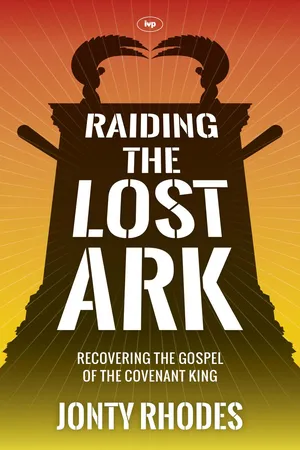
Yes, you can access Raiding the Lost Ark by Jonty Rhodes in PDF and/or ePUB format, as well as other popular books in Theology & Religion & Christianity. We have over 1.5 million books available in our catalogue for you to explore.