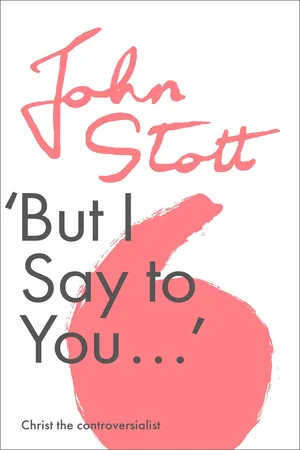
Jesus Christ has a way of cutting right across our logic and opinions, just as he did while on earth. He took issue with his contemporaries on basic questions like:
Who God is - The authority of Scripture - The way of salvation - Morality - Worship.In short, Jesus was a controversialist. And he still is today. Nothing has changed.Are we prepared to be challenged? Submit to wisdom that seems countercultural, dogmatic even?This is what following Christ really means. It will cost us our will and our pride. And a whole lot more besides. Here is the fruit of biblical study, rigorous Christian thought and personal devotion.
- English
- ePUB (mobile friendly)
- Available on iOS & Android
eBook - ePub
About this book
Information
Topic
Theology & ReligionSubtopic
Christian Theology1
Religion: Natural or supernatural?
The popular image of Christ as ‘gentle Jesus, meek and mild’ simply will not do. It is a false image. Certainly, he was full of love, compassion and tenderness. But he was also uninhibited when it came to exposing error and denouncing sin, especially hypocrisy. Christ was a controversialist. The Gospel writers show him as constantly debating with the religious leaders of his day. The purpose of studying his controversies is to make sure that the principles on which he took his stand are those which we are seeking to maintain today.
The first controversy we shall consider stems from a question which the Sadducees posed about the resurrection. It is strikingly relevant for today, because it highlights the issue of whether religion is natural or supernatural. Actually it goes further than this. It concerns not only what kind of religion the Christian religion is, but what kind of God the Christian God is. So it is fundamental.
The Sadducees and their modern counterparts
But before we listen to the Sadducees’ question, we must take a look at the Sadducees themselves. They were a small but influential Jewish party, which had its origins in the days of the Maccabean dynasty, a century or so before Christ. Most of them lived in Jerusalem and were educated, wealthy and aristocratic. The high-priestly families were Sadducees, so that Luke is quite correct to identify ‘the party of the Sadducees’ with ‘the high priest and all his associates’.1 Although influential politically, they were unpopular because they collaborated with the authorities of the Roman occupation. Theologically they were conservative, accepting the written law (though in a very formal way) and rejecting the ‘traditions of the elders’ which were so much loved by the Pharisees. Thus, ‘the Pharisees had an elaborate doctrine of immortality, resurrection, angels, demons, heaven, hell, the intermediate state and the Messianic kingdom, about all of which the Sadducees were agnostic.’2 Flavius Josephus, the first-century Jewish historian, gave a succinct summary of this difference between the two major parties. The Pharisees, he wrote, ‘believe that souls have an immortal vigour in them’, whereas the Sadducees ‘take away the belief of the immortal duration of the soul’, teaching instead ‘that souls die with the bodies’.3
This same basic theological distinction between the Pharisees and the Sadducees is faithfully recorded in the Gospels. Mark describes the Sadducees as those ‘who say there is no resurrection’.4 Similarly Luke comments in the Acts: ‘The Sadducees say that there is no resurrection, and that there are neither angels nor spirits, but the Pharisees believe all these things.’5
We might therefore refer to the Sadducees as ‘modernists’. Although in one sense theologically conservative, since they acknowledged the authority of the law of Moses, they were blind to the power of the living God which it reveals. They denied the supernatural.
Their contemporary equivalents are those who have absorbed the spirit of scientific materialism. Here are the kind of questions which modern Sadducees are asking: ‘Hasn’t science demonstrated that the universe is a closed, mechanistic system, and therefore done away with any need for God?’ ‘Isn’t human experience to be explained entirely in terms of natural processes, so that we must reject even the possibility of the super-natural?’ ‘Isn’t religion itself a natural phenomenon, having partly physiological and partly psychological causes, so that what it proves is not the existence of the God believed in but the disturbance in the brain chemistry of the believer?’ ‘And even if we can still believe in God as the creator and controller of the universe, surely we must now give up the old-fashioned idea that he has ever intervened supernaturally in human history, let alone that he still does so?’
These are typical questions asked by modern Sadducees. We discover how to answer them as we see how Jesus answered their ancient predecessors. These original Sadducees came to Jesus and began: ‘Teacher, Moses wrote for us . . . ’6 We note that they referred to a passage in what we know as the Old Testament law of Moses (for which they held special respect) and that they regarded its message as having a contemporary application (‘Moses wrote for us . . . ’). The particular law to which they were referring laid down that a woman who was widowed and childless was not to be married ‘outside the family to a stranger’, but to her brother-in-law, her deceased husband’s brother, so that he might ‘build up his brother’s house’. This was the background to the Sadducees’ question. Here’s how Mark sets it out:
Now there were seven brothers. The first one married and died without leaving any children. The second one married the widow, but he also died, leaving no child. It was the same with the third. In fact, none of the seven left any children. Last of all, the woman died too. At the resurrection [a resurrection, the Sadducees implied, in which the Pharisees believe, but we don’t] whose wife will she be, since the seven were married to her?7
The Sadducees clearly thought they were being very clever and that by their imaginary case they had exposed what they saw as the absurdity of the doctrine of the resurrection. Their intention was to hold it up to ridicule. Their argument was that this life creates so many anomalies that to carry it on beyond the grave would be unthinkable. An afterlife would simply magnify the problems of this life. Take the poor woman in this question. She would be claimed by seven men, all seeking to be her husband. Would she have to reject them all (which would hardly be fair on her) or just choose one of them (which would be tough on the other six)? Or will she somehow be married to all seven at once? The Sadducees imagined that their problem had no solution. They thought they had caught Jesus out.
Jesus began and ended his reply with a clear statement of their error. ‘You are in error,’ he said (v. 24). ‘You are badly mistaken’ (v. 27). I have to say that I find his outspokenness very refreshing. Jesus did not compliment them, as we might have done, on getting hold of an important aspect of the truth, or on contributing a valuable insight to current theological debate. No. They were quite simply wrong.
He then added the reason for their mistake. They were wrong, he said, because they were ignorant. These educated aristocrats, priests and leaders of Israel, who believed in Moses’ law and considered themselves extremely clever, were actually unaware of two truths: ‘You do not know the Scriptures or the power of God’ (v. 24). Their ignorance of Scripture was the immediate cause of their mistake about the resurrection, but the root cause was their ignorance of the power of God. We shall look at the causes of their error in this order (although Jesus discussed them in the opposite order). This means leaving verse 25 aside for the moment.
Ignorance of Scripture
We shall not go into this in any detail, because the supremacy of Scripture is the subject of the next chapter. But ignorance of Scripture is an issue here.
In general, Jesus traced the error of the Sadducees to their ignorance of the Bible. In the same way, most errors in the church today, especially those which lead to unnecessary controversy, are due to ignorance of or lack of respect for the Bible. It is highly significant that, in his disputes with both Pharisees and Sadducees, Jesus regarded Scripture as the authority in the debate and the final court of appeal. When they came to him with a question, he would usually respond with a counter-question which referred them to Scripture. For example, when a lawyer asked about eternal life, he replied, ‘What is written in the law? How do you read it?’8 Again, when the Pharisees enquired about his views on divorce, his immediate response was ‘Have you not read?’9 and ‘What did Moses command you?’10 It is the same here with the Sadducees. ‘Have you not read in the book of Moses . . . ?’ he asked. This was common ground between them. They had quoted Scripture; he quoted Scripture. They had referred to Moses; he also referred to Moses. In doing so, however, he had to draw attention to their misunderstanding, which was so great that it equated to ignorance.
In particular, he quoted Exodus 3:6, where, in the passage about the burning bush, God told Moses that he was ‘the God of Abraham, the God of Isaac, and the God of Jacob’. This way of describing himself, Jesus added, carried with it the implication of their resurrection, because ‘He is not the God of the dead, but of the living’ (vv. 26, 27). The first point to note is that the question at issue was not merely their survival, but their resurrection. Christ introduced his answer with the words ‘about the dead rising’ (v. 26). This is because, according to Scripture, a human being is a combination of body and soul, whose final destiny can’t be fulfilled through the immortality of the soul alone, but must also include the resurrection of the body.
Then there is a second point to consider. Is Christ’s argument fair? You might think that for God to call himself ‘the God of Abraham, Isaac and Jacob’ implies no more than that he is the God of history, the God who revealed himself successively to the three generations of patriarchs.
But no. The words mean more than this, much more. The argument rests not merely on the sentence ‘I am the God of Abraham, Isaac and Jacob’, still less on the verb and its tense ‘I am’ (for in any case there is no verb in the Hebrew), but on the whole context in which the sentence comes. The God who is speaking is both the eternally self-existing God who reveals himself as ‘I am that I am’ and the covenant God of Abraham, Isaac and Jacob. He had made with Abraham ‘an everlasting covenant, to be your God and the God of your descendants after you’,11 which he had then confirmed with Isaac and Jacob. Further, his covenant promises were too extensive to be fulfilled in their lifetime, and they knew it. According to the Epistle to the Hebrews, ‘they were foreigners and strangers on earth’, who ‘were longing for a better country – a heavenly one’.12 So when God announced himself to Moses as the God of Abraham, Isaac and Jacob, he meant not only that he had been their God centuries before, but that he was still their God and would be to the end, keeping covenant with them, sustaining them with his constant love. The God of ancient promise was the God of eternal fulfilment. ‘He is not the God of the dead, but of the living; for,’ as Luke adds, ‘to him all are alive.’13 The whole point of creating and choosing people was that they might live to him – and so it is ludicrous to suggest that God’s purpose would be thwarted by death! The God of Abraham, Isaac and Jacob is himself the living God, and the living God is the God of the living.
This, then, was the first answer which Jesus gave to the Sadducees’ question. They were ignorant of the Scriptures. As Luke’s version puts it: ‘even Moses showed that the dead rise.’14 Yet for all their proud boast of loyalty to Moses, they had rejected what Moses himself said. Their minds had become blinded by prejudice or by rationalism or by the Greek culture they had absorbed. They no longer submitted to the revelation of God.
Ignorance of God’s power
The more basic cause of the Sadducees’ error, however, was their ignorance of the power of God.
They seem genuinely to have thought that their question about the law would be enough to overturn the notion of resurrection. In their opinion the problems which an afterlife would create made it unthinkable. They hoped that their story abou...
Table of contents
- FOREWORD
- PREFACE
- Foundations
- A
- B
- Chapters
- 1
- 2
- 3
- 4
- 5
- 6
- 7
- 8
- Postscript:
- Notes
- John Stott
- A Timeline
Trusted by 375,005 students
Access to over 1.5 million titles for a fair monthly price.
Study more efficiently using our study tools.
Frequently asked questions
Yes, you can cancel anytime from the Subscription tab in your account settings on the Perlego website. Your subscription will stay active until the end of your current billing period. Learn how to cancel your subscription
No, books cannot be downloaded as external files, such as PDFs, for use outside of Perlego. However, you can download books within the Perlego app for offline reading on mobile or tablet. Learn how to download books offline
Perlego offers two plans: Essential and Complete
- Essential is ideal for learners and professionals who enjoy exploring a wide range of subjects. Access the Essential Library with 800,000+ trusted titles and best-sellers across business, personal growth, and the humanities. Includes unlimited reading time and Standard Read Aloud voice.
- Complete: Perfect for advanced learners and researchers needing full, unrestricted access. Unlock 1.5M+ books across hundreds of subjects, including academic and specialized titles. The Complete Plan also includes advanced features like Premium Read Aloud and Research Assistant.
We are an online textbook subscription service, where you can get access to an entire online library for less than the price of a single book per month. With over 1.5 million books across 990+ topics, we’ve got you covered! Learn about our mission
Look out for the read-aloud symbol on your next book to see if you can listen to it. The read-aloud tool reads text aloud for you, highlighting the text as it is being read. You can pause it, speed it up and slow it down. Learn more about Read Aloud
Yes! You can use the Perlego app on both iOS and Android devices to read anytime, anywhere — even offline. Perfect for commutes or when you’re on the go.
Please note we cannot support devices running on iOS 13 and Android 7 or earlier. Learn more about using the app
Please note we cannot support devices running on iOS 13 and Android 7 or earlier. Learn more about using the app
Yes, you can access But I Say to You by John Stott in PDF and/or ePUB format, as well as other popular books in Theology & Religion & Christian Theology. We have over 1.5 million books available in our catalogue for you to explore.