God speaks. By his Spirit. Through the Bible. About his Son.This is one of the most crucial things for any Christian to get to grips with. If we understand how God speaks, then we can truly know him. Everything else slots into place. We see Jesus clearly. We fall in love with him more deeply. We make sense of our world. But get this wrong and we lose it all.This book covers the whole sweep of the subject from start to finish. It puts all the parts of the jigsaw in their proper place. Yet, mixing our metaphors, it's also an appetizer, whetting your palate for more...
- English
- ePUB (mobile friendly)
- Available on iOS & Android
eBook - ePub
About this book
Information
Topic
Theology & ReligionSubtopic
Christianity1. Evolution and the Church
Alistair Donald
The relationship between Darwin’s theory and the Church has been by no means straightforward, nor, despite claims to the contrary, is the matter finally settled. Given that the scientific evidence is in significant ways at variance with Darwinism, as outlined elsewhere in this book, Christians need certainly not feel compelled to subsume their theology to the theory of evolution. The implications of doing so are considerable, as will be made clear later in this chapter, but first it will be helpful to look at the historical context.
The relationship between evolution and the Church
Since first publication of On the Origin of Species in 1859 the Church has been divided in its view of Darwin’s evolutionary theory. It is true that Rev. Charles Kingsley gave a fulsome endorsement some days before publication, having received an advance copy. As an Anglican clergyman he is often referred to in an attempt to demonstrate that the Church of England had no difficulty accepting Darwin’s thesis. However, when Rev. Dr Malcolm Brown, Director of Mission and Public Affairs for the Church of England recently wrote, ‘the Church of England owes you an apology for misunderstanding you and, by getting our first reaction wrong, encouraging others to misunderstand you still’, then it is clear that Kingsley’s enthusiasm was not universally shared.
Even those whom Darwin counted among his friends and mentors did not wholly support his views, due to their Christian convictions. Charles Lyell struggled to accept natural selection as the primary mechanism driving evolution and could not agree that man was descended from brute beasts. When he eventually accepted natural selection it was in an equivocal way. At the same time Asa Gray, described by Darwin as his best advocate, was challenging the utter randomness he saw in the theory and could not accept the absence of divine purpose and design in the process. He corresponded at length with Darwin while also writing articles and essays to persuade others of Darwin’s essential thesis. In 1876 Gray, aware of growing religious opposition to evolution, published Darwiniana, to try to reconcile it with Protestant Christianity.
From a Catholic perspective, St George Mivart was endeavouring to demonstrate that there was no conflict between evolution and the teaching of the Church. In 1871, he wrote On the Genesis of Species and addressed, in chapter 12, the perceived theological objections. In spite of his own view that these could be reconciled, he acknowledged that there were others, such as atheists Carl Vogt and Ludwig Büchner, who did not agree. Mivart eventually lost his friendship with Darwin and Huxley and was later excommunicated from the Roman Catholic Church. However, in 1950 a papal encyclical from Pope Pious XII stated that biological evolution was compatible with Christian faith, though declaring that divine intervention was necessary for the creation of the human soul.
In 1865, the Victoria Institute was founded in recognition that Darwin’s theory impinged on matters well beyond science. Its stated first object is telling: ‘To investigate fully and impartially the most important questions of Philosophy and Science, but more especially those that bear upon the great truths revealed in Holy Scripture, with the view of defending these truths against the oppositions of Science, falsely so called.’ The Institute was not officially opposed to evolution but perusing their Journal of Transactions illustrates the fact that many were challenging it. These challenges were often scientific but the objects make it clear that the motive of these challenges was the defence of Scripture.
Among Presbyterians on both sides of the Atlantic there was an ambivalent approach to Darwinism. Hugh Miller, the highly influential naturalist and Scottish Free Churchman, was no friend to young-earth views of geology, arguing against the ‘anti-geologists of the Church of England’, but although he died three years before Darwin’s Origins was published we know that he was opposed to existing theories of transmutation in biology and would surely have been sceptical of Darwin. In due course many Scottish churchmen did embrace the new theory with enthusiasm. By the early twentieth century B. B. Warfield, Principal of Princeton Seminary, did so as well, although the ‘Darwinism’ that was endorsed by him emphatically ruled out the purely chance element that is arguably intrinsic to the theory. Warfield’s predecessor at Princeton, Charles Hodge, had written specifically on the issue in 1874, bluntly branding Darwinism as ‘atheism’. Arnold Guyot, a Swiss-American geologist and evangelical Presbyterian, also challenged the theory, most notably in his 1884 work Creation, or the Biblical Cosmogony in the Light of Modern Science. In 1886, Augustus H. Strong of the American Baptists weighed into the fray. In his Systematics he argued that evolution could have been the mechanism that God used to create. Philip Gosse of the Plymouth Brethren was opposed to Darwin.
The Baptist Union in Great Britain was to feel the impact of the controversy in 1887. Charles Haddon Spurgeon was their best known minister and regarded as ‘the Prince of Preachers’. In the Surrey Music Hall he commanded crowds of 10,000 and at the Crystal Palace he preached to 23,654 people. In 1861, his congregation had moved to the Metropolitan Tabernacle, which seated 5,000 with room for a further 1,000 standing. He published a monthly magazine, The Sword and the Trowel, and in 1887 this was used to highlight the Down Grade Controversy. This was concerned with higher criticism, the authority of Scripture and the impact of Darwinism. Initially, two articles were published anonymously in March and April. These were actually written by Robert Shindler, Spurgeon’s friend. In the first one he spoke of the Down Grade being responsible for spawning the theory of evolution.
The response to these articles was enormous and Spurgeon himself wrote further on this perceived malaise, citing Darwin’s theory as part of the problem. The consequences were far-reaching, with many lining up on either side of the divide. Spurgeon withdrew from the Baptist Union and the Union censured Spurgeon. Baptist Associations from various parts of Canada and America sent resolutions unanimously supporting the stand that Spurgeon had taken. Just one of those, the Baptist Association of the State of Kentucky, represented 960 ministers. It is evident from this that, at that time, there were thousands of ministers who had problems with evolution.
In response to the liberal theology of the latter part of the nineteen century, The Fundamentals were written between 1910 and 1915. This was a series of ninety essays intended to set out essential Christian doctrine. These included an attack on evolution by George F. Wright, a geologist and Congregational minister. As a friend of Asa Gray he had been at one time something of a leader among Christian Darwinists, but in later life he revised his position completely, asserting that special creation was wholly responsible for biological variation. Many believe The Fundamentals gave rise to the fundamentalist movement within Christianity. This is interesting because some of those who wrote The Fundamentals, like B. B. Warfield, in fact subscribed to a form of theistic evolution.
George McCready Price, a Seventh-Day Adventist and avowed creationist, regularly attended the meetings of the Victoria Institute held between 1924 and 1928. He produced numerous anti-evolutionary works, including The New Geology. During this time Sir Ambrose Fleming was appointed President of the Institute (1927), but the influence of those sceptical of Darwinism was waning and some were looking for an opportunity more effectively to gather and organize opponents of evolution. In 1932, Sir Ambrose Fleming, Douglas Dewar and Captain Bernard Acworth, all leading members of the Victoria Institute, founded the Evolution Protest Movement. At its first public meeting in 1935, with 600 in attendance, the scientific credibility of evolution was challenged and some religious implications identified. Since that time it has changed its name to the Creation Science Movement and continues to pursue its original objectives.
In 1946 Henry Morris wrote a short book seeking to attack evolution. In 1961 he co-authored The Genesis Flood with John Whitcomb and cited George McCready Price as a key influence. This book went through thirty-nine reprints and sold over 200,000 copies, making a significant impact on American evangelicals. It sought to interpret geology in light of a global flood. Morris subsequently was involved in founding the Creation Research Society and then the Institute for Creation Research. He is regarded by some as responsible for the rise of the modern creation science movement. The Presbyterian Church of the United States (now the PCUSA) revisited its own position in 1969. They officially declared that there is no contradiction between the theory of evolution and the Bible and overturned their previous statements of 1886, 1888, 1889 and 1924.
In the early 1990s the Intelligent Design (ID) movement emerged, from roots in the previous decade. It is often incorrectly maintained that ID was an offshoot of biblical creationism, but in fact the movement originated among scientists who were formerly Darwinists but had come to be sceptical of the theory because recent advances in science, particularly biochemistry and information science, seemed to be incompatible with Darwinism.
This short overview demonstrates two primary points. First, the Church has been divided over its view on Darwinism since 1859 to the present time. Secondly, the division over evolutionary theory has not come from one particular wing of the Church but from a wide variety of denominational perspectives.
The implications of embracing evolution
As highlighted in the Preface, there is currently a call for the Church to embrace evolution, and it is asserted that there is no contradiction between Christian faith and Darwinism. In order to consider this claim carefully we need to identify the implications for the Church of embracing evolutionary theory. There are obviously many who believe that evolution is the mechanism that God used to create the variety of life on this planet. However, for those who are serious about the supremacy of Scripture, it is essential that any apparent theological tensions that arise from this are rigorously reviewed. It would be premature to say the least to commit to a scientific position without having a clearly worked out theology that accords with it, particularly when so much of the scientific evidence does not necessitate a Darwinian explanation.
One significant difficulty in trying to reconcile evolution and the Bible is that Darwinian evolution does not allow that there is a hierarchy of life within the natural world. Natural selection ensures that each species is best adapted to survive and thrive within its own environment but it cannot ascribe a special significance to humanity. The Bible on the other hand describes man and woman as the pinnacle of God’s creative work. Humankind is seen as both special and different to the other life forms and is given dominion over them. The greatest demonstration of this special nature is seen in Christ taking on himself human flesh and laying down his life at Calvary as Redeemer.
Humankind is identified in the Scriptures as being created in the image of God. Theologians wrestle with this concept, attempting to understand exactly what this means, and there are several different views normally posited. However, there is no dissent from the view that the Bible declares humanity as unique within creation. This was not the position of Charles Darwin. His friend and mentor, Charles Lyell, debated the issue with him. Lyell could not accept that humans were descended from beasts in the same way that other organisms had evolved, though he supported much of Darwin’s theory.
If Christians are to embrace evolution they must have an evolutionary theory that ascribes a special significance to humanity and recognizes the primacy of humankind within the evolutionary framework or else they must impose this special nature onto humanity apart from evolution. In his recent book, Denis Alexander, Director of the Faraday Institute for Science and Religion, St Edmund’s College Cambridge, finds the special nature of humanity not in the evolutionary process but in the intervention of God. He argues that the image of God is not imparted to Homo sapiens through evolution but by a special revelation to a particular couple, Adam and Eve, and this revelation makes them Homo divinus.1
In his suggested model, Adam and Eve were living among up to 10,000,000 other Homo sapiens, so how was the image of God imparted to them or their progeny? Obviously, the vast majority of the earth’s future population would not be descended from Adam and Eve. How then, are they created in the image of God? If one’s reading of the biblical text allows a global flood that destroys all the living, then it could be argued that those who followed the flood were direct descendants of Adam, through Noah, and they could be said to bear the image of God in that way. However, if one’s reading of the biblical text excludes a global flood, there must be some other explanation for how humanity as a whole is created in the image of God. As mentioned earlier, the Catholic Church adopted a position that necessitates divine intervention for the creation of the human soul and in this way God’s direct intervention sets man apart as unique.
The issue of humanity’s special position before God also requires that those embracing evolution explain why humans will not evolve into a different species. The alternative is to explain how this new species fits into the eternal purposes of God that are identified in the Bible. While there are wide-ranging eschatological interpretations, they all concern themselves with the eternity of humanity not its extinction.
When Christians embrace evolution it is usually with a conviction that this is the vehicle God has used to bring about the variety of life on our planet. It seems perfectly plausible to them that God set natural laws in place and chose this process for the development of life. However, this scenario raises numerous problems. Darwinian evolution does not allow any external direction. Natural selection working on random mutations is what gives force to the evolutionary process. Although the mutation mechanism was not known in Darwin’s day, the chance element was clearly emphasized and it was this that Asa Gray found so objectionable about Darwin’s position. He urged Darwin to acknowledge design and refuted the randomness that Darwin championed.
If God is immanent in his creation then to what degree is he directing the process of evolution? Darwin withstood any notion of divine direction, not least because of the pain and death in nature he had observed. He could not attribute such activity or design to a benevolent God. Theists believe in the immanence of God. They do not subscribe to the concept of a deity who started a process of creation that he is now uninvolved in. This is a concept that Darwin would not dismiss, but he totally refused to accept the immanence of God in the process of evolution. This was his great idea – natural selection not God explained the development of all life on earth!
Alexander repeatedly asserts the immanence of God in every aspect of life and this, of course, is in line with orthodox evangelical theology but it is in direct contradiction to Darwin’s theory of evolution. To embrace evolution and Christianity one must reconcile natural selection with the immanence of God. It is not sufficient to simply assert that both are true. The originator of natural selection believed them to be mutually exclusive. Stephen Jay Gould held to the view (widely supported by the scientific community) that if the whole process of evolution was to start again it is highly improbable that it would result in the same end-point. Alexander is challenging that view because it cannot be reconciled to his theology. Any theology that embraces evolution must explain, at some level, how God is directing the process of natural selection and this explanation must make clear how natural selection can then still be considered to be natural selection.
Those who believe that God has indeed chosen evolution must address the issue of pain, suffering and death that evolution necessitates in order for life to develop. Often the debate focuses on whether it is more or less glorious that God should create instantly or design an intricate process that creates different species over billions of years. However, that seems entirely secondary to explaining how God is glorified by a process that demands agony, disease, death and extinction as necessary to the evolution of life. To conclude that God deliberately designed this process makes God directly responsible for suffering and death and runs completely counter to the view of God’s goodness expressed in the Bible. Alexander will not concede that God may deliberately hide himself or his purposes because he argues that to do so would be deceitful and God is not a liar! Yet he can conceive of a God who deliberately designed a process of disease and death for the development of life.2
Traditionally, Christian theology holds that the fall is responsible for the entrance of sin and death into the world. It acknowledges that pain and suffering are part and parcel of this life but anticipates that they will be completely overthrown in the coming kingdom. It views death as an enemy that will ultimately be destroyed. Evolution, on the other hand, accepts death as essential to the development of new life forms. Death is not an enemy if it is part of a created order that God considers to be very good. How is the place given to death in evolutionary theory in any way compatible with the place given to death in the Bible? These questions do not go away by an appeal to the genre of Genesis, but are central to the key themes of Christianity.
Another key issue that must be resolved is how all humanity is reckoned to be ‘in Adam’. The cross is unquestionably central to Christian theology and the great hope that it affords is that ‘one man’ has atoned for the sins of all. The parallelism of New Testament teaching is between Adam and Christ as federal representatives of humanity. In the theology being expounded by Alexander it is very difficult to understand how one among several millions and who had been predated by others could properly be said to represent the whole. This is not secondary, it is central to our understanding of Christian faith. The New Testament argues that we can have confidence that we are included in the atoning work of Christ because it is evident that we are included in Adam.
Synthesizing contradictory worldviews
Christianity is not a set of unrelated assertions about truth. It is a narrative, beginning with a creation that is good, the story of its fall and an account of the redemptive activity of God that will lead to the perfect order of God for life finally being established. In this narrative, something of the character and nature of God is revealed. In the person and work of Christ the truth of this worldview is intended to be established. If, therefore, some aspects of biblical interpretation or traditional theological perspectives are to be challenged, consideration needs to be given to the impact on the whole Christian story.
Christianity reveals Christ as a saviour. It explains humanity’s need to be saved from their sin and their inability to save themselves. Evolutionary theory is trying to understand humanity’s propensity for good or evil. In the early 1970s, George R. Price suggested a mathematical formula to explain altruism in humanity as part of the process of natural selection. Subsequently Richard Dawkins argued strongly that the selfish gene determines the behaviour of humanity and consequently he struggles to ascribe responsibility to people. These scientists were and are following the natural course of questioning that is suggested by the evolutionary worldview. How will we reconcile their explanations with our gospel? This line of argument is not from fear of what might be uncovered by science but to illustrate a point. What is the minimum we will accept as essential to hold to Christianity?
If my genetic make up is responsible for my moral conduct, in what way can God hold me accountable and why do I need a saviour? Already Denis Alexander is positing a ‘fall’ that is no big deal and suggests that traditional Christian theology is more of a reflection of Milton’s Paradise Lost than of the Bible (although it may be wondered where Milton got the concept from!). Death becomes then not a result of the fall but a natural part of life’s evolutionary advance. It seems a very postmodern approach that allows the individual to pick various parts of opposing worldviews and to seek to synthesize them into ‘my’ truth.
A naturalistic definition of science rules out any consideration of a Christian worldview from the data that science uncovers. Did the fall have any impact on the natural world? Is there a bondage to decay in the creation that was not part of God’s original created order? Many would argue that the answer to both of these questions is yes, but such matters can never be considered in the light of methodological naturalism. If either of the above questions is answered in the affirmative then that would have important implications for all origins research. If theism is true, then insisting on naturalistic processes for the origin and development of life is based on a false premise. ...
Table of contents
- Contents
- CONTRIBUTORS
- Foreword
- Preface: A Twenty-First-Century Challenge
- 1. Evolution and the Church
- 2. The Language of Genesis
- 3. Adam and Eve
- 4. The Fall and death
- 5. Creation, Redemption and Eschatology
- 6. The Nature and Character of God
- 7. Faith and Creation
- 8. TOWARDS A SCIENCE WORTHY OF CREATURES IN IMAGO DEI
- 9. Interpretation of Scientific evidence 9A. Homology
- 9B. The Nature of the Fossil Record
- C. Chromosomal Fusion and common ancestry
- 9D. Information and Thermodynamics
- 10. Does the Genome Provide Evidence for Common Ancestry?
- 11. The Origin of Life: Scientists Play Dice
- Conclusion: Should Christians embrace Evolution?
Trusted by 375,005 students
Access to over 1.5 million titles for a fair monthly price.
Study more efficiently using our study tools.
Frequently asked questions
Yes, you can cancel anytime from the Subscription tab in your account settings on the Perlego website. Your subscription will stay active until the end of your current billing period. Learn how to cancel your subscription
No, books cannot be downloaded as external files, such as PDFs, for use outside of Perlego. However, you can download books within the Perlego app for offline reading on mobile or tablet. Learn how to download books offline
Perlego offers two plans: Essential and Complete
- Essential is ideal for learners and professionals who enjoy exploring a wide range of subjects. Access the Essential Library with 800,000+ trusted titles and best-sellers across business, personal growth, and the humanities. Includes unlimited reading time and Standard Read Aloud voice.
- Complete: Perfect for advanced learners and researchers needing full, unrestricted access. Unlock 1.5M+ books across hundreds of subjects, including academic and specialized titles. The Complete Plan also includes advanced features like Premium Read Aloud and Research Assistant.
We are an online textbook subscription service, where you can get access to an entire online library for less than the price of a single book per month. With over 1.5 million books across 990+ topics, we’ve got you covered! Learn about our mission
Look out for the read-aloud symbol on your next book to see if you can listen to it. The read-aloud tool reads text aloud for you, highlighting the text as it is being read. You can pause it, speed it up and slow it down. Learn more about Read Aloud
Yes! You can use the Perlego app on both iOS and Android devices to read anytime, anywhere — even offline. Perfect for commutes or when you’re on the go.
Please note we cannot support devices running on iOS 13 and Android 7 or earlier. Learn more about using the app
Please note we cannot support devices running on iOS 13 and Android 7 or earlier. Learn more about using the app
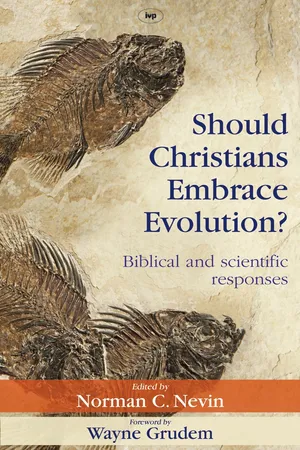
Yes, you can access Should Christians Embrace Evolution? by in PDF and/or ePUB format, as well as other popular books in Theology & Religion & Christianity. We have over 1.5 million books available in our catalogue for you to explore.