Integrity matters. We expect it of leaders in all walks of
life. But why is integrity so rare? Jonathan Lamb looks at the example of
the apostle Paul in 2 Corinthians and offers us a model of integrity in
leadership that spans the centuries.
- English
- ePUB (mobile friendly)
- Available on iOS & Android
eBook - ePub
About this book
Information
Topic
Theology & ReligionSubtopic
Christianity1. FIRST STEPS ON THE STAGE
On 27 April 1921, to Arnold and Lily Stott's delight, their first and only son was born. They called him John Robert Walmsley. Joanna, aged nine, and Joy, two, were intrigued to have a baby brother. Arnold was thirty-six and, with Lily now aged forty-one, John was to be their last child.

Joanna and Joy were intrigued to have a baby brother.
On returning to civilian life after serving as a major in the Royal Army Medical Corps in the First World War, Arnold had established his own department of electrocardiography at the Westminster Hospital. He was highly regarded as a teacher. Although his students were wary of his critical and sometimes caustic comments, they recognised that his instruction at the bedside gave them a valuable introduction to clinical medicine.
In 1911, Arnold had married Emily Holland, whom he had met as a student. Emily was always known in the family as Lily and had been born in Antwerp. A month after John's arrival, the Stott family moved from West Kensington to 58 Harley Street, where Arnold established his own consulting rooms. Harley Street had been the medical heart of London for over a hundred years. The house, which still stands almost on the corner where Harley Street crosses New Cavendish Street, is imposing, with bow-fronted rooms on three of its six floors. But Lily wasn't sure that her husband had made a wise choice.
"The house is too small and inconvenient," she complained. "If I hadn't been recovering from John's birth, I would never have agreed to Arnold buying the place. There are too many stairs and our dining room has to double as a patient waiting room."
Arnold's consulting room was on the first floor at the back of the house, separated from the drawing room by a glass door. His secretary-receptionist worked in the drawing room so no one in the family was allowed to use it in the afternoons. The main bedrooms were on the second floor, the nurseries on the third. The servants lived in the attic.
A number of nannies came and went, but at last one came who stayed. Nanny Golden was a cheerful Christian who taught John and his sister Joy to sing hymns and choruses. She took them along Harley Street to Park Square Gardens, and beyond into Regent's Park with its Rose Garden and famous zoo, giving them glimpses of giraffes or elephants. In the winter the frozen lake attracted skaters, while in the summer they sometimes saw the little princesses, Elizabeth (later to become Queen Elizabeth II) and Margaret Rose, driving in the inner circle.
When Nanny took the children for a picnic on a farm in the country, a cockerel showed an interest in the Stott family party. John toddled towards it with his hand outstretched to give the bird some bread. With unforgivable ingratitude the cockerel attacked John, leaving him with a scar beneath his eye.
Lily, whose mother was German, had imbibed Lutheran piety. She taught Joanna, Joy and John to go to church, read the Bible and say their prayers. But Arnold wasn't religious. A scientific humanist, he was committed to trying to make the world a better place. He believed passionately in the value of education and in the power of reason to right the world's wrongs. A keen naturalist, Arnold also loved music, stamp collecting, fly fishing and wine.
John never took to stamp collecting or developed much of a taste for alcohol, but he did inherit his father's love of music. He learnt to play the cello, accompanying his mother on the grand piano in the drawing room, and later played in his school orchestra. But Arnold's greatest success was to inspire John to take an interest in the world of nature, especially birds.
During the summer holidays, Arnold took John "sugaring" on warm nights.
"Shut your mouth," Arnold would say to John, "and open your eyes and ears!"
Together they brewed a sticky concoction, based on beer laced with treacle. Then, in the garden where they were staying, they painted a band, three or four inches wide, round the trunk of every tree. Around midnight, Arnold would wake his son. They crept out into the garden and switched on a torch. In the beam of light, they could see moths and butterflies that had been attracted by the sweetness, inebriated by the beer, and now had fallen to the foot of the tree. Quickly they slipped the rarer specimens – hawk moths, yellow or red underwings – into a killing bottle and later transferred them to their growing collection.
* * * * * *
Lily chose their local parish church, All Souls, Langham Place, as the family's place of worship – though Arnold only turned up there two or three times a year. John Nash, who designed the church in 1820, also oversaw the rebuilding of Buckingham Palace (the former Buckingham House) and planned Regent's Park and its surrounding fine terraces.
Nash's vision for All Souls, with its distinctive colonnaded portico and fluted cone spire, was that it should fit the chosen site where the upper end of Regent Street curved gently at Langham Place to meet the lower end of Portland Street. He thought that the portico and spire would offer a pleasant vista as you looked north from Oxford Circus. Since All Souls is a "crown living" church, the royal coat of arms hangs over the entrance door. It is Nash's only surviving London church, and few who have ventured inside forget the striking painting above the communion table. George IV presented Richard Westall's Ecce Homo to the church at its opening in 1824. It shows Christ, handcuffed in a purple cloak and wearing a crown of thorns. Round his head are the hands of jeering priests with soldiers looking and pointing at him.
When the Stott family began to attend All Souls, the church had a new Rector, Arthur Buxton, who cultivated friends from the world of theatre and invited them to his church. John and Joy were usually separated and made to sit one on each side of Nanny Golden to keep them in order. But this didn't prevent John making little pellets from used bus tickets and dropping them from his seat in the gallery on to the hats of the ladies sitting below. When he scored a direct hit, he would duck down so that he wasn't identified.
The BBC was founded in 1922 and, four years later, John Logie Baird invented television, although the first TV programmes were not broadcast until 1936. In 1928, builders began to demolish houses to the north of All Souls to make way for Broadcasting House. Arthur Buxton was quick to form a strong link between his church and the BBC, giving regular broadcast talks on Sunday evenings.
Harley Street was only five minutes' walk from Oxford Street and Regent Street, the heart of London's West End. At Christmas, the big shops like Selfridges competed to present the best illuminations and the most sumptuous window displays. On Christmas Day itself Arnold agreed to attend the service at All Souls before returning home for the family get-together in the drawing room. Arnold took to his hands and knees under the Christmas tree and distributed the presents one at a time. When John was eleven, the family listened to King George V making the first Christmas Day broadcast to the people of the British Empire.
At Christmas, too, Arnold took the children with him to the old Westminster Hospital opposite Westminster Abbey, on the site of the present Queen Elizabeth II Conference Centre. Arnold stood with a junior doctor at a heart patient's bedside. Both the younger man and the patient looked anxious.
"What," Arnold asked, turning to the doctor, "should he be given to eat?"
"A little fish, perhaps?"
Arnold snorted. "Do you mean a sardine or a sprat?"
The trainee doctor made a mental note to remember that his boss was a stickler for accuracy in the use of language.
But where was Stott junior? Arnold ordered a search and at last they found him flat on his back on the floor of the dispensary, his mouth open beneath the tap of a huge jar of cod liver oil and malt, the contents slowly trickling into his mouth.
Back at 58 Harley Street, John's cousin Tamara often stayed for long periods with the Stott family while her own parents were abroad. She was daughter of Lily's sister Ella who had married the famous conductor Albert Coates. "John was always fighting with his sister Joy," she recalled, "but would never fight with me, although I wished he would!"
Tamara also remembered Arnold as rather resenting her presence, and his habit of firing unkind remarks in her direction.
When John was eight, Arnold and Lily decided to send him away to preparatory school as a boarder. They chose Oakley Hall, near Cirencester in Gloucestershire. When John arrived at the school in September 1929, the Stotts' chauffeur parked the big Chrysler in the shadow of an ivy-covered building of Cotswold stone. With a butterfly net protruding from his luggage, John climbed out of the car and surveyed the scene: a flower garden, neatly cut lawns, gravel paths with trimmed edges, flowering shrubs, a lily-pond and fountain. Beyond, he saw a tennis court and cricket pitch. Major Letts, who had recently taken over as head teacher, greeted John and four other new boys before handing them to the care of his wife.

Oakley Hall School 1929-1935. When John arrived at the school in September 1929, the Stotts’ chauffeur parked the big Chrysler in the shadow of an ivy-covered building of Cotswold stone.
Mrs Letts prided herself on a large conservatory with vines and exotic plants. She showed the new boys into their dormitory, where John saw eight iron-frame beds covered with eiderdowns and a row of eight china wash basins. John soon discovered that Major Letts ran his school on military lines, with every day carefully ordered. He attached importance to academic work, hoping that his boys would gain entrance to one of the main public schools. But he thought that games were important too, in the afternoons, with soccer and rugby in winter and cricket in summer.
Lily was relieved, after a week or so, to get a letter from Mrs Letts explaining that John had settled in well. He was eating heartily. The cold he arrived with had gone. He was enjoying games. His first half-term report noted that his spelling was excellent and that the teaching in French he had received from French governesses at home, and from King Arthur's school, had served him well. When winter came, John found that the dormitory was virtually unheated and ice formed on his wash basin.

He was enjoying games.
An ex-army sergeant in charge of the gym taught John to box in a proper ring, wearing gloves. Major Letts reported that John's behaviour was by no means perfect but added, reassuringly, that "he is perfectly straightforward and such trouble as he gives is certainly no more than might be expected from a healthy boy of his age with a good deal of energy to work off. I think he has the makings of a first-class boy."
One morning, a teacher told John, "Your mother is in the head teacher's study and would like to see you."
An assistant escorted John to the study. He saw Lily standing there with Major Letts and his wife. Unable to decide how to behave in this situation, John advanced towards his mother and stretched out his hand to shake hers.
"How do you do, Mrs Stott?" he asked.
Mrs Letts burst out laughing, but Lily played along with her son.
"How do you do, Johnnie!" she said.
A few weeks later, in a letter home, John honestly reported that he had been beaten six times, receiving twenty-five strokes of the cane since he had been at the school. Anxiously, Lily wrote back asking what he had done to be punished so.
"I honestly don't know why I get caned such a lot," he replied.
On his first summer holidays from Oakley Hall, Arnold presented John with a leather-bound notebook, inscribed, "Johnnie from Daddy, 19th August 1930, Burton Bradstock, Dorset." Burton Bradstock was a favourite holiday destination for the family.
At the start of his final year, the school put on a performance of Scenes from Julius Caesar. The drama teacher needed someone with a keen sense of the theatrical to play the part of Mark Antony. He chose John to star in one of the most dramatic moments in any of Shakespeare's plays, when Mark Anthony enters a packed forum in Rome bearing the body of the murdered Caesar. John rose to the occasion:
Friends, Romans, countrymen, lend me your ears;I come to bury Caesar, not to praise him.The evil that men do lives after them;The good is oft interred with their bones:So let it be with Caesar ...
John knew that this was high drama. He recognised that, in this speech, words were beautifully used and crafted by the world's greatest master of language. Although the school magazine reported that he was "inclined to overact," the account concluded that overall John Stott's "performance can rarely have been equalled in this school".
A new teacher arrived at the school, Robbie Bickersteth, having just graduated from Eton College. He lacked teaching qualifications but was a keen bird watcher. In the distant corner of the main playing field, a common whitethroat had built her fragile nest in a bed of nettles. Robbie and John constructed a ramshackle hide out of old sacking, and erected it within photographic range of the nest. They didn't have to wait long before the eggs hatched and the parents were busy feeding their chicks. With a camera his father had given him, John took a picture of a parent carrying an insect to the nest – it won the school photographic competition.
During his last few months at the school, in 1934, Major Letts made John head prefect. Then, in November, he sat the scholarship examination for Rugby, the school where Arnold had been a pupil from 1898 to 1904. A few days later a telegram arrived at Oakley Hall addressed to John.
23 NOVEMBER 1934: HEARTIEST CONGRATULATIONS ON GETTING AMONG THE FIRST THREE LOVE MUMMY AND DADDY.
In his final school report, Major Letts wrote that John "has made an excellent Head Prefect. I am very sorry to lose him and wish him every success at Rugby."
* * * * * *
Rugby School, in Warwickshire, had long been a household word through rugby football, invented in a moment in 1823 when William Webb Ellis, ignoring the rules of soccer as it had always been played, picked up the ball and ran with it. From then the distinctive feature of the game of rugby as it is played throughout the world came into being. The name and reputation of the school's most famous headmaster, Thomas Arnold, lingered. Arnold had put character before brains as the aim of education, and made the senior boys his colleagues in securing it. At Rugby they made everyone work. The school's fame was perpetuated through Thomas Hughes' book, Tom Brown's Schooldays. School House still displayed, as it does today, the original fireplace where Tom Brown was "roasted" as part of his initiation into Rugby life.
In 1935, when John arrived, Rugby had become more civilised than in the days of Tom Brown. He discovered that the long tradition of "fagging" remained, however: new and younger boys had to do chores for the senior boys in the house. When the cry of "fag" rang out, John had to race along the long corridor. If he was last to arrive, he had to do the fagging – perhaps fetch something from the school shop, clean some shoes, carry some books or polish some brass buttons on the school military uniform.
Arnold Stott wrote to John regularly and made no secret of his pride when his son began to demonstrate that he had unusual abilities: "You are already a form higher, at least, than I was at your age, and nothing in the world will please me more than you beating me at anything..."
* * * * * *
Arnold and Lily had never found No. 58 Harley Street large enough to contain all that went on there. So when, in 1936, No. 65, just across the road, came on the market, Lily persuaded Arnold to buy it. The house was six stories high, with steps leading to a stone porch under a high semicircular roof, supported by elegant columns. There was a mews for the chauffeur and doctor's car.
Twice a year, Arnold arranged formal dinner parties for the doctors in his departments at the Westminster and Royal Chest hospitals. The young men were careful to be on their best behaviour, calling Arnold "Sir" while Lily did her best to put them at their ease.
Small, grave and determined, with half-moon spectacles, Arnold acted and spoke with great precision. At dinner he preferred the doctors training under him to think before they spoke, and then to express what they had to say as concisely as possible. But while his trainees found him an awe-inspiring figure, Arnold's colleagues thought of him as a charming dinner companion. One said of him that "his appreciation of good food and wine, his pretty wit, his lively anecdotes, and his sound common sense make him the happiest of companions and the most agreeable of men".
One evening during the summer holidays of 1936, Lily was driving John on the South Carriage Drive through Hyde Park. It was getting dark, the lighting was poor, and Lily failed to spot a bollard in the middle of the road: there was a mighty crash as she drove straight into it. John was catapulted forward, putting his chin through the windscreen, and landing on the pavement.
Lily thought for a long moment she had killed her son. He lost consciousness and only came to in Westminster Hospital, where he spent a few days before emerging with a scar beneath his chin, just inches from his jugular vein.
* * * * * *
When John recovered, the family took a holiday in County Galway on the west coast of Ireland, staying at a small hotel near Moyard in what later became Connemara National Park. They enjoyed the view of the mountains, expanses of bogs, heaths, woodlands and coastal inlets washed by the Atlantic. Arnold introduced John to th...
Table of contents
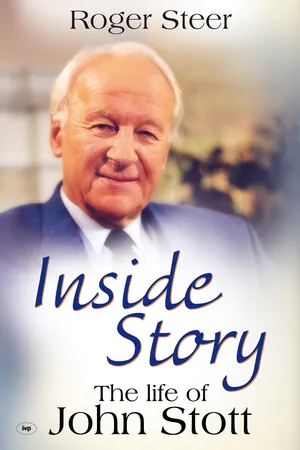
- Inside Story
- CONTENTS
- TIMELINE
- PREFACE
- 1. FIRST STEPS ON THE STAGE
- 2. OPENING THE DOOR
- 3. CAMBRIDGE BATTLES
- 4. DISCOVERING THE INNER LOGIC
- 5. CURATE IN A MIXED PARISH
- 6. UNDER CHARING CROSS ARCHES
- 7. THE KING APPROVES
- 8. DESERTED FARMHOUSE IN WALES
- 9. "YOU'D BETTER COME AND BE MY SECRETARY"
- 10. SPECIAL RELATIONSHIP
- 11. MODELLING JESUS
- 12. APPROACHING RENEWAL
- 13. DRAMA AT THE CENTRAL HALL
- 14. COMING OUT OF THE GHETTO
- 15. NEW MAN AT ALL SOULS
- 16. WHERE THE BATTLE FOR HOLINESS IS WON
- 17. GIANT AT LAUSANNE
- 18. UNCLE JOHN
- 19. MEETING FANTASY WITH REALITY
- 20. WHAT IS AN EVANGELICAL?
- 21. INTIMATE ENCOUNTERS
- 22. PREACHING FIT FOR A QUEEN
- 23. INSTITUTE AND ISSUES
- 24. CLIMBING THE HILL CALLED CALVARY
- 25. WINCING UNDER ATTACK
- 26. LOST IN THE JUNGLE
- 27. AN URGENT PLEA
- 28. THE LUCKIEST MAN ON EARTH
- 29. LAPS OF HONOUR
- 30. SHAPING OUR WORLD
- THANKING GOD FOR JOHN
- MORE INFORMATION
- BIBLIOGRAPHY
Trusted by 375,005 students
Access to over 1.5 million titles for a fair monthly price.
Study more efficiently using our study tools.
Frequently asked questions
Yes, you can cancel anytime from the Subscription tab in your account settings on the Perlego website. Your subscription will stay active until the end of your current billing period. Learn how to cancel your subscription
No, books cannot be downloaded as external files, such as PDFs, for use outside of Perlego. However, you can download books within the Perlego app for offline reading on mobile or tablet. Learn how to download books offline
Perlego offers two plans: Essential and Complete
- Essential is ideal for learners and professionals who enjoy exploring a wide range of subjects. Access the Essential Library with 800,000+ trusted titles and best-sellers across business, personal growth, and the humanities. Includes unlimited reading time and Standard Read Aloud voice.
- Complete: Perfect for advanced learners and researchers needing full, unrestricted access. Unlock 1.5M+ books across hundreds of subjects, including academic and specialized titles. The Complete Plan also includes advanced features like Premium Read Aloud and Research Assistant.
We are an online textbook subscription service, where you can get access to an entire online library for less than the price of a single book per month. With over 1.5 million books across 990+ topics, we’ve got you covered! Learn about our mission
Look out for the read-aloud symbol on your next book to see if you can listen to it. The read-aloud tool reads text aloud for you, highlighting the text as it is being read. You can pause it, speed it up and slow it down. Learn more about Read Aloud
Yes! You can use the Perlego app on both iOS and Android devices to read anytime, anywhere — even offline. Perfect for commutes or when you’re on the go.
Please note we cannot support devices running on iOS 13 and Android 7 or earlier. Learn more about using the app
Please note we cannot support devices running on iOS 13 and Android 7 or earlier. Learn more about using the app
Yes, you can access Inside Story by Roger Steer in PDF and/or ePUB format, as well as other popular books in Theology & Religion & Christianity. We have over 1.5 million books available in our catalogue for you to explore.