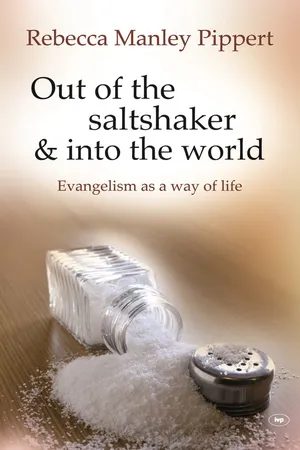
Evangelism isn't something you do, it's a world-changing way of life. Rebecca Manley Pippert shows how we as Christians, who are called to be the salt of the earth, can get out of the saltshaker and into life itself. People crowd the pages, with language and lifestyles to match. She confronts them with a Jesus as contemporary as themselves, a Christ they can see, who cares. Reading her book we laugh at her mistakes, identify with her failures, and find ourselves eager to emulate her spiritual progress.
Christians and non-Christians have something in common: we’re both uptight about evangelism. Our fear as Christians seems to be How many people did I offend this week? We think that we must be a little obnoxious in order to be good evangelists. A tension builds inside: Should I be sensitive to people and forget about evangelism, or should I blast them with the gospel and forget about their dignity as human beings? Many Christians choose to be aware of the person but then feel defensive and guilty for not evangelizing.
A Year Abroad
I certainly felt that way during my junior year abroad at the University of Barcelona, Spain. Of course I wanted my friends to know God, but every time I got up courage to be vocal about Jesus, an image leaped into my mind of an aggressive Christian buttonholing an unwitting victim. As a nonbeliever I had thought many Christians were weird, spreading leaflets on street corners and nabbing strangers. I was terrified that if I said anything at all about Christ, my friends would consider me just as strange. And I would agree with them. There was a part of me that secretly felt evangelism was something you shouldn’t do to your dog, let alone a friend.
To evangelize, it seemed, required insensitivity and an inclination to blurt out a memorized gospel outline, without inhaling, to every stranger you met. It never occurred to me that my pre-Christian, unredeemed, almost common sense understanding about how to relate warmly to people might be valid. For instance, I knew how offended I had been as an agnostic when someone tried to push religion on me without even bothering to discover who I was or what I believed. That was a proper response, I see now, for I should be offended when I’m being treated as someone’s evangelistic project instead of as a person.
Yet when I became a Christian I thought I was supposed to toss in my common sense perceptions in order to be spiritual. I thought I was called to “offend for Jesus’ sake.” How I thought I was supposed to share my faith went against my very grain. But, I thought with a somewhat twisted logic, Is it really so much to ask that I turn people off as soon as I meet them, when you think of all that Christ has done for me?
Still, I knew Christians were called on to do hard things. And because it was so hard to do, I thought such evangelism had to be spiritual. The result was that I would put off witnessing as long as possible. Whenever the guilt became too great to bear, I would overpower the nearest unsuspecting skeptic with a nonstop running monologue and then dash away thinking, Whew! Well, I did it. It’s spring and hopefully the guilt won’t overcome me again till Christmas. (And I’m sure my skeptic friends hoped the same!)
I witnessed like a Pavlovian dog. The bell would ring; I would get ready, activated, juices running; and then—BAM!—I’d spit it out.
Paradoxically, I also knew that unless I really cared for my friends, they would never be interested in the gospel. I was deeply moved by the way Jesus demonstrated compassion to the people he met. I wanted to do the same, although it didn’t occur to me that this had much to do with evangelism. So I tried to reach out and care for the people God had placed around me. But I felt guilty for not giving a gospel outline to every nonbeliever I met.
It wasn’t that I never spoke about my faith; in retrospect, however, I was far too paranoid about people’s responses to me and consequently too silent. But one thing hindered me from speaking: I felt that unless I gave a person the whole ball of wax, all at one time, then I wasn’t “evangelizing.” So when my friends at the University of Barcelona said they were curious about my faith and began asking questions, I thought, Isn’t that amazing! And I wasn’t even evangelizing!
So I approached my year abroad in Spain seeking to establish caring relationships with students and asking God to touch their lives. I also asked him to teach me how to share my faith and to free me from fear.
During this time I lived with Ruth Siemens, who was working for a collegiate ministry called the International Fellowship of Evangelical Students. She is a remarkable woman, abounding in gifts, intelligence, zest and vision. Every time we talked about my desire for ministry, she suggested I start a Bible discussion for my friends who were seekers. I acted as though it was an interesting idea, but to myself I thought, Well, that’s what happens when you’ve been in the Spanish sun for too long. You sort of lose touch with reality.
But Ruth was persistent, and at last I decided to do it even though I thought it was ridiculous. She helped by coaching me on what to say as I asked my friends to a study on the life of Christ. Assuming I was having a conversation that related to spiritual things, I could say, “How would you like to come to a study on the biographies of Jesus Christ?” or “Wouldn’t it be fascinating to examine the primary source documents to see for ourselves what Jesus has to say and who he claims to be?” or “Why don’t we see for ourselves how Jesus views the role of women?”
When the actual moment arrived, my fear was so great that it reduced me to a rather catatonic state, and I mumbled, “You don’t want to come to a Bible discussion, do you?” To my amazement and alarm, they all said that it was a great idea and that they were eager to come. The study was to begin the following Wednesday evening at my apartment.
One of the surprises was the kind of people who wanted to come. Without realizing it I had formed a mental picture of the people God would lead me to. I expected it to be the “likely” ones: those who seemed a bit passive or lonely or vulnerable. But it wasn’t at all the anemic types that God brought into my life. They all seemed terribly normal. They were vital, opinionated, interesting people who had strong questions about the existence of God as well as about everything else. They were stimulating to be around, but I would never have thought of them as being open to spiritual things.
Then I met Mary. She was a young Irishwoman taking a year’s study in Spain. She was bright and funny, with a ready quip for everything. I invited her over for a meal to meet my roommates. I wondered if she would be interested in coming to the Bible discussion. Suddenly, not knowing yet that I was a Christian, she said, “This has been the best month I’ve had all year! Do you know that I’ve talked three people out of being Christians this month!”
I gulped and thought, Thank goodness I didn’t ask her to the Bible discussion! I would die if someone like that ever came.
The next day I ran into her after class and she smirked. “See you next Wednesday at seven. What a lark that will be! I wouldn’t miss it for the world!”
I smiled blankly and said it would be great, but nothing registered in my mind. What was I doing next Wednesday? Wednesday! Oh, no—it wasn’t possible. How did she find out? Who told her? Nothing could possibly be worse than Mary coming to the Bible discussion.
I raced to my apartment to tell Ruth and my other roommate, Kathy Lang, the terrible news. Then I noticed a sly expression on their faces. “OK,” I demanded, “which one of you did it? Who betrayed me?”
They laughed but refused to confess. They said simply that God was answering my prayer by bringing spiritually open students to the Bible discussion. I moaned and wondered who else God would bring that would be as open and receptive as Mary.
One thing was clear: God and I had drastically different opinions about who was spiritually open. He seemed to have a special attraction to hard-core cases. And I felt he wanted to give them all to me.
I had Christians all over Barcelona praying. It was almost my first experience in leading a Bible discussion, and to do it with a group made up mostly of nonbelievers terrified me. Then Wednesday came. The study was to begin at 7:00. It was 7:15 when the doorbell finally rang. I opened the door, expecting to see the crowd, but there stood Mary, alone. She sauntered in, took a quick look around and said, “My, looks like you’re really packing them in tonight.”
“Ah, well, you know how busy everyone is, and it’s early yet. Listen, make yourself at home and I’ll be right back,” I said as I dashed to the bathroom, closed the door and burst into tears. I felt so ridiculous. Everyone was praying for me and would ask how the Bible discussion went. And then of all people to show up, it had to be Mary.
I returned and decided to make polite conversation, thinking she would leave soon. Instead, she abruptly asked, “Why are you a Christian? How can you be a thinking person and reject your mind? It’s intellectual suicide to believe something without any evidence to support it.”
“Mary,” I said with unexpected courage, “I couldn’t agree with you more. I’ve always been amazed by people who can accept Christ blindly. But you know what else mystifies me? How anyone can reject Christianity blindly without bothering to investigate the evidence.” And so began a two-hour conversation. We discussed such issues as the historicity of the New Testament documents, the uniqueness of Jesus and the evidence for the resurrection. It seemed largely an intellectual exercise to me.
Then as she was leaving I popped John Stott’s book Basic Christianity into her hands. “Read it sometime in the next couple of years,” I said as she walked out the door. No one could have ever accused me of using pressure tactics.
The next day the others who were supposed to come to the study apologized and said they had completely forgotten. But they promised they would be there next Wednesday. And next Wednesday came. I felt reassured. God wouldn’t let me go through another experience like that. And once more I asked several Christians in Barcelona to pray.
So 7:00 came. Then 7:10, 7:15, 7:20, and finally the doorbell rang. I rushed to the door, eager to see my friends. I threw open the door, but only one person was standing there—Mary.
Once more she took a quick look around and said, “This Bible discussion is really dynamite, isn’t it? Never seen such crowds.”
That did it. This was the closest thing to martyrdom I’d ever experienced. “Mary, would you excuse me for a minute. I’ll be right back,” I said and rushed into the bathroom again. I couldn’t believe it. This was the second week I had prepared the same passage. I had prayed every day. And the only “faithful” member was Mary!
I didn’t understand, but I returned to Mary, hoping she would leave quickly so I could cry later. Instead, she said, “I read that book you gave me. I came to that chapter on sin and I wanted to hide under the bed.”
It never occurred to me as she spoke that the Holy Spirit was convicting her of sin. I merely thought it was a strange but interesting response. She plied me with questions and told me a great deal about her life and her family. I began to glimpse for the first time who she was—a sensitive young woman who covered her questions and wounds effectively. I was moved as she shared her life, and I genuinely cared for her.
Still, her initial disdain and negativity toward Christianity intimidated me. I thought that perhaps God was seeking her. What I didn’t see was that her badgering me with questions, her coming to the study, even her hostility and anger were signs that she was grappling with God.
Then came the bomb. She suddenly looked straight at me and said, “I feel like God is over there,” as she gestured with her hand, “and I am over here. I’ve really wanted to know God all of my life. But how do I bridge the gap? What would I do if I wanted to become a Christian?”
I stared at her in disbelief. No one had ever asked me that question. I felt not only inept but terrified that at this crucial moment God wouldn’t come through. I had wondered what I would do if this ever happened, but the same scenario had always plagued me: The person would ask me to become a Christian. I would say, “Fine. Let’s just pray together and ask God to come into your life.” We would pray and then she would say, “Uh, Becky, I hate to say this, but . . . um . . . I don’t feel any different. I mean I feel just exactly the way I did before we prayed.” I would secretly think, Oh, how embarrassing! but I would say, “Well, listen. Why don’t we just try it again.” We would pray again, but then she would tell me she still felt the same. Then I would say, “Well, look, it’s Saturday. Maybe weekends are a busy time. Let’s try it again next week.” And I would escape as fast as I could.
Just the thought of facing such an episode made me quake. And here was Mary, asking me to help her, immediately, directly and now.
“Well, what should I do?” Mary asked me.
“Uhhhh, well, I guess you could, um, pray,” I answered weakly.
“I don’t know how. What should I say?” she persisted.
“Well, uh, you could tell God what you told me,” I stammered.
“OK. When should I tell him?” she asked.
For the first time I brightened. “You can tell him the minute you get home,” I replied, leaping from my chair and ushering her quickly out of the room. “As soon as you get home, just tell him everything,” I said as I pushed her through the front door. “And read the last chapter of Stott’s book on how to become a Christian,” I shouted as she walked down the steps looking a bit bewildered.
I felt miserable. God wasn’t asking John Stott to lead Mary to faith; he was asking me. And I felt I had failed. I had been ashamed and embarrassed. I felt inadequate and unqualified to help Mary. But most of all, I lacked the faith and the guts to believe that God actually would come through and that he could use me. So I tried to forget the entire incident. After all, maybe Mary had just had a bad day. She was probably feeling emotional and would have been terribly embarrassed later if I had done anything anyway.
The next day Ruth returned from a trip. As I recounted my experience with Mary to her, she became more and more excited. Before I could even finish, she interrupted, her eyes shining, and she said, “Oh, Becky, then you led her to Christ, right?”
And I answered, a bit subdued, “No, actually I led her out the door.”
It was the only time I ever saw Ruth unable to cover her disappointment. “Becky! Why not? You’ve led other friends to Christ, haven’t you?”
“Uh, well, let’s see now. It’s kind of hard to remember. I guess, uh, actually, uh, no.”
Mary returned to my apartment a few days later. I was amazed to hear her account of what happened after she left me and amused by how she described it. She told Ruth in a somewhat exasperated tone, “Well, I asked Becky what to do and she told me to go home. But at least she said to read the last chapter of that book. Now listen, I really do believe this stuff and I prayed that prayer at the end of the book. Does that mean I’m ‘in’?”
Ruth assured her that she was indeed a child of God. But I remained somewhat skeptical and waited to see the results. The results, by the way, were that Mary grew steadily and is a Christian to this day. It was apparent that God had been working on her a long time before I ever met her.
Being Yourself
Two feelings came from this experience. One was a feeling of failure. I think we could safely say that, by most standards, I had failed. I felt sadness over my lack of faith and courage—but not despair. In fact, my other feeling was hope. That experience made me realize that when God is seeking a person, he will not allow my fear, my feeling of intimidation or my lack of knowledge or experience to prevent that person from finding him. With all the mistakes, I still had seen the power of God at work overcoming my clumsiness and helping me speak to Mary.
The more I reflected, the more I realized that I couldn’t have done it worse. And yet Mary had survived me! Even with all my mistakes, God had used me. Granted, I wasn’t much more than a warm body sitting in front of her. But I had guided her to the right book. At least I had tried to answer her questions, and I genuinely cared for her.
This experience forced me to reflect seriously about my problems in evangelism. I had thought that only with a slick presentation, a polished formula and memorized verses could anyone be successful in evangelism. But I discovered that God was indeed glorified in my weakness.
If anyone had told me then that I would eventually be writing a book on evangelism, I would have laughed uproariously. The incongruity simply would have been too great. It has been a long pilgrimage with many failures from my experience with Mary to where I am today. And even now, when I speak on the subject of evangelism, I often sense people are breathlessly waiting for the same thing that I was: a new argument-proof, jelled approach, the magic formula that works on one and all or your money back. But even if I had such a formula to sell, it still wouldn’t work.
Our problem in evangelism is not that we don’t have enough information—it is that we don’t know how to be ourselves. We forget we are called to be witnesses to what we have seen and know, not to what we don’t know. The key on our part is authenticity and obedience, not a doctorate in theology. We haven’t grasped that it really is OK for us to be who we are when we are with seekers, even if we don’t have all the answers to their questions or if our knowledge of Scripture is limited.
But there is a d...
Table of contents
Out of the Saltshaker & into the World
Contents
Introduction
1 Sleepless in Spain ..............
2 Jesus— the Most Human of Us All ..............
3 Jesus— the Lord of All ..............
4 A Question of Love ..............
5 A Question of Holiness ..............
6 A Question of Obedience ..............
7 Christ with Us ..............
8 Practicing the Presence of Christ ..............
9 Developing Conversational Skills ..............
10 Three Ways to Witness ..............
11 Cultivating the Soil ..............
12 Planting the Seed ..............
13 Reaping the Harvest in God’s Truth & Love ..............
14 Reaping the Harvest in God’s Power ..............
15 Revealing Truth Through Reason ..............
16 Revealing Truth Through Stories ..............
17 Revealing Truth Through the Power of the Spirit ..............
18 The Witness of Community ..............
19 Without a Vision the People Will Perish ..............
Appendix 1
Appendix 2
Appendix 3
Notes
About the Author
Trusted by 375,005 students
Access to over 1.5 million titles for a fair monthly price.
Study more efficiently using our study tools.
Frequently asked questions
Yes, you can cancel anytime from the Subscription tab in your account settings on the Perlego website. Your subscription will stay active until the end of your current billing period. Learn how to cancel your subscription
No, books cannot be downloaded as external files, such as PDFs, for use outside of Perlego. However, you can download books within the Perlego app for offline reading on mobile or tablet. Learn how to download books offline
Perlego offers two plans: Essential and Complete
Essential is ideal for learners and professionals who enjoy exploring a wide range of subjects. Access the Essential Library with 800,000+ trusted titles and best-sellers across business, personal growth, and the humanities. Includes unlimited reading time and Standard Read Aloud voice.
Complete: Perfect for advanced learners and researchers needing full, unrestricted access. Unlock 1.5M+ books across hundreds of subjects, including academic and specialized titles. The Complete Plan also includes advanced features like Premium Read Aloud and Research Assistant.
Both plans are available with monthly, semester, or annual billing cycles.
We are an online textbook subscription service, where you can get access to an entire online library for less than the price of a single book per month. With over 1.5 million books across 990+ topics, we’ve got you covered! Learn about our mission
Look out for the read-aloud symbol on your next book to see if you can listen to it. The read-aloud tool reads text aloud for you, highlighting the text as it is being read. You can pause it, speed it up and slow it down. Learn more about Read Aloud
Yes! You can use the Perlego app on both iOS and Android devices to read anytime, anywhere — even offline. Perfect for commutes or when you’re on the go. Please note we cannot support devices running on iOS 13 and Android 7 or earlier. Learn more about using the app
Yes, you can access Out of the Saltshaker and into the World by Rebecca Manley Pippert,David Peterson,Rebecca Manley-Pippert in PDF and/or ePUB format, as well as other popular books in Theology & Religion & Christianity. We have over 1.5 million books available in our catalogue for you to explore.