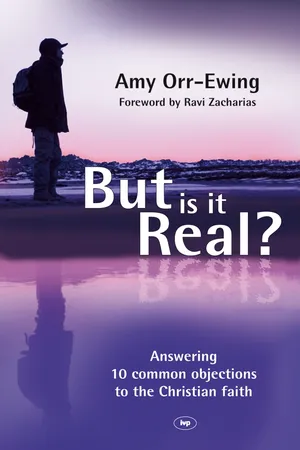
Your relationship with God is just a psychological crutch. Belief in God is dangerous. I used to believe, but I've given it all up. Is God real? Is it possible to know anything, let alone know him? Why do bad things happen to people who worship this God? What about the spiritual experiences of other faiths? All of these accusations, objections and questions have come directly from real-life situations. Amy says, 'I hope that the thoughts offered here will help you see what the Christian faith has to say amid all the pain, confusion and complexity of life.'
- English
- ePUB (mobile friendly)
- Available on iOS & Android
eBook - ePub
About this book
Information
Topic
Theology & ReligionSubtopic
Christianity1. What about other people’s genuine experience of God?
A few years ago, an Oxford student asked if I would come and talk with his friend Jack, who had some questions about Christianity. We arranged a time to meet, and on a grey October Monday afternoon we sheltered from the rain in a coffee shop. At first it was a little awkward – we all knew why we were there, but, being English, we skirted around the subject of God and chatted about the weather, the improving quality of hot drinks in Oxford’s cafés and a number of other trivial subjects.
After a little while, Jack began tentatively to ask questions about Christianity. We talked about the nature of proof, whether science had dispensed with God, and the problem of suffering. It seemed quite difficult to make any progress, because as soon as I answered one question another unrelated issue would be brought up. As I was beginning to wonder whether this was purely an intellectual exercise or a genuine search for answers, I said: ‘I’ve tried to answer all your questions, and I’ve asked quite a few myself. So tell me, what do you feel your most important question is?’
The guy didn’t miss a beat. ‘My Christian friends claim to have a relationship with God and assert that Jesus is the only way to come to God. Isn’t it arrogant, even ridiculous, to nullify the genuine experience of Tibetan monks on the basis of your own experience? How can you say that your experience of God is real and theirs isn’t?’
One of the reasons this question is so powerful is that, at its heart, Christianity really is all about a personal relationship with a living God, and these ideas are in direct contradistinction to the fundamental beliefs of Buddhist monks. If Christianity is primarily about relationship with God through Jesus Christ, what is Buddhism all about? A brief synopsis may be helpful here for those less familiar with Buddhist ideas.
Buddhism
The Buddha (the name means means ‘enlightened one’) was born Siddhartha Gautama in Lumbini (in present-day Nepal) into a wealthy princely family of the Sakya clan. The date of his birth is variously placed between 624 and 448 BC, but the commonly accepted date is 560 BC. Guatama renounced his comfortable life at the age of twenty-nine and lived the life of a travelling sage, seeking out teachers who could instruct him. At the age of thirty-six, during the full-moon night of May, he received what he believed was enlightenment. This happened in Gaya (in present-day India). During the full-moon night of July he delivered his first discourse near Varanasi, introducing the world to the ‘Four Noble Truths’. At the age of eighty, he died, and his death is referred to as Parinibbana, or final release.
The Buddha’s teaching is encapsulated in his Four Noble Truths:
- The noble truth of dukkha (suffering, stress): this word is notoriously difficult to render accurately in English, but it seems to encapsulate the idea that life is fundamentally fraught with suffering and disappointment of every possible description.
- The noble truth of the cause of dukkha: the cause of this suffering and dissatisfaction is tanha (desire) in all its forms.
- The noble truth of the cessation of dukkha: an end to all suffering and dissatisfaction can be found through the abandonment of desire.
- The noble truth of the path leading to the cessation of dukkha: there is a method of achieving the end of all suffering, which is called the Noble Eightfold Path.
To each of these ‘noble truths’ the Buddha assigned a specific task that the follower is to carry out: the first noble truth is to be comprehended; the second is to be abandoned; the third is to be realized; the fourth is to be developed. The full realization of the third noble truth paves the way for nirvana, the transcendent freedom that stands as the final goal of all the Buddha’s teachings.
The Noble Eightfold Path is intended to deliver us from unhappiness and to help us find release, once and for all, from the painful and exhausting cycle of birth and death (samsara). Buddhism teaches that because of our ignorance (avijja) of the Four Noble Truths, we have been bound for countless aeons in this cycle. The Noble Eightfold Path offers a comprehensive practical guide to the development of the qualities and skills in the human heart that need to be cultivated in order to bring the practitioner to the final goal, the supreme freedom and happiness of nirvana. This means total oneness with Brahman – the impersonal Ultimate Reality.
If Buddhism is about the ultimate extinguishing of the individual into the One, Christianity is about a personal God who invites people into relationship with himself. These two rival claims could not be more divergent on this crucial idea of ‘experience’ or the related idea of ‘relationship’. To the Buddhist, human experience is part of the dukkha (suffering), which is dealt with by extinguishing all desire.
Now, this is a difficult idea to grasp, since it appears to be essentially self-contradictory: to want to get rid of desire is itself a desire. However, at its heart Buddhism is a religion guiding its followers through a process, the end aim of which is to lose one’s sense of experience, emotion and even personhood and self to attain oneness with the impersonal One. So, as we come back to the original question, we can see that any talk about Tibetan monks’ ‘experience of God’ is to misconstrue Buddhism entirely.
Christianity
In contrast, the heart of Christianity is God making an appeal of love to the human beings he has created. Through his Son Jesus’ sacrificial death on the cross, all the sin and rubbish that would stand between an ordinary human and a holy God can be forgiven and dealt with. But the offer is more than forgiveness – it is reconciliation. Christians are called ‘children of God’ (see Romans 8:16) because the forgiveness received opens the way for a relationship with this loving God. This relationship is real and is genuinely experienced in the life of the believer. I can no more deny the reality of my relationship with God than I can my relationship with my best friend who lives around the corner. Although I cannot see God, I can know him. This is the testimony of Christians throughout the ages.
There are so many examples of different kinds of people we could draw on to illustrate this. One of these is a man named Chuck Colson. He was an ex-Marine captain and President Nixon’s White House hatchet man, and he ended up going to prison for his part in the Watergate scandal. In the midst of his gripping life story, he talks of his search for God: ‘I guess I’m looking for something...I’m trying to find out what’s real and what isn’t – who we are – who I am in relation to God.’ When he finally committed his life to Christ in December 1973, there were shockwaves in Washington as many suspected a gimmick, but this unlikely convert had truly encountered God through Jesus Christ.
And so early that Friday morning, while I sat alone staring at the sea I love, words I had not been certain I could understand or say fell naturally from my lips: ‘Lord Jesus Christ, I believe You. I accept You. Please come into my life. I commit it to You.’ With these few words that morning, while the briny sea churned, came a sureness of mind that matched the depth of feeling in my heart. There came something more: strength and serenity, a wonderful new assurance about life, a fresh perception of myself and the world around me...I was coming alive to things I’d never seen before; as if God was filling the barren void I’d known for so many months.1
Colson’s life was completely transformed by this, and although he did go to prison for what he had done, he went on to found Prison Fellowship, which works with prisoners around the world, reaching out to those in need. A real encounter with God through Christ is the beginning of a relationship that the believer experiences in a real way. This is what Christianity lived out from day to day is all about.
We can see that Buddhism and Christianity have very different approaches to – and indeed frames of reference for – the very concept of experience, and so it is not surprising that one would seem to negate the other. It is better to be open and honest about this difference than to try to relativize or homogenize all the religions of the world so that they can appear to be the same.
But if the friend I had met in the café had asked about Muslim experience rather than Tibetan monks, wouldn’t the answer have been different? Well, of course, Islam is very different from Buddhism, but it is also fundamentally different from Christianity.
Islam
The doctrine of God within Islam is most significantly encapsulated in the important term tauhid. This word refers to faith in the principle that is at the very heart of Islam: the concept of Allah as one. God is unity itself. A universal Islamic declaration was made at the opening of the International Islamic Conference on 12 April 1980, affirming that the ‘Oneness of Allah (Tauhid) is the foundation of Islam. It affirms that Allah and Allah alone is our Creator, Sustainer, Guide and Lord: that He has no partners: that His will is supreme and encompasses the entire universe; that He is the Law Giver and to Him we must submit and surrender.’2
Islam’s perception of God, as put forward in the Qur’an, is that he is majestic and utterly transcendent. He is awesome and powerful, commanding all that he has made. He is not portrayed as a relational being in his essence, as the trinitarian God of the Bible is.
Within Christianity the statement ‘God is love’ applies to the being of God in distinction from his creation. Before God creates, he is already love; Father, Son and Holy Spirit love one another within the being of God from all eternity. Humans are then created and welcomed into relationship with God. The Islamic God is One; he is portrayed as loving his creatures, but love is not an essential part of his nature, because before he creates, there is no one to love. The Islamic God is primarily transcendent, and secondarily loving, once he has created.
The Qur’an is focused on the idea of submission to this transcendent God rather than personal relationship with him.3 This is not a pejorative statement about Islam, since for Muslims God’s strength and beauty, his ‘otherness’, are key. For the Muslim, the perceived weakness of Christianity is the anthropomorphizing of God (attributing personal, human, qualities to him). This is especially relevant to the idea that God’s love costs him as much as Christianity claims it does; such an idea of God’s love seems to bring shame on God, and for a Muslim that is a travesty. One Muslim author observes:
Beyond their speculations concerning God, the necessity of his existence, and his properties, Muslim theologians and philosophers have apparently felt no need to question the possibility and reality of a human experience of God...It is even difficult to find an appropriate Arabic or Persian expression for ‘experience of God’ without running the risk of encroaching on the absolute transcendence of the God of Islam, of anthropomorphizing him.4
The God of Islam should not be talked about in personal or humanized terms; to do so is to undermine the nature of Muhammad’s perception of the nature of God and to risk misunderstanding the Qur’an entirely.
Neither Buddhism nor Islam has any concept equivalent to the idea of relationship with God, which is at the heart of the Christian message – it is, in fact, unique. This is why Christian testimony – a personal account of one’s relationship with God – underlines the uniqueness of Jesus rather than raising the question: ‘What about other people’s experiences; aren’t they genuine too?’
The differences affirmed here between the approaches of Islam, Buddhism and Christianity on the issue of experience help us to navigate the genuine distinctions and opposing truth claims that do really exist. But underlying my friend’s question at the beginning of this chapter was the basic assumption that these differences are not important – as if all the religions are a melting-pot of skewed ‘faith-based’ views that can be lumped together.
The exception to this paradigm is a secular worldview that is uncritically accepted as being entirely unbiased and neutral in its approach. The Indian Christian apologist Ravi Zacharias helpfully comments that, in our postmodern society, many people like to believe that all the religions are fundamentally the same but just superficially different, whereas in reality they are just superficially similar but fundamentally different. As one poet put it:
We believe there’s something in horoscopes, UFOs and bent spoons; Jesus was a good man just like Buddha, Mohammed and ourselves.We believe he was a good moral teacher but we think His good morals are really bad. We believe that all religions are basically the same, at least the one we read was. They all believe in love and goodness. They only differ on matters of creation, sin, heaven, hell, God and salvation.5
This helpful observation is true of this whole area of experience of God. However, many people in our society believe that to claim that Jesus is uniquely the way to God is somehow shockingly intolerant. If Christian experience is startlingly different and unique when laid alongside comparable alternatives, isn’t it still intolerant and even arrogant to assert that this somehow nullifies the others?
Tolerance
Tolerance of other people’s views is a highly prized virtue in our culture, and when talking about religion it has come to mean accepting that all religions are equally true or untrue. No distinctions can be made. But what does tolerance actually mean? A helpful definition of to tolerate is to ‘allow (something one dislikes or disagrees with) to exist without interference...[or to] patiently endure (something unpleasant)’.6
The important fact here is that tolerance is needed for people who have different opinions. If I agree that your path leads to God as much as mine, I don’t need to be tolerant because we both agree. It is only if I disagree that I need to be tolerant towards another person’s view. Yet Christianity is perceived as being intolerant. After all, isn’t it wrong to say that somebody else is wrong? Of course, the ironic thing is that the person saying that it is wrong to say that someone else is wrong is also saying that Christians are wrong for saying what they believe! Therefore, the crucial question at issue here is not whether Christian belief is tolerant or not, but whether it is true and real.
Arrogance
Another objection to Christian uniqueness is that it is arrogant to say that Jesus is the only way to God. This point is often made using the Indian story of an elephant in the jungle. Different blind scribes come up to the elephant and take hold of the different body parts. One holds the trunk and declares, ‘This is a snake.’ Another holds the leg and says, ‘You are wrong. It is not a snake, it is a tree trunk!’ Still another holds the tail and says, ‘You are both wrong. It is a rope.’ The different individuals represent the religions of the world, and the moral of the story is that no one faith has the whole truth; it would be arrogant to claim it. All have a little piece.
The intriguing thing about this parable is that there are two important differences between the person telling the story and the people inside the story. The first is a difference in perspective: the people inside the story are close up to the elephant, but the storyteller is standing back and has the whole picture.
The second difference is more fundamental: the people inside the story are blind, and the person telling the story can see. The clear implication of this story is that Jesus, Buddha, Krishna, Muhammad and Moses were blind, but the storyteller can see. Who sounds arrogant now? Is it not just as arrogant to claim that you know that all paths lead to God as it is to claim that you agree with Jesus that he is the only way to God?
Thus the real debate is not about who is arrogant or not, but instead about what is actually true and real. The issue on which you reject Christianity should not be its alleged arrogance, since surely it is just as arrogant to say that all paths lead to God as it is to say that none lead there. The question is not whether it is arrogant to say that Jesus is the way to God – but is it actually true? Is it real?
Exclusion
Another motivation or moral force behind questioning the unique truth claim that Jesus makes is that of exclusion. ‘How can you, the Christian, exclude all these religions?’ Again we need to think carefully about this, because the reality is that whatever position we hold, we exclude some views. Even the person who believes that all ways lead to God – which, to be consistent, must include the ideologies of people such as Idi Amin, Pol Pot, Stalin and Osama bin Laden – by that very position excludes the view that only some ways lead to God and the view that only one way leads to God.
In the same way, the average tolerant person with whom we are all friends would probably want to exclude the extreme views of Hitler or Milosovic, and therefore would believe that only some ways lead to God – perhaps the five main world religions. This position excludes the view that all ways lead to God and the view that one way leads to God. And the Christian who wants to say ‘I follow Jesus and he said that he was the only way to the Father’ excludes the view that all ways or that some ways lead to God. Every view excludes some, so the key issue at stake is not who is excluding people, but what is actually true and real.
No matter how hard you try, you can’t escape the fact that one truth claim will always exclude some possibilities.
- The person who says that all ways to God are true excludes the possibility that only one way is true or that only some ways are true.
- The person who says that some ways to God are true excludes the possibility that only one way is true or that all ways to God are true.
- The person who says that only one way to God is true then also excludes others.
All views exclude, and so it seems a little unreasonable to single out Christianity and reject it on the basis that it excludes.
Sometimes the objection to Christianity as ‘the truth’ may be phrased as a common generalization: ‘All truth is relative’ – except that statement itself, of course. Roger Scruton, research professor ...
Table of contents
- But is it real?
- Contents
- Acknowledgments
- Foreword
- Introduction
- 1. What about other people’s genuine experience of God?
- 2. Your ‘experience of God’ is delusional, not real
- 3. Your relationship with God is just a psychological crutch
- 4. How can you say you have found the truth if you haven’t tried all the alternatives?
- 5. If Christianity is about A relationship with God, why does he let bad things happen to his friends?
- 6. If Christianity is about a transforming relationship with God, why are Christians so bad?
- 7. If God is so loving and relational, why did he go ahead and create when he knew people would end up in hell?
- 8. Belief in God is dangerous
- 9. I used to believe, but I’ve given it all up
- 10. How can I know?
- Notes
Trusted by 375,005 students
Access to over 1.5 million titles for a fair monthly price.
Study more efficiently using our study tools.
Frequently asked questions
Yes, you can cancel anytime from the Subscription tab in your account settings on the Perlego website. Your subscription will stay active until the end of your current billing period. Learn how to cancel your subscription
No, books cannot be downloaded as external files, such as PDFs, for use outside of Perlego. However, you can download books within the Perlego app for offline reading on mobile or tablet. Learn how to download books offline
Perlego offers two plans: Essential and Complete
- Essential is ideal for learners and professionals who enjoy exploring a wide range of subjects. Access the Essential Library with 800,000+ trusted titles and best-sellers across business, personal growth, and the humanities. Includes unlimited reading time and Standard Read Aloud voice.
- Complete: Perfect for advanced learners and researchers needing full, unrestricted access. Unlock 1.5M+ books across hundreds of subjects, including academic and specialized titles. The Complete Plan also includes advanced features like Premium Read Aloud and Research Assistant.
We are an online textbook subscription service, where you can get access to an entire online library for less than the price of a single book per month. With over 1.5 million books across 990+ topics, we’ve got you covered! Learn about our mission
Look out for the read-aloud symbol on your next book to see if you can listen to it. The read-aloud tool reads text aloud for you, highlighting the text as it is being read. You can pause it, speed it up and slow it down. Learn more about Read Aloud
Yes! You can use the Perlego app on both iOS and Android devices to read anytime, anywhere — even offline. Perfect for commutes or when you’re on the go.
Please note we cannot support devices running on iOS 13 and Android 7 or earlier. Learn more about using the app
Please note we cannot support devices running on iOS 13 and Android 7 or earlier. Learn more about using the app
Yes, you can access But Is It Real? by Amy Orr-Ewing in PDF and/or ePUB format, as well as other popular books in Theology & Religion & Christianity. We have over 1.5 million books available in our catalogue for you to explore.