The crucifixion of Jesus: dreadful mistake? Tragic failure? Irrelevant? Absurd? An embarrassment?
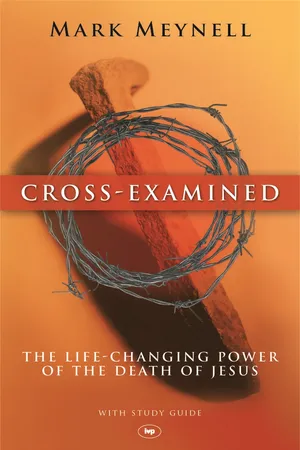
The cross of Christ is, in fact, at the centre of God's plan for men and women. 'Cross examined' explains why.
Using a wealth of illustration, Mark Meynell looks with freshness and clarity at the Bible's teaching, to show how God himself 'cross-examines' us in the death of Jesus.
At the cross, God exposes our deepest need, meets it fully and enables us to live transformed lives.
- English
- ePUB (mobile friendly)
- Available on iOS & Android
eBook - ePub
About this book
Information
Subtopic
Théologie chrétienne
Part 1. Cross-examined
1. In the dock
Please read John 18
God on trial
Time slows down in the middle of the night. When you cannot get to sleep, the ticks of the alarm clock seem to get louder, and the minutes feel like hours. The more you long for sleep, the more awake you feel and, whether you like it or not, you have extra thinking-time on your hands. Those fears, regrets and doubts, which remain at the back of the mind during the day, come to the fore in the restlessness of an unsettled night. Perhaps it was an unkind word here, or a missed opportunity there. Perhaps it is the dread of an imminent exam, or the real sense of regret at a failed relationship.
Doubts and fears can then quickly give way to big questions. Perhaps the most common are ‘Why?’ or ‘How could you?’ They are vital questions, but awkward. They can apply both to deeply personal situations and to issues that affect the whole world; and it is very often God who ends up being the defendant in our imaginary courtroom. Charges range from the private (‘If he is there, why does he seem so remote? He never answered my prayers when I needed him most. He never looks after me!’) to the global (‘How can a world tormented by pain, injustice and evil be compatible with belief in the God of the Bible? Isn’t he meant to be powerful and good? So how could he permit nationwide ethnic cleansing? How can he claim to be powerful and good?’) The singer Robbie Williams found himself confronted by these sorts of questions on his trip to flood-ravaged Mozambique as a UNICEF ambassador. In a subsequent interview, he said, ‘You come here and you say, “Where’s their God, where’s their God, why? Why has that happened? Why were they born here, why do they have a flood and why do they have another flood?” ’1
Even if you are a convinced Christian, you cannot deny that these questions are formidable. Being a Christian does not provide immunity from such doubts, and glib answers to those questions will never do. Irving Greenberg, a writer on the Holocaust, commented on the issue of the existence of God in a suffering world in these shocking terms: ‘No statement, theological or otherwise, should be made that would not be credible in the presence of burning children.’2 That is a horrific thought, yet is one which tragedies like the Holocaust will not let us dismiss. After the uniquely bloody twentieth century, the charges against God seem impregnable. Is there anything credible that can be said? Is it any wonder that the century that has witnessed more suffering than any other has also seen the most hostility to belief in a good, creator God? Whether people spend their nights wrestling with the problem or not, many construct their own challenge to such a God. If he is there, they want answers.
There are biblical precedents for this, of course. The writer of the Psalms could be ruthlessly honest about the doubts and questions he wanted God to address (read, for example, Psalms 22, 55 and 142). He endured many a sleepless night. Then there was Job, who suffered such intolerable hardship that he experienced a major crisis of faith (read, for example, Job 23 – 24). Nevertheless, despite their doubts, both Job and the psalmist managed to persist in their trust in God. Job, for one, even received a revitalizing vision, described at the end of the book (Job 38 – 42). It did not provide him with easy answers, nor leave him unchallenged, but it did vindicate his persistent trust in God. Job was convinced that although many of his questions remain unresolved, God was still good.
These precedents indicate that questioning God may not in itself be wrong. They also indicate that trusting God despite terrible circumstances is not impossible. How this might be we will go on to explore. However, before we proceed, we must be conscious of our motives when we bring our questions to God, because they may not be as innocent as we might think. C. S. Lewis deliberately confronts us with the step we are taking:
The ancient man approached God (or even the gods) as the accused person approaches his judge. For the modern man the roles are reversed. He is the judge: God is in the dock. He is quite a kindly judge: if God should have a reasonable defence for being the god who permits war, poverty and disease, he is ready to listen to it. The trial may even end in God’s acquittal. But the important thing is that man is on the bench and God in the dock.3
That is a significant development, and one which at the very least should cause us to proceed with caution.
A king on trial
Lewis describes a relatively modern phenomenon, but the New Testament does contain an ancient ‘divine trial’. Like so many of our imaginary trials, this one happened in the middle of the night nearly 2,000 years ago. This was no figment of a fevered imagination, however. It occurred on a very cold night, such that those who were awake struggled to keep warm by huddling around dying fires. The air was heavy with betrayal and conspiracy. An essential difference between Job’s story and this one lies in the fact that very few, if any, of those who conducted the trial realized the true identity of the defendant. He claimed to be King of the Jews, but his interrogators gave very little credence, if any, to the possibility that this might actually be true. They were unwaveringly hostile and determined to eliminate him. Summary execution would have been preferable, but was impossible; as citizens of a subject nation, the Jewish leaders were forced to resort to conspiring with the Roman authorities to achieve their ends.
Jesus of Nazareth was on trial for his life. He had been adored and vilified in almost equal measure. Surely, if he really had been God’s king, trial and execution at the hands of human beings would be inconceivable, wouldn’t it? What a ridiculous idea! That in itself merely confirmed the Jewish leaders’ conviction that he was not who he claimed to be. The great kings of Israel had, of course, been through some difficult situations over the centuries, but none of them had ever endured the ignominy of impeachment proceedings. Jesus couldn’t possibly be who he claimed to be; so they no doubt felt safe. Not only that; they felt it was their religious duty to do away with this peasant rabblerouser and ludicrous royal pretender.
During that eventful night, however, something extraordinary happened. All four Gospel-writers describe it, but perhaps none more vividly than John. In John 18, we travel from Jesus’ arrest in the garden of Gethsemane to his various trials before the Jewish and Roman authorities. Interlaced is the story of Peter’s denials of Jesus, which added to the sense of Jesus’ isolation. Be alert to what is happening throughout the account. While the action quickly shifts from the high priest’s house to the Roman governor’s palace, the constant question behind John’s account of the trials is, ‘Who is really in control here?’
First is Annas (John 18:12–14). He had been the high priest until the Roman authorities deposed him, but he still wielded significant influence in Jerusalem. Several members of his family had actually succeeded him. Intriguingly, John here seems more interested in Annas’s son-in-law, Caiaphas, who was the current incumbent as high priest. He writes, ‘Caiaphas was the one who had advised the Jews that it would be good if one man died for the people’ (John 18:14). That detail is not given merely for identification purposes, since there could be little doubt as to who was in mind. Instead, John mentions it specifically to recall Caiaphas’s remark in the Jewish council, the Sanhedrin.4 Dripping with unconscious irony, Caiaphas had then appealed to Jewish political expediency. His gist was that it would be far better to get rid of just one troublemaker than to give the Romans further grounds for destroying the whole Jewish way of life. Jesus should die for the sake of the nation. Caiaphas, of course, had no idea how close he was to the truth. John saw it, and he wants his readers to see it. Jesus was indeed to die for a purpose – but it was to be for the eternal benefit of all people. Without the slightest appreciation of that fact, Caiaphas was absolutely right. As we shall come to understand, someone as well versed in the Jewish Scriptures as the high priest should have anticipated Jesus’ mission.
After Peter’s first denial, Jesus’ first interrogation got under way (John 18:19–24). The previous verses inform us that it was night. That in itself casts doubt on the legitimacy of the proceedings of Jesus’ trial. They were technically illegal if not held during the day,5 but that was not the only irregularity. It is probable that in contemporary Jewish law it was also illegal to put questions to a defendant at all, since the ‘case had to rest on the weight of the testimony of witnesses’.6 Because control over the proceedings lay in the hands of his opponents, the deck was hopelessly stacked against Jesus. He was a mere carpenter without a legal qualification to his name, and Caiaphas and the Sanhedrin knew what they were doing. What chance did Jesus have against those who could simply rewrite the rules? Nevertheless, Jesus was composed, a fact that forces us to keep asking, ‘Who is really in control here?’
In reply to the first questions Jesus had nothing to hide about his activities. Notice how he came back at his accusers: ‘Why question me? Ask those who heard me. Surely they know what I said’ (John 18:21). Not only was Jesus secure in his innocence, but he also had the confidence to challenge his accusers directly. If we are correct in thinking that it really was illegal to question defendants in Jesus’ time, then it should have been members of his audience answering the charges, not Jesus. He had a point. No wonder this challenge brought Jesus a violent blow to the face. Again he was not deterred: ‘If I said something wrong...testify as to what is wrong. But if I spoke the truth, why did you strike me?’ (John 18:23). Jesus was calm and level-headed. He was the one dominating the scene, not Caiaphas.
Before we can fully understand what actually occurred that night, however, we need to move on to Jesus’ encounter with the Roman governor, Pontius Pilate. Pilate had an unenviable task. Violence and cruelty were second nature to him, but that did not prevent him feeling torn when confronted by Jesus. He was clearly suspicious of the charges brought against him, so he put the crucial question directly to the defendant: ‘Are you the king of the Jews?’ (John 18:33). Yet again, Jesus replied with a question: ‘Is that your own idea...or did others talk to you about me?’ (John 18:34). Pilate was indignant and impatient: ‘Am I a Jew?’ (John 18:35). From his point of view, Jesus was a parochial Jewish problem. It hardly concerned him. Jesus was not Pilate’s king. That really would be a preposterous idea...
Jesus explained that his kingship was of a different order. He was no revolutionary Che Guevara, no imperialistic Alexander the Great, no tyrannical Caesar. This king sits on an eternal and divine throne. His authority far exceeds that of any human monarch: ‘My kingdom is not of this world. If it were, my servants would fight to prevent my arrest by the Jews. But now my kingdom is from another place’ (John 18:36). Pilate grasped very little of what Jesus was talking about. He was simply fishing for a clear-cut admission of a claim to the Jewish throne – that would at least give some grounds for accepting the charges against Jesus. Pilate did eventually get what he was after, but it was not in quite the straightforward way he would have wanted: ‘You are right in saying I am a king. In fact, for this reason I was born, and for this I came into the world, to testify to the truth. Everyone on the side of truth listens to me’ (John 18:37).
Do you notice the tremendous challenge to Pilate there? It is as if Jesus was replying to Pilate’s subconscious thoughts: ‘Yes, I am your king. If you were on the side of truth, you would accept that.’ Implicitly, Jesus was throwing down the gauntlet: ‘Are you on the side of truth?’ The man in the dock has issued an invitation to his prosecutor. It is an invitation to be aligned with the truth, and so to become subject to this other-worldly king. Superficially, it seems a forlorn and hollow boast, coming as it did from a man on death row with nothing to lose. Jesus here seemed easy to dismiss, and a dismissal was what he received. ‘What is truth?’ was Pilate’s impatient retort (John 18:38).
Was Pilate merely trying to avoid an answer? Or did he genuinely struggle with the existence of objective truth? We shall never know; the conversation ends abruptly with that momentous question. Pilate walked out to give the Jewish leaders his preliminary thoughts. He was initially unable to justify the death penalty, and yet he could see no political alternative to the unjust demands of the Sanhedrin. His struggle between conscience and expediency gave him a restless night of his own. The one who had seemed easy to dismiss was in fact far too compelling. Nevertheless, the fact that his struggle did not stop him executing an innocent man demonstrates that he was not on the side of what he knew to be true. The Roman governor with power over life and death was humiliated by the God-sent king who reveals what is true. Pilate left the gauntlet where it fell.
Prosecution or defence?
Jesus’ trials have mystified and provoked readers for centuries. We witness a man at the height of his powers and in full control of himself. Not only that; he seemed in full control of the predicament he was in. Despite this, Jesus made no effort to protect himself. He even restrained his uncomprehending disciples. To top it all, the defence he gave at his trial was nothing if not highly provocative. No right-minded barrister would ever recommend that tactic. To prosecute the judge when he should have been pleading for his life was sheer lunacy! He should have settled for answering the questions, rather than firing them back. It gives the impression that his deliberate plan was to die on the cross...
What appears to have been folly was no such thing, however. Jesus’ trial actually demonstrates a vital reality. When we put God in the dock, however justified the charges against him might seem, we quickly find that we have searching questions to answer for ourselves. Both Job and Pilate discovered that fact in their different ways, but only one was on the side of truth; only one accepted God’s right to do this. Now, technically, a cross-examination in a court of law occurs when a defendant or witness is questioned by an opposing barrister about statements already made. It is a necessary process to verify the soundness of their testimony. However, when God is placed in the dock, there is a cross-examination with a difference. I, the prosecutor, find the tables turned as I seek to challenge God’s defence. God, the defendant, has questions to put to me.
We shall discover the same unsettling phenomenon as we explore what happened at the cross. As far as the Bible is concerned, that event is the supreme achievement of God’s activity in the world. It was always part of his plan to send Jesus to die there, and Jesus himself deliberately set out on the road to the cross. Astonishingly, it is only through examining the cross that credible answers to so many of the accusations hurled at God can be found. It acts as God’s final statement of defence to a suffering world. The one we seek to prosecute answers the charges against himself perfectly. He has nothing to hide. However, as we examine his ‘defence’, we ourselves are forced on to the defensive. God the accused issues his own challenge. He performs an acutely personal cross-examination of each of us: ‘Whose side are you on? Are you ready to accept the verdict of the truth? Will you submit to the king who reveals that truth?’ This means that grappling with the cross will never be a light matter, even if that is something we have done many times before. It will always be challenging. So if that is a challenge you are prepared to face, then read on!
Summary
- When we consider the sufferings and injustices of our world, God is very often the one from whom we demand answers.
- While many of these questions are entirely justified, however, we cannot escape our own answerability to God.
- As we shall see, the cross of Jesus is where we are faced with both of these issues: there we find both God’s answer to a suffering world and our own answerability to God.
2. ‘You can’t believe that, can you?’
Please read 1 Corinthians 1:18–25
A symbol that invites ridicule
For many, belief in the God of the Bible seems wishful thinking at best, an obscenity at worst. On more than one occasion, people have said to me, ‘You can’t honestly expect me to believe all that stuff, can you?’ Combine that understandable incredulity with the central premise of Christianity, namely, that the one we worship was executed on a cross, and it all seems absurd. Our overfamiliarity with the universal Christian symbol of the cross blinds us to its horror. As comedian Bill Hicks once pointed out with reference to President John F. Kennedy’s assassination from a Dallas book depository, ‘People who think JFK was a hero don’t wear a shotgun on their lapel.’1
Consider it once more. On the cross Jesus died. He is the one in whom the hope of every Christian is invested. He is the one who apparently has equality with God, who apparently reveals what God is like, who apparently enables us to know God. Yet he died! On a cross! That wraps up those claims once and for all, surely? ‘You can’t honestly expect me to believe that, can you?’ God’s anticipated robust defence to humanity’s prosecution never seemed to get off the ground. ‘If that’s all he can come up with, then there’s no point giving him another moment’s thought.’
P. D. James is a writer renowned for her intricate and thought-provoking detective novels, but one book has a very different theme. The Children of Men describes the world twenty-one years after it has suffered a global pandemic of human infertility. No children have been born anywhere on the planet, and the human race is simply awaiting extinction. England, in common with many other parts of the world, is living under the shadow of dictatorship, but that does not seem to matter to most people. The only important thing for them is dulling their agony through a full immersion in pleasure. Consequently, the book is a parable for our self-indulgent world, and there are many unnerving parallels with our own culture. One of the most striking observations is what happens to religious belief. The narrator describes the renowned preacher of a recently devised religion, one Rosie McClure: ‘Rosie...has virtually abolished the Second Person of the Trinity together with His cross, substituting a golden orb of the sun in glory, like a garish Victorian pub sign. The change was immediately popular. Even to unbelievers like myself, the cross, the stigma of the barbarism of officialdom and of man’s ineluctable cruelty, has never been a comfortable symbol.’2
The narrator pinpoints the problem precisely. No marketing executive would ever choose the cross for a new corporate logo. How can an ancient instrument of institutional torture and execution possibly be God’s answer to a suffering world? What good could it possibly achieve? It is ridiculous. More than that, it is obscene.
Where, then, do we begin in our response to these reasonable and valid questions?
A death that demands interpretation
In apartheid South Africa, township vigilantes used to reserve their most horrific punishment for those they regarded as traitors. Their kangaroo courts aimed both to execute culprits and to terrify potential traitors. ‘Rubber neck...
Table of contents
- Cross-examined
- Contents
- Preface
- Part 1. Cross-examined
- Part 2. Hard to accept, but hard to hide
- Part 3. Messiah: God’s gift
- Part 4. Raised to life: so live it!
- Study guide
Trusted by 375,005 students
Access to over 1.5 million titles for a fair monthly price.
Study more efficiently using our study tools.
Frequently asked questions
Yes, you can cancel anytime from the Subscription tab in your account settings on the Perlego website. Your subscription will stay active until the end of your current billing period. Learn how to cancel your subscription
No, books cannot be downloaded as external files, such as PDFs, for use outside of Perlego. However, you can download books within the Perlego app for offline reading on mobile or tablet. Learn how to download books offline
Perlego offers two plans: Essential and Complete
- Essential is ideal for learners and professionals who enjoy exploring a wide range of subjects. Access the Essential Library with 800,000+ trusted titles and best-sellers across business, personal growth, and the humanities. Includes unlimited reading time and Standard Read Aloud voice.
- Complete: Perfect for advanced learners and researchers needing full, unrestricted access. Unlock 1.5M+ books across hundreds of subjects, including academic and specialized titles. The Complete Plan also includes advanced features like Premium Read Aloud and Research Assistant.
We are an online textbook subscription service, where you can get access to an entire online library for less than the price of a single book per month. With over 1.5 million books across 990+ topics, we’ve got you covered! Learn about our mission
Look out for the read-aloud symbol on your next book to see if you can listen to it. The read-aloud tool reads text aloud for you, highlighting the text as it is being read. You can pause it, speed it up and slow it down. Learn more about Read Aloud
Yes! You can use the Perlego app on both iOS and Android devices to read anytime, anywhere — even offline. Perfect for commutes or when you’re on the go.
Please note we cannot support devices running on iOS 13 and Android 7 or earlier. Learn more about using the app
Please note we cannot support devices running on iOS 13 and Android 7 or earlier. Learn more about using the app
Yes, you can access Cross-Examined by Mark Meynell in PDF and/or ePUB format, as well as other popular books in Théologie et religion & Théologie chrétienne. We have over 1.5 million books available in our catalogue for you to explore.