Lord I believe! Help my unbelief!' (Mark 9: 24) perfectly captures the anxiety of many Christians. They have discovered in Jesus Christ something far more wonderful than they had ever dared to hope for. God seemed very close in their early days of faith. Yet nagging doubts persist.
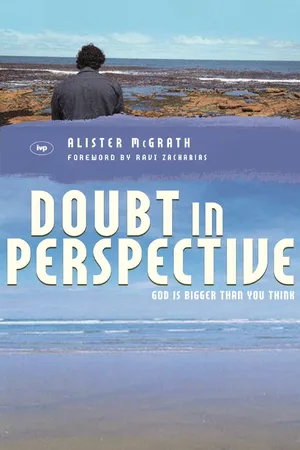
'Doubt in Perspective' addresses specific doubts that Christians experience, particularly within our postmodern culture. The account of the origins of doubt will help us to understand why they continue to trouble so many people. McGrath's perceptive account of the origins of doubt will help many to understand why they continue to trouble so many people. His powerful argument that all world-views, including atheism, ultimately involve unprovable beliefs is of especial importance in understanding doubt as a universal problem, not limited to Christians.
Arguing that doubt can be seen positively, as an invitation to grow in faith and understanding, the author moves on to deal with common doubts, including doubts about the gospel, God and Jesus Christ. In each case he offers helpful and persuasive responses, from both a pastoral and theological perspective.
This sensitive and accessible book is written in an engaging style, with many helpful, practical suggestions. Authored by a former atheist who is now one of Christianity's leading writers, it is a vital resource for any Christian plagued by doubt or wanting to help doubting friends.
- English
- ePUB (mobile friendly)
- Available on iOS & Android
eBook - ePub
Doubt in Perspective
About this book
Information
Topic
Teologia e religioneSubtopic
Cristianesimo1
Doubt: what it is – and what it isn’t
It’s surprising how many Christians prefer not to talk about doubt. Some even refuse to think about it. Somehow, admitting to doubt seems to amount to insulting God, calling his integrity into question. It is quite understandable that you should feel this way about doubt: on the one hand, you may feel that admitting to doubt is a sign of spiritual or intellectual weakness; on the other, you may be reluctant to admit those doubts to your friends, in case you upset them, perhaps damaging their own faith.
Many Christians thus suppress their doubts. They feel it is improper to own up to them. Or they are afraid they will look stupid if they do. Maybe they are worried their pride or self-esteem would suffer. Yet one of the reasons why so many Christians have difficulty in coping with doubt is that they confuse it with two quite separate ideas, which at first seem similar, but are actually rather different.
In the first place, doubt is not scepticism – the decision to doubt everything deliberately, as a matter of principle.
In the second, it’s not unbelief – the decision not to have faith in God. Unbelief is an act of will, rather than a difficulty in understanding.
Doubt often means asking questions or voicing uncertainties from the standpoint of faith. You believe – but you have difficulties with that faith, or are worried about it in some way. Faith and doubt aren’t mutually exclusive – but faith and unbelief are.
Doubt is probably a permanent feature of the Christian life. It’s like some kind of spiritual growing pain. Sometimes, it recedes into the background; at other times, it comes to the forefront, making its presence felt with a vengeance. A medical practitioner I knew once remarked that life was a permanent battle against all sorts of diseases, with good health being little more than an ability to keep disease at bay. For some people, the life of faith often seems like that – a permanent battle against doubt. It is helpful to think of doubt as a symptom of our human frailty, of our reluctance to trust God. Let’s develop this by thinking about how people come to faith.
Coming to faith – with unresolved doubts
One way of understanding conversion runs like this. What stops people from coming to faith in God is doubt. After wrestling with these various doubts and overcoming them, the way is clear to come to faith. Coming to faith thus happens once all doubt has been cleared out of the way. Faith excludes doubt! Now it is quite possible that some people do come to faith this way. However, most do not. Experience suggests that a rather different way of understanding conversion is more reliable.
Many people feel deeply attracted by the gospel, despite their doubts. On the one hand, their doubts are real, and hold them back from faith; on the other, the pull of the gospel is strong, and draws them towards faith. In the end, they decide to put their trust in God and in Jesus Christ, despite unresolved anxieties and difficulties. They are still in two minds. They hope their doubts and difficulties will be sorted out as they grow in faith. The seventeenth-century philosopher Francis Bacon commended this way in his Advancement of Learning (1605): ‘If a man will begin with certainties, he will end in doubts; but if he is content to begin with doubts, he will end in certainties.’
An analogy may make this clearer. Suppose you are at a really boring party one evening, when you meet someone you feel drawn to. You get to know this person, and, as time goes on, realize you’re falling in love. However, you hold back from allowing the relationship to develop any further. After all, you don’t really know the other person that well. There might be some dark side to their character. Can you really trust them? And, like many people, you may have a sense of personal inadequacy: what, you wonder, could this other person possibly see in you? Could they ever possibly fall in love with you? You are profoundly attracted to them, yet you hold back. You have doubts. You’re in two minds about it.
Now in this situation, you have two options. You can still hold back, and become a prisoner of your doubts and hesitations. If we all did that all the time, we’d miss out on many of life’s great adventures and surprises – including both falling in love and discovering the Christian faith. Or you can take a risk. You can say, ‘I’m going to give this a try, and hope that my doubts and anxieties will be resolved as things go on.’ And so you allow the relationship to develop.
Many people become Christians in that kind of spirit. They are aware of the enormous attraction of the gospel; they are deeply moved by the thought of Jesus Christ dying for their sins; they are excited by the great gospel promises of forgiveness and newness of life. Or they have experienced glimpses of transcendence, and just know there is a God out there. They decide to reach out in faith, and claim these as their own. As for their doubts and anxieties? They hope they will be resolved and put in their proper perspective as their relationship with God develops. ‘I believe; help my unbelief!’ (Mark 9:24).
If you’re in this situation, wrestling with doubt will be an important part of your life as a Christian. The way in which you came to faith sets an agenda for you. It decides what things need to be sorted out. You’ll want to think about the same kind of questions that arise in any personal relationship. Can I really trust God? Does he really love me? What about my personal inadequacies – does he know what I’m really like? And there may be other doubts about the gospel, about yourself, about Jesus Christ, and about God himself. This book aims to deal with that agenda. But your doubts in no way invalidate your conversion experience – you really are a Christian!
Doubt – a reminder of human sinfulness and frailty
If we are going to set doubt in perspective, we need to see ourselves in the right perspective first. Above all, we need to appreciate the limits set on what we can know. We are finite, sinful human beings. And that limits what we can be sure about. In this section, we shall explore this theme in some detail.
The gospel is about redemption – about the transformation made possible by Christ, through the Spirit. We have been set free from sin through the death and resurrection of Jesus Christ. Redemption, however, is not something that can be achieved in an instant! The story is told of a little girl who asked a bishop whether he was saved. ‘I have been saved from the penalty of sin, I am being saved from the power of sin, and one day I shall be saved from the presence of sin,’ he replied. Salvation takes time! It is a process, in which we mature in faith, like a seed growing into a plant.
In classic evangelical thought, a useful distinction is made between justification and sanctification. In justification, we are declared to be right with God; our status changes, as we become an adopted child of God; we are given the gift of the Holy Spirit as a surety or pledge of being a Christian. Sanctification, however, is a long process, in which we are gradually conformed to the likeness of Christ. It cannot happen overnight. The fact that it takes so long doesn’t point to any failing on God’s part, but indicates how deeply rooted sin is within us.
Martin Luther used a phrase that is very helpful here. He talked of the Christian as being ‘righteous and sinful at one and the same time’. By this, Luther meant that Christians are righteous (in that they stand in a right relationship with God) but are still sinful (in that sin has yet to be completely eradicated from our nature). To use a military analogy, the decisive victory over sin has been achieved with your conversion; nevertheless, mopping up operations must continue, as isolated pockets of resistance are overcome. Sin may have been defeated in our lives; nevertheless, it remains a lingering presence. We are deluding ourselves if we pretend we have no sin (1 John 1:8; 2:1). Ignoring sin, or pretending it’s not there, points to an inadequate understanding of the seriousness of human sinfulness. For Paul, grace and sin are like two powers, battling it out within us. We know what the final outcome of that battle will be – but while it lasts, we cannot ignore its effects. One of them is doubt.
Doubt reflects the continued presence and power of sin within us, reminding us of our need for grace and preventing us from becoming complacent about our relationship with God. We are all sinners, and we all suffer from doubt, to a greater or lesser extent. Our relationship with God is something we need to work at, conscious that in doing so, we are working with God and not on our own (Philippians 2:12–13). Sin causes us to challenge the promises of God, to mistrust him. (Note how mistrust of God is the ‘original sin’ of Genesis 3:1–5.) Only by causing us to turn away from God can sin regain its hold over us. Faith is not just a willingness and ability to trust in God – it is the channel through which God’s grace flows to us. It is our lifeline to God. It is like the trunk of a tree, transferring life-giving sap from its roots to its branches – it both supports and nourishes their growth. Break that link, and the branches wither (cf. John 15:1–8). If sin has any strategy after your conversion, it is to break that link, destroy your faith and deny you access to the promises and power of God – and to allow itself to regain its former hold over your life.
Doubt, then, needs to be seen in its proper context – that of our struggle against sin (Hebrew 12:4). It is an integral part of the process of growing in faith and encountering resistance from our old natures in doing so.
Yet there is more to it than this. It is not entirely correct to describe doubt as simply due to human sinfulness. It is also a reflection of human frailty. We are human beings – and, quite frankly, this means we operate under limits. There are many things we cannot do, and many we cannot see, simply because we are human, not divine. We’re like grasshoppers, trying to make sense of a vast universe (Isaiah 40:22). We’re so small: how can we ever hope to make sense of something so immense? How can our tiny minds take in something so vast? That’s why the idea of revelation, God revealing himself, is so important. If we were left to find out about God by using our own limited resources, we wouldn’t get very far. And God comes to our aid, by making himself known. He takes the initiative.
The severe limitations placed upon human capacities by the fact that we are creatures, not God, has been a major theme of Christian theology down the centuries. God is bigger than we think – and our minds struggle even to begin to wrestle with him. Protesting against slick and too-easy notions of God in the fifth century, Augustine wrote of the inability of the human mind to comprehend God fully. If you can comprehend it, he remarked, it’s not God. To comprehend is to grasp something in its totality. But what if it is too great, too deep, for us to do this? What if we are confronted with the deepest of oceans, and we can only skim its surface? If we cannot see something in its totality, we are not going to be able to make complete sense of it.
There is a story about Augustine worth telling here. Augustine is particularly remembered for a massive treatise he wrote on the mystery of the Trinity – the distinctively Christian understanding of the richly textured nature of God. Perhaps in the midst of writing this book, Augustine found himself pacing the Mediterranean shoreline of his native North Africa, not far from the great city of Carthage. While wandering across the sand, he noticed a small boy scooping seawater into his hands, and pouring as much as his small hands could hold into a hole he had earlier hollowed in the sand. Puzzled, Augustine watched as the lad repeated his action again and again.
Eventually, his curiosity got the better of him. What, he asked the boy, did he think he was doing? The reply probably perplexed him still further. The boy informed him that he was in the process of emptying the ocean into the small cavity he had scooped out in the hot sand. Augustine laughed. How could such a vast body of water be contained in such a small hole? But the boy shot back his reply: how could Augustine expect to contain the vast mystery of God in the mere words of a book?
The story illuminates one of the central themes of Christian theology and spirituality alike – that there are limits placed upon the human ability to grasp the things of God. And because we can’t fully grasp something, we sometimes doubt whether it is true. We misinterpret our inability to understand something as a sign that it is not true, or not real. In reality, the situation is very different. We are confronted with many things in the world – including the Christian gospel – which are just too big for our minds to embrace. And we have to learn to live with that tension – not doubting, but trusting.
Thomas Aquinas, writing in the thirteenth century, stressed that God was obliged to speak to us using images and analogies. Why? On account of the weakness of our intellects. Our minds aren’t big enough to comprehend God. We cannot fully understand God and his ways: as a result, God reveals himself partially (but accurately and adequately), up to the limits of our abilities. This reflects a limitation on our part, not God’s.
John Calvin, writing in the sixteenth century, set out a principle that is helpful here: ‘God accommodates himself to our weakness.’ In other words, God knows our limitations, and adapts himself accordingly. We cannot see the full picture, so God presents us with a reliable guide to its contents, hitting the high points. No more is possible, given the limitations placed upon us. Of course we have difficulties in trying to understand God and the world – but this doesn’t mean our faith is misplaced!
An example of how the limitation of being human affects the way we see things may help make this point clearer. Suppose you want to see the stars, or catch a glimpse of the Milky Way. You can’t do this in broad daylight. You have to wait until it’s dark. Now the stars are still there during the day: it’s just that you can’t see them. Our eyes just aren’t discerning enough to pick up their light during the day. When it’s night, our eyes adjust to allow us to see their tiny pinpoints of light, coming from the depths of our universe, highlighted against the blackness of the night. The stars don’t need darkness to exist – but we need darkness if we are to see them, and convince ourselves they are still there!
So it is with God. Just as our eyes can’t see stars during the day, so our minds can’t take in the fullness of God. It’s the way we see things, rather than the way things actually are, which is the problem here. (Or, to use the technical language of philosophy for a moment, the issue is noetic, not ontic.) Being human places limits on what we can see, know and understand.
We need to understand what those limits are. Because in the end, doubt arises partly on account of our unrealistic expectations about certainty. We think we ought to be able to prove with absolute certainty that certain things are true – for example, that God exists. But it’s just not like that. Being prepared to accept our limitations is an essential part of growing in faith. There’s a paradox here: it’s only when we use our reason that we begin to appreciate its limits. The great French writer and philosopher Pascal put this rather well: ‘Reason’s final step is to realize that there are an infinite number of things which lie beyond it. It is simply feeble if it doesn’t get as far as realizing that.’
This principle applies to just about everything, and not just to religious beliefs. In 1932 Albert Einstein wrote a letter to Queen Elizabeth of Belgium, in which he commented, ‘As a human being one has been endowed with intelligence to be able to see clearly how utterly inadequate that intelligence is when confronted with what exists.’ The point Einstein made is critically important. The world is something of a mystery, and the fact that we can make any kind of sense of it is something of a miracle. And there are limits to what we can understand, just as there are limits to what we can prove. And in such situations, we have to trust that we can get things more or less right.
It is only natural that we should want to see and know more. But that’s like wanting to see stars in the daytime. It’s overlooking our limitations. It’s like saying, ‘Because I can’t see the stars in the daylight, they’re not really there.’ That’s confusing our perception of the situation with the reality of that situation. The way we see things isn’t necessarily the way things really are.
Doubt often reflects a sense of unease about the way in which experience, reason, feeling and faith relate. Sometimes they seem to be out of step with each other – so which do we believe? Which is right? The central insight here is that our frailty and weakness prevent us from fully comprehending the way in which these things relate to each other. As George MacDonald once pointed out, ‘everything difficult indicates something more than our theory of life yet embraces’. Faith assures us that, though we do not see the picture totally, we nevertheless see it reliably (1 Corinthians 13:12).
Yet many want more than this. They long for total certainty, for absolute peace of mind. Surely we can hope for such reassurance, here and now? In the next chapter, we shall explore the implications of this deep-seated human craving for certainty.
2
Doubt and the futile search for certainty
Deep within all of us lies a longing for absolute security, to be able to know with total certainty. We feel we should be completely sure of everything we believe.
Yet absolute certainty is actually reserved for a very small class of beliefs. What sorts of beliefs? Well, for example, things that are self-evident or capable of being logically demonstrated by propositions. Christianity doesn’t concern logical propositions or self-evident truths (such as ‘2 + 2 = 4’, or ‘the whole is greater than the part’). Both of these are certainly true. We may be able to know such truths with absolute certainty – but what is their relevance to life? Realizing that ‘the whole is greater than the part’ isn’t going to turn your life inside out! Knowing that two and two equal four isn’t going to tell you anything much about the meaning of life. It won’t excite you. Frankly, the sort of things you can know with absolute certainty are actually not that important.
The things in life that really matter cannot be proven with certainty – whether they are ethical values (such as respect for human life), social attitudes (such as democracy) or religious beliefs (such as Christianity). ‘There is no philosopher in the world so great but he believes a million things on the faith of other people and accepts a great many more truths than he demonstrates’ (Alexis de Toqueville). Richard Rorty, probably the greatest American philosopher of the twentieth century, makes this point well, when he points out that
if anyone really believed that the worth of a theory depends on its philosophical grounding, then indeed they would be dubious about physics, or democracy, until relativism in respect to philosophical theories had been overcome. Fortunately, almost nobody believes anything of the sort.
His point? That we can commit ourselves to the great world-views of our time without having to wait for absolute proof – a proof that, by the very nature of things, is never going to happen.
The British nineteenth-century poet Lord Tennyson made this point rather nicely in his poem The Ancient Sage:
For nothing worthy proving can be proven,Nor yet disproven; wherefore thou be wise,Cleave ever to the sunnier side of doubt.
The really important beliefs in life concern such things as whether there is a God and what he is like, or the mystery of human nature and destiny. These – and a whole host of other important beliefs – have two basic features. In the first place, they are relevant to life. They matter, in that they affect the way in which we think, live, hope and act. In the second place, they cannot be proved (or disproved) with total certainty. By their very nature, they make claims that cannot be proved with certainty. At best, we may hope to know them as probably true. There will always be an element of doubt in any statement that goes beyond the world of logic and self-evident propositions. Christianity shares this situation. It is not unique in this respect: an atheist or Marxist is confronted with precisely the same dilemma, as we will see in the next chapter. Anyone who wants to talk about the meaning of life has to make statements that rest on faith, not absolute certainty. Anyway, God isn’t a proposition – he’s a person!
To believe in God demands an act of faith – as does the decision not to believe in him. Neither is based upon absolute certainty, nor can it be. To accept Jesus demands a leap of faith – but so does the decision to reject him. To accept Christianity demands faith – and so does the decision to reject it. Both rest upon faith, in that nobody can prove with absolute certainty that Jesus is the Son of God, the risen Saviour of humanity – just as nobody can prove with absolute certainty that he is not. The decision, whatever it may be, rests upon faith. There is an element of doubt in each case. Every attitude to Jesus (except the decision not to have any attitude at all!) rests upon faith, not certainty. Faith is not belief without p...
Table of contents
- DOUBT IN PERSPECTIVE
- Contents
- Foreword
- Preface
- 1 Doubt: what it is – and what it isn’t
- 2 Doubt and the futile search for certainty
- 3 Doubt in other world-views: the case of atheism
- 4 The personal aspects of doubt
- 5 Doubt in the Bible: analogies and images
- 6 Doubts about the gospel
- 7 Doubts about yourself
- 8 Doubts about Jesus Christ
- 9
- 10 Doubt: how to handle it
- 11 Doubt: putting it in perspective
- For further study
Trusted by 375,005 students
Access to over 1.5 million titles for a fair monthly price.
Study more efficiently using our study tools.
Frequently asked questions
Yes, you can cancel anytime from the Subscription tab in your account settings on the Perlego website. Your subscription will stay active until the end of your current billing period. Learn how to cancel your subscription
No, books cannot be downloaded as external files, such as PDFs, for use outside of Perlego. However, you can download books within the Perlego app for offline reading on mobile or tablet. Learn how to download books offline
Perlego offers two plans: Essential and Complete
- Essential is ideal for learners and professionals who enjoy exploring a wide range of subjects. Access the Essential Library with 800,000+ trusted titles and best-sellers across business, personal growth, and the humanities. Includes unlimited reading time and Standard Read Aloud voice.
- Complete: Perfect for advanced learners and researchers needing full, unrestricted access. Unlock 1.5M+ books across hundreds of subjects, including academic and specialized titles. The Complete Plan also includes advanced features like Premium Read Aloud and Research Assistant.
We are an online textbook subscription service, where you can get access to an entire online library for less than the price of a single book per month. With over 1.5 million books across 990+ topics, we’ve got you covered! Learn about our mission
Look out for the read-aloud symbol on your next book to see if you can listen to it. The read-aloud tool reads text aloud for you, highlighting the text as it is being read. You can pause it, speed it up and slow it down. Learn more about Read Aloud
Yes! You can use the Perlego app on both iOS and Android devices to read anytime, anywhere — even offline. Perfect for commutes or when you’re on the go.
Please note we cannot support devices running on iOS 13 and Android 7 or earlier. Learn more about using the app
Please note we cannot support devices running on iOS 13 and Android 7 or earlier. Learn more about using the app
Yes, you can access Doubt in Perspective by Alister McGrath in PDF and/or ePUB format, as well as other popular books in Teologia e religione & Cristianesimo. We have over 1.5 million books available in our catalogue for you to explore.