What makes some preaching gripping - unforgettable even?
What can we learn from the best preachers?
How can we appreciate great preaching, often at the click of a mouse, without devaluing the role of the local church minister?
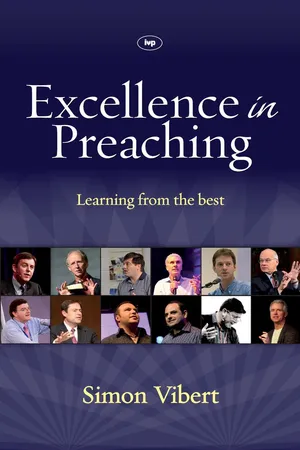
'Without creating a guru mentality, I focus on one positive aspect from each preacher and offer hints on how other preachers might emulate them.' says author Simon Vibert. He also looks at the Bible's own take on good preaching, and focuses on the exemplary models of Jesus and Paul.
This is not a how-to manual, nor a biblical theology of preaching, nor even a critique of the subjects. Rather, it is a focus on modern-day practitioners, from whom all preachers can form a composite picture of excellence, and from whom all preachers would do well to learn.
- English
- ePUB (mobile friendly)
- Available on iOS & Android
eBook - ePub
Excellence in Preaching
About this book
Information
Topic
Theology & ReligionSubtopic
Christianity1. Jesus Christ, the preacher: Setting the supreme standard
The world is full of books about Jesus Christ. But ironically, Jesus did not write any books. His first followers called him ‘Rabbi’. Friends and enemies alike recognized him as a great ‘teacher’ (a term used more than forty times in the Gospels). As we read Jesus’ sermons and parables, we should remember by contrast that the crowds first heard them. Preparing a book on the things that great preachers do well, I have regularly and perhaps inevitably asked myself: is it possible to hear Jesus the preacher?
Of course we know nothing of Jesus’ tone of voice, his inflection or his cadence. There was no MP3 recorder to help us analyse his speaking. His worldwide reach succeeded, long before the internet. The abiding power of his speech is felt today by the force of his imagery, his succinct phraseology and his challenging incisiveness.
But Jesus was obviously a compelling speaker. It goes without saying that he stands out as the unique preacher and, unlike every other preacher in this book, is flawless and perfect in his preaching. The Gospels record the audiences’ reactions: ‘The large crowd listened to him with delight’ (Mark 12:37). Crowds followed him, even when he sought to withdraw in private. Jesus was also aware of the fickleness and impulsiveness of the crowd, particularly when they looked for dramatic miracles rather than taking seriously the message he sought to preach (e.g. Luke 4:42–44).
We would also do well to remember that Jesus was around when the art of public speaking was a prized gift. From a Jewish point of view, generational education was given through skilled oral instruction. Rabbis were expected to teach their followers, and this included the practice of reciting familiar forms of prayers, proverbs and prose. For example, the Mishnah – the Jewish oral law – communicated the oral traditions of the law in a form that encouraged recollection and rote learning. A rabbi was a skilled oral communicator.
What was true for the history of Jewish education was even more evident in the Greco-Roman world. Those skilled in rhetoric (Plato, Aristotle, Cicero and others) captivated audiences by their displays of wisdom and persuasion.
Born into an environment steeped in good public oratory, Jesus, we can be fairly sure, knew something about the ‘rules’ of public speaking, and his audiences were familiar with listening. For sure, Jesus surprised his followers with earthy, counter-intuitive teaching methods. But it is also true that some of the contemporary patterns of rhetoric are evident in Jesus’ use of words and language.
As we consider Jesus as a preacher, it is important primarily to ‘hear’ what he has to say. Throughout its 2000-year history the church has emphasized the need to listen to, and even more, to hear, the Word of God.1 The public reading of Scripture and the preaching of the Word of God are major parts of Christian worship, communal and communicative acts.
It was the conviction of the apostles that through preaching the audience could engage with God. For example, in Romans 10:14–18 Paul asks:
How, then, can they call on the one they have not believed in? And how can they believe in the one of whom they have not heard? And how can they hear without someone preaching to them? And how can they preach unless they are sent? As it is written, ‘How beautiful are the feet of those who bring good news!’But not all the Israelites accepted the good news. For Isaiah says, ‘Lord, who has believed our message?’ Consequently, faith comes from hearing the message, and the message is heard through the word of Christ.
The apostle’s conviction was that faith comes, not by reading, but by hearing. And it is a certain kind of hearing which is important, namely hearing Jesus’ words with a conviction that we need to put them into practice (Matthew 7:24). See also Jesus’ comment, ‘He who has ears, let him hear’ (Matthew 11:15; 13:9, 43).
I wonder, then, if it is possible for us to sit at the feet of Jesus today? Can we too ‘hear the word of Christ’?
The Sermon on the Mount
Jesus’ best-known teaching is encapsulated in the Sermon on the Mount (Matthew 5 – 7). A similar sermon, sometimes called the ‘Sermon on the Plain’, is recorded in Luke 6, which would seem to imply that the Gospel writers have included a selected summary of Jesus’ teachings which he gave to more than one audience on different occasions.
Nevertheless, the Sermon on the Mount is written up as if it was one sermon. Modern readers may still feel as though they are in the crowd, listening to Jesus preaching timeless and persuasive words. We should still try to ‘hear’ it as a sermon today.
Jesus’ sermon contains some of the best known and most quoted pieces of moral and ethical wisdom of all time. Phrases like ‘an eye for an eye’, ‘turn the other cheek’, ‘love your neighbour’, to name but a few, are included, along with a prayer which we can still recite today (usually in traditional language): ‘Our Father which art in heaven, hallowed be thy name...’
Audience
Jesus goes to a mountainous area (perhaps with deliberate echoes of the giving of the Ten Commandments by Moses on Mount Sinai?) in order to teach his disciples. From this vantage point it would have been possible for his voice to be carried across the hill and down the slopes to where the crowds had gathered.
His intended audience seems to have been primarily his own closest followers. (According to custom, teachers sat down in order to teach.) But Matthew also makes it plain that there are ‘crowds’ present: in other words, a wider and more general audience listening in. One memorable feature of good communicators is, in fact, their ability to speak at multiple levels. In Jesus’ case, this enabled devoted followers to go deeper in their understanding of the faith, while at the same time, his speaking with such simple clarity allowed first-time hearers to access the content. The Sermon on the Mount is a model of this type of communication. Matthew concludes his record with these comments:
When Jesus had finished saying these things, the crowds were amazed at his teaching, because he taught as one who had authority, and not as their teachers of the law.(Matthew 7:28–29)
Theme and content
The content of the sermon, as recorded by Matthew in Greek, contains around two thousand words. If this was all that Jesus said on this occasion, it would have taken under half an hour to deliver. However, as we have already noted, it is likely that Matthew recorded edited highlights, collating them in such a way that the modern hearer may get a flavour of the overall flow and theme.
Scholars note the strong resonance with key themes in more recent Old Testament writings. For some, Jesus is a preacher of wisdom similar to the ancient sage or proverbial writer. For them, Jesus is to be heard as the supremely wise one whose words need to be heeded and applied.
For others, Jesus’ words should be heard as apocalyptic warning, foretelling the end times which are implicit in the announcement of the king’s arrival. The emphasis is upon the urgency of living faithfully in his kingdom, particularly as empires crumble and fall. His followers should be aware that his kingdom has been announced and proclaimed, but it is not yet fully evident to all. They will need to live with that kind of tension.
Both of these themes may be evident in Jesus’ sermon: wise sayings coupled with urgent appeal. ‘Teaching plus exhortation’ marks out this genre of preaching. The uniting theme of the Sermon on the Mount is: what it means to be a true disciple of Jesus Christ. Jesus begins by spelling out the nature of true discipleship (positively and negatively: what it is and what it isn’t), and follows this up with a challenge to be righteous in a way that exceeds the usual pattern of righteousness as taught by the Pharisees.
Structure
In terms of formal rhetoric, the sermon uses common Old Testament devices to give it shape.
The first is inclusio, or ‘bookends’. Words and themes introduced at the beginning are repeated at the end in order to bring to the speech a sense of completeness. This enables the audience to grasp the theme clearly introduced at the beginning: ‘Blessed are...’ (5:3, etc.), and then return to a clear conclusion: ‘Therefore everyone who hears these words of mine and puts them into practice is like a wise man who built his house on the rock...’ (7:24). The blessed and wise person is the follower who heeds Jesus’ words.
The second rhetorical device is known as the chiasm. Subject matter appears in a symmetrical or rhythmic pattern, to help hearers to remember it. This may be demonstrated as follows:
A1 – 5:3–10. Beatitudes. Who the disciples are.
B1 – 5.11–16. The disciples’ vocation.
C1 – 5:17–19. Conditions for implementing the vocation.
D1 – 5:20. Introduction of antitheses (framing material)
E1 – 5:21–47. Antithesis. The overabundant righteousness
D2 – 5:47–48. Conclusions of the antithesis (framing material)
D3 – 6:1. Introduction to the next unit (framing material)
E2 – 6:2–16. The overabundant righteousness.
D4 – 6:19–21. Conclusion of preceding unit (framing material)
C2 – 6:22 – 7:12. Conditions for implementing the vocation
B2 – 7:13–20. The disciples’ vocation.
A2 – 7:21–27. Who the disciples are.2
Through the use of ‘bookends’ and ‘symmetry’, it becomes clear that the central theme of discipleship is skilfully introduced and illustrated, and poignantly applied to the crowds.
Manner
How did Jesus seek to persuade his audience, hold their attention and communicate in a way which (to quote Cicero) ‘taught, delighted and moved’ them? What evidence is there in Jesus’ teaching that he showed any awareness of the ancient Greek, Roman or Jewish history of rhetoric? And how, if at all, should today’s preachers seek to preach as Jesus preached?
Authority
There are a number of ways in which Jesus assumes authority. He says things such as ‘verily’, or ‘truly I say’, or ‘I tell you the truth’ (the word is ‘amen’). He also makes assumptions about his right to judge who will and will not be in the kingdom, and this on the basis of their acknowledgment of his authority.3
When Jesus says, ‘You have heard that it was said...But I tell you’ throughout chapter 5, he is building up a strong contrast between his authoritative teaching and that of the scribes and Pharisees. His authority is based upon his own interpretation of God’s law. Their teaching usually includes long lists of citations from other teachers of the law: ‘Rabbi So-and-so says thus...’ Jesus by contrast says, ‘I tell you...’ This must have made a powerful impact on his hearers. His words need no bolstering from others; he claims a right to interpret the law for himself.
So Jesus speaks authoritatively, proclaiming the kingdom. Rhetoricians seek to persuade through rational deduction, whereas Jesus makes assumptions about his right to speak definitively, fully anticipating a response of obedience.
Rhetorical techniques
Anaphora is a verbal technique which makes use of the same word to begin a series of sentences. (The word ‘anaphora’ comes from the Greek word meaning, ‘I repeat...’) Winston Churchill skilfully and successfully employed this device when he said:
...we shall not flag or fail.We shall go on to the end. We shall fight in France, we shall fight on the seas and oceans, we shall fight with growing confidence and growing strength in the air, we shall defend our island, whatever the cost may be.We shall fight on the beaches, we shall fight on the landing grounds, we shall fight in the fields and in the streets, we shall fight in the hills; we shall never surrender.4
By repeating the phrase, ‘Blessed are...’, Jesus draws the audience towards a cumulative conclusion: this is what it means to be truly blessed.
Syllogism is a form of deductive reasoning leading to a certain conclusion, illustrated in this familiar example: All humans are mortal (major irrefutable premise), I am a human (minor premise), therefore, I am mortal (inescapable conclusion). In the Sermon on the Mount the conclusion, stated at the first, is: all who are my disciples – those who are in my kingdom – are blessed. Minor premise: the poor in spirit are blessed. Major premise: the poor are in my kingdom. The unusual conclusion of these premises is based upon the assumed authority Jesus exercises in judging who will and will not be his true disciple.5
Metaphor. The sermon is full of powerful metaphors. Jesus says, for example, ‘If your right eye causes you to sin, gouge it out...And if your right hand causes you to sin, cut it off and throw it away.’ Some preachers of Jesus’ sermon did actually interpret these words literally. The third-century preacher, Origen of Alexander (c.185 – c.254), literally did emasculate himself. However, Jesus’ immediate hearers apparently did not react to Jesus’ teaching in such an impulsive, exacting way. They understood the rhetorical force of his message and heard the drastic language as metaphorical rather than literal.
Rhetorical questions assume that the audience understand the direction in which the sermon is going and are therefore able to anticipate answers to questions. Here are examples:
- ‘Is not life more important than food, and the body more important than clothes?’ (Matthew 6:25). This is a no-brainer – life and body are of course more important than food and clothes.
- ‘Are you not much more valuable than [the birds of the air]?’ (Matthew 6:26). Well, yes, we do not send an ambulance to take a bird to A&E, but humans have a whole medical system in place to rescue ailing people.
- ‘Who of you by worrying can add a single hour to his life?’ (Matthew 6:27). No-one can of course. Indeed, worry might have the opposite effect.
- ‘Which of you, if his son asks for bread, will give him a stone? Or if he asks for a fish, will give him a snake?’ (Matthew 7:9–10). Once again the audience immediately know that, though they are not perfect, they would not treat their children in this way, which enables Jesus logically to conclude: Why then is it any different when you think about your perfect heavenly father?
Exaggeration, humour and graphic illustration. Jesus’ use of colourful and memorable language would have elicited evocative imagery in the minds of his hearers,which would have assisted their ability to recall the key points of his sermon. Such phrases include: ‘Why do you look at the speck of sawdust in your brother’s eye and pay no attention to the plank in your own eye?’ (Matthew 7:3). Imagine staggering around with a plank protruding out of your eye, while delicately trying to remove a shaving from your brother’s!
Proverb. We are familiar with English proverbs such as, ‘A leopard cannot change its spots,’ and ‘Absolute power corrupts absolutely.’ Such pithy proverbial sayings feature in this sermon, for example:
You are the salt of the earth. But if the salt loses its saltiness, how can it be made salty again? It is no longer good for anything, except to be thrown out and trampled by men.You are the light of the world. A city on a hill cannot be hidden. Neither do people light a lamp and put it under a bowl. Instead they put it on its stand, and it gives light to everyone in the house. In the same way, let your light shine before men, that they may see your good deeds and praise your Father in heaven.(Matthew 5:13–16)
This fits in with the long Jewish history of the use of mashal, including proverbs, pithy sayings and so forth.6 It was a form of communication which Jesus adapted and used to great effect in the longer parables in the rest of the Gospel.
Parable. It is clear that Jesus’ use of parable was a significant feature of his communication (see Matthew 13:34). Some reckon that as much as one third of Jesus’ teaching ministry was in the form of parable. This device acted as a sifting mechanism in order that those in his kingdom would grow in knowledge and appreciation, while outsiders, on the other hand, would remain perplexed and distanced. Parables were not supposed to be equally comprehensible to everyone. Jesus explains the purpose of this kind of teachi...
Table of contents
- Excellence in Preaching
- Contents
- Preface
- Introduction: Preaching the Bible way
- 1. Jesus Christ, the preacher: Setting the supreme standard
- 2. Tim Keller: Be aware of cultural and philosophical challenges to the gospel
- 3. John Piper: Inspire a passion for the glory of God
- 4. Vaughan Roberts: Let the Bible speak with simplicity and freshness
- 5. Simon Ponsonby: Be a Word-and-Spirit preacher
- 6. J.John: Use humour and story to connect and engage, and dismantle barriers
- 7. David Cook: Create interest; apply well
- 8. John Ortberg: Preach with spiritual formation in mind
- 9. Nicky Gumbel: Make much of Jesus Christ
- 10. Rico Tice: Preach with urgency and evangelistic zeal
- 11. Alistair Begg: Persuade people by passionate argument from the Bible
- 12. Mark Driscoll: Teach with directness, challenge and relevance
- 13. Mark Dever: Expose all of God’s Word to all of God’s people
- Conclusion: Preaching that changes lives
- Appendix: The survey and online resources
- Notes
Trusted by 375,005 students
Access to over 1.5 million titles for a fair monthly price.
Study more efficiently using our study tools.
Frequently asked questions
Yes, you can cancel anytime from the Subscription tab in your account settings on the Perlego website. Your subscription will stay active until the end of your current billing period. Learn how to cancel your subscription
No, books cannot be downloaded as external files, such as PDFs, for use outside of Perlego. However, you can download books within the Perlego app for offline reading on mobile or tablet. Learn how to download books offline
Perlego offers two plans: Essential and Complete
- Essential is ideal for learners and professionals who enjoy exploring a wide range of subjects. Access the Essential Library with 800,000+ trusted titles and best-sellers across business, personal growth, and the humanities. Includes unlimited reading time and Standard Read Aloud voice.
- Complete: Perfect for advanced learners and researchers needing full, unrestricted access. Unlock 1.5M+ books across hundreds of subjects, including academic and specialized titles. The Complete Plan also includes advanced features like Premium Read Aloud and Research Assistant.
We are an online textbook subscription service, where you can get access to an entire online library for less than the price of a single book per month. With over 1.5 million books across 990+ topics, we’ve got you covered! Learn about our mission
Look out for the read-aloud symbol on your next book to see if you can listen to it. The read-aloud tool reads text aloud for you, highlighting the text as it is being read. You can pause it, speed it up and slow it down. Learn more about Read Aloud
Yes! You can use the Perlego app on both iOS and Android devices to read anytime, anywhere — even offline. Perfect for commutes or when you’re on the go.
Please note we cannot support devices running on iOS 13 and Android 7 or earlier. Learn more about using the app
Please note we cannot support devices running on iOS 13 and Android 7 or earlier. Learn more about using the app
Yes, you can access Excellence in Preaching by Simon Vibert in PDF and/or ePUB format, as well as other popular books in Theology & Religion & Christianity. We have over 1.5 million books available in our catalogue for you to explore.