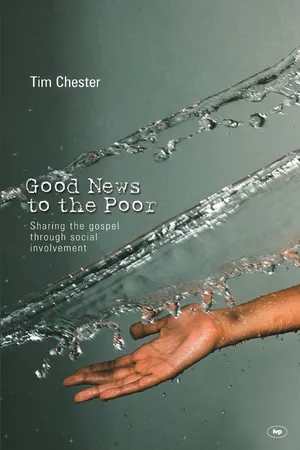
How do we respond to the silent appeal in the dark eyes of the child in the charity catalogue, or the blanketed figure in the cold shop doorway? Should we share the gospel with them, or a bowl of soup?
Throughout history, men and women such as Wilberforce and Shaftesbury, Carey and Booth have recognized a call to help the needy. Others have argued that our first task is evangelism, that Christians should not meddle in politics, that social action is a distraction. Do we serve Christ through preaching his Word, or should we use words only when necessary?
Tim Chester argues passionately that evangelism and social action are inseparable, as two arms of the church's mission. He presents a biblical case for truly evangelical social action, that is shaped and inspired by the gospel. He shows how social activity is a response to evangelism, a bridge and a partner to it. He urges conservatives not to marginalize those who uphold the cause of the oppressed, and those involved in social action not to neglect the preaching of the Word.
- English
- ePUB (mobile friendly)
- Available on iOS & Android
eBook - ePub
About this book
Information
Topic
Theology & ReligionSubtopic
Christianity1. The case for social involvement
I stood in Sector Twelve among small, squat houses roofed with plastic weighted down with rubbish. With me was Dr Kiran Martin, Director of ASHA, a Christian organization working in the slums of Delhi. Around us a crowd gathered, eager to talk. Most of the men had jobs – railway workers, construction site labourers, balloon sellers. Some of the one-room houses had a television, the electricity tapped off from the mains. There was a communal toilet block, above which ASHA has a small clinic. When we asked if anyone ever escaped the slum, the answer was no. The only jobs available are low-paid with long hours. Most people cannot even read bus numbers. Alcoholism and crime are common. People are subject to slum landlords – protectors and oppressors at one and the same time. Standing there I realized that the problem for these people was not simply lack of material possessions, but powerlessness.
When Kiran Martin graduated as a doctor she had the opportunity of a well-paid job and a comfortable life. Instead, starting with just a table and chair, she has given herself in the service of the poor. Several years on, ASHA has an impact on the lives of 150,000 slum dwellers – empowering communities by training health workers and lobbying government to improve slum conditions. Kiran Martin has invested time in building relationships with slum landlords, hosting an annual meal for them. She persuaded them to see that it was in everybody’s interest to tackle some of the problems that were oppressing the slum dwellers. In the same way, she has built relationships with local government officials so that they have been willing to trust resources to ASHA. Through patience and allowing officials to share the credit for achievements, ASHA has also been able to negotiate government-funded slum redevelopments. Now the government’s new housing policy has adopted the model used by ASHA to transform slums into established communities.
But that is not all: in sector 12 there is now a church of 25 Hindu converts. This is an area known for its Hindu extremism. But everywhere Kiran Martin walks in the slums she is greeted warmly. Church planting that had proved impossible in the past was now possible because of the trust and respect built by Kiran Martin in Christ’s name.
The example of William Carey
I visited Kiran Martin’s work in Delhi in 1993. Two hundred years before, in 1793, William Carey arrived in India. Ruth and Vishal Mangalwadi begin their appreciation of Carey with a fictional quiz. They imagine a competition for Indian university students in which the question is asked: ‘Who was William Carey?’ The first reply is that William Carey was a botanist who published the first books on the natural history of India, introduced new systems of gardening and after whom a variety of eucalyptus is named. Next an engineering student says William Carey introduced the steam engine to India and began the first indigenous paper and printing industries. Another student sees Carey as a social reformer who successfully campaigned for women’s rights. Another as a campaigner for the humane treatment of lepers. An economics student points out that Carey introduced savings banks to combat usury. Carey is credited with starting the first newspaper in any oriental language. He conducted a systematic survey of Indian agricultural practices and founded the Indian Agri-Horticultural Society, thirty years before the Royal Agricultural Society was established in England. Carey was the first to translate and publish the religious classics of India, and wrote the first Sanskrit dictionary for scholars. He founded dozen of schools, providing education for people of all castes, boys and girls. He pioneered lending libraries, wrote the first essays on forestry in India. To a significant degree he transformed the ethos of the British administration in India from colonial exploitation to a genuine sense of civil service.
And so it goes on with Carey’s contribution to science, engineering, industry, economics, medicine, agriculture and forestry, literature, education, social reform, public administration and philosophy all being celebrated.1 Yet most of us know William Carey as the cobbler from Northamptonshire who became a pioneer missionary and evangelist. Who was the real William Carey? The answer is that Carey was all these things and more.
The example of early Christians
Christians have a long history of being involved in social issues – care for the poor, involvement in the arts, science and culture, participation in civil society, campaigning in the political arena. Tertullian, the North African theologian, writing at the end of the second century after Christ, famously described how his fellow-Christians shared with each other:
If he likes, each puts in a small donation; but only if it he wants to and only if he is able. There is no compulsion; all is voluntary. These gifts are, as it were, piety’s deposit fund. For they are not taken and spent on feasting and drinking-sessions, but to support and bury poor people, to supply the wants of needy boys and girls without parents, and of house-bound old people...People say, See how they love one another...One in mind and soul, we do not hesitate to share our earthly goods with one another. We have all things in common except our wives.2
Writing in a similar vein at about the same time, Irenaeus said:
Instead of tithes which the law commanded, the Lord said to divide everything we have with the poor...Those who have received freedom set aside all their possessions for the Lord’s purposes, giving joyfully and freely and not just the least valuable of their possessions.3
Basil the Great, writing in the fourth century AD, warned his readers:
The bread which you keep, belongs to the hungry; the coat which you preserve in your wardrobe, to the shoeless; the gold which you have hidden in the ground, to the needy. Wherefore, as often as you were able to help others, and refused, so often did you do them wrong.4
During this period the church was seeing significant and widespread growth. About half a million new members were added every generation. By the beginning of the fourth century the numbers had risen to 5 million – about 8% of the Roman Empire – despite periodic persecution and constant revilement. The twin factors of gospel growth and persecution led to the first apologetics. These were not only appeals for toleration, but also for conversion. One of the most prominent early apologists was Justin Martyr. Justin was from a pagan background, but, being born in Samaria, he would have probably been familiar with Judaism. He spent some time wandering around the Mediterranean looking for a worldview that made sense to him. He was finally converted through a chance encounter with an old man on the shore near Ephesus. After his conversion he became an evangelist and, although travelling widely, spent most of his life in Rome where he was martyred in AD 163.
Justin wrote an Apology addressed to the Emperor some time after AD 151 in which he attempted carefully to explain Christianity in a context where it was being misunderstood. Typically the apologists like Justin who wrote to a Roman audience focused on the civil consequences of Christianity. Describing the supposedly secret gatherings of Christians, Justin says: ‘They who are well to do, and willing, give what each thinks fit; and what is collected is deposited with the president, who succours the orphans and widows and those who, through sickness or any other cause, are in want, and those who are in bonds and the strangers sojourning among us, and in a word takes care of all who are in need.’5
Justin recognizes that in one sense Christianity is subversive. It operates with a set of values that is contrary to elements of Roman society and culture. So he is not afraid to argue for the moral superiority of Christianity. The concern of the early church was not confined to other Christians. The Christians, for example, would collect unwanted children, left on the city rubbish dumps to die, and bring them up themselves. Justin says, ‘But as for us, we have been taught that to expose newly-born children is the act of wicked men; and this we have been taught so that we should not do anyone an injury and so that we should not sin against God.’6 Justin describes how many of the children exposed were taken to be brought up as prostitutes and this he strongly condemns. He says to the Emperor, ‘You even collect pay and levies and taxes from these [prostitutes] whom you ought to exterminate from your civilized world...You charge against us the actions that you commit openly and treat with honour.’7 Justin does not hesitate to condemn social injustice and call on the Emperor to change his policies. What is striking about this is that it comes in the context of a plea for tolerance towards Christians.
Nevertheless, although elements of Christianity run contrary to the values of Roman society, Justin wants to show that Christianity is good for society. ‘We are in fact of all men your best helpers and allies in securing good order.’8 He says that Christians live under God’s eyes so they do what is right even without the sanction of the civil authorities. He points to the changed lives of Christians and describes Christ’s teaching on marriage, love for enemies, generosity, honesty and paying taxes.9
We used to value getting wealth and possessions above all things, but now we bring what we have to a common fund and share with every one in need. We used to hate and destroy one another and were racists. But now, since the coming of Christ, we live in harmony with others of different races and pray for our enemies.10
The life of the early church described by Justin, the pioneering work of William Carey and the contemporary ministry of Dr Kiran Martin are just three examples of Christian involvement in social issues and political reform. But is social involvement a legitimate activity of Christians? Does it have biblical and theological support? This chapter sets out the case for Christian social involvement, offering three interrelated reasons: the character of God, the reign of God and the grace of God.
1. The character of God
The psalmist describes God in the following way:
He upholds the cause of the oppressed
and gives food to the hungry.The LORD sets prisoners free,
the LORD gives sight to the blind,the LORD lifts up those who are bowed down,
the LORD loves the righteous.The LORD watches over the alien
and sustains the fatherless and the widow,
but he frustrates the ways of the wicked.(Ps. 146:7–9)
Social involvement is rooted in the character of God. He is the God who upholds the cause of the oppressed, who provides for the poor and liberates the prisoner; he sustains the marginalized and the vulnerable.
Our understanding of poverty is fundamentally related to our understanding of God. It is a question of what kind of God we worship. According to Ron Sider, concern for the poor is not ‘merely an ethical teaching’: ‘it is first of all a theological truth, a central doctrine of the creed, a constantly repeated biblical teaching about the God we worship. The biblical insistence on God’s concern for the poor is first of all a theological statement about the Creator and Sovereign of the universe.’11 Commenting on Deut. 10:12–17 Vinoth Ramachandra says:
Among Israel’s neighbours, as indeed in the ancient cultures of the world (including Indian, Chinese, African and South American civilizations), the power of the gods was channelled through the power of certain males – the priests, kings and warriors embodied divine power. Opposition to them was tantamount to rebellion against the gods. But here, in Israel’s rival vision, it is ‘the orphan, the widow and the stranger’ with whom Yahweh takes his stand. His power is exercised in history for their empowerment.12
It is sometimes said that God is ‘biased to the poor’, or people speak of his ‘preferential option for the poor’. But such statements are open to misunderstanding. It is not that God is prejudiced in some way, still less that the poor are more deserving because of their poverty. Rather, because he is a God of justice, God opposes those who perpetrate injustice and he sides with the victims of oppression. Vinoth Ramachandra comments: ‘in a sinful world where life is biased towards the wealthy and the powerful, God’s actions will always be perceived as a counter-bias’.13 In situations of exploitation it is the cause of the oppressed that God upholds.
And God expects us to do the same:
Speak up for those who cannot speak for themselves,
for the rights of all who are destitute.Speak up and judge fairly;
defend the rights of the poor and needy.(Prov. 31:8–9)
Away with the noise of your songs!
I will not listen to the music of your harps.But let justice roll on like a river,
righteousness like a never-failing stream!(Amos 5:23–24)
To walk in the ways of the Lord, says Chris Wright, is the summary of Old Testament ethics.14 The God who ‘upholds the cause of the oppressed and gives food to the hungry’ expects us to walk in his ways. He expects his people to share his concern for justice. Again and again the indictment of the Old Testament prophets against God’s people was both that they had turned from God to idols and that they had not upheld social justice (Amos 5:11–12). In Isaiah the people of God complain that God does not hear their prayers or respond to their fasting. It seems as if God is indifferent. But the problem, says Isaiah, is the indifference of the people to the cries of the poor:
Yet on the day of your fasting, you do as you please
and exploit all your workers.Your fasting ends in quarrelling and strife,
and in striking each other with wicked fists.You cannot fast as you do today
and expect your voice to be heard on high.Is this the kind of fast I have chosen,
only a day for a man to humble himself?Is it only for bowing one’s head like a reed
and for lying on sackcloth and ashes?Is that what you call a fast,
a day acceptable to the LORD?Is not this the kind of fasting I have chosen:to loose the chains of injustice
and untie the cords of the yoke,to set the oppressed free
and break every yoke?Is it not to share your food with the hungry
and to provide the poor wanderer with shelter—when you see the naked, to clothe him,
and not to turn away from your own flesh and blood?’(Is. 58:3–7)
God will not hear his people when they ignore the claims of the poor (Is. 1:10–17). The appropriate response to the God who upholds the poor is for us likewise to uphold the cause of the poor. This is the truly religious activity of those who follow the God of the Bible. This is what it means to know God. Addressing King Jehoahaz through the prophet Jeremiah, God reminds him of his father Josiah: ‘“He defended the cause of the poor and needy, and so all went well. Is that not what it means to know me?” declares the LORD’ (Jer. 22:16). In a similar way James says: ‘Religion that God our Father accepts as pure and faultless is this: to look after orphans and widows in their distress and to keep oneself from being polluted by the world’ (Jas. 1:27). Part of Job’s argument is that he has cared for the poor and therefore his suffering is undeserved (Job 31:13–28).
God’s concern for the poor was embodied in the Mosaic law. ‘I command you to be open-handed towards your brothers and towards the poor and needy in your land’ (Deut. 15:11). Numerous laws safeguarded both the needs and the dignity of the poor. The law of gleaning stated that landowners were to leave produce missed by the initial harvest so it could be gathered by the poor, enabling the poor to provide for themselves without being dependent on charity. Interest was not to be charged on loans to the poor so that people did not profit from their misfortune. And when a coat or millstone was taken as a guarantee for a loan it was to be returned when it was needed. Calvin argues that the eighth commandment forbidding theft involves an obligation to assist those ‘we see pressed by the difficulty of affairs...with our abundance’.15 Jesus summed up the law as to love God and to love your neighbour as yourself (Matt. 22:34–40).
Concern for those outside the Christian community
It is sometimes said that concern for the poor in the Bible is commanded only within the covenant community – whether the nation of Israel in the Old Testament or the church in the New Testament. And indeed with many texts often cited in support of social involvement, this is indeed the case. The fate of people in the parable of the sheep and the goats turns on how they have treated ‘the least of these my brothers’ – a reference to the Christian community (Matt. 25:31–46). Examples of the care of widows in the New Testament are within the Christian community (Acts 6:1–7; 1 Tim. 5:3–16). The command to love is focused on the people of God because we are to be a community of love reflecting the loving nature of our ...
Table of contents
- Good News to the Poor
- CONTENTS
- Acknowledgments
- Introduction
- 1. The case for social involvement
- 2. More than a private faith
- 3. The case for evangelizing the poor
- 4. Social involvement and proclamation
- 5. Social involvement and the kingdom of God
- 6. Good news to the poor
- 7. Good news to the rich
- 8. Welcoming the excluded
- 9. Strengthening the powerless
- 10. Following the crucified Lord
- 11. Can we make a difference?
- Further reading
- Select bibliography
- Notes
Trusted by 375,005 students
Access to over 1.5 million titles for a fair monthly price.
Study more efficiently using our study tools.
Frequently asked questions
Yes, you can cancel anytime from the Subscription tab in your account settings on the Perlego website. Your subscription will stay active until the end of your current billing period. Learn how to cancel your subscription
No, books cannot be downloaded as external files, such as PDFs, for use outside of Perlego. However, you can download books within the Perlego app for offline reading on mobile or tablet. Learn how to download books offline
Perlego offers two plans: Essential and Complete
- Essential is ideal for learners and professionals who enjoy exploring a wide range of subjects. Access the Essential Library with 800,000+ trusted titles and best-sellers across business, personal growth, and the humanities. Includes unlimited reading time and Standard Read Aloud voice.
- Complete: Perfect for advanced learners and researchers needing full, unrestricted access. Unlock 1.5M+ books across hundreds of subjects, including academic and specialized titles. The Complete Plan also includes advanced features like Premium Read Aloud and Research Assistant.
We are an online textbook subscription service, where you can get access to an entire online library for less than the price of a single book per month. With over 1.5 million books across 990+ topics, we’ve got you covered! Learn about our mission
Look out for the read-aloud symbol on your next book to see if you can listen to it. The read-aloud tool reads text aloud for you, highlighting the text as it is being read. You can pause it, speed it up and slow it down. Learn more about Read Aloud
Yes! You can use the Perlego app on both iOS and Android devices to read anytime, anywhere — even offline. Perfect for commutes or when you’re on the go.
Please note we cannot support devices running on iOS 13 and Android 7 or earlier. Learn more about using the app
Please note we cannot support devices running on iOS 13 and Android 7 or earlier. Learn more about using the app
Yes, you can access Good news to the poor by Tim Chester in PDF and/or ePUB format, as well as other popular books in Theology & Religion & Christianity. We have over 1.5 million books available in our catalogue for you to explore.