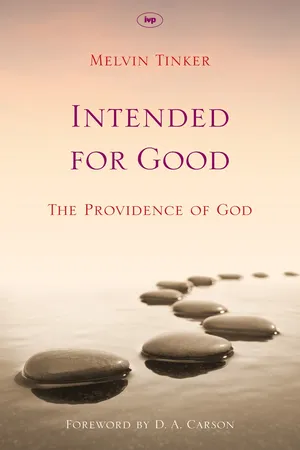
... in all things God works for the good of those who love him, who have been called according to his purpose' (Romans 8: 28)The Puritans used to say that 'providence is the last refuge of the saints'. Melvin Tinker's personal experience and work as a pastor have led him to believe that the doctrine of God's providence should be amongst the first refuges for the Christian seeking strength and comfort.From the early church right through into the nineteenth century, belief in providence was part of the staple diet of professing Christians. For various reasons, the doctrine was eclipsed in the twentieth century, and still lies on the edges of much Christian thought and practice today. However, rightly understood, the providence of God shines as a glorious jewel in the crown of the Christian faith. Melvin Tinker's exploration and exposition of some of the wonderful facets of that jewel is both pastoral and practical.
- English
- ePUB (mobile friendly)
- Available on iOS & Android
eBook - ePub
About this book
Information
1. PROVIDENCE AND THE PURPOSES OF GOD (Romans 8:28)
One of the most well-loved hymns of an earlier generation is, ‘God moves in a mysterious way’:
God moves in a mysterious way
His wonders to perform;He plants His footsteps in the sea,
And rides upon the storm.Deep in unfathomable mines
Of never-failing skill,He treasures up His bright designs
And works His sovereign will.Ye fearful saints, fresh courage take;
The clouds you so much dreadAre big with mercy, and shall break
In blessings on your head.Judge not the Lord by feeble sense,
But trust Him for His grace;Behind a frowning providence
He hides a smiling face.His purposes will ripen fast,
Unfolding every hour;The bud may have a bitter taste,
But sweet will be the flower.Blind unbelief is sure to err,
And scan his work in vain;God is his own interpreter,
And He will make it plain.
The hymn was written by William Cowper on 1st January 1773. What many people don’t realize is that earlier that morning he was walking in a field near Olney, where he lived, when he had a terrible premonition that a curse of madness was going to fall upon him. He had been plagued with mental problems before. Struggling to make a declaration of his Christian faith in poetic form before the cloud of depression engulfed his mind (he was a first-class poet), he struggled home, picked up his pen and wrote that magnificent hymn. It was soon after he had finished writing that Cowper’s mind plunged into the abyss of a complete mental breakdown. During the night he had terrible dreams and hallucinations; in one fit of madness he believed that he had received God’s command to take his own life with a knife, similar to the way Abraham was called to sacrifice his son Isaac. Amazingly the suicide attempt was thwarted by a Christian friend, Mary Unwin, who in the small hours of the morning sent for Cowper’s local vicar and friend, another hymn writer, John Newton of ‘Amazing Grace’ fame. When Newton found him, Cowper’s body was a bloody mess but thankfully his suicide attempt had not been fatal. Throughout the following weeks, day after day, night after night, Newton tried to calm and console his troubled friend. This went on for four months until April when Cowper made some measure of recovery, which sadly, was never to be a full one. In August of 1775, three years later, Newton described Cowper’s mental illness as, ‘mysterious...a very great trial to me. But I hope I am learning (though I am a slow student) to silence all vain reasonings and unbelieving complaints with the consideration of the Lord’s sovereignty, wisdom and love’.1
What was it that enabled John Newton to write those words and Cowper his hymn? It was the steadying belief expressed in these famous words of the apostle Paul: ‘And we know that in all things God works for the good of those who love him, who have been called according to his purpose’ (Rom. 8:28). We might ask: ‘Is Paul really serious in saying that God is working for the good of those who love him in all things, even the hard and painful things?’ Most certainly, which is why Paul wrote these words at this point in his letter, because a few verses earlier he had been talking about the whole of creation groaning because of the corrosive effects of sin, and a few verses later he will speak of Christians suffering persecution and famine and yet conclude, ‘in all these things we are more than conquerors through him who loved us’ (v. 37) and that nothing in heaven or on earth or in hell ‘will be able to separate us from the love of God that is in Christ Jesus our Lord’ (v. 39).
A basis for confidence
We may be minded to ask: why should Paul and all Christians have such confidence? The answer is because of the power and purposes of God which come together in the doctrine of providence. In the Bible God presents himself from beginning to end as the one who is in complete personal control of every detail of human existence. Here it is, for example, in Isaiah 45:6–7: ‘I am the LORD, and there is no other. I form the light and create darkness, I bring prosperity and create disaster; I, the LORD, do all these things.’ God is involved in the macro level of world politics, which is what Isaiah refers to earlier in the chapter when speaking of God raising up King Cyrus (who at the time of writing was not even born), to bring down Babylon which was about to take God’s people into captivity. Cyrus was to be God’s servant (pagan though he was) in setting God’s people free.
But God is also at work at the micro level too, such that he personally determines the lifespan of a single sparrow according to the teaching of Jesus: ‘Are not two sparrows sold for a penny? Yet not one of them will fall to the ground apart from the will of your Father. And even the very hairs of your head are numbered’ (Matt. 10:29–30). God is concerned with that amount of detail! However, we are not to envisage that this is the obsessive concern of a celestial busybody, because Jesus goes on to say to his followers, ‘So don’t be afraid; you are worth more than many sparrows.’ This is a very practical teaching which is meant to comfort and encourage God’s people, especially for when the tough times come our way. After all, Jesus says that the God who is all powerful, all wise and all good is the one we can call ‘Father’.2
The doctrine of providence is a subset of the doctrine of God’s sovereignty which Bruce Ware defines in these terms: ‘God exhaustively plans and meticulously carries out his perfect will as he alone knows best, regarding all that is in heaven and on earth, and he does so without failure or defeat, accomplishing his purposes in all of creation from the smallest details to the grand purposes of his plan for the whole of the created order.’3 From an earlier generation, B. B. Warfield speaks of God’s providential control in these terms, ‘There is nothing that is, and nothing that comes to pass, that [God] has not first decreed and then brought to pass by His creation or providence.’4
Although we shall be focusing on the implications of providence for Christian believers, it is important to underscore the fact that by definition providence applies to all creation and all people:
Jesus himself urges us to pray for daily bread, a petition almost certainly based on his Father’s providential care in daily living (especially in the wider context of Matthew 6). It does indeed seem that the activity of God is ‘all in all’. There is no time or space where he is excluded, no kinds of men or society or natural phenomena which are not caught up in some way within the pervasive, perpetual and purposive motion of God.5
But what do Christians mean when they speak of providence? Perhaps a useful starting point would be to think of the different ways Christians tend to use the term.12
Providence – different meanings
Imagine that there has been a pandemic of bird flu and despite the fact that the rest of her family went down with it, Mrs Miggins didn’t. Wisely she took reasonable precautions against contracting the illness; she had an inoculation, she made sure her hands were always washed (of course she had prayed about it too!). Being a Christian believer she naturally attributes the fact that she was spared to God’s providence. What she means when she speaks in this way is that her not going down with flu was a good thing and it was God who had made sure she hadn’t contracted it. To be sure, this still leaves us with the issue as to what God was doing with those who did go down with flu, but we shall come back to that question in a moment. We can put it like this: Mrs Miggins believes that it is not the devil that is in the detail, but God who is sovereignly bringing about his good purposes for his people, ‘providing’ or ‘governing’ if you will. That is providence.
Imagine another situation. Bob Bates is a salesman. He too is a Christian but has been finding life to be something of a struggle for him recently. The economic downturn has not been too kind to his business and he is a hairsbreadth away from insolvency. To add insult to injury he just misses his train to London for an important business appointment which he hoped would land him a good order. To make things really miserable it begins to rain. However, it so happens that Bob bumps into an old school friend he hasn’t seen for years who, unlike himself, has done quite well in the business world. As a result of this ‘chance’ meeting, his friend places a large order for Bob’s products. What does Bob conclude? Like Mrs Miggins, Bob is a Christian and so reflects on the matter biblically and comes to the happy conclusion that it was ‘providential’ that he missed the train because if he had caught it, he wouldn’t have met his friend and in turn he wouldn’t have bagged the order which put his business back on its feet.
From one point of view, to say that God is providentially at work in all things may mean no more than whatever happens, happens by divine say-so. This means that even falling off the pavement, which at one level can be described as an ‘accident’ because of a loose slab, at another (higher) level can be conceived as being within the orbit of God’s personal ruling decree. However, what we normally mean when we speak of something being ‘providential’ is that we perceive an event or series of happenings to be significant, we believe that we can see some sort of divine pattern or purpose in them: Mrs Miggins being kept healthy to care for her sick family, Bob Bates being provided for his business and so on. Accordingly, we might define providence as: God our heavenly Father working in and through all things by his wisdom and power for the good of his people and the glory of his name.
Much of what we call ‘providence’ is considered with hindsight, that is, it is retrospective. Sometimes things happen to us and while they are happening we haven’t a clue as to their significance; it is only months, or sometimes years, later that we can look back and say, ‘Now I see; that is what God was doing.’ The other reason why we have not to be too quick in deciding whether an occurrence is providential or not in an immediately good sense is because things might turn out rather differently as time goes by. For example, let’s imagine that Bob Bates as a result of his business deal with his friend decides, unwisely as it turns out, to expand his business. In fact he over-expands, with the result that he becomes bankrupt. If that happens he might be less eager to call his chance meeting with his friend at the train station providential. But then again that is not necessarily the end of the story. Let us further imagine that as a result of his bankruptcy he goes on to gain a better perspective on life, with the result that he no longer spends all his waking hours at work, trying to make more and more money. Indeed, he now begins to spend more time with his family who up to this point have seen very little of him. What is more, Bob gets involved in the children’s work at his local church which has been desperate for a male worker for years. At this juncture Bob reflects on all that has happened and gladly attributes it all to the providence of God.
This relates to another aspect of providence, what can be called the ‘preventative hand’ of providence. This is the understanding that God sometimes prevents untoward things happening which are unbeknown to us. However, we may discover God’s protective care in such cases at a later time. An example of this aspect of providence is an incident which occurred during the American Civil War.6 Levi Hefner, a Confederate courier, was sent one night by his commanding officer, General Robert E. Lee, to take a message through an area partially occupied by Union troops. As he approached a bridge, his horse balked and reared nervously. Hefner dismounted and attempted to calm him. In the darkness he began singing softly a familiar hymn, ‘Jesus, Lover of My Soul’, and in a few minutes the horse became quiet. Hefner then mounted his horse, crossed the bridge without incident and completed his mission. A number of years after the war, Hefner attended a reunion of soldiers from both sides of the conflict. As they gathered in small groups to share experiences they remembered from the war, a Union soldier from Ohio recounted standing guard one dark night at a bridge, having been ordered to shoot anyone approaching from the other side. During the night only one rider came his way, and so he raised his rifle to shoot as soon as he could see the form in the darkness. Just then, however, the horse balked and the rider dismounted. To calm the horse, the rider began singing softly a hymn, ‘Jesus, Lover of My Soul’. The Union soldier told the circle of old soldiers that the sound of the hymn so touched him that he lowered his rifle and quietly turned away. He said, ‘I could not shoot him.’ Levi Hefner jumped up and embraced the Union soldier, saying, ‘That was me!’ He realized for the first time that his singing that dark night had saved his life, or from another standpoint, God had saved it.
Principles in understanding providence
There are three important principles which come into play when we think about providence and how we might begin to understand it.
First, we need to identify properly the good purpose that God has in mind. Paul says, ‘In all things God works for the good for those who love him, who have been called according to his purpose’. It is what God considers to be ‘good’ rather than what we think is good that matters. This is not a text for the Prosperity Gospel: ‘Have faith and God will bless you with riches and a happy and trouble-free life.’ It is important to look very carefully at what Paul says next: ‘For those God foreknew he also predestined to be conformed to the likeness of his Son.’ Now we can see clearly what God’s good purpose is – it is to be made more like Jesus, having a practical conformity to Christ. Mrs Miggins was spared the flu so that she could show kindness and love, just like Jesus. Bill Bates learnt his lesson from his greed and adjusted his priorities so that he would be like Jesus in ‘seeking first the kingdom of heaven’.
This also helps towards answering the question: ‘What about those in the family who did become ill with the flu?’ It could be reasoned that they had to go down with the flu and Mrs Miggins spared, if she was to be in a position to care for them and so become more like Christ (in this context this is what is known as a ‘necessary condition’). What is more, this was an opportunity for the rest of the family to perhaps take stock of what really matters, maybe to appreciate God’s blessings of good health in the light of its absence as well as the kindness of God shown through Mrs Miggins. The point is this: whether easy times or hard times come our way, God will use them to shape us so that we become little mirror images of his Son.
Secondly, how God will work providentially so that we become more like Jesus will to some degree depend upon our response to what happens to us. This is not fatalism – we are not talking about ‘whatever will be will be’ – because human choices are involved, which God is involved in too. Again going back to our two examples, Mrs Miggins could have taken her escaping the flu as an opportunity to be selfish. She might have said, ‘Let the family fend for itself, I am taking a holiday in Spain until all of this blows over.’ Bob Bates might have responded to his loss of his business with cynicism and resentment, throwing in the towel with the cry, ‘Why has God done this to me?’ But instead both chose to respond positively in obedient faith. They knew God’s commands: love your neighbour as yourself, seek first the kingdom of God, and so they decided with the help of God’s Spirit to obey him.
Thirdly, we have to have a proper perspective, which is the long-term view. Being made more like Jesus is a lifetime’s work God does within us. So we are not always able to discern a providential pattern straight away. In fact we have to admit that in this life we may not be able to discern much of a pattern at all in some of the things which happen to us. Some lives, including some Christian ones, seemed marked by very little else but pointlessness and tragedy, the stuff of the book of Ecclesiastes: ‘Vanity, vanity, all is vanity’ (as the King James version puts it), words written by a believer.7 The pain being borne by someone might be such that, to be frank, it is very difficult for a person to reflect calmly and rationally upon what is happening to them and the ones they love. What are they to do then, when their world seems to be falling apart? That is when in the teeth of the evidence they hold on to what Paul teaches in Romans 8, that God is still our Father, that he is still on the throne and that he is working all things for the good of those who love him.8
I know a minister who many years ago was involved in a terrible car accident in which his young wife died. He himself was seriously injured and had to have extensive surgery to rebuild his face. He asked his own minister at the time what he could possibly do, how on earth was he ever going to retrieve his life after this? And very gently, but with a quiet conviction, the minister wisely told him to keep on reading Romans 8:28 over and over to himself until he really believed it. He did just that. Eventually he remarried and now has a family and fruitful...
Table of contents
- Intended for Good
- CONTENTS
- FOREWORD
- ACKNOWLEDGEMENTS
- 1. PROVIDENCE AND THE PURPOSES OF GOD (Romans 8:28)
- 2. PROVIDENCE AND HUMAN RESPONSIBILITY
- 3. PROVIDENCE AND TIME (Psalm 90)
- 4. PROVIDENCE IN ACTION (Joseph)
- 5. PROVIDENCE AND THE INDIVIDUAL (Psalm 139)
- 6. PROVIDENCE AND PRAYER
- 7. PROVIDENCE AND GUIDANCE
- 8. PROVIDENCE AND SUFFERING (Job)
- 9. PROVIDENCE AND CONVERSION (Acts 8:26–40)
- 10. PROVIDENCE – HARD AND HOPEFUL (Ruth)
- APPENDIX: GOING DEEPER
Trusted by 375,005 students
Access to over 1.5 million titles for a fair monthly price.
Study more efficiently using our study tools.
Frequently asked questions
Yes, you can cancel anytime from the Subscription tab in your account settings on the Perlego website. Your subscription will stay active until the end of your current billing period. Learn how to cancel your subscription
No, books cannot be downloaded as external files, such as PDFs, for use outside of Perlego. However, you can download books within the Perlego app for offline reading on mobile or tablet. Learn how to download books offline
Perlego offers two plans: Essential and Complete
- Essential is ideal for learners and professionals who enjoy exploring a wide range of subjects. Access the Essential Library with 800,000+ trusted titles and best-sellers across business, personal growth, and the humanities. Includes unlimited reading time and Standard Read Aloud voice.
- Complete: Perfect for advanced learners and researchers needing full, unrestricted access. Unlock 1.5M+ books across hundreds of subjects, including academic and specialized titles. The Complete Plan also includes advanced features like Premium Read Aloud and Research Assistant.
We are an online textbook subscription service, where you can get access to an entire online library for less than the price of a single book per month. With over 1.5 million books across 990+ topics, we’ve got you covered! Learn about our mission
Look out for the read-aloud symbol on your next book to see if you can listen to it. The read-aloud tool reads text aloud for you, highlighting the text as it is being read. You can pause it, speed it up and slow it down. Learn more about Read Aloud
Yes! You can use the Perlego app on both iOS and Android devices to read anytime, anywhere — even offline. Perfect for commutes or when you’re on the go.
Please note we cannot support devices running on iOS 13 and Android 7 or earlier. Learn more about using the app
Please note we cannot support devices running on iOS 13 and Android 7 or earlier. Learn more about using the app
Yes, you can access Intended for Good by Melvin Tinker in PDF and/or ePUB format, as well as other popular books in Theology & Religion & Christianity. We have over 1.5 million books available in our catalogue for you to explore.