Too many people find their experience as Christians incomplete and unsatisfactory...
Jamal enjoys his voluntary work with down-and-outs but finds church irrelevant.
Jack believes he's going to heaven but isn't sure what difference Jesus makes to him now.
Aimee loves being part of a lively church but at work no-one would know she was a Christian.
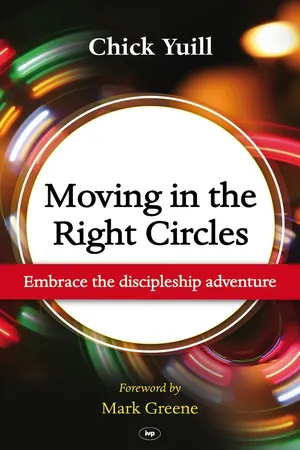
They're all missing something. But life with Jesus is meant to be an all-encompassing adventure. In this dynamic and punchy book Chick Yuill explores the four concentric circles that make up the authentic Christian life: * walking in the company of Jesus
* growing in the community of believers
* engaging with the culture of the times
* looking to the coming of the King
Only when all four are in place can followers of Jesus fully embrace the discipleship adventure.
Packed with stories and illustrations, this book explores how Christians can live life to the best.
- English
- ePUB (mobile friendly)
- Available on iOS & Android
eBook - ePub
About this book
Information
Topic
Theology & ReligionSubtopic
Christianity1. Invitation
Starting from the wrong place
To say that I was surprised to be invited to appear on The Jeremy Kyle Show on daytime TV would be an understatement. For anyone who doesn’t know, he’s Britain’s answer to America’s Jerry Springer, and the show’s unashamed agenda is simply to encourage the participants to share the lurid details of the less attractive side of their family life with the general public. In return they receive some of the host’s homespun, if somewhat questionable, wisdom. As often as not, the protagonists end up having to be restrained from indulging in something akin to a bare-knuckle boxing match. However, after being informed of the subject for that day, I agreed to appear on the show. It turned out to be an interesting experience.
The producers had arranged a live link with three members of a church in America’s Midwest which has gained notoriety for two things. They fly all over the States in order to demonstrate at the funerals of American service personnel who have been killed on active service; their protest takes the form of carrying placards aggressively declaring their conviction that the deaths of these young men and women represent a judgment from God on their country. And they are virulently and notoriously anti-gay. To make that point clear, the three church members on the live link that day were wearing black T-shirts with the legend in bold white lettering: ‘GOD HATES FAGS’.
Worse was yet to come. Following the opening credits there was a video clip of the founder of the church speaking a couple of years before, just days after a campus shooting in the States in which thirty students had been killed. ‘We rejoice in those deaths,’ he said. ‘They represent God’s judgment on America. Our only regret is that it wasn’t 30,000 people killed.’ I took a deep breath, offered up a quick prayer, and hoped that I might say something that would convince the audience that Christianity, insensitivity and insanity were not interchangeable terms!
There were three of us on the panel in the studio that day. On my right was a woman whose son had been killed on active service in Iraq. The black-shirted church members told her that her son was cursed by God and was certainly now in hell. On my left was a young man who was the publicity officer for the Lesbian and Gay Foundation in the north-west of England. I don’t ever want to repeat what they said to him. And there in the middle was me, trying to bring some sanctified sanity and genuine Christian compassion to the debate.
I couldn’t do anything else but question the angry denunciations of these censorious followers of Christ. ‘Aren’t you being excessively judgmental?’ I dared to ask. ‘Surely the gospel teaches that God loves all sinners?’
They turned on me with a venom that was quite unnerving. ‘No, you’re wrong!’ they shouted. ‘God hates us until we repent. Only then does he start to love us.’
That’s when I realized how they could have such a distorted view of the Christian faith. They had started at the wrong place. Their theology began with divine judgment and then called for human repentance in order to win God’s favour and approval. They totally ignored the fact that it’s only God’s love and grace that makes such repentance possible.
Of course, I’ve taken an extreme example. But here’s the really worrying thing. As the discussion widened out to involve the members of the studio audience, it became all too clear that many of them thought that the angry judgmentalism of the guests from across the Atlantic was characteristic of all Christians. Little wonder then that the Christian gospel is failing to make an impact on people for whom it has such negative connotations. And what if there is even just a modicum of truth in their perception of what Christians believe? We can protest that their understanding is skewed and their verdict unfair as much as we like – but the little they’ve observed of our witness and the less they’ve seen of our worship have conveyed something quite different from what our words attempt to communicate. Could it be, in fact, that we have all too often started from the wrong place, not only in our thinking on mission and discipleship, but in our understanding of the gospel itself?
Ian is in his late fifties. Despite growing up in a Christian family, he has no contact with church, other than attending weddings and funerals. He describes himself as still holding to many of the values he learned as a child – honesty, faithfulness in marriage, compassion for the poor. But he doesn’t trust religion. On the few occasions when he speaks about the matter, he refers to his childhood experience of Sunday School.‘They used to teach us a chorus which they made us sing most weeks: “He sees all I do, He hears all I say, My God is writing all the time, time, time...” I hated that chorus. And I didn’t like the idea of a God like that who snooped on kids instead of getting on with looking after the universe and putting right the injustices of the world. I still don’t like the thought of a God like that. So church is not for me.’
Going back to the beginning
It’s time to follow the wise counsel of Maria to the von Trapp children in The Sound of Music:
Let’s start at the very beginning,A very good place to start...
In fact, it’s time to go right back to the Gospels and to the dramatic sentences with which Mark introduces the public ministry of Jesus: ‘After John was put in prison, Jesus went into Galilee, proclaiming the good news of God. “The time has come,” he said. “The kingdom of God is near. Repent and believe the good news!” ’ (Mark 1:14–15)
Time change
When you set them in the context of their time, Mark’s words are startling and unsettling. Clearly Galilee under the reign of Herod Antipas, a particularly unpleasant and unpredict- able ruler, was an unpromising setting for establishing new ministries! John the Baptist’s prophetic challenge resulted in his imprisonment and impending execution. But no sooner is he incarcerated in Herod’s dungeon than Jesus appears on the scene to launch his campaign. Not great timing, it would seem! Either Jesus is consumed with a self-destructive urge that has rendered him oblivious to the consequences of his actions, or else he’s carrying an urgent message whose time has come and which will brook no delay.
Mark is in no doubt that it’s the second of these possibilities that drives Jesus on. The urgency of his mission is expressed in a succinct message: The time has come. Those simple but powerful words are not just the beginning of Mark’s account of the life of Jesus. They seem to be written large over every genuine encounter that human beings have had with Jesus across the centuries. This is a man to be reckoned with and, if you take him seriously, everything changes from that point onwards. It’s no coincidence that we date our calendars from the coming of Jesus. Things are never going to be the same again! When you decide to follow him, it doesn’t really feel like converting to a new religion. It’s much more like entering – or maybe, more accurately, like being engulfed by – a whole new reality. Whenever he appears on the scene, everything changes. You cross a threshold into a brand-new kind of living.
Good news
Eddie and Joe are gay. Over the years they have attended a number of different churches. They didn’t usually stay too long. When the rest of the congregation found out about their sexual orientation, they felt less than welcome.Now they’re attending a church where one of the members has taken a special interest in them. She says, ‘They’re sinners just like me and the first thing they need to hear is not someone condemning their lifestyle, but a fellow sinner telling them that God loves all of us, whoever and whatever we are, and wants the best for us. Of course, when we meet in our small group we try to examine what the Bible says about how we should live. But we emphasize that we’re all a work in progress and we’re all in need of forgiveness.’Eddie and Joe have stayed longer than they ever have done in any previous church.
The content and tone of Jesus’ message highlight the radical change ushered in by his breaking onto the scene. Although his summons carried implications of God’s judgment, it was unlike John’s preaching which immediately preceded it. John had put the spotlight on human guilt, but Jesus focused his message much more on the good news of God’s grace. That ‘good news’ lay at the heart of everything he was to say and do. He communicated his teaching in everyday stories of ordinary people in commonplace situations – but those seemingly simple parables were, in fact, invitations to see through the apparently mundane events of life to the mystery of a God whose essential nature is love and whose most apt name is Father.
His words and actions were all of a piece. He sought out the company of the marginalized and despised, offering them a forgiveness and acceptance they had never experienced before. Everything he did was a disclosure of the character of an infinitely loving God in a human life. His miracles were a demonstration of the hand of God in healing and providing for his children. And his death and resurrection were the ultimate revelation of the triumph of love over hate, good over evil, forgiveness over sin, life over death. In short, the Jesus we meet in the Gospels brings – indeed, he is – good news about God and good news from God.
The Greek word euangelion occurs more than seventy times in the New Testament and it’s the word that’s translated in English as ‘good news’. Even the word ‘gospel’ that we use to sum up the Christian message is derived from the Anglo-Saxon words god spel, meaning ‘good story’. The story of Jesus is good news – a good story – from beginning to end. It’s not by accident that the first four books of the New Testament which tell the story of his ministry and witness to his identity as the Son of God are described as ‘the four Gospels’. To speak of Jesus is to tell good news.
If being in the company of Jesus is the centre from which we move out in ever-widening circles, then right at the hub is good news, the best news the world can ever hear: God is love and he reveals himself fully in Jesus. To begin from any other point – however worthy our intentions, however passionate our desire to follow, however sound our theology in other respects, however morally right our actions, however deep our desire to serve humanity – is to miss the mark. We will fail to be true followers of Jesus and our efforts will count for little.
I’ve been fortunate enough to run the London Marathon half a dozen times. Only the elite runners get to line up right on the starting line. The rest of us less talented athletes form part of a crowd that stretches back for a very long way. The slower your predicted finishing time, the further back you are. You can be shuffling forwards for fifteen minutes before you even reach the starting line! But until you do, the race hasn’t begun. And you can jog on the spot or jump up and down as much as you like, but they won’t give you a medal for that. Once or twice I’ve glanced at some of my fellow runners just as we cross the line to start the race proper, only to discover that they look exhausted already. They’ve used up all their energy before the race has started. I think I’ve seen the same worn-out expression on the faces of some of my fellow believers who’ve still to discover that you don’t even begin to follow Jesus until you cross the starting line and grasp the truth that it begins with the good news of the gospel, not with the hard graft of human effort.
Kingdom come
There’s still more to this opening sortie in Jesus’ campaign. The declaration of good news is linked with a promise for which the people of Israel had waited a long time: The kingdom of God is near. This is the consistent theme that runs through his teaching. It’s like a recurring motif in a great musical composition. He refers to it again and again. He frequently gives imaginative pictures of what ‘the kingdom’ might be like in his parables. Biblical scholars constantly and rightly remind us that the phrase ‘the kingdom of God’ (or, as Matthew’s Gospel has it, ‘the kingdom of heaven’) refers not to a place but to the reign or the rule of God. Wherever God’s will is done, wherever his sovereign rule is obeyed, something of the kingdom of God can be seen.
Often, however, things don’t look as if God is in control. Throughout her long and troubled history, the nation of Israel suffered at the hands of nations that were larger and more powerful politically and militarily. But despite her repeated failures to be the people God had called her to be, her faith in God remained alive. Across long centuries, the hope that God would break through and assert his just and wise rule sustained the people of Israel through their darkest days of defeat and exile. The people prayed for God’s kingdom – his sovereign rule – to break through. And the prophets pointed to the Day of the Lord when God would put all wrongs right and his people would return to their homeland and be free once again.
The hope of God’s coming kingdom went beyond their desire for national regeneration, however. It was the recognition deep in Israel’s understanding of God’s plan – often faint and submerged, sometimes stronger and clearer – that the anticipated breakthrough of God’s rule was not just about Israel’s restoration but about the renewal of the entire creation, which human sin and selfishness had twisted and corrupted. Israel’s purpose as God’s chosen people was to declare and live out the truth of God’s rule. They were to be a picture of what life would look like when God is in control. They were to be his servants in bringing the good news of God to a world that was morally diseased and spiritually desperate. Sadly, Israel’s record in playing their part in establishing the kingdom of God on earth was chequered, to say the least. Again and again God had to discipline them as they strayed from his will and were seduced by the pagan gods and the selfish goals of the nations around them.
But now, at last, here is Jesus announcing that the time has come: the kingdom is here! The long-awaited reign of God is now upon us. And, more to the point, its imminent emergence is inseparably bound up with his ministry. As his first disciples reflected on his life and ministry they came to see that all he would do and say from this point on would mean nothing less than the inauguration of the loving and just rule of his Father. His miracles and healings would be both works of compassion and signs of the new order when all things would be made new and whole. His death and resurrection would secure victory over the rebellious and destructive powers of evil that have for so long blighted God’s good creation. His ascension would guarantee his authority over all things with his Father. And his promised appearing at the end of this present age would finally bring his redemptive work to glorious completion.
About turn
To proclaim the arrival of the kingdom of God as Jesus did was to leave his hearers with no room for uncommitted neutrality or idle curiosity. This is not an interesting speculative concept whose merits are to be discussed at length, much as one might debate the relative merits of the latest fad in wall-art. It’s much more like that iconic First World War poster issued by the British government in 1914. In recruiting offices all over the country the image of Lord Horatio Herbert Kitchener, the Secretary of State for War, stared into the eyes of the young men of Britain. No-one who has seen it – including those born long after the cessation of the conflict to which it relates – can ever forget it. Kitchener fixes you with a steely gaze, his finger points directly at you, and the caption seems almost to leap off the page: Your country needs YOU. This isn’t a portrait to be examined dispassionately or appreciated artistically. This is a picture that challenges the viewer and demands a response. Many a young man left home and family, took the king’s shilling, donned the uniform of the British Army and died in the trenches of France because of the challenge of that poster.
The kingdom of God, like the poster of Kitchener, demands a response. Repent and believe the good news is the challenge that Jesus makes. And we need to be clear what Jesus is calling for. Normally we speak of repentance purely in terms of turning away from our own sins and turning towards God for forgiveness. That’s certainly part – and a vitally important part – of what Jesus is saying here, but it isn’t the whole truth. The reason and incentive for our repentance is the coming of the kingdom of God, his righteous reign in which love and justice will hold sway. The call to repent is more than merely an invitation to forsake our sins and be forgiven. It’s nothing less than a call to align our whole lives with the values of God’s kingdom, to live in a radically different way, to devote ourselves to working for the kingdom, to play our part in bringing God’s plan of redemption and renewal to fruition, and to make the service of others in Christ’s name our overriding ambition. We are to be citizens of the kingdom. We are to be agents of transformation. We are to do the work of God’s kingdom wherever we are and share its summons to commitment and action with everyone we encounter.
Centre point
To believe the good news will require so much more than simply giving mental assent to certain statements of faith and formulations of doctrine, important as they are. It will involve us in taking Jesus at his word. It will involve us in risking everything on the conviction that the good news he brings really is true, even when all the evidence seems to suggest the contrary. It will mean seeking to live like Jesus, in obedience to God and in service to others for the sake of the gospel. And it will mean our lives actually becoming good news by the way we embody and express the values of the kingdom. In short, it will mean, as som...
Table of contents
- MOVING IN THE RIGHT CIRCLES
- Contents
- Foreword
- Up, up and away?
- Walking in the company of Jesus
- 1. Invitation
- 2. Crucifixion
- 3. Imitation
- 4. Incarnation
- Growing in the community of believers
- 5. A worshipping community
- 6. A dying community
- 7. A learning community
- 8. A witnessing community
- Engaging with the culture of the times
- 9. Engaging intelligently
- 10. Engaging Christianly
- Looking to the coming of the King
- 11. What will be, will be
- Notes
Trusted by 375,005 students
Access to over 1.5 million titles for a fair monthly price.
Study more efficiently using our study tools.
Frequently asked questions
Yes, you can cancel anytime from the Subscription tab in your account settings on the Perlego website. Your subscription will stay active until the end of your current billing period. Learn how to cancel your subscription
No, books cannot be downloaded as external files, such as PDFs, for use outside of Perlego. However, you can download books within the Perlego app for offline reading on mobile or tablet. Learn how to download books offline
Perlego offers two plans: Essential and Complete
- Essential is ideal for learners and professionals who enjoy exploring a wide range of subjects. Access the Essential Library with 800,000+ trusted titles and best-sellers across business, personal growth, and the humanities. Includes unlimited reading time and Standard Read Aloud voice.
- Complete: Perfect for advanced learners and researchers needing full, unrestricted access. Unlock 1.5M+ books across hundreds of subjects, including academic and specialized titles. The Complete Plan also includes advanced features like Premium Read Aloud and Research Assistant.
We are an online textbook subscription service, where you can get access to an entire online library for less than the price of a single book per month. With over 1.5 million books across 990+ topics, we’ve got you covered! Learn about our mission
Look out for the read-aloud symbol on your next book to see if you can listen to it. The read-aloud tool reads text aloud for you, highlighting the text as it is being read. You can pause it, speed it up and slow it down. Learn more about Read Aloud
Yes! You can use the Perlego app on both iOS and Android devices to read anytime, anywhere — even offline. Perfect for commutes or when you’re on the go.
Please note we cannot support devices running on iOS 13 and Android 7 or earlier. Learn more about using the app
Please note we cannot support devices running on iOS 13 and Android 7 or earlier. Learn more about using the app
Yes, you can access Moving in the Right Circles by Chick ill,Chick Yuill in PDF and/or ePUB format, as well as other popular books in Theology & Religion & Christianity. We have over 1.5 million books available in our catalogue for you to explore.