The doctrine of penal substitution states that God gave himself in the person of his Son to suffer instead of us the death, punishment and curse due to fallen humanity as the penalty for sin. The belief that Jesus died for us, suffering the wrath of his own Father in our place, has been the wellspring of the hope of countless Christians through the ages.
However, an increasing number of theologians and church leaders are questioning this doctrine, claiming, for example, that it misunderstands the nature of God's judgment; that it divides the Trinity; or that it misreads crucial texts such as Isaiah 53 or Mark 10: 45. The doctrine has been pro-vocatively described as 'a form of cosmic child abuse'. In recent years, the criticisms - including some from within the evangelical constituency - have intensified. Furthermore, the debate is no longer confined to the academy, and has now found its way into popular Christian books and magazines.
In response, Jeffery, Ovey and Sach offer a fresh articulation and affirmation of penal substitution. In Part 1 they make the case that the doctrine is clearly taught in Scripture; that it has a central place in Christian theology; that its neglect has serious pastoral consequences; and that it has an impeccable pedigree in the history of the Christian church.
In Part 2, the authors then engage systematically with over twenty specific objections that have been brought against penal substitution. Their clear exposition and analysis, and charitable but firm responses, are accessible to all with a serious concern for the issues.
eBook - ePub
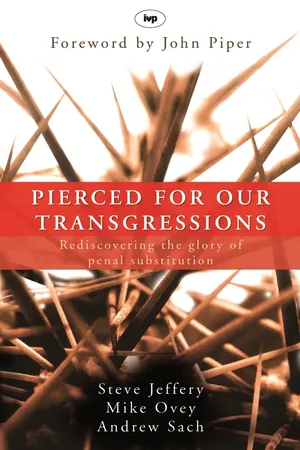
Pierced for our transgressions
Rediscovering The Glory Of Penal Substitution
- English
- ePUB (mobile friendly)
- Available on iOS & Android
eBook - ePub
Pierced for our transgressions
Rediscovering The Glory Of Penal Substitution
About this book
Information
Topic
Theology & ReligionSubtopic
ChristianityPart One: Making the Case
1. INTRODUCTION
Setting the scene
The doctrine of penal substitution states that God gave himself in the person of his Son to suffer instead of us the death, punishment and curse due to fallen humanity as the penalty for sin.
This understanding of the cross of Christ stands at the very heart of the gospel. There is a captivating beauty in the sacrificial love of a God who gave himself for his people. It is this that first draws many believers to the Lord Jesus Christ, and this that will draw us to him when he returns on the last day to vindicate his name and welcome his people into his eternal kingdom. That the Lord Jesus Christ died for us – a shameful death, bearing our curse, enduring our pain, suffering the wrath of his own Father in our place – has been the wellspring of the hope of countless Christians throughout the ages.
It is therefore unsurprising that many have been deeply troubled in recent years to hear dissenting voices raised against this teaching. We fear that Christ will be robbed of his glory, that believers will be robbed of their assurance and that preachers will be robbed of their confidence in ‘the old, old story’ of the life-transforming power of the cross of Christ. The great Baptist preacher Charles Spurgeon foresaw the devastating consequences of losing penal substitution well over a century ago, in a sermon that now takes on an eerily prophetic tone.
If ever there should come a wretched day when all our pulpits shall be full of modern thought, and the old doctrine of a substitutionary sacrifice shall be exploded, then will there remain no word of comfort for the guilty or hope for the despairing. Hushed will be for ever those silver notes which now console the living, and cheer the dying; a dumb spirit will possess this sullen world, and no voice of joy will break the blank silence of despair. The gospel speaks through the propitiation for sin, and if that be denied, it speaketh no more. Those who preach not the atonement exhibit a dumb and dummy gospel; a mouth it hath, but speaketh not; they that make it are like unto their idol...Would you have me silence the doctrine of the blood of sprinkling? Would any one of you attempt so horrible a deed? Shall we be censured if we continually proclaim the heaven-sent message of the blood of Jesus? Shall we speak with bated breath because some affected person shudders at the sound of the word ‘blood’? or some ‘cultured’ individual rebels at the old-fashioned thought of sacrifice? Nay, verily, we will sooner have our tongue cut out than cease to speak of the precious blood of Jesus Christ.1
Mercifully, that ‘wretched day’ has not quite arrived – at least not yet. For ‘the old doctrine of a substitutionary sacrifice’ has not been ‘exploded’; it is still preached faithfully and fervently in churches all over the world. However, an increasing number of theologians and church leaders are calling it into question.
Where did these dissenting voices come from? Many of them can be traced to the rise of liberal theology in the middle of the nineteenth century. Liberalism had little time for the motifs of sacrifice, divine wrath and propitiation entailed in penal substitution. As Henri Blocher observes, ‘Liberal Protestants...felt outraged at the doctrine and complained about a “blood” theology, in their eyes an ugly relic of primitive stages in man’s religious evolution.’2
During the decades that followed, various alternative accounts of the atonement emerged, none of which left room for penal substitution, and some of which explicitly attacked it. Among the most prominent were John McLeod Campbell’s The Nature of the Atonement (1856), Horace Bushnell’s The Vicarious Sacrifice (1866), R. C. Moberly’s Atonement and Personality (1901) and Gustav Aulén’s Christus Victor (1931).3
In the mid-twentieth century, the case against penal substitution was articulated most strongly by the biblical scholar C. H. Dodd.4 In his commentaries on Romans and the letters of John,5 Dodd argued against the traditional rendering ‘propitiation’ for the Greek hilastērion word group, thereby obscuring the references in Romans 3:25, 1 John 2:2 and 4:10 to the fact that Christ’s death averted God’s wrath from sinful people. Dodd’s view was vigorously challenged by evangelicals such as Leon Morris and Roger Nicole, and was later opposed by popular preachers, particularly Martyn Lloyd-Jones, but nonetheless proved influential, not least because Dodd directed the committees that produced the New English Bible. His understanding of these texts was also reflected in the Revised Standard Version, produced in 1946.
In recent years this tide of criticism has intensified with the appearance of works such as Stephen Travis’s Christ and the Judgment of God (1986); Eleonore Stump’s essay ‘Atonement According to Aquinas’ (1988); Colin Gunton’s The Actuality of Atonement (1988); Paul Fiddes’ Past Event and Present Salvation (1989); Vernon White’s Atonement and Incarnation (1991); Stephen Sykes’s ‘Outline of a Theology of Sacrifice’ (1991) and The Story of Atonement (1997); Timothy Gorringe’s God’s Just Vengeance (1996); Tom Smail’s Once and for All (1998); Joel Green and Mark Baker’s Recovering the Scandal of the Cross (2000); J. Denney Weaver’s The Nonviolent Atonement (2001); and Martin Davie’s article ‘Dead to Sin and Alive to God’ (2001).6 John Goldingay, then Principal of St John’s College, Nottingham, edited Atonement Today (1995),7 many of the contributors to which are wary or explicitly critical of penal substitution. John Carroll and Joel Green collaborated with Robert Van Voorst, Joel Marcus and Donald Senior to produce The Death of Jesus in Early Christianity (1995).8
In one sense, it is no surprise that the Bible’s teaching should be criticized in this way, for foundational truths of the Christian faith always come under attack from time to time – witness the debates that have raged in the past over the Trinity, the deity of Christ, the bodily resurrection, and so on. The apostle Paul warned that ‘the time will come when men will not put up with sound doctrine. Instead, to suit their own desires, they will gather around them a great number of teachers to say what their itching ears want to hear’ (2 Tim. 4:3). The more disturbing thing is that some of the more recent critics of penal substitution regard themselves as evangelicals, and claim to be committed to the authority of Scripture. Moreover, whereas criticism of penal substitution was once confined largely to academic books and journals, it has now found its way into popular Christian books and magazines, creating confusion and alarm among Christians.
One of the most significant books of this kind is The Lost Message of Jesus by Steve Chalke and Alan Mann (2003).9 Although not written explicitly as a critique of penal substitution, its description of the doctrine as ‘a form of cosmic child abuse’10 provoked considerable disquiet, not least because Steve Chalke is well known as the founding director of the Oasis Trust and a contributor to several popular Christian magazines. The Evangelical Alliance (EA) responded to the controversy by hosting a public debate in London in October 2004, attended by hundreds of Christians from both sides of the dispute. Both positions were aired but with little resolution. The following summer, the EA organized a symposium at the London School of Theology, attended by over a hundred evangelical scholars, pastors and laypeople. The EA’s own research showed that the vast majority of those present affirmed penal substitution, but the controversy remains firmly on the evangelical agenda, and shows no sign of receding.11
Other criticisms of penal substitution at a popular level have come from Alan Mann in his Atonement for a ‘Sinless’ Society (2005), Stuart Murray Williams in his contributions to the public debates, and Brian McLaren, a leading figure in the ‘Emerging Church’ movement in the USA, in The Story We Find Ourselves in (2003).12
In short, after rumbling away for a century and a half behind the closed doors of the liberal scholarly academy, criticisms of penal substitution have recently been voiced by several influential evangelical theologians and church leaders, provoking a storm of controversy within the Christian community.
Responding to the challenge
Of course, advocates of penal substitution have not been silent during this time. Many have written in defence of the doctrine and the biblical and theological framework that underpins it.
One of the most significant contributions came from the pen of Leon Morris. His article ‘The Use of hilaskesthai etc. in Biblical Greek’ (1951) was a direct challenge to Dodd’s attempt to reinterpret the vocabulary of ‘propitiation’ in the New Testament. Morris concludes that ‘the word group under discussion has reference to the wrath of God, and expresses the great truth that the death of Christ is the means of turning that wrath away from sinners conclusively and finally’.13 A few years later, he published The Apostolic Preaching of the Cross (1955), which discusses in detail the meaning in context of important New Testament vocabulary such as ‘redemption’, ‘propitiation’ and ‘reconciliation’, and clearly affirms the doctrine of penal substitution. He built on this foundation in The Cross in the New Testament (1965), which adopts a broader perspective, surveying all of the New Testament’s teaching about the cross, and harvested the fruits of his academic work for a wider audience in Glory in the Cross (1966), The Atonement (1983) and The Cross of Jesus (1988).14
Unfortunately, Morris’s writings have not had the impact they deserve, because critics of his position paid little attention. Indeed, one of the strangest things about modern challenges to penal substitution is the extent to which they continue to rely on interpretations of Scripture soundly refuted by Morris decades ago, without even attempting to reply to his case.
At around the same time that Morris was writing in Australia, scholars in America also mounted a solid defence of the doctrine. Roger Nicole focused his attention on the task of biblical exegesis, and wrote two significant articles refuting Dodd’s reading of the disputed New Testament texts. John Murray, meanwhile, gave a resounding endorsement to the Reformed doctrine of salvation in his Redemption Accomplished and Applied (1955), as did Louis Berkhof in his Systematic Theology (1941).15
A few years later, back in the United Kingdom, J. I. Packer defended penal substitution in his 1973 Tyndale Biblical Theology Lecture entitled ‘What Did the Cross Achieve? The Logic of Penal Substitution’. This was subsequently published in the Tyndale Bulletin before appearing as a short booklet and as a chapter in volume 1 of his Collected Shorter Writings. Packer’s best-selling book Knowing God (1973) also outlines and defends penal substitution in a chapter entitled ‘The Heart of the Gospel’.16
One of the most important affirmations of the doctrine in recent years is John Stott’s The Cross of Christ (1986). It is breathtaking in its scope and remarkable in its attention to detail, displaying the author’s firm grasp of Scripture and his profound reflection on a whole range of theological and pastoral issues. It has deservedly come to be regarded among evangelicals as one of the standard texts on the cross. Mark Meynell’s Cross Examined (2001) covers similar ground more simply, and draws on the author’s experience of communicating the gospel to university students. This book sets the cross in the broad context of the doctrine of salvation and the Christian life, and it covers a range of biblical, theological and pastoral themes in a highly accessible style.17
More scholarly works in support of penal substitution continue to be published. The French theologian Henri Blocher has contributed three important essays to the debate. ‘The Sacrifice of Christ: The Current Theological Situation’ (1999) and ‘Biblical Metaphors and the Doctrine of the Atonement’ (2004) contain insightful replies to some recent criticisms of the doctrine, and ‘Agnus Victor: The Atonement as Victory and Vicarious Punishment’ (2002) is an incisive response to the claim that penal substitution is excluded by the biblical teaching that at the cross Christ triumphed over evil.18
In a similar vein, Where Wrath and Mercy Meet (2001) is a collection of papers edited by David Peterson, presented at a conference on the atonement held at Oak Hill Theological College, London, in 2000.19 It contains essays on the atonement in the Old and New Testaments, theological studies relating the doctrine to creation, new creation, sin, guilt and punishment, and some reflections on preaching the atonement. It makes a strong case for penal substitution, and responds to several recent challenges. Critics of penal substitution have received it in a similar way to Leon Morris’s work: its arguments have largely been ignored.
The Glory of the Atonement (2004) is another substantial scholarly contribution, written in appreciation of the ministry of Roger Nicole.20 It contains studies of some relevant biblical material, as well as essays from historical and practical perspectives. Nicole himself contributed a ‘Postscript on Penal Substitution’, which by itself does a great deal to clarify the issues involved.
Other recent works include Dan Strange’s ‘The Many-Splendoured Cross’ (2005), Ben Cooper’s Must God Punish Sin? (2005) and Garry Williams’s contribution to the EA symposium on penal substitution, ‘Justice, Law, and Guilt’ (2005). D. A. Carson’s assessment of the ‘Emerging Church’ movement, Becoming Conversant with the Emerging Church (2005), includes brief responses to the criticisms levelled against penal substitution by Brian McLaren and Steve Chalke. Thomas Schreiner defends penal substitution and responds to some alternative positions in Four Views of the Atonement (2006). Frank Thielman has contributed a chapter on the subject for Central Themes in Biblical Theology: Mapping Unity in Diversity (2007).21 Finally, A. T. B. McGowan’s ‘The Atonement as Penal Substitution’ (2006)22 includes a revealing analysis of how penal substitution has become in recent years ‘a major fault line within evangelical theology’,23 as well as an illuminating critique of Steve Chalke and Alan Mann’s The Lost Message of Jesus.
At a more popular level, Ian J. Shaw and Brian H. Edwards’s The Divine Substitute (2006) contains a helpful survey of the last two thousand years, highlighting various figures who were committed to penal substitution. Liam Goligher’s The Jesus Gospel: Recovering the Lost Message (2006) presents the story of the Bible as a drama in three acts, demonstrating how penal substitution is woven into it. Paul Wells’s Cross Words (2006) reflects on the events at Calvary from a range of perspectives, such as ‘Scandal’, ‘Violence’ and ‘Penalty’. Robert Reymond’s The Lamb of God (2006) traces the idea of sacrifice through the Bible, offering helpful treatments of Exodus 12, Leviticus 16 and Isaiah 53 in particular.24
Finally, Ben Cooper’s little book Just Love (2005) is designed to be accessible to both Christians and unbelievers.25 In a short space and an informal style, it explores the specific question of how a loving God can punish sin, and approaches penal substitution from the perspective of God’s justice.
In view of all this material in support of penal substitution, one might reasonably ask whether another book is n...
Table of contents
- Pierced For Our Transgressions
- Contents
- FOREWORD
- ACKNOWLEDGMENTS
- THE AUTHORS
- Part One: Making the Case
- 2. SEARCHING THE SCRIPTURES: THE BIBLICAL FOUNDATIONS OF PENAL SUBSTITUTION
- 3. ASSEMBLING THE PIECES: THE THEOLOGICAL FRAMEWORK FOR PENAL SUBSTITUTION
- 4. EXPLORING THE IMPLICATIONS: THE PASTORAL IMPORTANCE OF PENAL SUBSTITUTION
- 5. SURVEYING THE HERITAGE: THE HISTORICAL PEDIGREE OF PENAL SUBSTITUTION
- Part Two: Answering the Critics
- 7. PENAL SUBSTITUTION AND THE BIBLE
- 8. PENAL SUBSTITUTION AND CULTURE
- 9. PENAL SUBSTITUTION AND VIOLENCE
- 10. PENAL SUBSTITUTION AND JUSTICE
- 11. PENAL SUBSTITUTION AND OUR UNDERSTANDING OF GOD
- 12. PENAL SUBSTITUTION AND THE CHRISTIAN LIFE
- APPENDIX: A personal note to preachers
- BIBLIOGRAPHY
- Notes
Trusted by 375,005 students
Access to over 1.5 million titles for a fair monthly price.
Study more efficiently using our study tools.
Frequently asked questions
Yes, you can cancel anytime from the Subscription tab in your account settings on the Perlego website. Your subscription will stay active until the end of your current billing period. Learn how to cancel your subscription
No, books cannot be downloaded as external files, such as PDFs, for use outside of Perlego. However, you can download books within the Perlego app for offline reading on mobile or tablet. Learn how to download books offline
Perlego offers two plans: Essential and Complete
- Essential is ideal for learners and professionals who enjoy exploring a wide range of subjects. Access the Essential Library with 800,000+ trusted titles and best-sellers across business, personal growth, and the humanities. Includes unlimited reading time and Standard Read Aloud voice.
- Complete: Perfect for advanced learners and researchers needing full, unrestricted access. Unlock 1.5M+ books across hundreds of subjects, including academic and specialized titles. The Complete Plan also includes advanced features like Premium Read Aloud and Research Assistant.
We are an online textbook subscription service, where you can get access to an entire online library for less than the price of a single book per month. With over 1.5 million books across 990+ topics, we’ve got you covered! Learn about our mission
Look out for the read-aloud symbol on your next book to see if you can listen to it. The read-aloud tool reads text aloud for you, highlighting the text as it is being read. You can pause it, speed it up and slow it down. Learn more about Read Aloud
Yes! You can use the Perlego app on both iOS and Android devices to read anytime, anywhere — even offline. Perfect for commutes or when you’re on the go.
Please note we cannot support devices running on iOS 13 and Android 7 or earlier. Learn more about using the app
Please note we cannot support devices running on iOS 13 and Android 7 or earlier. Learn more about using the app
Yes, you can access Pierced for our transgressions by Andrew Sach,Steve Jeffery in PDF and/or ePUB format, as well as other popular books in Theology & Religion & Christianity. We have over 1.5 million books available in our catalogue for you to explore.