- English
- ePUB (mobile friendly)
- Available on iOS & Android
eBook - ePub
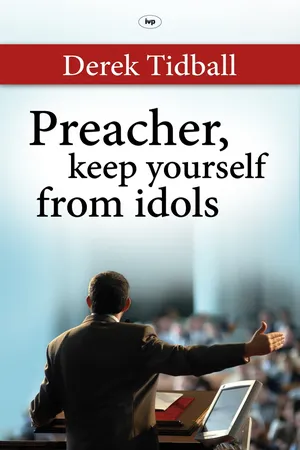
Preacher, Keep Yourself from Idols
About this book
Guidance and wisdom for maintaining good practice and avoiding temptation in preaching. With insight and wisdom, Derek Tidball reviews a selection of idols to which preachers are particularly vulnerable, under four headings: the self, the age, the task and the ministry. His aim is not to condemn, but to alert.
Information
1. The Idol Of The Pulpit
Some idols lie very close to any preacher’s heart. They have to do with the preacher’s core identity and affect both personal and vocational self-understanding. The idols relate to the nature of the calling to be a preacher and the sort of people who respond to that calling.
Three such idols may be identified: the idol of the pulpit, the idol of authority (or power) and the idol of popularity.
To describe the pulpit as a potential idol is perhaps a surprising place to begin, especially as ‘the pulpit’ is being used not in the sense of a raised platform from which the preacher speaks, but as a synonym for preaching itself. The platform from which someone preaches may have symbolic significance. It can be a symbol for the status of the preacher which can corrupt his or her motives and become an end in itself. Its elevation above the congregation may suggest that the preacher is above the congregation in authority or holiness: famously ‘six foot above contradiction’. Today, however, one is more likely to speak from a rickety and precarious makeshift platform shared with a group of musicians who have barely left the preacher enough room to stand. The reduction in elevation and the incursion of others into the space is symbolic either of the lessening authority of the preacher in some circles, or, in others, of a more ‘innocent’ accommodation to forms of communication that fit contemporary culture. But the pulpit as a platform is not our concern here.
Affirmations about preaching
The pulpit can easily become an idol because the activity it represents – that is, preaching – can become an end in itself. Preachers can become pulpiteers. This is not to say all preaching is idolatrous. Far from it. God has given teachers to his church who play a very significant part in proclaiming, applying and preserving the integrity of the gospel.1 It remains an immense privilege to be called to be a preacher and I readily affirm its importance in the mind and ways of God. Astonishingly, God continues to use preachers as the medium through which he not only speaks but brings his creative, life-giving and transforming word to people’s lives. I have no doubt about its significance or potential effectiveness. Our God is a God who from the very beginning spoke and his words made things happen. Down the centuries he has chosen preachers of one sort or another to continue this work of conveying his words and producing their desired effect.2 As Sidney Greidanus puts it,
Contemporary preaching of the gospel...is an indispensable link in the chain of God’s redemptive activity which runs from Old Testament times to the last day (Matt. 24:14). God uses contemporary preaching to bring his salvation to people today, to build his church, to bring in his kingdom. In short, contemporary preaching is nothing less than a redemptive event.3
Whatever the qualifications, the trajectory that leads from Moses, through the Hebrew prophets and the apostles, and down through the centuries to the contemporary sermon forms a path which is connected and shows marked coherence, while at the same time it also demonstrates change and development. Preaching is a significant instrument which God has used and continues to use under the direction of the Holy Spirit to communicate his word to those he has created. Consequently, preaching has always been a significant barometer of the health of the church over the centuries. P. T. Forsyth asserted its importance but was nonetheless probably correct when he began his lectures, entitled Positive Preaching and the Modern Mind, with the statement, ‘It is, perhaps, an overbold beginning, but I will venture to say that with its preaching Christianity stands or falls.’ 4 Indeed, perhaps such a claim is overstated and begins to hint at the way in which preaching may become idolatrous.
Preaching as idolatry
In spite of these positive affirmations about preaching, there are signs that preaching, and its contemporary form ‘the sermon’, is in danger of being idolized in some circles today. In recent days, the number of conferences, training courses, workshops, addresses and publications that celebrate ‘the glory of preaching’ 5 have greatly increased. In many of these the role of preaching – for which read ‘the contemporary sermon’ – is exalted and awarded the status of being an essential and indispensible means by which the dying church is to be revived and a healthy church replenished. Other means of reviving the church are downgraded and other marks of a healthy church are recalculated so that preaching assumes the place of supreme importance.
Curiously, the number of such claims have increased almost in direct, inverse proportion to the decline of the importance of preaching in the popular mind,6 and of criticisms of it within the church.7 Those of a suspicious turn of mind might think that those who advocate the glory of preaching suffer from a severe case of cognitive dissonance.8 Cognitive dissonance leads to our adopting strategies to ease the discomfort between knowing our position cannot really be sustained and our ongoing commitment to it and even advocacy of it anyway. Usually it is based on the mistaken understanding that the more we can persuade others to believe what we believe, the more it must be true. It is a form of the old joke about the preacher’s sermon notes on which was written, ‘Argument weak, shout louder!’
One example of this overblown status is found in the work of the greatly and deservedly respected Martyn Lloyd-Jones. In his lectures on preaching he argued that there was ‘no substitute’ for it.9 Reviewing other forms of ministry, he dismissed them as essentially relieving symptoms rather than providing cures. He argued that personal counselling, or a man who reads about salvation on his own, or one who watches television and finds Christ, has missed out in some way. The ‘very atmosphere’, he writes, ‘of Christian people meeting together to worship God and to listen to the preaching of the Gospel’ is part of the mystery God uses to accomplish his purposes.10 But, beneficial though such a setting may be, this is surely a half-truth at best. It certainly does not fit the sweep of biblical evidence. Stephen before the Sanhedrin, the eunuch on the way home from Jerusalem to Ethiopia, the Philippian jailer and the people debating at Athens do not conform to this model and were not subject to the sort of preaching Lloyd-Jones was advocating. God is not as restricted in the way he works as we frequently wish he were. God clearly has not read our rulebooks.
Citing Ephesians 3:8–10 (‘His intent was that now, through the church, the manifold wisdom of God should be made known to the rulers and authorities in the heavenly realms’), Lloyd-Jones argued, ‘My whole contention is that it is the Church alone who can do this, and it is the preacher therefore who alone can make it known. He is set apart by the Church...to serve this particular function, to perform this particular task.’ 11 In the wider context Paul had indeed been talking about his calling as an apostle, but he had then broadened his argument to include the church in its collective life as the means by which God would announce the gospel to the unseen powers of the universe. There is no legitimate reason for narrowing this role to ‘the preacher alone’. God works through the church as a whole, through many different witnesses, not all of whom are preachers. The demonstration of its members’ transformed lives, their exercise of love and their use of the varied gifts which make up the body are all used by God, not just the mouth! Through its ongoing life, the whole church proclaims the gospel.
Lesslie Newbigin was on much surer biblical ground when he wrote about mission, ‘I am suggesting that the only answer, the only hermeneutic of the gospel is a congregation of men and women who believe and live by it.’ 12 A congregation, note, not a preacher.
Some evangelicals have an almost sacramental view of the sermon and imply it is the exclusive, or near exclusive, means God uses to channel his grace today. They are in danger of displacing the biblical sacraments of baptism and the Lord’s Supper by the sacrament of the word.13 But this is surely to be questioned and potentially leads us in the direction of idolatry as easily as did some of the medieval and superstitious views of the Catholic mass.
Some contemporary talk about the sermon echoes Israel’s trust in the temple that Jeremiah so roundly denounced in his ‘Temple Sermon’.14 Israel placed their trust in the erroneous belief that the mere existence of the temple in the heart of their community would give them security and exempt them from God’s judgment. To trust in this, Jeremiah said, was to trust in ‘deceptive words that are worthless’ (Jer. 7:4, 8). To trust in the presence of fine and abundant preaching, as if that alone brings security and makes for spiritual health, is similarly to court disaster rather than the blessing of God. According to Jeremiah, it is not the chanting of mantras about the temple, but just and righteous living that brings security. So it is with preaching. It is not our devotion to the pulpit, nor the frequency with which we preach or taste sermons, but the practice of righteous and Christ-like lives that counts. Anything else is no more than empty words.
Preaching and the modern sermon
Part of the problem with those who advocate ‘the glory of preaching’ lies in the neat equation that is often made between God as a communicator and the form of the contemporary sermon. The equation is often an unspoken assumption. The Bible reveals a God who adopts various means of communicating to his people, both of a visual and a verbal kind, and to narrow his communication down to one form should be treated with caution. There are several reasons for making such a statement.
First, within the Bible God communicates directly in words and through the messages that his prophets and other messengers speak. But he also communicates through dreams, visions, dramatic actions, carefully composed poetry, song, thinking-aloud-type reflection and, perhaps most commonly, through narratives and history. While today any communication from God must be totally in line with his completed revelation in scripture, why should the means he uses be reduced exclusively to one, even if that one method assumes some measure of priority?
Second, truth compels us to admit that we know remarkably little about the form taken by early Christian preaching to a Christian congregation, on which the contemporary sermon is said to be modelled.15 The sermons in the Acts are mostly summaries of evangelistic sermons to a Jewish audience, although on two occasions they are addressed to Gentiles, and they leave a good deal unsaid. We can probably reconstruct what Paul’s preaching was like from his writings, since these were composed orally and then read to a congregation, but to get from them to what we now call a sermon involves a number of steps and assumptions which we do not often admit. Then again, we can build on what we know about the tradition of synagogue preaching, but our knowledge is limited and our claims should be correspondingly modest. To say the twenty-minute (or whatever length you choose) monologue to believers in a church building which we call preaching is the heir to New Testament preaching may short-change New Testament preaching.
Third, down the centuries God has clearly used other forms of communication as well as the sermon. These include:
- theological disputation and debate, as in the Reformation;
- Bible translation and the direct, unmediated use of scripture;
- dramatic enactments, such as those pioneered by the prophets;
- writing, such as contemporary evangelistic books, which take their cue from the Gospels;
- even visionary experiences and dreams, for which there is much biblical precedent.
All of these, and more, have played and continue to play a role in the church.
Fourth, forms and style of communication are very much influenced by culture, and many more and different means of communication are available today than previously. None of these are to be used uncritically, some are more effective than others and some are more tainted than others. Modern methods of communication have not taken the Creator by surprise and it would be remarkable indeed if he did not make use of every available medium of communication to broadcast his truth. They all need to be claimed for Christ. As Paul reminded the Corinthians, who were picking and choosing between leaders, ‘all are yours, and you are of Christ, and Christ is of God’ (1 Cor. 3:22–23). None can claim a monopoly in leadership, nor in the way in which God communicates to his world.
So, to exalt the pulpit and the modern sermon above all other forms of communication and to place them in a supreme place may be to claim too much. Preachers should be careful to apply the image of the church as a body 16 to their own calling. Preachers are more prominent than other members of the church because theirs is the most regular, visible and collective form of communication. But other members of that same body, and other forms of communication, are equally valuable. We should heed Paul’s warning that ‘our presentable parts need no special treatment’ (1 Cor. 12:24): that is to say, they should not be treated differently in terms of honour and status, even though they may require special training. The sermon is a vital tool by which God speaks, but one among others.
The practical impact of how we estimate the value of preaching
Without lessening the responsibility we should feel, or the honour that is ours when called to preach, we frequently need to demonstrate more humility in our estimate of the significance of preaching, especially if we want to know God’s blessing on it. How we estimate the status of preaching has a very practical effect on our ministry.
First, inflated ideas of preaching can lead us to inflated ideas of ourselves. Whether we intend it or not, as we enhance the status of preaching so we enhance the status of the preacher. Consequently, some preachers see themselves as above the church rather than part of the church. But preachers are merely members using the particular gifts God has given them among the many others to whom God has given different gifts, all of which are essential to a healthy body. A right estimate of preaching leads us to personal humility, to the deposing of pride and the exalting of grace. It leads us to a more apostolic view of ministry – that ‘we have this treasure in jars of clay’ (2 Cor. 4:7), or, as Paul puts it in a celebrated put-down, ‘What, after all, is Apollos? And what is Paul? Only servants...’ (1 Cor. 3:5). Paul’s command, ‘Do not think you are superior’ (Rom. 12:16), applies to preachers as much as to anyone else.
In his much-acclaimed lectures on preaching, Phillips Brooks identified ‘self-conceit’ as ‘beyond all doubt’ the first danger that a preacher faces. He explained that,
in a certain sense every young minister is conceited ...At least every man begins with extravagant expectations of what his ministry may result in. We come out from it by and by. A man’s first wonder when he begins to preach is that people do not come to hear him. After a while, if he is good for anything, he begins to wonder why they do. He finds out that the old Adam is too strong for the young Melanchthon.17
He continued by explaining that after a time we deal with this initial self-conceit by substituting smaller self-conceits, ‘some petty pride’, as he called it. We become content that our sermons are commended, or our name is known in our denomination, or we stress ‘the dignity of ordination’. We say to ourselves, ‘I am a minister. I bear a dignity that these laymen cannot boast. I have an ordination which separates me into an indefinable, mysterious privilege.’ He warned, ‘Here is, the beginning of many of the fantastic and exaggerated theories about the ministry. The little preacher magnifies his office in a most unpauline way.’18 To avoid such conceit, Brooks advocated the need for a growing dedication of one’s life to God, and the more and more complete absorption of our beings ‘in seeking God’s glory’.19
Second, a correct estimate of preaching reduces the pressure on the preacher, whereas an overestimate increases the pressure on the preacher. Again, Phillips Brooks has wisdom to offer. Having stressed the importance of preparation and the need to remove, as much as possible, ‘the fallible messenger’ from the ‘infallible message’,20 he speaks of the way in which the pressure to preach ‘a great sermon’ haunts preachers. This is aggravated when we magnify the importance of ‘the sermon’. Such a notion, he says, is fatal. ‘It hamper...
Table of contents
- Derek Tidball
- Preacher, keep yourself from idols
- Contents
- Abbreviations
- Preface
- Introduction: The Nature Of Idolatry
- The idols of the self
- 1. The Idol Of The Pulpit
- 2. The Idol Of Authority
- 3. The Idol Of Popularity
- The idols of the age
- 4. The Idol Of Sucess
- 5. The Idol Of Entertainment
- 6. The Idol Of Novelty
- 7. The Idol Of Secularization
- The idols of the task
- 8. The Idol Of Oratory
- 9. The Idol Of Immediacy
- The idols of the ministry
- 10. The Idol Of Professionalism
- 11. The Idol of Busyness
- 12. The Idol Of Familiarity
- Epilogue
- Notes
Trusted by 375,005 students
Access to over 1.5 million titles for a fair monthly price.
Study more efficiently using our study tools.
Frequently asked questions
Yes, you can cancel anytime from the Subscription tab in your account settings on the Perlego website. Your subscription will stay active until the end of your current billing period. Learn how to cancel your subscription
No, books cannot be downloaded as external files, such as PDFs, for use outside of Perlego. However, you can download books within the Perlego app for offline reading on mobile or tablet. Learn how to download books offline
Perlego offers two plans: Essential and Complete
- Essential is ideal for learners and professionals who enjoy exploring a wide range of subjects. Access the Essential Library with 800,000+ trusted titles and best-sellers across business, personal growth, and the humanities. Includes unlimited reading time and Standard Read Aloud voice.
- Complete: Perfect for advanced learners and researchers needing full, unrestricted access. Unlock 1.5M+ books across hundreds of subjects, including academic and specialized titles. The Complete Plan also includes advanced features like Premium Read Aloud and Research Assistant.
We are an online textbook subscription service, where you can get access to an entire online library for less than the price of a single book per month. With over 1.5 million books across 990+ topics, we’ve got you covered! Learn about our mission
Look out for the read-aloud symbol on your next book to see if you can listen to it. The read-aloud tool reads text aloud for you, highlighting the text as it is being read. You can pause it, speed it up and slow it down. Learn more about Read Aloud
Yes! You can use the Perlego app on both iOS and Android devices to read anytime, anywhere — even offline. Perfect for commutes or when you’re on the go.
Please note we cannot support devices running on iOS 13 and Android 7 or earlier. Learn more about using the app
Please note we cannot support devices running on iOS 13 and Android 7 or earlier. Learn more about using the app
Yes, you can access Preacher, Keep Yourself from Idols by Derek Tidball in PDF and/or ePUB format, as well as other popular books in Theology & Religion & Christian Church. We have over 1.5 million books available in our catalogue for you to explore.