Forty pilot whales lie stranded on Darlington Beach, Tasmania. Marine conservation biologist Andrew Irvine knows he must act fast...
The Bible teaches that as the whale was made for the ocean, men and women were made for God. Our relationship with him is the environment in which we are free to be fully human.
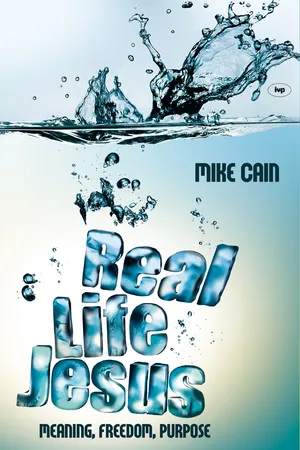
Author Mike Cain unpacks Jesus' claims in John's Gospel and shows us why they cannot be ignored: sin, forgiveness and restoration affect us personally. With humour, originality, passion and sensitivity, Mike asks us to look again at Jesus: the real-life version, not the caricature.
This is a heartfelt appeal from one whose own life has been transformed.
- English
- ePUB (mobile friendly)
- Available on iOS & Android
eBook - ePub
About this book
Information
Topic
Theology & ReligionSubtopic
ChristianityChapter 1
A rescue story
Forty pilot whales lie stranded on Darlington beach, Tasmania. Andrew Irvine, a marine conservation officer, knows that he must act fast.
Scientists are not sure what causes a whale to beach itself. Some have suggested that it is the result of a disease that upsets the mammal’s internal navigation system. Herding instincts mean that the whole pod may then follow its disorientated leader into danger. Others believe that the mammals have simply chased their prey too close to the shore and have found themselves trapped in the shallows.
What we do know is that – without intervention – being beached is invariably fatal. Sometimes the whale becomes dehydrated. Sometimes it suffocates as its lungs are crushed under its own body weight, or drowns when the incoming tide covers its blowhole as it lies immobile on its side.
On Darlington beach the huge grey slabs of whale blow and gasp. Several are twitching their fins, and occasionally one will thrash its tail in a desperate bid to right itself. As people arrive on the scene, eager to help, Irvine coordinates the rescue attempt. Someone sets up a hose pump and begins to spray the whales with seawater. Others spread heavy hessian mats over the bodies of the whales and wet them down.
One team of about fifteen people gathers around a large bull pilot whale. The first task is to set the animal upright. Some of the volunteers are in wetsuits; others, in their work clothes, take off their jackets, roll up their trousers and lean their shoulders into the smooth, hard flank of the whale. As though lifting a car on to its side, they eventually heave the whale up and Irvine slides hessian mats under his nose and tail. The team then tries to haul the mats along under the whale’s body. Some roll him slowly from side to side. Others scrape away the sand beneath him with hands and spades to get the mats under his middle. When someone brings a spade down by his head the whale flinches, and then falls still. His breathing has become very quiet.
Once the mat is in place, the team begins to drag the whale back towards the sea. On the count of three they lift him for a few metres at a time, then drag and lift and drag until they are waist-deep in water. They push on and soon the whale is floating. But he is very still. Five of the team stay with him to keep him stable. After nearly an hour, he gently flicks his tail and swims off into the ocean. He is back where he belongs.
Stranded men and women
The whale was made for the ocean. The ocean is the environment in which it is free to be a whale: to swim, to leap, to sing, to dive down a thousand metres into the dark depths and catch squid with its built-in sonar. It is an awesome creature. On the beach you can still see something of its power and its beauty, but your admiration is mixed with sadness. As it thrashes its tail helplessly, as it lies there limp and wheezing, you know that this was not the life it was created for. A beached whale is a dead whale.
The Bible teaches that, as the whale was made for the ocean, men and women were made for God. He created us to enjoy his love and to reflect his ways on earth. Our relationship with him is, as it were, the environment in which we are free to be fully human. But, as the whale has crashed out of the ocean, humankind has walked out on God. We thought that it would set us free. But it has left us stranded on the beach. Like the whale on the beach, we are noble creatures, but we cannot reflect on our beauty without a sense of sadness.
During the past few days, I have sat by the fire and laughed with friends. I have wandered round an art gallery. I have eaten lamb tagine and lemon syllabub. I have danced around the kitchen table. I have sat spellbound with my children in the theatre and gone with my family for a long and happy walk in the Mendips, when the winter sun shone and the countryside was golden. Life is beautiful. And yet that beauty is shot through with sadness. During the same few days I have wept at the funeral of a friend who committed suicide. Someone else has told me that his marriage is breaking up. The news has been full of the gun crime on our streets, and the body count in the Middle East goes on rising.
The beauty in our world is easy. We don’t think twice about what we are to do with it – we just enjoy it. But what are we to do with the sadness?
What are we to do with our sadness?
We have been brought up to believe that the story of humankind is a story of progress. In some ways that is true. On the surface, the twenty-first century looks very different from the first century. The world is healthier and wealthier than it has ever been. But under the surface, do you think there is less sadness in the twenty-first century than in the first? Do you think we shed fewer tears? Why is it that we are able to put man on the moon but, despite all the years of technological advancement, we haven’t been able to stop him invading other countries, or bullying his friends, or stealing from his neighbour, or walking out on his family? In some parts of the world we may well have extended the average life expectancy by a few years. But when confronted by death we are as helpless and as frightened as we have ever been. For all our progress, we show no sign of being able to eradicate the pain and suffering that blights our world. Whether we are surfing the internet in our high-rise apartment block in Manhattan or lighting a fire outside our tent in the Sahara desert, it makes no difference. Our experience of being human is inextricably bound up with an experience of sadness.
The cheery optimism that says that humankind is on the up and up is a bit like a whale trying to persuade itself that, despite all the evidence, it was made for the beach and that suffocating under its own body weight is as good as it gets. In order to keep up the pretence, the whale has to tell itself that there is in fact no ocean. We have to try to tell ourselves that there is no God.
If there is no ocean, then the whale’s experience of the beach is not a problem. It is just how things are. Similarly, if there is no God, then our experience of sadness is not a problem. It is just how things are. If life is just the result of a cosmic roll of the dice, then laughter and tears are neither good nor bad. They are just the numbers that came up. Just as there are mountains and valleys, there is war and there is peace. And just as we wouldn’t try to argue that mountains are morally better than valleys, a godless universe gives us no grounds for arguing that peace is morally better than war. Stuff just happens.
If there is no God, then our experience of sadness is not a problem. It is just how things are.
When we talk about the behaviour of animals, we tend to use the language of instinct and conditioning rather than the language of right and wrong. So we might put down a dog because it had become dangerous, but we wouldn’t blame it. Because we have been brought up to believe that we are no different from any other animal, when it comes to talking about human behaviour we have tried to use the language of instinct and conditioning rather than the language of moral responsibility. In other words, we have tried to say ‘Don’t blame me – it was my genes...or my upbringing...or my environment.’ What we do is just what we do. As polar bears hunt seals, so human beings prey on those who are weak and who stand in their way.
But it seems to me that there is a tension between the story we have told ourselves about what it means to be human and our everyday experience of being human. We say that we are no more than ‘naked apes’, yet when someone behaves ‘like an animal’, we are quick to identify what they did as being somehow less than human. In other words, we say that we are no more than animals and yet, day by day, we expect people to behave as though they were a whole lot more than animals. Think of how we respond to crime. The fact that I have no job may form part of the explanation for why I mugged you, stole your wallet and left you bleeding in the street. But you would be reluctant to conclude that what I did was just an instinctive response conditioned by my environment. You would say that what I did was wrong. If I were to run you down in my car because I was drunk, you wouldn’t be satisfied if the judge in the court dismissed the case by declaring that my actions were no more than chemical reactions to external stimulation. You would want to blame me for the choices I had made.
In other words, central to our sense of what it is to be human is a sense that we are able to make moral choices. In this, our behaviour is at odds with our beliefs. The logical conclusion to draw from the story of the universe that we tell ourselves is that our thoughts and actions are no more than a series of chemical reactions over which we have no control. And yet we go on talking about what people should do or ought not to have done as though there is such a thing as an ability to make moral and meaningful choices. But the fact is that the story we have told ourselves about what it means to be human gives us no foundation for our sense of being moral creatures. From where have we smuggled in this sense of morality and meaning?
I am not saying that this proves that there is a God. I am just saying that we find it hard to live in a way that is consistent with our atheism. The story we tell to make sense of what it means to be human doesn’t seem to be big enough. So there is a tension at the heart of the human experience. Face down in the sand, all we can see is beach. It is only logical for us to conclude that the beach is all there is. And yet the longing for the ocean won’t go away. We’re not able just to shrug our shoulders in the face of the sadness and the suffering. We wish that life didn’t hurt so much. We campaign against injustice because we think it is wrong, and we weep at the loss of those whom we love. And every time we dream of a better world, we are admitting that human beings are made for something bigger than the beach on which we find ourselves stranded. We are admitting that something has indeed gone wrong.
The Bible makes sense of the tension
One of the reasons I take the Bible seriously is because it makes sense of the tension that we feel. The story it tells starts with Genesis. Of course, there is scope for debate on how exactly we are to read the first few chapters. But the author wants us to know that the story of the universe begins with God. It is God who charges the whole universe with meaning. And we are not just an accidental assortment of atoms. The Bible says that God made us in his image. In other words, the Bible has a noble view of humanity and says that we have been created for a noble purpose. As those made in the image of God, our purpose is to enjoy his love and reflect his ways in the world. And life with the Creator, who made the stars and the dragonflies, is never dull. He didn’t give us fuel to stick into our sides. He gave us food to taste – like lamb tagine and lemon syllabub. The author of Genesis says that God looked at all that he had made and called it ‘very good’.
So, on the one hand, the Bible makes sense of the beauty of life. It says God created this world for us to enjoy. On the other hand, it also makes sense of the sadness.
The Bible is not an escapist fantasy. It doesn’t duck the hard questions. The Christian God does not call on us to grin and bear the pain and pretend it isn’t there and doesn’t hurt. He wants us to come clean about the ugliness in this world and the sadness in our lives. He wants us to face up to the fact that there is a problem, because recognizing that there is a problem is the first step to a solution. It is like ignoring a lump in your breast. Pretending that all is well will only make things worse in the long run.
The Bible says we are right to dream of a better world. As things stand, this world of ours is not as good as it gets. In the beginning it was good. Very good. But something has gone wrong. We have gone wrong. We have gone wrong because we have turned our backs on the God who made us.
Our culture is deeply suspicious of any suggestion that we might be in any way to blame for the mess our world is in. To our ears, it sounds like a sure-fire route to low self-esteem. So to get ourselves off the hook we have pushed God further and further out of the picture. But do you see what has happened? Shrink God, and we end up shrinking all that it means to be human.
The Bible’s diagnosis of the human condition may take some chewing on. But you need to know that it does not lead to low self-esteem. Just the opposite. The very fact that we are held responsible underlines the fact that we are not meaningless animals. We are noble creatures, but we have used our nobility badly. Instead of using it to enjoy the God who made us, we have used it to crash out of the ocean. That is why our beauty is shot through with sadness. Stranded on the beach, we thrash about, fighting to eke out some kind of existence. But it’s not the life that we were made for. Our days are shot through with death. And our sickness, our frailty and our mortality all point to the fact that we are cut off from the fullness of the life for which we were created, because we have walked out on the God who is the source of life.
Jesus has come to restore us to the life we were created for
Towards the end of his account of the life and ministry of Jesus of Nazareth, John, one of Jesus’ followers, tells us why he has taken the trouble to write it all up.
But these are written that you may believe that Jesus is the Christ, the Son of God, and that by believing you may have life in his name. (John 20:31)
In the next chapter we will look at the meaning of words like ‘believe’ and ‘Christ’ and ‘Son of God’. For now we’re just going to concentrate on what John says that Jesus is offering to people like me and you. That phrase ‘in his name’ means ‘on the basis of all that he is and all that he has done’. John is saying that, on the basis of all that Jesus is and all that he has done, dying people like us may have life. In fact, Jesus himself says ‘I have come that they may have life, and have it to the full’ (10:10).
I think that this comes as something of a shock to us. We have picked up the idea that Jesus came to tie us up in ‘thou shalt’ knots that are going to restrict our freedom. The word on the street is that he is going to tell us to sit up straight and stop enjoying ourselves: stop thinking, stop feeling, stop laughing. Stop going to the cinema, or making music, or asking questions. We think that following Jesus will mean missing out on life. We think it will mean wearing cardigans and drinking lemon squash from polystyrene cups in the back of musty church halls. We think.
But John says: when you think about what Jesus has come to do, don’t think of rules and regulations and rituals. Think of a beached whale being restored to the ocean. Think of it swimming free again.
Jesus goes on to define the ‘life’ that he has come to bring. On one occasion, when he is praying for his disciples, he says, ‘Now this is eternal life: that they [the disciples] may know you, the only true God, and Jesus Christ, whom you have sent’ (17:3). He says that the life he has come to bring is about knowing ‘the only true God’. In other words, Jesus has come to restore us to the environment for which we were created, because he has come to give us a relationship with the God who made us.
There might be a bit of you that is jumpy about the whole idea of knowing God. We are not sure that we want God looking over our shoulder and breathing down our neck the whole time. It sounds so oppressive. But the ocean doesn’t oppress the whale. The deeper it goes into the water, the freer it is to enjoy all that it means to be a whale. God doesn’t compromise our humanity. The deeper our relationship with him, the freer we are to enjoy all that it means to be human.
John’s big claim is that Jesus has come to restore us to the reason we were put on this planet. He has come to give us the life that we were created for – the life that we long for. Real life.
* * *
‘OK,’ you say, ‘that’s all well and good and everything. I can see how some people might get quite excited about a claim like that. In theory. But it’s just not for me.’
Let me put my cards on the table. I want to try to show you that it is for you.
Chapter 2
A claim we can’t walk away from
John 20:31
For most people, religion comes under the same category as stamp collecting or Latin American dancing. It is what some people choose to do with their spare time. And, in the same way that not exactly everyone goes for train spotting, not exactly everyone goes for religion. If you do, then we are, on the whole, happy for you. Personally, we can’t see the attraction. But then (we find ourselves saying) ‘I am not the religious type.’
Fair enough, you might think.
But imagine this. You and I are walking across the Clifton Suspension Bridge in Bristol, admiring the Avon Gorge and peering down at the muddy old river some eighty metres below. After a while, we decide to head down to the towpath. While you make your way back along the bridge, I stay out in the middle and begin to clamber over the railings. I am just about to step off into thin air when you see what I am up to and yell out, ‘Mike, what are you doing?!’
‘Well, we wanted to get to the riverbank, so I thought it would be quicker to climb straight down from here,’ I explain, in a matter-of-fact sort of way.
‘But, Mike, you’ll drop straight down into the river. You’ll kill yourself!’
‘No. Not me,’ I reply. ‘You see, I am not the gravity type.’
Well, what would you say to that? I take it that you’d tell me in no uncertain terms that, when it came to gravity, my ‘type’ was irrelevant. You’d tell me that gravity was not just an idea that some people found helpful. Gravity was a reality that everyone in the world needed to reckon with. At least, that’s what I hope you’d say.
Our culture has left us with a view of the world in which we would be seriously concerned about the mental well-being of anyone we met who said they were ‘not the gravity type’, but if we met someone who said they were ‘not the religious type’ we would barely raise an eyebrow. We have been brought up to believe in two separate worlds. On the one hand there is what we might call the ‘physical world’, in which we can publicly agree that it is, for example, dangerous to step off suspension bridges. On the other hand there is what we might call the ‘spiritual world’, which we regard as being essentially private.
Our working assumption is that when people talk about physical things (such as the best route to Middleton-on-Sea), they are talking about something we all need to reckon with. The reason we make a mental note of their suggested route is that we are confident that it will come in handy for us the next time we are heading to the West Sussex coast. But when it comes to someone talking about spiritual things, it is an altogether different story. We have been brought up to believe that when it comes to talking about the route to God, we cannot offer anything more than what we call our ‘personal opinion’. By ‘personal’, we mean ‘personal’ as in ‘personal stereo’, as in ‘This music is just for me to enjoy.’ And just as the music you download and listen to on your iPod reflects your own taste, so the way you talk about God is really just a reflection of your own hopes and hang-ups.
Last week, I had a long conversation over dinner with a woman who told me that she had spent the past three years on a spiritual journey. I asked her if she felt she was approaching any sort of a destination. Had she, for example, found God?
‘Oh, no,’ she replied. ‘But that’s not the point. It’s the journey that matters, not the destination. This isn’t about so...
Table of contents
- Real Life Jesus
- Contents
- Foreword
- Preface
- Acknowledgments
- Chapter 1 A rescue story
- Chapter 2 A claim we can’t walk away from
- Chapter 3 God has a face
- Chapter 4 A fresh start
- Chapter 5 The love that we long for
- Chapter 6 The revolution
- Chapter 7 Our life in his hands
- Chapter 8 Bread for the journey
- Chapter 9 Life to the full
- Chapter 10 The Servant King
- Chapter 11 The future starts today
- Suggestions for further reading
Trusted by 375,005 students
Access to over 1.5 million titles for a fair monthly price.
Study more efficiently using our study tools.
Frequently asked questions
Yes, you can cancel anytime from the Subscription tab in your account settings on the Perlego website. Your subscription will stay active until the end of your current billing period. Learn how to cancel your subscription
No, books cannot be downloaded as external files, such as PDFs, for use outside of Perlego. However, you can download books within the Perlego app for offline reading on mobile or tablet. Learn how to download books offline
Perlego offers two plans: Essential and Complete
- Essential is ideal for learners and professionals who enjoy exploring a wide range of subjects. Access the Essential Library with 800,000+ trusted titles and best-sellers across business, personal growth, and the humanities. Includes unlimited reading time and Standard Read Aloud voice.
- Complete: Perfect for advanced learners and researchers needing full, unrestricted access. Unlock 1.5M+ books across hundreds of subjects, including academic and specialized titles. The Complete Plan also includes advanced features like Premium Read Aloud and Research Assistant.
We are an online textbook subscription service, where you can get access to an entire online library for less than the price of a single book per month. With over 1.5 million books across 990+ topics, we’ve got you covered! Learn about our mission
Look out for the read-aloud symbol on your next book to see if you can listen to it. The read-aloud tool reads text aloud for you, highlighting the text as it is being read. You can pause it, speed it up and slow it down. Learn more about Read Aloud
Yes! You can use the Perlego app on both iOS and Android devices to read anytime, anywhere — even offline. Perfect for commutes or when you’re on the go.
Please note we cannot support devices running on iOS 13 and Android 7 or earlier. Learn more about using the app
Please note we cannot support devices running on iOS 13 and Android 7 or earlier. Learn more about using the app
Yes, you can access Real life Jesus by Mike Cain in PDF and/or ePUB format, as well as other popular books in Theology & Religion & Christianity. We have over 1.5 million books available in our catalogue for you to explore.