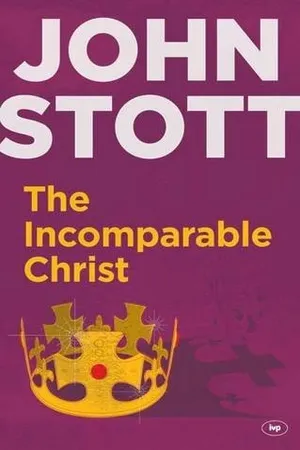
Jesus Christ has been the dominant figure in the history of Western culture for two millennia, and his birth the pivot of our calendar.He is the focus of Scripture: as Luther declared, 'The entire Scripture deals only with Christ everywhere.' He is the heart of mission, the message that countless Christians cross land and sea, continents and cultures, to deliver. In masterly surveys, John Stott looks at the New Testament witness, at the way the church has portrayed Christ down through the centuries, and at the influence Christ has had on individuals over the last two millennia. Finally, turning to the book of Revelation, he asks what Jesus Christ should mean to us today. Here is the fruit of a lifetime of biblical study, rigorous Christian thought and devotion to the person of Jesus Christ.'John Stott paints a picture of the incomparable Christ on a huge canvas. He applies his incisive mind, his commitment to Scripture and his sense of awe at God's purpose in human history, focusing with humility on the Jesus he knew and loved throughout his life. The result is a rare combination of wisdom and inspiration.' - Roy McCloughry
- English
- ePUB (mobile friendly)
- Available on iOS & Android
eBook - ePub
The Incomparable Christ
About this book
Information
Subtopic
ChristianismePART I: THE ORIGINAL JESUS
(or how the New Testament witnesses to him)
The four Gospels
1. The Gospel of Matthew: Christ the fulfilment of Scripture
How thankful we should be that in God’s providence we have four Gospels! For Jesus Christ is too great and glorious a person to be captured by one author or depicted from one perspective. The Jesus of the Gospels is a portrait with four faces, a diamond with four facets.
What then is the major feature of Jesus according to Matthew? It can be stated in one word: fulfilment. Strongly Jewish in his origin and culture, Matthew portrays Jesus as the fulfilment of the Old Testament. For his Gospel serves as a bridge between the two testaments, between preparation and fulfilment. Consider these words of Jesus recorded in Matthew 13:16–17: ‘Blessed are your eyes because they see, and your ears because they hear. For I tell you the truth, many prophets and righteous men longed to see what you see but did not see it, and to hear what you hear but did not hear it.’
In other words, the Old Testament prophets lived in the period of anticipation; the apostles were living in the time of fulfilment. Their eyes were actually seeing, and their ears actually hearing, what their predecessors had longed to see and hear. So Matthew does not portray Jesus so much as another prophet, one more seer in the succession of the centuries, but rather as the fulfilment of all prophecy. It was in and with the ministry of Jesus that the long-awaited kingdom of God had come.
First, then, Matthew’s Christ was the fulfilment of prophecy. This is forced on our attention by the genealogy with which the Gospel begins (1:1–17). For Matthew traces Jesus’ lineage back to Abraham, the father of the chosen people, through whom God promised to bless the world, and to David, the greatest of Israel’s kings, who was the exemplar of the great King to come. Thus Matthew gives the genealogy of the royal line. His concern is to show that Jesus was ‘the son of David’ (a title he uses more often than the three other evangelists together), who had a right to David’s throne.
Matthew’s favourite formula is: ‘now this took place that it might be fulfilled which was written’. It occurs eleven times. His anxiety is to demonstrate that everything that happened had been predicted and that everything predicted had been fulfilled. In addition, Matthew sees in the story of Jesus a recapitulation of the story of Israel. As Israel had been oppressed in Egypt under the despotic Pharaoh, so the baby Jesus became a refugee in Egypt under the despotic Herod. As Israel passed through the waters of the Red Sea, in order to be tested in the wilderness for forty years, so Jesus passed through the waters of John’s baptism at the River Jordan, in order to be tested in the wilderness of Judea for forty days. Again, as Moses from Mount Sinai gave Israel the law, so Jesus from the Mount of the Beatitudes gave his followers the true interpretation and amplification of the law.
The theme of fulfilment is most clearly displayed in Jesus’ inauguration of the kingdom of God. All four evangelists write that he proclaimed the kingdom, but Matthew had his special emphasis. In deference to Jewish reluctance to pronounce the sacred name of God, Matthew uses instead the expression ‘the kingdom of heaven’ (about fifty times). He also grasps that the kingdom is both a present reality (for the kingdom had ‘come upon’ them, 12:28) and a future expectation (for at the end of history the King would sit on his glorious throne and judge the nations, 25:31–46). In all these ways – in the genealogy, in Matthew’s favourite formula, in the recapitulation of the story of Israel and in his teaching about the kingdom – Matthew’s Christ is the fulfilment of prophecy.
Secondly, Matthew’s Christ is the fulfilment of the law. Jesus seemed to his contemporaries to be disrespectful to the law: for example, breaking the Sabbath law, flouting the laws of ritual purification and neglecting the law of fasting. He seemed to be lax where they were strict. But Jesus insisted that he was loyal to the law. Some scholars think that Matthew deliberately portrayed Jesus as the new Moses. For, just as there are five books of Moses in the Pentateuch, so there are five collections of Jesus’ teaching in Matthew’s Gospel, which is a kind of Christian Pentateuch.
At all events, Matthew records these words of Jesus:
Do not think that I have come to abolish the Law or the Prophets; I have not come to abolish them but to fulfil them. I tell you the truth, until heaven and earth disappear, not the smallest letter, not the least stroke of a pen, will by any means disappear from the Law until everything is accomplished...For I tell you that unless your righteousness surpasses that of the Pharisees and the teachers of the law, you will certainly not enter the kingdom of heaven (Matt. 5:17–18, 20).
The disciples must have been dumbfounded by these words of Jesus, for the Pharisees were the most righteous people in the world. How, then, could the followers of Jesus be more righteous than the most righteous people on earth? The Master must be joking! But Christian righteousness is greater than Pharisaic righteousness because it is deeper. It is a righteousness of the heart, a righteousness not of words and deeds only, but especially of thoughts and motives (see Matt. 5:21–30). It is in this sense that Jesus was the fulfilment of the law. He took it to its logical conclusion. He looked beyond a superficial understanding of it to its radical demand for heart-righteousness.
Thirdly, Matthew’s Christ is the fulfilment of Israel. This is the most subtle of the three fulfilments. It is possible to read Matthew and miss it. Matthew sees Jesus confronting Israel with a final summons to repent. So Jesus told the apostles that he had been sent ‘only to the lost sheep of Israel’ (15:24) and that they were to go only ‘to the lost sheep of Israel’ (10:6). Later, of course, Jesus’ great commission would open the apostles’ horizons to the Gentile world; now, however, during his earthly ministry, Israel was to be given one more chance. But they persisted in their rebellion. So Jesus wept over the city, expressed his longing to have gathered her citizens under the shelter of his wings, and warned her that his judgment would fall on that very generation, which happened of course in AD 70 (Matt. 23:36–39).
Thus Jesus saw himself as the sole surviving representative of authentic Israel. He alone remained faithful; otherwise the whole nation had become apostate. At the same time, he was the beginning of a new Israel. So he deliberately chose twelve apostles as equivalent to the twelve tribes and as the nucleus of the new Israel. To them the kingdom of God would be transferred (21:43). Moreover, he called this people his ‘church’, a counter-cultural community characterized by the values and standards of his kingdom, as described in the Sermon on the Mount.
Jesus also made it clear that this new Israel would be interracial and international, and salt and light to the world. It is especially remarkable that Matthew, the most Jewish of the four evangelists, nevertheless portrays near the beginning of his Gospel the visit of those mysterious Magi, representatives of the Gentile nations, and at its end the commission of the risen Lord to go and disciple the nations. Thus his kingdom community would grow like a mustard seed from tiny, unpropitious beginnings until it fills the earth: ‘I say to you that many will come from the east and the west, and will take their places at the feast with Abraham, Isaac and Jacob in the kingdom of heaven’ (Matt. 8:11).
2. The Gospel of Mark: Christ the Suffering Servant
If Matthew presents Jesus as the Christ of Scripture, Mark presents him as the Suffering Servant of the Lord, who dies for his people’s sins. The cross is at the centre of Mark’s understanding of Jesus.
Mark’s Gospel, like the other three, is strictly anonymous. Its author does not disclose his identity, but a very ancient tradition attributes the second Gospel to Mark. At the same time, there is known to have been a close association between Mark and the apostle Peter. Papias, Bishop of Hierapolis at the beginning of the second century, called Mark Peter’s ‘interpreter’, who recorded Peter’s memoirs and sermons. Certainly there are more references to Peter in Mark’s Gospel than in the others, and Mark tells more fully and vividly than the other evangelists the follies, foibles and denials of Peter. Some have suggested that this gave Mark a fellow-feeling with Peter, because Mark too had been a failure. If the young man who fled naked in the garden of Gethsemane was Mark (14:51–52), then he also ran away. And during Paul’s first missionary journey he ran away a second time (Acts 13:13; 15:37–38). But if, like Peter, Mark had denied Jesus, like Peter he had also been restored. For in later New Testament letters we find Mark giving loyal service to both Peter and Paul. For example, ‘Mark...is helpful to me in my ministry,’ wrote Paul (2 Tim. 4:11).
Consider now a crucial passage from Mark’s Gospel, which brings together three of his favourite themes, namely who Jesus was, what he had come to do, and what he requires of his followers. This text is a turning point in the Gospel because it was a turning point in the ministry of Jesus. Before this incident, Jesus had been fêted as a popular teacher and healer; from now on he warned his disciples of the coming cross:
Jesus and his disciples went on to the villages around Caesarea Philippi. On the way he asked them, ‘Who do people say I am?’They replied, ‘Some say John the Baptist; others say Elijah; and still others, one of the prophets.’‘But what about you?’ he asked. ‘Who do you say I am?’ Peter answered, ‘You are the Christ.’Jesus warned them not to tell anyone about him.He then began to teach them that the Son of Man must suffer many things and be rejected by the elders, chief priests and teachers of the law, and that he must be killed and after three days rise again. He spoke plainly about this, and Peter took him aside and began to rebuke him.But when Jesus turned and looked at his disciples, he rebuked Peter. ‘Out of my sight, Satan!’ he said. ‘You do not have in mind the things of God, but the things of men.’Then he called the crowd to him along with his disciples and said, ‘If anyone would come after me, he must deny himself and take up his cross and follow me. For whoever wants to save his life will lose it, but whoever loses his life for me and for the gospel will save it. What good is it for a man to gain the whole world, yet forfeit his soul? Or what can a man give in exchange for his soul? If anyone is ashamed of me and my words in this adulterous and sinful generation, the Son of Man will be ashamed of him when he comes in his Father’s glory with the holy angels’ (Mark 8:27–38).
First, consider who Jesus was. He knew there was a difference between the people’s public perceptions of his identity and the apostles’ private dawning conviction. According to public opinion he was John the Baptist, Elijah or another prophet; according to the Twelve he was not another prophet, but ‘the Christ’, the fulfilment of all prophecy. Matthew adds ‘the Son of God’, probably meaning not that he was the eternal Son, but (as in Psalm 2:7–8) the Messiah.
Immediately after the disciples had made this confession of faith, ‘Jesus warned them not to tell anyone about him’ (8:30), but to remain silent and keep his identity a secret. This command to silence and secrecy has puzzled many readers. But it is not hard to understand, for Mark has already given two examples of the command to silence. After curing a leprosy sufferer, Jesus said to him, ‘See that you don’t tell this to anyone’ (1:44). And after a deaf-mute had been healed, Jesus ‘commanded them not to tell anyone’ (7:36). But why were they to keep their mouths shut? The reason is that the public had false political notions of the Messiah. For more than 700 years Israel had been oppressed by a foreign yoke, except for a brief and intoxicating period of freedom under the Maccabees. But now the people were dreaming that Yahweh was going to intervene again, that his enemies would be destroyed, that his people would be liberated, and that the Messianic age would dawn. Galilee was a hotbed of such nationalistic expectations.
Jesus was evidently afraid that the people would cast him in this revolutionary role, and he had good reasons for this fear. After the feeding of the 5,000, according to John, the crowd ‘intended to come and make him king by force’ ( John 6:15). But he had not come to be a political Messiah. He had come rather to die, and through death to secure a spiritual liberation for his people. So (8:31) once the disciples had recognized him as the Messiah, ‘he then began to teach them that the Son of Man must suffer many things and be rejected by the elders, chief priests and teachers of the law, and that he must be killed and after three days rise again’. Further, he spoke ‘plainly about this’ (v. 32), that is, openly and publicly; there was to be no secret about the kind of Messiah he had come to be.
Secondly, consider what Jesus came to do. Mark explains that, once the Twelve had grasped his identity, he laid all his emphasis on the cross. On three more separate occasions Jesus plainly predicted his sufferings and death (9:31; 10:33, 45). Indeed, one third of Mark’s whole Gospel is devoted to the story of the cross.
Three phrases in Jesus’ predictions are worthy of special note. First, ‘the Son of man must suffer many things and...be killed’ (8:31, my emphasis). This note of compulsion is introduced. Why must he suffer and die? Answer: because the Scriptures must be fulfilled. Hearing Jesus’ prediction of the cross, Peter was brash enough to rebuke him, so that Jesus turned and rebuked Peter (vv. 32–33). Nothing must be allowed to undermine the necessity of the cross.
The second phrase of note is that it is ‘the Son of Man’ who must suffer. Although ‘son of man’ is the regular Hebrew expression for a human being, and is often used thus in Scripture, it seems clear that Jesus adopted it as a self-designation in reference to the vision of Daniel 7. Here ‘one like a son of man’ (that is, a human figure) came with the clouds of heaven, approached the Ancient of Days (Almighty God) on his throne, and was given authority, glory and sovereign power, so that in consequence people of every race, nation and language worshipped him. His dominion, Daniel adds, is an everlasting dominion that will not pass away, and his kingdom is one that will never be destroyed (Dan. 7:13–14). But now Jesus makes the astonishing declaration that the son of man must suffer. It means that Jesus adopted the title but changed his role. According to Daniel, all nations will serve him. According to Jesus, he would not be served, but serve. Thus Jesus did what nobody else had ever done. He fused the two Old Testament images – the servant who would suffer (Isa. 53) and the son of man who would reign (Dan. 7). Oscar Cullmann writes:
‘Son of man’ represents the highest conceivable declaration of exaltation in Judaism; ebed Yahweh (the servant of the Lord) is the expression of deepest humiliation...This is the unheard-of new act of Jesus, that he united these two apparently contradictory tasks in his self-consciousness, and that he expressed that union in his life and teaching.1
The third expression Jesus used in reference to his death is that ‘even the Son of Man did not come to be served, but to serve, and to give his life as a ransom for many’ (Mark 10:45, my emphasis). A ‘ransom’ is a price paid for the release of captives. So Jesus taught that human beings are in captivity (especially to sin, guilt and judgment), and that we cannot save ourselves. So he would give himself as a ransom instead of the many. The cross would be the means of our liberation. Only because he died in our place can we be set free. All this is part of Jesus Christ’s understanding of the cross, according to Mark.
Thirdly, consider what Jesus asks of us. After speaking of his coming death, Jesus called the crowd to him and said, ‘If anyone would come after me, he must deny himself and take up his cross and follow me’ (8:34). That is, Jesus moved at once from his cross to ours, and portrayed Christian discipleship in terms of self-denial and even death. For we can understand the significance of cross-bearing only against the cultural background of Roman-occupied Palestine. The Romans reserved crucifixion for the worst criminals and compelled those condemned to death by crucifixion to carry their own cross to the place of execution. So if we are following Christ and bearing a cross, there is only one place to which we can be going, and that is the scaffold.
Christian discipleship is much more radical than an amalgam of beliefs, good works and religious practices. No imagery can do it justice but death and resurrection. For when we lose ourselves we find ourselves, and when we die we live (8:35).
Here are three fundamental Marcan themes. Who is Jesus? The Christ. What did he come to do? To serve, to suffer and to die. What does he ask of his disciples? To take up our cross and follow him through the death of self-denial into the glory of resurrection.
All through church history the crucial questions have been Christological. They concern the identity, the mission and the demands of Jesus. In seeking to discover these things, we should beware both of public opinion (‘Who do people say I am?’) and of idiosyncratic church leaders (who like Peter are impertinent enough to contradict Jesus). Instead, we should listen to him in his own self-testimony, especially as Mark records his emphasis on the cross. There is no authentic Christian faith or life unless the cross is at the centre.
3. Luke’s Gospel and the Acts: Christ the Saviour of the world
There is a fundamental correspondence between who the evangelists are and how they present Jesus Christ. For divine inspiration shaped but did not obliterate the human personality of the writers. The best New Testament example of this principle is Luke. He is the only Gentile contributor to the New Testament. So it is entirely appropriate that he should present Jesus neither as the Christ of Scripture (as Matthew does), nor as the Suffering Servant (as Mark does), but as the Saviour of the world, irrespective of race or nationality, rank, sex, need or age.
First, Luke was a doctor (Col. 4:14). Consequently he was well educated, a man of culture (writing polished Greek) and a compassionate human being (who presumably will have sworn the Hippocratic Oath).
Secondly, Luke was a Gentile, for Paul distinguished him from ‘the only Jews among my fellow-workers’ (Col. 4:11). So he belonged to the extensive world of the Roman Empire. During at least three periods (the ‘we’ sections of the Acts) Luke accompanied Paul on his travels. He was a man of wide horizons and broad sympathies. Whereas the other three evangelists refer to the Sea of Galilee, only Luke calls it a lake. In comparison with the Great Sea, the Mediterranean, on which he had sailed, Galilee was not much more than a pond.
Thirdly, Luke was a historian. We must take at full value what he writes about his method in his preface to his Gospel. He has written neither myth nor midrash; he claims to have written historical truth. For the events surrounding the birth, ministry, death and resurrection of Jesus had been handed down by eyewitnesses. Luke had himself investigated them, and he was now writing them down, so that his readers might know the certainty of what they h...
Table of contents
- CONTENTS
- FOREWORD
- ACKNOWLEDGMENTS
- INTRODUCTION
- PART I: THE ORIGINAL JESUS (or how the New Testament witnesses to him)
- The four Gospels
- The thirteen letters of Paul
- Three more Jewish authors
- Conclusion: Diversity in unity
- PART II: THE ECCLESIASTICAL JESUS (or how the church has presented him)
- Introduction: ‘Another Jesus’
- Conclusion: Authenticity versus accommodation
- PART III: THE INFLUENTIAL JESUS (or how he has inspired people)
- Introduction: The story of Jesus
- Conclusion: The radical nature of Christ’s influence
- PART IV: THE ETERNAL JESUS (or how he challenges us today)
- Introduction: ‘The Revelation of Jesus Christ’
- Epilogue (Rev. 22:6–21)
- CONCLUSION
- NOTES
Trusted by 375,005 students
Access to over 1.5 million titles for a fair monthly price.
Study more efficiently using our study tools.
Frequently asked questions
Yes, you can cancel anytime from the Subscription tab in your account settings on the Perlego website. Your subscription will stay active until the end of your current billing period. Learn how to cancel your subscription
No, books cannot be downloaded as external files, such as PDFs, for use outside of Perlego. However, you can download books within the Perlego app for offline reading on mobile or tablet. Learn how to download books offline
Perlego offers two plans: Essential and Complete
- Essential is ideal for learners and professionals who enjoy exploring a wide range of subjects. Access the Essential Library with 800,000+ trusted titles and best-sellers across business, personal growth, and the humanities. Includes unlimited reading time and Standard Read Aloud voice.
- Complete: Perfect for advanced learners and researchers needing full, unrestricted access. Unlock 1.5M+ books across hundreds of subjects, including academic and specialized titles. The Complete Plan also includes advanced features like Premium Read Aloud and Research Assistant.
We are an online textbook subscription service, where you can get access to an entire online library for less than the price of a single book per month. With over 1.5 million books across 990+ topics, we’ve got you covered! Learn about our mission
Look out for the read-aloud symbol on your next book to see if you can listen to it. The read-aloud tool reads text aloud for you, highlighting the text as it is being read. You can pause it, speed it up and slow it down. Learn more about Read Aloud
Yes! You can use the Perlego app on both iOS and Android devices to read anytime, anywhere — even offline. Perfect for commutes or when you’re on the go.
Please note we cannot support devices running on iOS 13 and Android 7 or earlier. Learn more about using the app
Please note we cannot support devices running on iOS 13 and Android 7 or earlier. Learn more about using the app
Yes, you can access The Incomparable Christ by John Stott in PDF and/or ePUB format, as well as other popular books in Théologie et religion & Christianisme. We have over 1.5 million books available in our catalogue for you to explore.